


0,49 €
Niedrigster Preis in 30 Tagen: 1,99 €
Niedrigster Preis in 30 Tagen: 1,99 €
Mehr erfahren.
- Herausgeber: Booksell-Verlag
- Kategorie: Poesie und Drama
- Sprache: Englisch
In 'The Tinker's Wedding,' J. M. Synge explores the complexities of love, social class, and human aspiration through the turbulent relationship between a tinker, a member of a marginalized itinerant group, and a strong-willed woman, Mary. The play is characterized by its lyrical language, folk-inspired dialogue, and a keen sense of the Irish landscape, reflecting Synge's immersive engagement with the vernacular speech and cultural contexts of rural Ireland. It navigates themes of identity and societal constraints, offering a poignant critique of the rigid class structures prevalent during the early 20th century and demonstrating the dramatic tension inherent in personal resilience against adversity. J. M. Synge, a pivotal figure in the Irish Literary Renaissance, drew upon his experiences while traveling through the Aran Islands and observing the lives of the Irish peasantry. His fascination with the cultural and social dynamics of Ireland profoundly shaped his work. 'The Tinker's Wedding' is a testament to his understanding of the complexities of rural life and the nuances of human relationships, echoing the socio-political sentiments of his time. This play is highly recommended for readers interested in the intersection of literature and social critique, as it provides a rich tapestry of themes and emotions. Synge's craftsmanship will not only engage your mind but also evoke a deeper understanding of the human condition, making it a vital study for both enthusiasts of Irish drama and broader literary audiences. In this enriched edition, we have carefully created added value for your reading experience: - A succinct Introduction situates the work's timeless appeal and themes. - The Synopsis outlines the central plot, highlighting key developments without spoiling critical twists. - A detailed Historical Context immerses you in the era's events and influences that shaped the writing. - A thorough Analysis dissects symbols, motifs, and character arcs to unearth underlying meanings. - Reflection questions prompt you to engage personally with the work's messages, connecting them to modern life. - Hand‐picked Memorable Quotes shine a spotlight on moments of literary brilliance. - Interactive footnotes clarify unusual references, historical allusions, and archaic phrases for an effortless, more informed read.
Das E-Book können Sie in Legimi-Apps oder einer beliebigen App lesen, die das folgende Format unterstützen:
Veröffentlichungsjahr: 2019
Ähnliche


The Tinker's Wedding
Table of Contents
Introduction
A community’s moral authority is tested most sharply when it is asked to sanctify what it already despises.
J. M. Synge’s The Tinker’s Wedding is a short dramatic work, commonly read as a one-act play, written in the early twentieth-century context of the Irish Literary Revival and first published in that era. Set in rural Ireland, it draws on idiomatic speech, folk attitudes, and the social geography of small communities where reputation, poverty, and power are closely intertwined. Although brief, the play belongs to Synge’s wider dramatic project of staging marginal lives with an unflinching eye, using comedy to press on questions of class, authority, and the fraught place of outsiders within a supposedly cohesive social order.
The premise is simple and combustible: a tinker and his partner seek to be married, but the ceremony becomes a site of negotiation, obstruction, and public struggle. The plot does not depend on mysteries so much as on escalation, as personal desire collides with institutional gatekeeping and local prejudice. Readers can expect a tightly paced encounter rather than a spacious narrative, with the action driven by talk, confrontations, and sudden shifts of advantage. Synge’s economy of form intensifies the pressure, making each exchange feel consequential and making the social setting itself seem like an active participant in the conflict.
Synge’s voice is marked by vigorous, rhythmic dialogue that gives the play much of its momentum and its distinctive texture. The style aims at a spoken immediacy, shaping character through cadence, insistence, and verbal sparring rather than through extended exposition. The tone is comic without being comforting, presenting laughter as a tool for exposure rather than as relief; moments of humor sharpen, rather than soften, the sense of vulnerability and tension. Even when the action turns farcical, the play keeps its attention on how quickly ordinary speech can become coercive, and how easily social rituals can become instruments of dominance.
One of the play’s central concerns is the collision between private need and public permission, especially when religious and civic authority are embodied in figures who can grant or withhold legitimacy. The marriage rite, instead of functioning as a purely spiritual or communal blessing, becomes entangled with money, status, and contempt. Synge probes how marginal people are made to plead for recognition and how their dependence can be exploited. Alongside this, the play examines how respectability is performed and policed, and how communities can treat poverty not as a condition to be met with compassion but as a moral failing to be punished or mocked.
The Tinker’s Wedding also investigates the instability of power in a setting where words can wound, bargain, or temporarily invert hierarchies. Synge depicts a world in which authority is not only top-down but also negotiated in the heat of conflict, with insults, persuasion, and calculation shaping outcomes moment by moment. The work’s comic energy comes from these contests of will, yet the comedy has an edge because the stakes are human: dignity, belonging, and the right to participate in shared institutions. In making the audience attend closely to the mechanics of everyday humiliation, the play turns a local quarrel into a broader study of social cruelty.
For contemporary readers, the play matters because its questions remain familiar even when the particulars of rural Ireland recede: who gets access to public recognition, what institutions demand in exchange for legitimacy, and how stereotypes are used to justify exclusion. Synge’s concise dramatic form makes these questions immediate, and his tonal balance of wit and severity refuses easy comfort. The Tinker’s Wedding invites readers to notice how quickly communities rationalize harshness as tradition or propriety, and how humor can both conceal and reveal injustice. Its continuing force lies in its capacity to make social gatekeeping visible, and to insist that the margins are central to any honest portrait of a society.
Synopsis
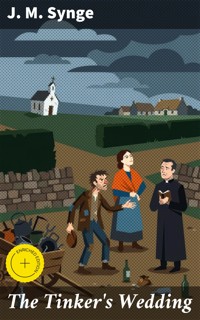
J. M. Synge’s one-act farce The Tinker’s Wedding, first published and staged in the early twentieth-century Irish theatrical milieu associated with the Abbey Theatre, follows a pair of itinerant tinkers who arrive at a rural chapel determined to secure a church wedding on their own terms. The play opens with practical bargaining and sharp social comedy as the couple’s desire for respectability collides with their impatience and the local clerical routine. From the outset Synge frames marriage as both a spiritual rite and a transaction, vulnerable to coercion, pride, and public performance.
paragraphs
The central pair, Sarah Casey and Michael Byrne, approach the priest with a mixture of urgency and calculation, insisting on immediate attention despite having little money and a reputation that makes them unwelcome. Their pursuit of a formal ceremony is not presented as sentimental; it is driven by status, rivalry, and a wish to control how they are seen in a community that judges them. Synge builds the early scenes around negotiation—over fees, timing, and authority—so that the chapel becomes a stage where class tension and moral policing are tested in plain, comic exchanges.
The priest, a figure of institutional power, resists being bullied or cheated, and the play quickly becomes a contest of will. He attempts to assert the church’s rules and his own dignity, while the tinkers treat the sacrament as something that can be forced, purchased, or strategically managed. Their verbal sparring exposes mutual contempt: the priest views them as disorderly outsiders, and they view him as an obstacle to be handled. The tone remains brisk and ironic, with humor arising from mismatched expectations about what the wedding means and who controls it.
As the argument intensifies, the tinkers refuse to leave quietly, escalating the dispute beyond simple haggling. Synge keeps the action tightly contained, using the single setting and rapid exchanges to emphasize how quickly a public ritual can turn into a struggle over dominance. The couple’s determination to be married in church clashes with their disruptive methods, and the priest’s insistence on propriety is undercut by his own vulnerability when confronted with people who do not accept his customary authority. The scene’s energy comes from this unstable balance between order and defiance.
Secondary figures from the local world, including the clerk, reinforce the social boundaries the tinkers challenge and illustrate how communal institutions protect themselves. Their presence heightens the sense that the wedding is not just a private matter but a performance judged by onlookers and mediated by officials. Synge uses these interactions to show how reputations are made and enforced, and how the church’s procedures can become entangled with everyday suspicion and petty power. The tinkers’ language and tactics keep pushing the encounter toward comic disorder and embarrassment.
The confrontation reaches a point where the ceremony’s legitimacy and the participants’ control over it are put in doubt, and the chapel’s expected decorum breaks down. Synge’s farce depends on reversals of advantage and on the way threats, bargaining, and appeals to morality can all be turned into weapons. Without relying on sentiment, the play suggests that the desire for respect and recognition can coexist with opportunism and aggression, and that institutional authority, though formidable, can be shaken by those who refuse its terms. The action concludes in a sharp, satirical register rather than a reconciliatory one, with outcomes kept pointedly ironic rather than fully resolved here.
Historical Context
J. M. Synge wrote The Tinker’s Wedding in the first decade of the twentieth century, in the context of British rule in Ireland and the cultural politics of the Irish Revival. Ireland was still governed from London under the Act of Union (1801), and debate over Home Rule dominated parliamentary life, with major bills introduced in 1886 and 1893 and a later crisis building toward 1912. Rural poverty, emigration, and uneven modernization marked daily life, while nationalist and unionist identities sharpened. Synge’s work emerged amid efforts to define an Irish national culture distinct from Victorian English norms.
The Irish Literary Revival sought to recover and refashion Irish language, folklore, and rural traditions as sources for modern literature and theatre. Organizations such as the Gaelic League (founded 1893) promoted the Irish language, while cultural nationalists encouraged native subject matter in art. In 1904, the Abbey Theatre (initially the Irish National Theatre Society) opened in Dublin, aiming to stage Irish plays for Irish audiences. Synge became closely associated with the Abbey through W. B. Yeats and Lady Gregory. The theatre’s mission placed new scrutiny on how writers represented rural people and marginalized groups.
Synge’s development as a writer was strongly influenced by Yeats’s advice that he study life in the Aran Islands. Synge visited the islands repeatedly from 1898 and recorded observations in notebooks later published as The Aran Islands (1907). These visits deepened his interest in Hiberno-English speech, oral storytelling, and the social realities of communities shaped by subsistence living and strong local customs. His dramatic language drew on idioms and rhythms he encountered, though crafted for theatrical effect. This background informs the play’s stylized dialogue and its focus on folk figures and village institutions familiar in the west of Ireland.
The play’s world is also shaped by the central social power of the Roman Catholic Church in late nineteenth- and early twentieth-century Ireland. After Catholic Emancipation (1829), the church expanded its influence through parish structures, schooling, and moral authority, and by the period of Synge’s writing it exercised significant control over marriage, sexual conduct, and respectability. Catholic canon law required a priest to solemnize marriage for it to be recognized by the church, and parish priests were key local gatekeepers. Tensions between popular behavior and clerical discipline were common subjects of debate, especially where poverty and itinerancy challenged parish control.
Ireland’s poor law system, established in the 1830s, and the legacy of the Great Famine (1845–1852) remained crucial historical background. Workhouses, dispensaries, and local officials formed an institutional landscape that affected the poorest and shaped attitudes toward charity and coercion. In many areas, hardship persisted through land agitation and economic instability, even after land reforms began to transfer ownership from landlords to tenants. Public discussion of poverty often mixed moral judgment with fear of disorder. Synge’s dramatic interest in bargaining, petty authority, and survival tactics reflects this environment, where small resources and official power could decide daily outcomes.
Itinerant “tinkers,” commonly associated with tinsmithing and seasonal work, were a visible presence in Ireland and Britain, though the period’s press and official discourse frequently stigmatized them. Mobile families faced legal and social pressure through vagrancy laws and local policing, and they were often depicted as disorderly or immoral within settled communities. Such stereotypes circulated widely in late Victorian and Edwardian culture and were not confined to Ireland. Synge’s choice to center itinerant characters situates the play within contemporary debates about respectability, mobility, and social inclusion. The setting highlights how marginal groups encountered both dependency and hostility from local institutions.
Synge wrote for audiences shaped by Victorian moral expectations and by nationalist cultural politics that demanded dignified representations of “the Irish.” Controversies at the Abbey Theatre show how charged such representations were: in 1907, The Playboy of the Western World provoked riots, partly over its language and portrayal of rural life. Synge’s earlier The Shadow of the Glen (1903) had also drawn criticism for its depiction of marriage and rural sexuality. These disputes reveal the pressures placed on dramatists and the public’s sensitivity to perceived insult or moral scandal. The Tinker’s Wedding belongs to this contested theatrical moment, where realism, satire, and nationalism collided.
Against this historical backdrop, The Tinker’s Wedding reflects and critiques the era’s intersections of poverty, clerical authority, and social prejudice. Its reliance on vernacular speech and folk materials aligns with Revival aims, yet its satire challenges idealized rural images promoted by some cultural nationalists. By placing marriage and parish power in the foreground, the play engages verifiable realities of church-centered community regulation and the vulnerability of people outside settled respectability. Its focus on itinerant figures exposes how official and informal controls operated at the local level. In doing so, Synge’s work mirrors early twentieth-century Ireland’s struggles over identity, morality, and who could claim social legitimacy.




