



2,79 €
Mehr erfahren.
- Herausgeber: Fervent Crux Press
- Kategorie: Krimi
- Serie: Argolicus Mysteries
- Sprache: Englisch
Mystery in History
A Childhood Friend. An Overbearing Father. A Worldly Bishop.
Argolicus unravels the threads.
In ancient Italy where religion and politics mesh, patrician Argolicus can’t resist following clues when his friend is murdered.
When his childhood friend is brutally murdered, old wounds open as Argolicus’ friend’s powerful father forbids him to dig deeper. He finds himself trapped in old conflicts while new enemies try to stop him at any cost. As the tension builds, he pledges to find the killer.
But then, his mother makes a counter pledge that plunges him in a dilemma. A word given is trust, and now he’s caught in a double bind that drives him toward the killer. Tempers flare and everything seems hopeless until the vellum scribe shares his wisdom. With death threats looming, Argolicus has one chance to find the killer.
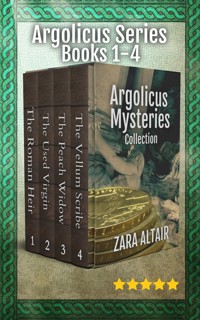
The Vellum Scribe is the fourth book in the Argolicus mysteries set in Ostrogoth Italy. If you like a puzzling mystery and rich historical detail, you’ll love The Vellum Scribe.
Buy The Vellum Scribe now to solve the puzzle today!
“A very rewarding read.”
Das E-Book können Sie in Legimi-Apps oder einer beliebigen App lesen, die das folgende Format unterstützen:
Seitenzahl: 113
Veröffentlichungsjahr: 2019
Ähnliche















Praise for Zara Altair
A cracking yarn that wears its deep research lightly...
— CLARISSA PALMER
Leaves you wanting more!
— DAVID AMERLAND, AUTHOR
This series would make an excellent show!
— JOE MCGAHA, WRITER/PRODUCER
The Vellum Scribe
An Argolicus Mystery
Zara Altair
Contents
Introduction
Arrival
The Body and the Soul
Family Treasure
Strategy Without a Plan
Mattheus at the Door
The Bishop’s Collection
The Maria Quandary
At Bartholomaeus’ Door
Meadow Crossing
Painting a New Picture
Palace Order
Glossary
Afterword
Author Note
About the Author
Also By Zara Altair
This is a work of fiction. Names, characters, places, and incidents either are the product of the author’s imagination or are used fictitiously. Any resemblance to actual persons, living or dead, events, or locales is entirely coincidental.
Copyright © 2018 by Zara Altair All rights reserved. No part of this book may be reproduced in any form or by any electronic or mechanical means, including information storage and retrieval systems, without written permission from the author, except for the use of brief quotations in a book review.
ISBN: 978-1-7327225-0-7
Introduction
Thank you for reading The Vellum Scribe.
Join the Fans of Argolicus. Get a free Argolicus book. And, I’ll send you personal updates about the Argolicus Mysteries.
Ostrogoth is a term created by historians centuries after the reign of Theoderic. They referred to themselves as The People. Their language was Our Language. Their church, Arian in nature and established before the Council of Nicea, was Our Church.
At the time of the story, monks both Arian and Trinitarian either lived alone or in loose communities based on the tradition of the Desert Fathers like Anthony. At this time, Benedict lived alone in a cave following that tradition. He had yet to form his monastery or create his Rules. Of course, his connection with Lucas comes from my imagination.
Modern readers should understand that religion and politics were intertwined. Feelings ran high about the nature of Christ and colored daily activities and interactions in a way it’s difficult to comprehend today.
The Henotikon was a document issued by the Emperor Zeno in 491 C.E. in an attempt to unify the various sects (heresies) of the Christian church. It caused a schism between East and West and was not settled until 519 C.E. seven years after the time of this story.
To the Trinitarian Church in Constantinople, Argolicus and his uncle, Wiliarit, were heretics.
Enter the world of Argolicus
With few exceptions, the western world was at peace in the year 512 after Christ’s birth. Warlords were plotting in the Balkans either for the East or the West, but mainly for their own power. Rumblings in Persian borderlands perhaps threatened the Roman Empire as seated in Constantinople. The most recent disturbances—betrayals, if you will—of the Frankish kingdoms had been settled some five years. Bishops and clergy squabbled over textual interpretations of the Gospel, patristic writings, or Patriarchal proclamations, as usual, some in a huff, others with conciliatory leanings. Vandals had controlled northern Africa for almost 100 years. The Visigoths ruled Spain and traded with avarice. In Italy, affairs of concern were mainly internal—the parallel Roman law and Ostrogoth legal systems ran under the regal Edicts guided by a sense of civility, providing structure for dispute resolution.
CHAPTER 1
ARRIVAL
The patrician, Argolicus, dropped his practice sword when he heard his mother cry out. He ran from the courtyard to villa’s front, followed by his sparring partner and tutor slave, Nikolaos.
A cart stood in front of the villa at the end of the road that came up from the town of Squillace. The Ionian sea shone blue in the early morning March sun. The carter unloaded several wooden boxes, carefully placing each one on the ground. Argolicus heard his mother laugh and saw her long blond braid covered by thick arms. A large man in a plain brown robe held her close in a tremendous hug and then pushed her away.
“Uncle,” Argolicus cried in Their Language. His face broke out in a spontaneous smile.
The big man turned. “Argolicus. The Father and the Son together!”
“Worship and glorify,” Argolicus responded. “Uncle Wiliarit, where have you been this time?” He embraced his uncle, who reciprocated in a hearty hug, squeezing him into the large chest.
Wiliarit continued in the language of The People, “I’ve been in Constantinople working on a commission. But now I’m here to finish, and I’m hoping Nikolaos will help.”
Nikolaos heard his name and came closer, still clutching his practice sword. Besides keeping Argolicus in practice with arms, he was an excellent grammarian and had taught Argolicus Greek since childhood. But, his language skills stopped at the tongue of King Theoderic and his people.
“Nikolaos?” Argolicus replied.
“Yes, it’s a medical reference book. He knows much about plants and herbs. I’m hoping he can point out some live specimens for illustrations. What I have now as a source are drawings in another manuscript. I want this one to be as excellent as possible. It is quite a large commission.”
* * *
Argolicus put down his pen and knife and looked up from his calligraphy of The People’s language when he heard Nikolaos calling his name outside the villa. Wiliarit, his uncle, had chastised his nephew for not practicing writing and had set him to calligraphy with the language of The People—the king’s People, Wiliarit’s People, his mother’s People, his People. He glanced down at his work and frowned at his lack of skill. Wiliarit was right. Neglect was obvious.
But now, Nikolaos was closer, and his calls were urgent. “Master! Master!” He arrived panting in the study.
“What is it? I thought you were looking for flowers.” Argolicus said, standing up from his table.
“We are. We were. But down in the Angel’s Meadow, there’s a body. Come.” Now, his tutor was out of breath.
“A body? Do you mean someone is dead? A dead body?” Argolicus shook his head.
“Yes, yes, a very dead body. His face is blue. The skin…” His face distorted as he searched for words and then gave up. “You must come and see.”
Argolicus nodded, reached for his cloak on a chair, shouldered it against the cool late March air, and followed Nikolaos along a maze of animal trails over a hill to a verdant meadow. Here and there, wildflower colors - yellow, purple, blue, red - protruded among the green of early grasses.
Wiliarit stood in his dark brown robe in the middle of the meadow, ignoring his unopened box of paints and vellum sheets beside him. His head was bowed, and his arms uplifted in prayer. They waited for him to finish. When he concluded, Wiliarit lowered his arms, raised his head, and turned toward Argolicus.
“Alone... without a burial.” Wiliarit shook his head. “And his head—who would do such a thing?”
Argolicus walked toward the body. Dark hair covered his head, but the skin was dark blue. Mottled arms of orange and red skin tones poked out from an old linen tunic. A wool cloak lay crumpled under the body. The odor of rotting flesh permeated the cold air. Argolicus noticed the concave wound on the skull and knew the cause of death.
“Days,” he said. “He’s been here many days. A week? Maybe.” Sunlight glistened off a ring submerged in a bloated finger—a circlet of gold with one dark ruby. “I know that ring.” He turned to Wiliarit. “Do you remember Lucas?”
Wiliarit nodded. “Yes, so sad. That was a hard lesson for you.”
“Lucas? The son of Bartholomaeus?” Nikolaos asked. “That Lucas?” He moved closer to Argolicus and the body and peered down.
“It wasn’t his fault our friendship ended,” Argolicus said. “It was his father. His father didn’t want him near a heretic like Wiliarit. Remember all the antagonism toward Our Church and the threat Wiliarit posed to his son’s true faith? Father was a Roman. With Father, a Roman, gone, Wiliarit’s influence was anathema. The Nature of Christ is always a contentious point, especially here in the South. Lucas came one last time to say goodbye even though his father forbade his seeing me.”
“He was a better swordsman than you,” Nikolaos said. “But what is he doing here? Why doesn’t his family miss him? I’ve heard nothing about his being missing among the slave gossip.”
Argolicus stood. “We must tell the family. Nikolaos, go back and tell Lucius or whoever is in the stables to get horses ready.”
“I’ll stay here by the body and paint,” Wiliarit said. “As I remember, I would open old wounds. That would just add to the old man’s sorrow.”
“Closed minds seem to stay closed,” Argolicus said. He sighed. “We wouldn’t want to open those old wounds now.” He turned toward the disappearing Nikolaos and shouted, “Two horses. Just two.”
Wiliarit looked at his nephew. “I know you are a grown man now, but do you think it is wise to see that family?”
“They have to know about Lucas. Being direct is always the best action in the long run. I’ll deliver the news and leave.”
Wiliarit nodded. “Go in peace. I’ll just sketch that little red flower. I’ve forgotten what Nikolaos said it was, but he can tell me later.”
* * *
“What do you mean, Lucas?” Bartholomaeus asked. A man in his late fifties, his voice filled the room as he glowered at Argolicus. His face was long, accented by a prominent hooked nose. “In Angel’s Meadow? He’s in Rome, or he was leaving Rome to visit a monk in the mountains. Someone named Benedictus. You must be mistaken.”
Argolicus stood in the atrium of the large villa of Vibius Horatius Bartholomaeus, whose money supported the local church. The midday sun shone through the opening above onto the rich mosaics on the floor and highlighted the man’s silk robes. His biblically named sons, Matthaeus and Marcus, stood next to him cast from the same mold—dark hair, sturdy medium build, and a permanent frown. The surrounding walls were painted in bright colors and frescoes of saints, richly adorned, but saints. Argolicus knew even though he was equal in standing, religious affiliation to the Trinitarian doctrine held more power here than it did in Rome. Not all Christians were equal here, no matter how much King Theoderic had proclaimed tolerance and cooperation in his rule of civilitas. This family held the local power because they supported the Church. But, whatever the staunch religious antagonist had to say, Argolicus knew Lucas was the dead man in the meadow.
“I recognized his ring. And even in death, I recognized my friend,” he said, keeping the topic focused on the dead body and not religious debates.
“Stop. Stop right there. He is... was... not your friend. Get out of my house with your barbarian tricks.” Bartholomaeus put up his hands as if to ward off Argolicus. His gesture denoted abhorrence rather than an order to leave.
“I will leave here to notify the bishop, so the man will have a burial. He was bludgeoned with a club or large branch. He deserves Christian care.”
Bartholomaeus scowled.
“Father, Argolicus is right,” Marcus, the younger son. said. “Our first concern is to care for Lucas.” He turned to his sister, Maria, dark-eyed and lithe. “Get people ready to receive his body. We will prepare him here.”
Maria looked at Marcus, then her father, and gave a tearful, beseeching look to Argolicus before she turned to find the servants. Her soft leather shoes padded across the marble mosaics as she headed toward a hallway.
“Our bishop, Braga, will serve all of our funeral needs,” Matthaeus said, his frown an echo of his father’s dark glower. “Now, you can leave.” His silks whispered as his arm swept the air in a dismissive gesture toward the entry.
“Matthaeus, wait,” Marcus said, stopping his brother. “I will go with Argolicus to bring back Lucas.” He turned to Argolicus. “I’ll meet you in front. I’ll bring slaves and a cart.”
Argolicus took in the three men and nodded at Marcus. “Your Sublimity,” he said to Bartholomaeus. He turned toward the entryway and strode across the grand room to the vestibule. Nikolaos trailed behind.
In the vestibule before the large entry doors, Maria emerged from a small room. Once again, her brown eyes implored. “Wait,” she said. “I want to talk to you. They are lying.” She pressed a small folded piece of vellum in his hand and scurried away.
When Marcus arrived outside, he rode alongside Argolicus as Nikolaos and a cart with six slaves to load the body trailed behind. His bearing was not as aggressive now that they were away from the villa.
“You have to understand that my father’s faith keeps him from seeing the big picture.”
“My friendship with Lucas is part of that big picture he missed,” Argolicus said. “I know now that people come and go in life, but Lucas was a friend, a part of my youth.”
“Your friendship started my father’s disapproval of Lucas. My brother was always a bit of a rebel, and Father wanted to quell his differences.”
“His differences? When we were together, he was a normal boy—running, climbing trees, shooting arrows. What is different about those things? You are supporting your father’s ideas without looking at what was happening. We never once talked about religion. We were boys exploring the world.” Argolicus felt his anger grow as he tightened his grip on the reins. Marcus was an adult. Why didn’t he form his own opinions?
Marcus shifted in the saddle. Nikolaos behind them and the slaves on the creaking cart all were silent in the way that collected gossip and then sent it everywhere.




