



0,49 €
Niedrigster Preis in 30 Tagen: 0,00 €
Niedrigster Preis in 30 Tagen: 0,00 €
Mehr erfahren.
- Herausgeber: DigiCat
- Kategorie: Gesellschafts- und Liebesromane
- Sprache: Englisch
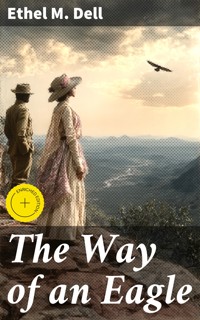
Ethel M. Dell's "The Way of an Eagle" is a compelling novel that explores themes of love, sacrifice, and personal growth against the backdrop of early 20th-century British society. Dell's prose is characterized by its lyrical quality and vivid imagery, immersing readers in a world where emotional depth and moral dilemmas take precedence. The narrative follows the protagonist's tumultuous journey to self-discovery, reflecting the tensions of the time and the societal expectations that shape individual destinies. Aptly blending romance and adventure, Dell crafts a story that resonates with the complexities of human relationships. Ethel M. Dell was a pioneering novelist who gained prominence in the early 1900s. Her own experiences and observations of contemporary social issues likely influenced her storytelling. Growing up in an era marked by rapid change and the burgeoning women's rights movement, Dell's literature often reflects her progressive perspectives on gender roles and personal autonomy. Her writings frequently highlight the conflicts faced by her characters, mirroring the struggles of women in a patriarchal society, thus offering an intimate glimpse into her worldview. "The Way of an Eagle" is a must-read for those interested in early feminist literature and character-driven narratives. Dell's ability to weave emotional complexity with social critique invites readers to reflect on their own lives, making this novel not only a poignant love story but also a timeless exploration of the human spirit. Delve into this striking tale, and let Dell's unforgettable characters and rich storytelling linger in your mind. In this enriched edition, we have carefully created added value for your reading experience: - A succinct Introduction situates the work's timeless appeal and themes. - The Synopsis outlines the central plot, highlighting key developments without spoiling critical twists. - A detailed Historical Context immerses you in the era's events and influences that shaped the writing. - A thorough Analysis dissects symbols, motifs, and character arcs to unearth underlying meanings. - Reflection questions prompt you to engage personally with the work's messages, connecting them to modern life. - Hand‐picked Memorable Quotes shine a spotlight on moments of literary brilliance. - Interactive footnotes clarify unusual references, historical allusions, and archaic phrases for an effortless, more informed read.
Das E-Book können Sie in Legimi-Apps oder einer beliebigen App lesen, die das folgende Format unterstützen:
Veröffentlichungsjahr: 2022
Ähnliche


















The Way of an Eagle
Table of Contents
Introduction
Poised between the peril of an unforgiving frontier and the more intimate hazards of trust, The Way of an Eagle charts how courage, desire, pride, and duty clash until love becomes not a retreat but a crucible, a testing of will and tenderness in which survival demands sacrifice, honor is weighed against the need for mercy, and two indomitable spirits contend with the wounds of the past, the pressures of society, and the stark demands of the present, discovering that ascendance is measured less by conquest of the world than by mastery of self and generosity toward another hard-won heart.
Ethel M. Dell’s novel belongs to the romantic adventure tradition and unfolds primarily against the backdrop of British India, an imperial frontier whose harsh distances and volatile edges shape character as much as circumstance. First appearing in the early 1910s, during a period when popular fiction mingled high emotion with brisk incident, it exemplifies the bestselling appeal that made Dell a household name. The book’s landscape is not merely scenic; it furnishes danger, urgency, and moral testing, while expatriate society and its codes provide the counterweight of decorum, reputation, and expectation that persists long after immediate crises fade.
Without disclosing the turns that give the story its drive, the opening pitches a young woman into sudden, life-altering danger and compels an uneasy alliance with a seasoned, implacable protector whose motives can be at once practical and opaque. What begins in necessity evolves into a layered contest of trust and autonomy, as proximity exposes frailty and resilience on both sides. Later chapters move from raw survival to the subtler battlegrounds of promise, honor, and forgiveness, where choices carry emotional consequence. The narrative keeps the stakes personal and immediate, privileging the slow forging of character over any single act of daring.
Readers encounter an ardent, unapologetically heightened style that pairs swift action with searching interiority. Dell writes with concentrated intensity—scenes of physical danger surge, then yield to quiet reckonings in which pride, shame, and longing are weighed with almost ethical gravity. The tone is earnest and dramatic rather than ironic, aiming for catharsis through ordeal and reconciliation. While the plot turns are brisk, the emotional developments are patient, circling and returning, attentive to the way a word withheld can matter as much as a deed performed. The result feels both intimate and expansive, a chamber piece staged on open ground.
At its core the novel explores endurance, moral responsibility, and the reclamation of self under pressure. The imperial setting introduces questions about violence, belonging, and the limits of control that echo in the protagonists’ private negotiations of power and vulnerability. Ideas of duty and desire intersect not as opposites but as forces that can refine or distort one another. The book also invites reflection on agency and consent, particularly how protection can shade into possessiveness and how strength can learn to make room for another’s freedom. Themes of forgiveness and earned trust provide the work’s sustaining warmth.
For contemporary readers, the novel offers both a gripping romance and a historical artifact that rewards critical attention. Its depiction of colonial frontiers and expatriate society carries attitudes and assumptions of its era, making it important to read with awareness of their limitations and effects. At the same time, the story’s insistence that love must contend with pride, fear, and circumstance feels enduring. Those interested in classic popular fiction, the genealogy of modern romance, or narratives where external danger mirrors inner conflict will find a text that is engaging, revealing, and ripe for conversation.
The Way of an Eagle remains compelling because it treats passion as a discipline, not merely a sensation, and suggests that constancy is a practiced courage. Dell’s blend of peril, perseverance, and self-scrutiny offers a narrative arc as bracing as the landscapes it crosses, while the title’s avian image evokes flight won by effort, altitude earned through trials. Approached with both empathy and critique, the novel can be read as a study in how people learn to wield strength without doing harm and to accept tenderness without surrendering themselves, a lesson as resonant now as in its early twentieth-century moment.
Synopsis
The Way of an Eagle, an early twentieth-century novel by Ethel M. Dell, opens in British India, where a young Englishwoman is caught amid a sudden eruption of frontier violence. A hardened, resourceful officer engineers her escape with speed and command that verge on ruthlessness. The flight through peril establishes the story’s central tension: the pull between gratitude and fear, attraction and resistance. Dell stages these opening chapters as both adventure and moral crucible, testing endurance and will. The experience forges an involuntary bond between rescuer and rescued, a connection shadowed by trauma and questions of agency that will reverberate long after immediate danger passes.
The escape compels a grueling journey across hostile terrain, where scarcity and threat force stark choices. The officer’s single-minded insistence on survival often overrides polite boundaries, while the heroine’s pride and nascent independence sharpen under pressure. Their exchanges are marked by candor, flashes of discord, and uneasy reliance. Acts of care arrive alongside commands; concessions are made, but not always freely. What emerges is a contested debt—partly lifesaving obligation, partly emotional claim—that neither can easily define. In Dell’s telling, endurance becomes character: fear narrows to practical focus, courage learns patience, and the first outlines of trust form without resolving deeper misgivings.
Once safety is secured, the narrative shifts to England, exchanging frontier urgency for drawing-room scrutiny. The heroine seeks normalcy within a world of family interests, social expectations, and whispered judgments that reframe her ordeal. A more conventional suitor—gracious, approved, and less alarming—offers a future that appears calm and comprehensible. Yet the earlier rescuer’s presence, whether direct or implied, unsettles these prospects, his reputation a mixture of admiration and unease. Dell contrasts public decorum with private reckoning, showing how trauma lingers beneath polite conversation and how society’s courtesies can obscure the harder work of recovery and choice.
Complications multiply as promises, hinted attachments, and half-understood motives intersect. Episodes of misunderstanding and jealousy expose the cost of pride and the peril of hasty judgment. The officer’s rigorous sense of duty, capable of startling gentleness, can also shade into mastery; the heroine’s quest for autonomy risks hardening into refusal. Reputation becomes a battleground, with small missteps threatening disproportionate consequences. Through these conflicts Dell explores power without cruelty, tenderness without surrender, and the difficulty of discerning love from possession when gratitude and fear blur the edges of consent.
Secondary figures—family guardians, worldly friends, and seasoned observers—frame the central drama with counsel that reflects their era’s ideals. Some recommend prudent retreat into safety and social approval; others argue for courage that accepts uncertainty and imperfection. Scenes of country-house visiting, quiet travel, and guarded confidences sketch a moral landscape where kindness can be strategic and sincerity risky. Dell uses these contrasts to question what constitutes honor: bravery on the frontier, steadfastness in hardship, or the quieter discipline of keeping faith when situations grow ambiguous and talk is cheap. Their advice shapes crossroads without dictating outcomes.
As the story tightens, a fresh crisis compels decisions that conversation alone cannot settle. Tensions long deferred surface under pressure, and hidden motives acquire clearer outlines. Past actions are reinterpreted in a harsher light, yet self-restraint and sacrifice begin to read differently too. The title’s image suggests a way of looking far and holding steady, a steadiness that may appear severe but proves protective when storms gather. Dell balances incident with inward reckoning, allowing realizations to arrive through action as much as speech, and guiding the principals toward a resolution that affirms tested character without exposing the final turn of events.
The Way of an Eagle endures as a blend of colonial adventure and domestic romance, attentive to ordeal, recovery, and the fraught exchange between protection and freedom. Its appeal lies in earnest feeling and the moral weight given to courage, patience, and truthfulness under strain. While the plot moves toward reconciliation of will and tenderness, Dell preserves the dignity of discovery by keeping the last steps private to the reader’s experience. The novel’s broader resonance rests in its portrait of love tempered by responsibility and in its snapshot of early twentieth-century sensibilities negotiating danger abroad and duty at home.
Historical Context
The Way of an Eagle, published in 1912, was Ethel M. Dell’s debut novel and quickly established her as a leading writer of popular romantic fiction. Appearing in the late Edwardian and early George V period, it is set largely in British India with episodes on the imperial frontier. The British Empire was near its territorial peak, and India remained its most prized possession. Dell’s choice of locale aligned with a strong market for Anglo-Indian adventure and romance, shaped by readers’ familiarity with colonial news and travel writing. The book’s success positioned Dell within a booming mass readership before World War I.
British India in this era was administered under Crown rule (the Raj) established in 1858, headed by a Viceroy and supported by the Indian Civil Service and the British Indian Army. Civil stations, cantonments, and hill stations structured Anglo-Indian life, with clubs, officers’ messes, and bungalows forming distinctive social spaces. Railways, telegraphs, and colonial policing extended imperial reach, while segregation of European and Indian quarters remained common. The army combined British officers with Indian regiments, reflecting a hierarchy codified after the 1857 revolt. These institutions framed everyday routines, dangers, and social expectations that contemporary readers readily recognized in fiction set on the subcontinent.
The North-West Frontier of British India, formalized as a province in 1901 along the Durand Line with Afghanistan (1893), loomed large in British political and literary imagination. The region saw recurrent conflict—such as the Chitral expedition (1895) and the Tirah campaign (1897–98)—reported widely in the British press and memoirs. Frontier posts, mountain passes, and tribal territories became stock backdrops for Edwardian adventure narratives. Contemporary accounts emphasized sudden raids, difficult terrain, and the need for small-unit initiative, themes that shaped fiction’s portrayal of peril and endurance. This widely understood context of military danger and colonial vulnerability informs Dell’s use of a frontier setting.
Indian politics in the decade before 1912 were turbulent. The 1905 Partition of Bengal sparked the Swadeshi movement, boycotts of British goods, and new forms of political mobilization. The All-India Muslim League formed in 1906, while the Indian National Congress expanded its reach. Constitutional concessions in the Morley–Minto Reforms (1909) introduced limited elected representation. In 1911 the British annulled Bengal’s partition and moved the imperial capital from Calcutta to Delhi, marked by the Delhi Durbar where George V was proclaimed Emperor of India. This mix of unrest and imperial spectacle informed British perceptions of India as both loyal possession and restive polity.
Anglo-Indian society followed strict codes of class, race, and gender. Social life revolved around clubs, regimental events, and seasonal retreats to hill stations such as Simla, with elaborate etiquette governing introductions, chaperonage, and courtship. Victorian-Edwardian domestic ideals emphasized respectable marriage and female propriety, while the figure of the memsahib managed households and upheld British norms in colonial environments. Simultaneously, debates in Britain about women’s education and suffrage were reshaping expectations. Fiction of the period often juxtaposed constrained drawing-room manners with the testing conditions of the frontier, using danger, climate, and isolation to dramatize endurance, moral character, and romantic commitment.
Late Victorian and Edwardian military culture, shaped by the Second Boer War (1899–1902), prized discipline, endurance, and initiative. Reforms under figures like Haldane professionalized the army, while frontier service retained an aura of rugged prestige. Literary traditions from writers such as Rudyard Kipling and H. Rider Haggard popularized imperial adventure, featuring soldier-heroes, perilous landscapes, and moral trials. Journalism and illustrated periodicals amplified these themes by carrying reports from campaigns and remote stations. Dell’s use of a colonial setting and martial danger conformed to this mainstream idiom, giving readers recognizable images of courage and duty within the framework of popular romance.
The book emerged amid rapid growth in mass-market fiction. Lending libraries and railway bookstalls broadened access, and the single-volume novel had supplanted the old three-decker by the 1890s. Romantic and adventure fiction commanded large audiences, particularly among middle-class women. Dell’s style—emotional intensity within strict moral boundaries—met circulating-library expectations and sold in high numbers. While many reviewers disparaged such novels as sentimental, sales remained strong, and later critics like Q. D. Leavis cited Dell when analyzing commercial fiction’s appeal. This reception history situates The Way of an Eagle within a lively marketplace that favored dramatic plots and accessible prose.
Read against its time, The Way of an Eagle exemplifies the Edwardian imperial romance: a British perspective on India that mingles admiration for martial resolve with anxieties about distance, climate, and threat. Its settings, institutions, and social codes echo prevailing attitudes toward empire, hierarchy, and gender, portraying colonial spaces as both testing ground and moral theater. The novel’s emphasis on endurance, honor, and redemptive love aligns with contemporary ideals, while its popularity underscores prewar appetite for escapist narratives in exotic locales. In doing so, it records—and helps perpetuate—the cultural assumptions that sustained Britain’s imperial imagination on the eve of global upheaval.




