


1,99 €
Mehr erfahren.
- Herausgeber: e-artnow Collections
- Kategorie: Gesellschafts- und Liebesromane
- Sprache: Englisch
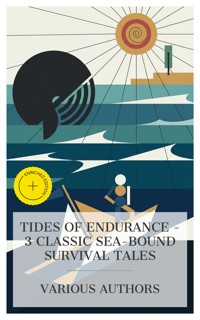
Tides of Endurance – 3 Classic Sea-bound Survival Tales is a compelling anthology that invites readers on a gripping voyage through the turbulent waters of human endurance and the relentless sea. This collection masterfully weaves together an array of literary styles, from Homeric epic poetry to Defoe's grounded yet adventurous prose, and Melville's dense symbolism-rich narrative. Each work captures the essence of humanity's timeless battle against nature's formidable forces, offering a diverse yet unified exploration of survival, conflict, and triumph. The anthology presents standout tales that echo universal themes of resilience, as the characters navigate treacherous seas and unforeseen challenges. This anthology is a testament to the profound contributions of its esteemed authors. Homer, the ancient epic poet, lays the foundation for literary immersion into the heroic struggle against inevitable fate. Daniel Defoe, a pivotal figure in early novelistic fiction, injects realism and novelty into the grand narrative of survival. Herman Melville, a towering presence in American literature, infuses his narrative with complexity and depth, exploring the profoundness of the human condition. Together, these authors span historic and cultural realms, inviting readers to witness the evolution of sea-bound storytelling across centuries. A treasure trove for both literary enthusiasts and scholars, Tides of Endurance offers readers a unique opportunity to immerse themselves in a multifaceted dialogue on perseverance and the human spirit. The anthology blends different eras, cultures, and literary movements, providing an enlightening educational experience. By traversing the expansive ocean of these narrative landscapes, readers are bestowed with newfound insights and empathy, compelling them to reflect on the enduring, unchanging essence of humanity's struggle for survival. Dive into this timeless collection and savor the rich, interwoven tales that chart the depths of courage and endurance, each resonating with their enduring significance.
Das E-Book können Sie in Legimi-Apps oder einer beliebigen App lesen, die das folgende Format unterstützen:
Veröffentlichungsjahr: 2025
Ähnliche



Tides of Endurance – 3 Classic Sea-bound Survival Tales
Table of Contents
Introduction
Curatorial Vision
Tides of Endurance brings together The Odyssey, Robinson Crusoe, and Moby Dick; Or, The Whale to frame the sea as a proving ground for human persistence. Spanning epic, early novel, and expansive romance, these narratives orchestrate encounters with peril, solitude, and wonder, testing the boundary between human intention and unruly waters. Each work centers survival not as mere continuance but as a disciplined art—navigation, improvisation, judgment. Assembling them underscores how the ocean magnifies character, pressing ingenuity and conscience into view. Together they stage an exacting inquiry into what endures when companions, provisions, or certainties fall away.
Despite vast differences in origin and style, the three works converge on a philosophical core: resilience tested against chance, law, and desire. The Odyssey examines cunning and obligation under the long shadow of fate. Robinson Crusoe considers the ethics of self-reliance, resource management, and spiritual accounting. Moby Dick; Or, The Whale interrogates obsession, leadership, and the limits of knowledge amid elemental force. Read side by side, they chart a spectrum from communal restoration to solitary industry to collective risk under a commanding will, revealing how survival depends as much on narrative orientation as on tools, rations, or seamanship.
This collection aims to trace an arc of sea-bound endurance from mythic return, through grounded maintenance of life, to metaphysical pursuit. The sequence highlights recurring challenges—storm, scarcity, isolation—while emphasizing evolving answers: craft and prudence, industrious routine, or dangerous assertion of purpose. Juxtaposition clarifies shifting attitudes toward authority, hospitality, and home. Presented together rather than as separate, stand-alone publications, the works invite comparison across form and era, allowing the scale and stakes of survival to be measured not by a single voyage but by a chorus of distinct yet interlocking sea narratives.
Unlike solitary readings that foreground a single protagonist or mode, this grouping privileges conversation among forms: epic song, economic journal-like reflection, and encyclopedic meditation. The aim is not to smooth differences but to let frictions illuminate shared questions about limits—of body, community, language, and command. Placing them in dialogue makes visible how techniques of endurance migrate: a knot learned as craft becomes a ritual of self-governance, then a symbol tested against unknowable depths. The collection offers a navigational frame where contrast sharpens insight, and where the sea’s changing meanings are tracked across imaginative, ethical, and existential registers.
Thematic & Aesthetic Interplay
Across the three works, the sea is both corridor and crucible. Storms discipline the will; calms test patience; islands promise respite while exposing vulnerability. Cunning, craft, and conscience recur as survival’s tripod: Odyssean strategy, Crusoe’s methodical labor, and a whaling crew’s contested authority render endurance a negotiated art. Food, shelter, tools, and stories themselves become provisions, replenishing resolve when material stores thin. Oaths and contracts, whether sacred or secular, structure risk and responsibility. In each text, navigation is at once practical and moral, a process of reading signs, weighing counsel, and deciding when to resist or submit.
Motifs echo and deepen across settings: shipboards as fragile polities, shorelines as thresholds, and gifts or provisions as tests of obligation. The Odyssey’s ceremonial exchanges frame hospitality as law; Robinson Crusoe recasts hospitality as stewardship under scarcity; Moby Dick; Or, The Whale subjects hospitality to the strain of hierarchy at sea. Perspective also shifts. An epic’s panoramic gaze moves to intimate accounting and then to searching interiority braided with documentary textures. These tonal contrasts—celebratory, didactic, and ruminative—do not cancel one another; they refine the moral calculus of action when outcomes remain uncertain and the horizon refuses to settle.
Dialogues of form travel between the works. Melville adapts epic scale to modern uncertainty, drawing on sea-journey archetypes familiar from Homer while fracturing them through multiple voices and technical excursus. Defoe, composing an early prose narrative of survival, retools voyage material into a ledger of practice and reflection that nonetheless retains echoes of wandering and return. Homer’s long view of trials and homecoming anticipates later concerns with rule, mercy, and cunning under pressure. These crosscurrents allow readers to sense inheritance without dependence: each work both listens to and resists the others, asserting distinct answers to peril’s demands.
Tone modulates the experience of danger. Homer casts peril within a patterned song that balances suffering with ceremony and recognition. Defoe assumes a sober cadence, locating meaning in habit, inventory, and measured gratitude. Melville amplifies uncertainty, yoking granular observation to vertiginous metaphysics. Perspective shifts accordingly: communal memory, private journal-like introspection, and a many-voiced vessel of competing claims. These differences generate a productive tension. Survival appears alternately as return to order, as construction of order from scarcity, and as confrontation with an order that may be indifferent or hostile, thereby testing the ethical limits of command and compliance.
Enduring Impact & Critical Reception
The collection retains urgency because it treats survival as a moral and imaginative practice rather than a spectacle. In an era preoccupied with control, these works insist on limits: weather, chance, isolation, and the opacity of others. They also affirm forms of knowledge that grow from repetition, craft, and story. By staging encounters with alterity—creatures, strangers, tempests—they probe what obligations persist when familiar institutions recede. The sea’s scale deflates self-certainty while inviting resolve. That tension, between humility and agency, continues to animate ethical debates about leadership, resource use, and the responsibilities owed to companions and unknown fellow travelers.
These narratives have circulated widely across languages and media, generating a durable cultural presence. Their episodes, figures, and phrases migrate into stage and screen, visual art, and music, while also seeding classrooms and public conversation. Critical assessments, from celebrations of narrative ingenuity to scrutinies of power and belief, have made each work a touchstone for thinking about exploration, law, and conscience. The consistency of attention suggests that the sea, as imagined here, serves as a global commons of thought: a setting where communities test stories about origin, risk, belonging, and the fragile bargains that make life together possible.
Public and scholarly debates have approached these works as laboratories for questions of empire, trade, faith, and governance. The Odyssey’s diplomacy and conflict, Robinson Crusoe’s labor and exchange, and Moby Dick; Or, The Whale’s contested authority and interpretive anxiety provide durable materials for argument. Discussions range from the ethics of mastery over nature to the legitimacy of command under uncertainty and the allure and peril of charismatic aims. Because the texts admit multiple readings, they accommodate critique and admiration at once, rewarding attention to imagery, structure, and voice while resisting reduction to a single thesis.
Considered together, these works turn survival into a meditation on forming, reforming, and sometimes unforming a self and a crew. The Odyssey imagines return as the restoration of bonds; Robinson Crusoe treats survival as the careful building of bonds; Moby Dick; Or, The Whale subjects bonds to inquiry under pressure. Their convergence in one volume emphasizes the interplay of prudence and daring, memory and experiment. Beyond historical origin, they endure because they teach how to read danger without panic, to value companionship without complacency, and to accept mystery without surrendering responsibility—a triad of lessons with abiding relevance.
Historical Context
Socio-Political Landscape
Across distant centuries, these sea-bound narratives arise from cultures where maritime power braided together trade, war, faith, and law. The Odyssey reflects an eastern Mediterranean world dependent on ships for exchange and reputation. Robinson Crusoe bears the imprint of early eighteenth-century British mercantile expansion and the legal-financial instruments that sustained it. Moby Dick emerges from a nineteenth-century United States whose global whaling industry supplied illumination and lubricants to an industrializing economy. Each work turns storms, shipboard hierarchies, and remote shores into theaters where authority is asserted, contested, and reimagined, revealing how survival at sea negotiates with empire, commerce, and civic obligation on land.
The Odyssey belongs to a landscape formed after palace systems waned and city-states coalesced. Power traveled along sea lanes where trade and raiding blurred, and honor circulated through gifts, oaths, and ritual hospitality. Leadership operated at the scale of the household and the assembly, with seafaring elites mediating distant contacts and local disputes. Maritime risk—shipwreck, piracy, unfamiliar laws—pressed communities to codify protection for guests and supplicants. The poem’s island-studded horizon registers a fragmented political map, where craft, persuasion, and shrewd intelligence often matter more than brute force. Home is a political unit as much as a shelter, and travel tests its boundaries.
The Odyssey also refracts the politics of return, inheritance, and legitimacy. While avoiding programmatic exposition, its settings encode anxieties about contested property, fragile succession, and the costs of prolonged absence due to war or expedition. Diplomatic exchange, oath-taking, and ritual sanctions mark an early legal consciousness, suggesting the movement from personal vengeance toward communal judgment. Foreign courts and littoral communities serve as mirrors for domestic order, projecting hopes and fears onto imagined others. The sea becomes a proving ground for statecraft: navigating unknown customs, bargaining with hosts, and gauging divine favor entwine with practical seamanship, giving political ethics a nautical form.
Robinson Crusoe appears amid Britain’s expansion of maritime trade routes, fortified by regulation, finance, and naval protection. Credit networks, insurance, and cargo accounting shape the risks a traveler assumes. Plantation schemes, colonial outposts, and the brutality of enslaved labor furnished both profit and moral contradiction. Religious dissent and commercial aspiration coexisted uneasily, casting personal enterprise as both calling and speculation. War at sea, privateering, and shifting alliances created volatile corridors of opportunity and loss. The novel’s lonely shore is haunted by these structures: the castaway’s needs, tools, and expectations are the residues of a metropolitan economy stretching across oceans.
The island polity that Robinson Crusoe assembles dramatizes emergent ideas of property, labor, and governance. Scarcity and danger authorize improvised institutions, while ledgers, calendars, and inventories become instruments of order and conscience. Authority presents itself as stewardship, yet carries the shadow of colonial command, imagining improvement through extraction and discipline. The narrative redeploys metropolitan habits—calculation, surveillance of time, rationalized work—in a stripped environment that makes their assumptions visible. Maritime perils recede into administrative routines: stockpiles, fortification, and risk management form a social contract of one, later tested by contact with others. Survival thus stages a political theory of sovereignty under duress.
Moby Dick originates in a republic stretched between maritime cosmopolitanism and internal fracture. Whaling, then a strategic energy industry, drew crews from many nations and cultures into floating factories governed by contractual hierarchies and severe discipline. The ship magnifies national contradictions: egalitarian ideals meet autocratic command; profit chases prey into legally ambiguous waters; zeal collides with the calculus of voyage returns. Expansionist rhetoric, debates over slavery, and speculation-fueled booms compose the moral weather of the era. As industrial tempos quicken, mastery over nature appears both triumphant and brittle, while shipwrecks, mutinies, and ghostly losses haunt the ledger of progress.
Intellectual & Aesthetic Currents
The Odyssey emerges from an oral performance culture where memory, meter, and formula knit communities together. Epic song joins seafaring practice to sacred story, giving navigational peril a cosmological frame in which fate and favor contend with prudence. Hospitality codes and supplication rites articulate a jurisprudence before statutes, while the poem’s similes and catalogues create a shared encyclopedia of craft, animals, seasons, and ships. Intelligence is tactical as well as moral, elevating resourceful endurance over mere might. The aesthetic result is elastic: episodic, ritually patterned, and capacious enough to absorb new routes, customs, and listeners across generations.
Robinson Crusoe participates in the rise of prose fiction that claims truth through detail. Lists, dates, measurements, and matter-of-fact tone produce an empirical surface modeled on travel logs and mercantile correspondence. The narrator reasons through contingencies, balancing fear and calculation, with spiritual accounting running alongside material inventories. The book channels a culture of improvement in which careful observation promises mastery over place. Print’s expanding marketplace, with its appetite for news and voyages, encourages a style that rewards plausibility and method. The solitary page becomes a workshop: tallying, projecting, and revising plans as if the mind were another instrument of navigation.
Technological imagination motors Robinson Crusoe. Navigation by dead reckoning, seasonal winds, and rough charts gives way to the intimate science of survival: carpentry, pottery, agriculture, husbandry, and architecture improvised from salvage. Timekeeping disciplines labor and prayer alike; measurement transforms fear into tasks. The island becomes a laboratory for applied knowledge in which accidents yield experiments and use-value outruns ornament. Providence and practicality speak to each other through the rhetoric of chances, deliverances, and designs. The narrative thus absorbs early scientific attitudes without abandoning moral teleology, yoking experiment to gratitude and procedure to confession.
Moby Dick fuses romance with inquiry, bending narrative into sermons, stage-like scenes, legal briefs, and anatomical treatises. Its rhetoric courts the sublime and the sardonic, moving from the microscope to the maelstrom with abrupt shifts in scale. Encyclopedic chapters anatomize tools, terms, and techniques, while reflective passages question whether cataloguing the world secures meaning or magnifies bewilderment. The sea is both archive and abyss; symbols proliferate, resisting final decoding. This hybrid form stretches the novel’s frame, making the reading experience mimic the voyage: digressive, arduous, and punctuated by flashes of terror, comedy, and eerie stillness.
The technological culture of Moby Dick is inseparable from its metaphysics. Tryworks, harpoons, and casks are studied with the seriousness of philosophical instruments. Celestial sightings and dead reckoning measure progress against a blank horizon that mocks precision. Cetological classifications promise mastery yet expose limits of knowledge when the subject dissolves into myth, bulk, or darkness. The ship becomes a furnace-powered factory and a peripatetic academy, where labor, classification, and speculation interpenetrate. The narrative experiments with data-like inserts and procedural chapters, questioning whether accumulation of facts restrains obsession or greases its slide into catastrophic certainty.
Across the collection, the sea functions as an epistemic frontier that remakes literary form. The Odyssey transmits communal memory by performance; Robinson Crusoe domesticates uncertainty through the instruments of print, number, and improvement; Moby Dick interrogates both traditions with skeptical, experimental montage. Realism and romance contend in each work, not as opposites but as alternating currents: procedural detail opens onto wonder, and mythic patterning anchors technical minutiae. Shifts in media, audience, and knowledge regimes—from sung halls to solitary readers to mass urban publics—frame differing claims to truth. Each book invents a way of knowing fit for its political seas.
Legacy & Reassessment Across Time
The Odyssey has traveled as a portable constitution of endurance, governance, and homecoming. Translators and educators repeatedly enlisted it to shape civic virtue, sometimes aligning its travelers with imperial ventures, sometimes with refugees and veterans returning to reordered homelands. Archaeological discoveries and philological scrutiny have deepened appreciation for its layered composition and maritime realism. Modern displacements have sharpened attention to hospitality, borders, and the ethics of reception. Performances and adaptations have highlighted its elasticity: an epic of seafaring becomes a guide to diasporic memory, a meditation on law and mercy, and a study of households as miniature states.
Robinson Crusoe entered global culture as a manual of survival and a parable of enterprise, then drew searching critique. As empires contracted and anti-colonial movements reshaped the map, readers confronted its assumptions about ownership, labor, and hierarchy. Economic readings mined its inventories for the origins of accounting subjectivity, while moral reconsiderations probed complicity with enslavement and conquest. Environmental thought reframed the island as a fragile ecosystem rather than a warehouse of improvement. Abridgments and pedagogical versions spread its influence widely, even as scholarship emphasized its unstable moral compass—oscillating between piety, prudence, and domination.
Moby Dick, coolly received in parts of its first life, surged into prominence as later readers embraced its audacity. Industrial calamities, total wars, and technological vastness made its obsessions newly legible. The ship’s workplace invited analyses of command, solidarity, and risk, while the diverse crew drew studies of identity and labor. Environmental perspectives reframed whaling as extractive violence within a global energy history, especially after conservation successes and legal protections altered public sentiment. Its shape-shifting form proved attractive to stage and screen, museums, and classrooms, where debates over meaning mirror the book’s own struggle with the opacity of the world.
Together, the three works have become prisms for interpreting modern crises. World wars taught readers to see homecoming as a political wound; decolonization unsettled the moral confidence of improvement narratives; the petroleum age made whaling’s empire an ancestor to fossil-fuel regimes. Climate change and oceanic degradation now inflect interpretations: storm, wreck, and scarcity read as harbingers rather than backdrops. Shipping globalization echoes ancient and early modern trade webs while heightening the stakes of maritime law, labor, and ecology. Survival at sea no longer signifies merely tenacity; it signals the fragility of planetary systems and institutions alike.
Scholarly debate continues to refine each book’s profile. The Odyssey invites questions about layered authorship, performance contexts, and how translation choices recalibrate agency and gendered voice. Robinson Crusoe remains a laboratory for arguments over whether the narrative legitimizes colonial extraction or troubles it through self-contradiction and fear. Moby Dick prompts disputes about whether its metaphysical ambitions indict or intoxicate industrial will, and how variant printings inflect tone and structure. Across the trio, textual transmission, pedagogy, and ethical framing remain live issues, ensuring that these sea narratives keep returning with new cargo to changing harbors of thought.
Tides of Endurance – 3 Classic Sea-bound Survival Tales
Voyage, Survival, and Return
Obsession, Fate, and the Sea as Mirror
Homer
The Odyssey
FOOTNOTES:
PREFACE TO FIRST EDITION
This translation is intended to supplement a work entitled "The Authoress of the Odyssey", which I published in 1897. I could not give the whole "Odyssey" in that book without making it unwieldy, I therefore epitomised my translation, which was already completed and which I now publish in full.
I shall not here argue the two main points dealt with in the work just mentioned; I have nothing either to add to, or to withdraw from, what I have there written. The points in question are:
(1) that the "Odyssey" was written entirely at, and drawn entirely from, the place now called Trapani on the West Coast of Sicily, alike as regards the Phaeacian and the Ithaca scenes; while the voyages of Ulysses, when once he is within easy reach of Sicily, solve themselves into a periplus of the island, practically from Trapani back to Trapani, via the Lipari islands, the Straits of Messina, and the island of Pantellaria.
(2) That the poem was entirely written by a very young woman, who lived at the place now called Trapani, and introduced herself into her work under the name of Nausicaa.
The main arguments on which I base the first of these somewhat startling contentions, have been prominently and repeatedly before the English and Italian public ever since they appeared (without rejoinder) in the "Athenaeum" for January 30 and February 20, 1892. Both contentions were urged (also without rejoinder) in the Johnian "Eagle" for the Lent and October terms of the same year. Nothing to which I should reply has reached me from any quarter, and knowing how anxiously I have endeavoured to learn the existence of any flaws in my argument, I begin to feel some confidence that, did such flaws exist, I should have heard, at any rate about some of them, before now. Without, therefore, for a moment pretending to think that scholars generally acquiesce in my conclusions, I shall act as thinking them little likely so to gainsay me as that it will be incumbent upon me to reply, and shall confine myself to translating the "Odyssey" for English readers, with such notes as I think will be found useful. Among these I would especially call attention to one on xxii. 465-473 which Lord Grimthorpe has kindly allowed me to make public.
I have repeated several of the illustrations used in "The Authoress of the Odyssey", and have added two which I hope may bring the outer court of Ulysses' house more vividly before the reader. I should like to explain that the presence of a man and a dog in one illustration is accidental, and was not observed by me till I developed the negative. In an appendix I have also reprinted the paragraphs explanatory of the plan of Ulysses' house, together with the plan itself. The reader is recommended to study this plan with some attention.
In the preface to my translation of the "Iliad" I have given my views as to the main principles by which a translator should be guided, and need not repeat them here, beyond pointing out that the initial liberty of translating poetry into prose involves the continual taking of more or less liberty throughout the translation; for much that is right in poetry is wrong in prose, and the exigencies of readable prose are the first things to be considered in a prose translation. That the reader, however, may see how far I have departed from strict construe, I will print here Messrs. Butcher and Lang's translation of the sixty lines or so of the "Odyssey." Their translation runs:
The "Odyssey" (as every one knows) abounds in passages borrowed from the "Iliad"; I had wished to print these in a slightly different type, with marginal references to the "Iliad," and had marked them to this end in my MS. I found, however, that the translation would be thus hopelessly scholasticised, and abandoned my intention. I would nevertheless urge on those who have the management of our University presses, that they would render a great service to students if they would publish a Greek text of the "Odyssey" with the Iliadic passages printed in a different type, and with marginal references. I have given the British Museum a copy of the "Odyssey" with the Iliadic passages underlined and referred to in MS.; I have also given an "Iliad" marked with all the Odyssean passages, and their references; but copies of both the "Iliad" and "Odyssey" so marked ought to be within easy reach of all students.
Any one who at the present day discusses the questions that have arisen round the "Iliad" since Wolf's time, without keeping it well before his reader's mind that the "Odyssey" was demonstrably written from one single neighbourhood, and hence (even though nothing else pointed to this conclusion) presumably by one person only—that it was written certainly before 750, and in all probability before 1000 B.C.—that the writer of this very early poem was demonstrably familiar with the "Iliad" as we now have it, borrowing as freely from those books whose genuineness has been most impugned, as from those which are admitted to be by Homer—any one who fails to keep these points before his readers, is hardly dealing equitably by them. Any one on the other hand, who will mark his "Iliad" and his "Odyssey" from the copies in the British Museum above referred to, and who will draw the only inference that common sense can draw from the presence of so many identical passages in both poems, will, I believe, find no difficulty in assigning their proper value to a large number of books here and on the Continent that at present enjoy considerable reputations. Furthermore, and this perhaps is an advantage better worth securing, he will find that many puzzles of the "Odyssey" cease to puzzle him on the discovery that they arise from over-saturation with the "Iliad."
Other difficulties will also disappear as soon as the development of the poem in the writer's mind is understood. I have dealt with this at some length in pp. 251-261 of "The Authoress of the Odyssey". Briefly, the "Odyssey" consists of two distinct poems: (1) The Return of Ulysses, which alone the Muse is asked to sing in the opening lines of the poem. This poem includes the Phaeacian episode, and the account of Ulysses' adventures as told by himself in Books ix.-xii. It consists of lines 1-79 (roughly) of Book i., of line 28 of Book v., and thence without intermission to the middle of line 187 of Book xiii., at which point the original scheme was abandoned.
(2) The story of Penelope and the suitors, with the episode of Telemachus' voyage to Pylos. This poem begins with line 80 (roughly) of Book i., is continued to the end of Book iv., and not resumed till Ulysses wakes in the middle of line 187, Book xiii., from whence it continues to the end of Book xxiv.
In "The Authoress of the Odyssey", I wrote:
I believe this to be substantially correct.
Lastly, to deal with a very unimportant point, I observe that the Leipsic Teubner edition of 894 makes Books ii. and iii. end with a comma. Stops are things of such far more recent date than the "Odyssey," that there does not seem much use in adhering to the text in so small a matter; still, from a spirit of mere conservatism, I have preferred to do so. Why [Greek] at the beginnings of Books ii. and viii., and [Greek], at the beginning of Book vii. should have initial capitals in an edition far too careful to admit a supposition of inadvertence, when [Greek] at the beginning of Books vi. and xiii., and [Greek] at the beginning of Book xvii. have no initial capitals, I cannot determine. No other Books of the "Odyssey" have initial capitals except the three mentioned unless the first word of the Book is a proper name.
S. BUTLER.
July 25, 1900.
PREFACE TO SECOND EDITION
Butler's Translation of the "Odyssey" appeared originally in 1900, and The Authoress of the Odyssey in 1897. In the preface to the new edition of "The Authoress", which is published simultaneously with this new edition of the Translation, I have given some account of the genesis of the two books.
The size of the original page has been reduced so as to make both books uniform with Butler's other works; and, fortunately, it has been possible, by using a smaller type, to get the same number of words into each page, so that the references remain good, and, with the exception of a few minor alterations and rearrangements now to be enumerated so far as they affect the Translation, the new editions are faithful reprints of the original editions, with misprints and obvious errors corrected—no attempt having been made to edit them or to bring them up to date.
(a) The Index has been revised.
(b) Owing to the reduction in the size of the page it has been necessary to shorten some of the headlines, and here advantage has been taken of various corrections of and additions to the headlines and shoulder-notes made by Butler in his own copies of the two books.
(c) For the most part each of the illustrations now occupies a page, whereas in the original editions they generally appeared two on the page. It has been necessary to reduce the plan of the House of Ulysses.
On page 153 of "The Authoress" Butler says: "No great poet would compare his hero to a paunch full of blood and fat, cooking before the fire (xx, 24-28)." This passage is not given in the abridged Story of the "Odyssey" at the beginning of the book, but in the Translation it occurs in these words:
"Thus he chided with his heart, and checked it into endurance, but he tossed about as one who turns a paunch full of blood and fat in front of a hot fire, doing it first on one side then on the other, that he may get it cooked as soon as possible; even so did he turn himself about from side to side, thinking all the time how, single-handed as he was, he should contrive to kill so large a body of men as the wicked suitors."
It looks as though in the interval between the publication of "The Authoress" (1897) and of the Translation (1900) Butler had changed his mind; for in the first case the comparison is between Ulysses and a paunch full, etc., and in the second it is between Ulysses and a man who turns a paunch full, etc. The second comparison is perhaps one which a great poet might make.
In seeing the works through the press I have had the invaluable assistance of Mr. A. T. Bartholomew of the University Library, Cambridge, and of Mr. Donald S. Robertson, Fellow of Trinity College, Cambridge. To both these friends I give my most cordial thanks for the care and skill exercised by them. Mr. Robertson has found time for the labour of checking and correcting all the quotations from and references to the "Iliad" and "Odyssey," and I believe that it could not have been better performed. It was, I know, a pleasure for him; and it would have been a pleasure also for Butler if he could have known that his work was being shepherded by the son of his old friend, Mr. H. R. Robertson, who more than half a century ago was a fellow-student with him at Cary's School of Art in Streatham Street, Bloomsbury.
HENRY FESTING JONES.
120 MAIDA VALE, W.9.
4th December, 1921.
THE ODYSSEY
BOOK I
THE GODS IN COUNCIL—MINERVA'S VISIT TO ITHACA—THE CHALLENGE FROM TELEMACHUS TO THE SUITORS.
Tell me, O Muse, of that ingenious hero who travelled far and wide after he had sacked the famous town of Troy. Many cities did he visit, and many were the nations with whose manners and customs he was acquainted; moreover he suffered much by sea while trying to save his own life and bring his men safely home; but do what he might he could not save his men, for they perished through their own sheer folly in eating the cattle of the Sun-god Hyperion; so the god prevented them from ever reaching home. Tell me, too, about all these things, oh daughter of Jove, from whatsoever source you may know them.
So now all who escaped death in battle or by shipwreck had got safely home except Ulysses, and he, though he was longing to return to his wife and country, was detained by the goddess Calypso, who had got him into a large cave and wanted to marry him. But as years went by, there came a time when the gods settled that he should go back to Ithaca; even then, however, when he was among his own people, his troubles were not yet over; nevertheless all the gods had now begun to pity him except Neptune, who still persecuted him without ceasing and would not let him get home.
Now Neptune had gone off to the Ethiopians, who are at the world's end, and lie in two halves, the one looking West and the other East. 1 He had gone there to accept a hecatomb of sheep and oxen, and was enjoying himself at his festival; but the other gods met in the house of Olympian Jove, and the sire of gods and men spoke first. At that moment he was thinking of Aegisthus, who had been killed by Agamemnon's son Orestes; so he said to the other gods:
"See now, how men lay blame upon us gods for what is after all nothing but their own folly. Look at Aegisthus; he must needs make love to Agamemnon's wife unrighteously and then kill Agamemnon, though he knew it would be the death of him; for I sent Mercury to warn him not to do either of these things, inasmuch as Orestes would be sure to take his revenge when he grew up and wanted to return home. Mercury told him this in all good will but he would not listen, and now he has paid for everything in full."
Then Minerva said, "Father, son of Saturn, King of kings, it served Aegisthus right, and so it would any one else who does as he did; but Aegisthus is neither here nor there; it is for Ulysses that my heart bleeds, when I think of his sufferings in that lonely sea-girt island, far away, poor man, from all his friends. It is an island covered with forest, in the very middle of the sea, and a goddess lives there, daughter of the magician Atlas, who looks after the bottom of the ocean, and carries the great columns that keep heaven and earth asunder. This daughter of Atlas has got hold of poor unhappy Ulysses, and keeps trying by every kind of blandishment to make him forget his home, so that he is tired of life, and thinks of nothing but how he may once more see the smoke of his own chimneys. You, sir, take no heed of this, and yet when Ulysses was before Troy did he not propitiate you with many a burnt sacrifice? Why then should you keep on being so angry with him?"
And Jove said, "My child, what are you talking about? How can I forget Ulysses than whom there is no more capable man on earth, nor more liberal in his offerings to the immortal gods that live in heaven? Bear in mind, however, that Neptune is still furious with Ulysses for having blinded an eye of Polyphemus king of the Cyclopes. Polyphemus is son to Neptune by the nymph Thoosa, daughter to the sea-king Phorcys; therefore though he will not kill Ulysses outright, he torments him by preventing him from getting home. Still, let us lay our heads together and see how we can help him to return; Neptune will then be pacified, for if we are all of a mind he can hardly stand out against us."
And Minerva said, "Father, son of Saturn, King of kings, if, then, the gods now mean that Ulysses should get home, we should first send Mercury to the Ogygian island to tell Calypso that we have made up our minds and that he is to return. In the meantime I will go to Ithaca, to put heart into Ulysses' son Telemachus; I will embolden him to call the Achaeans in assembly, and speak out to the suitors of his mother Penelope, who persist in eating up any number of his sheep and oxen; I will also conduct him to Sparta and to Pylos, to see if he can hear anything about the return of his dear father—for this will make people speak well of him."
So saying she bound on her glittering golden sandals, imperishable, with which she can fly like the wind over land or sea; she grasped the redoubtable bronze-shod spear, so stout and sturdy and strong, wherewith she quells the ranks of heroes who have displeased her, and down she darted from the topmost summits of Olympus, whereon forthwith she was in Ithaca, at the gateway of Ulysses' house, disguised as a visitor, Mentes, chief of the Taphians, and she held a bronze spear in her hand. There she found the lordly suitors seated on hides of the oxen which they had killed and eaten, and playing draughts in front of the house. Men-servants and pages were bustling about to wait upon them, some mixing wine with water in the mixing-bowls, some cleaning down the tables with wet sponges and laying them out again, and some cutting up great quantities of meat.
Telemachus saw her long before any one else did. He was sitting moodily among the suitors thinking about his brave father, and how he would send them flying out of the house, if he were to come to his own again and be honoured as in days gone by. Thus brooding as he sat among them, he caught sight of Minerva and went straight to the gate, for he was vexed that a stranger should be kept waiting for admittance. He took her right hand in his own, and bade her give him her spear. "Welcome," said he, "to our house, and when you have partaken of food you shall tell us what you have come for."
He led the way as he spoke, and Minerva followed him. When they were within he took her spear and set it in the spear-stand against a strong bearing-post along with the many other spears of his unhappy father, and he conducted her to a richly decorated seat under which he threw a cloth of damask. There was a footstool also for her feet,2 and he set another seat near her for himself, away from the suitors, that she might not be annoyed while eating by their noise and insolence, and that he might ask her more freely about his father.
A maid servant then brought them water in a beautiful golden ewer and poured it into a silver basin for them to wash their hands, and she drew a clean table beside them. An upper servant brought them bread, and offered them many good things of what there was in the house, the carver fetched them plates of all manner of meats and set cups of gold by their side, and a manservant brought them wine and poured it out for them.
Then the suitors came in and took their places on the benches and seats. 3 Forthwith men servants poured water over their hands, maids went round with the bread-baskets, pages filled the mixing-bowls with wine and water, and they laid their hands upon the good things that were before them. As soon as they had had enough to eat and drink they wanted music and dancing, which are the crowning embellishments of a banquet, so a servant brought a lyre to Phemius, whom they compelled perforce to sing to them. As soon as he touched his lyre and began to sing Telemachus spoke low to Minerva, with his head close to hers that no man might hear.
"I hope, sir," said he, "that you will not be offended with what I am going to say. Singing comes cheap to those who do not pay for it, and all this is done at the cost of one whose bones lie rotting in some wilderness or grinding to powder in the surf. If these men were to see my father come back to Ithaca they would pray for longer legs rather than a longer purse, for money would not serve them; but he, alas, has fallen on an ill fate, and even when people do sometimes say that he is coming, we no longer heed them; we shall never see him again. And now, sir, tell me and tell me true, who you are and where you come from. Tell me of your town and parents, what manner of ship you came in, how your crew brought you to Ithaca, and of what nation they declared themselves to be—for you cannot have come by land. Tell me also truly, for I want to know, are you a stranger to this house, or have you been here in my father's time? In the old days we had many visitors for my father went about much himself."
And Minerva answered, "I will tell you truly and particularly all about it. I am Mentes, son of Anchialus, and I am King of the Taphians. I have come here with my ship and crew, on a voyage to men of a foreign tongue being bound for Temesa 4 with a cargo of iron, and I shall bring back copper. As for my ship, it lies over yonder off the open country away from the town, in the harbour Rheithron 5 under the wooded mountain Neritum. 6 Our fathers were friends before us, as old Laertes will tell you, if you will go and ask him. They say, however, that he never comes to town now, and lives by himself in the country, faring hardly, with an old woman to look after him and get his dinner for him, when he comes in tired from pottering about his vineyard. They told me your father was at home again, and that was why I came, but it seems the gods are still keeping him back, for he is not dead yet not on the mainland. It is more likely he is on some sea-girt island in mid ocean, or a prisoner among savages who are detaining him against his will. I am no prophet, and know very little about omens, but I speak as it is borne in upon me from heaven, and assure you that he will not be away much longer; for he is a man of such resource that even though he were in chains of iron he would find some means of getting home again. But tell me, and tell me true, can Ulysses really have such a fine looking fellow for a son? You are indeed wonderfully like him about the head and eyes, for we were close friends before he set sail for Troy where the flower of all the Argives went also. Since that time we have never either of us seen the other."
"My mother," answered Telemachus, "tells me I am son to Ulysses, but it is a wise child that knows his own father. Would that I were son to one who had grown old upon his own estates, for, since you ask me, there is no more ill-starred man under heaven than he who they tell me is my father."
And Minerva said, "There is no fear of your race dying out yet, while Penelope has such a fine son as you are. But tell me, and tell me true, what is the meaning of all this feasting, and who are these people? What is it all about? Have you some banquet, or is there a wedding in the family—for no one seems to be bringing any provisions of his own? And the guests—how atrociously they are behaving; what riot they make over the whole house; it is enough to disgust any respectable person who comes near them."
"Sir," said Telemachus, "as regards your question, so long as my father was here it was well with us and with the house, but the gods in their displeasure have willed it otherwise, and have hidden him away more closely than mortal man was ever yet hidden. I could have borne it better even though he were dead, if he had fallen with his men before Troy, or had died with friends around him when the days of his fighting were done; for then the Achaeans would have built a mound over his ashes, and I should myself have been heir to his renown; but now the storm-winds have spirited him away we know not whither; he is gone without leaving so much as a trace behind him, and I inherit nothing but dismay. Nor does the matter end simply with grief for the loss of my father; heaven has laid sorrows upon me of yet another kind; for the chiefs from all our islands, Dulichium, Same, and the woodland island of Zacynthus, as also all the principal men of Ithaca itself, are eating up my house under the pretext of paying their court to my mother, who will neither point blank say that she will not marry, 7 nor yet bring matters to an end; so they are making havoc of my estate, and before long will do so also with myself."
"Is that so?" exclaimed Minerva, "then you do indeed want Ulysses home again. Give him his helmet, shield, and a couple of lances, and if he is the man he was when I first knew him in our house, drinking and making merry, he would soon lay his hands about these rascally suitors, were he to stand once more upon his own threshold. He was then coming from Ephyra, where he had been to beg poison for his arrows from Ilus, son of Mermerus. Ilus feared the ever-living gods and would not give him any, but my father let him have some, for he was very fond of him. If Ulysses is the man he then was these suitors will have a short shrift and a sorry wedding.
"But there! It rests with heaven to determine whether he is to return, and take his revenge in his own house or no; I would, however, urge you to set about trying to get rid of these suitors at once. Take my advice, call the Achaean heroes in assembly to-morrow morning—lay your case before them, and call heaven to bear you witness. Bid the suitors take themselves off, each to his own place, and if your mother's mind is set on marrying again, let her go back to her father, who will find her a husband and provide her with all the marriage gifts that so dear a daughter may expect. As for yourself, let me prevail upon you to take the best ship you can get, with a crew of twenty men, and go in quest of your father who has so long been missing. Some one may tell you something, or (and people often hear things in this way) some heaven-sent message may direct you. First go to Pylos and ask Nestor; thence go on to Sparta and visit Menelaus, for he got home last of all the Achaeans; if you hear that your father is alive and on his way home, you can put up with the waste these suitors will make for yet another twelve months. If on the other hand you hear of his death, come home at once, celebrate his funeral rites with all due pomp, build a barrow to his memory, and make your mother marry again. Then, having done all this, think it well over in your mind how, by fair means or foul, you may kill these suitors in your own house. You are too old to plead infancy any longer; have you not heard how people are singing Orestes' praises for having killed his father's murderer Aegisthus? You are a fine, smart looking fellow; show your mettle, then, and make yourself a name in story. Now, however, I must go back to my ship and to my crew, who will be impatient if I keep them waiting longer; think the matter over for yourself, and remember what I have said to you."
"Sir," answered Telemachus, "it has been very kind of you to talk to me in this way, as though I were your own son, and I will do all you tell me; I know you want to be getting on with your voyage, but stay a little longer till you have taken a bath and refreshed yourself. I will then give you a present, and you shall go on your way rejoicing; I will give you one of great beauty and value—a keepsake such as only dear friends give to one another."
Minerva answered, "Do not try to keep me, for I would be on my way at once. As for any present you may be disposed to make me, keep it till I come again, and I will take it home with me. You shall give me a very good one, and I will give you one of no less value in return."
With these words she flew away like a bird into the air, but she had given Telemachus courage, and had made him think more than ever about his father. He felt the change, wondered at it, and knew that the stranger had been a god, so he went straight to where the suitors were sitting.
Phemius was still singing, and his hearers sat rapt in silence as he told the sad tale of the return from Troy, and the ills Minerva had laid upon the Achaeans. Penelope, daughter of Icarius, heard his song from her room upstairs, and came down by the great staircase, not alone, but attended by two of her handmaids. When she reached the suitors she stood by one of the bearing posts that supported the roof of the cloisters 8 with a staid maiden on either side of her. She held a veil, moreover, before her face, and was weeping bitterly.
"Phemius," she cried, "you know many another feat of gods and heroes, such as poets love to celebrate. Sing the suitors some one of these, and let them drink their wine in silence, but cease this sad tale, for it breaks my sorrowful heart, and reminds me of my lost husband whom I mourn ever without ceasing, and whose name was great over all Hellas and middle Argos." 9
"Mother," answered Telemachus, "let the bard sing what he has a mind to; bards do not make the ills they sing of; it is Jove, not they, who makes them, and who sends weal or woe upon mankind according to his own good pleasure. This fellow means no harm by singing the ill-fated return of the Danaans, for people always applaud the latest songs most warmly. Make up your mind to it and bear it; Ulysses is not the only man who never came back from Troy, but many another went down as well as he. Go, then, within the house and busy yourself with your daily duties, your loom, your distaff, and the ordering of your servants; for speech is man's matter, and mine above all others 10—for it is I who am master here."
She went wondering back into the house, and laid her son's saying in her heart. Then, going upstairs with her handmaids into her room, she mourned her dear husband till Minerva shed sweet sleep over her eyes. But the suitors were clamorous throughout the covered cloisters 11, and prayed each one that he might be her bed fellow.
Then Telemachus spoke, "Shameless," he cried, "and insolent suitors, let us feast at our pleasure now, and let there be no brawling, for it is a rare thing to hear a man with such a divine voice as Phemius has; but in the morning meet me in full assembly that I may give you formal notice to depart, and feast at one another's houses, turn and turn about, at your own cost. If on the other hand you choose to persist in spunging upon one man, heaven help me, but Jove shall reckon with you in full, and when you fall in my father's house there shall be no man to avenge you."
The suitors bit their lips as they heard him, and marvelled at the boldness of his speech. Then, Antinous, son of Eupeithes, said, "The gods seem to have given you lessons in bluster and tall talking; may Jove never grant you to be chief in Ithaca as your father was before you."
Telemachus answered, "Antinous, do not chide with me, but, god willing, I will be chief too if I can. Is this the worst fate you can think of for me? It is no bad thing to be a chief, for it brings both riches and honour. Still, now that Ulysses is dead there are many great men in Ithaca both old and young, and some other may take the lead among them; nevertheless I will be chief in my own house, and will rule those whom Ulysses has won for me."
Then Eurymachus, son of Polybus, answered, "It rests with heaven to decide who shall be chief among us, but you shall be master in your own house and over your own possessions; no one while there is a man in Ithaca shall do you violence nor rob you. And now, my good fellow, I want to know about this stranger. What country does he come from? Of what family is he, and where is his estate? Has he brought you news about the return of your father, or was he on business of his own? He seemed a well to do man, but he hurried off so suddenly that he was gone in a moment before we could get to know him."
"My father is dead and gone," answered Telemachus, "and even if some rumour reaches me I put no more faith in it now. My mother does indeed sometimes send for a soothsayer and question him, but I give his prophecyings no heed. As for the stranger, he was Mentes, son of Anchialus, chief of the Taphians, an old friend of my father's." But in his heart he knew that it had been the goddess.
The suitors then returned to their singing and dancing until the evening; but when night fell upon their pleasuring they went home to bed each in his own abode. 12 Telemachus's room was high up in a tower 13 that looked on to the outer court; hither, then, he hied, brooding and full of thought. A good old woman, Euryclea, daughter of Ops, the son of Pisenor, went before him with a couple of blazing torches. Laertes had bought her with his own money when she was quite young; he gave the worth of twenty oxen for her, and shewed as much respect to her in his household as he did to his own wedded wife, but he did not take her to his bed for he feared his wife's resentment. 14 She it was who now lighted Telemachus to his room, and she loved him better than any of the other women in the house did, for she had nursed him when he was a baby. He opened the door of his bed room and sat down upon the bed; as he took off his shirt 15 he gave it to the good old woman, who folded it tidily up, and hung it for him over a peg by his bed side, after which she went out, pulled the door to by a silver catch, and drew the bolt home by means of the strap. 16 But Telemachus as he lay covered with a woollen fleece kept thinking all night through of his intended voyage and of the counsel that Minerva had given him.




