


1,49 €
Mehr erfahren.
- Herausgeber: Corvus
- Kategorie: Für Kinder und Jugendliche
- Sprache: Englisch
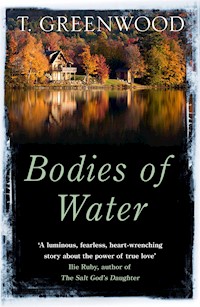
At thirty, Piper Kincaid feels too young to be dying. Cancer has eaten away her strength. Yet with all the questions of her future before her, she's adrift in the past, remembering the fateful summer she turned fourteen and her life changed forever. What Piper dreaded came to pass: her restless, artistic mother, finally left. She had a brother who loved her, but her mother's absence, her father's distance, and a volatile secret threatened to destroy everything... Now Piper is once again left with the jagged pieces of a shattered life. If she is ever going to survive, she'll have to begin with the summer that broke them all...
Das E-Book können Sie in Legimi-Apps oder einer beliebigen App lesen, die das folgende Format unterstützen:
Veröffentlichungsjahr: 2017
Ähnliche











Outstanding Praise for the Novels of T. Greenwood
Undressing the Moon
“This beautiful story, eloquently told, demands attention.”
—Library Journal (starred review)
“Greenwood has skillfully managed to create a novel with unforgettable characters, finely honed descriptions, and beautiful imagery.”
—Book Street USA
“A lyrical, delicately affecting tale.”
—Publishers Weekly
“Rarely has a writer rendered such highly charged topics … to so wrenching, yet so beautifully understated, an effect … T. Greenwood takes on risky subject matter, handling her volatile topics with admirable restraint. … Ultimately more about life than death, Undressing the Moon beautifully elucidates the human capacity to maintain grace under unrelenting fire.”
—The Los Angeles Times
The Hungry Season
“This compelling study of a family in need of rescue is very effective, owing to Greenwood’s eloquent, exquisite word artistry and her knack for developing subtle, suspenseful scenes. … Greenwood’s sensitive and gripping examination of a family in crisis is real, complex, and anything but formulaic.”
—Library Journal (starred review)
“A deeply psychological read.”
—Publishers Weekly
“Can there be life after tragedy? How do you live with the loss of a child, let alone the separation emotionally from all your loved ones? T. Greenwood with beautiful prose poses this question while delving into the psyches of a successful man, his wife, and his son. … This is a wonderful story, engaging from the beginning that gets better with every chapter.”
—The Washington Times
Turn the page for more outstandingpraise for the novels of T. Greenwood.
Two Rivers
“From the moment the train derails in the town of Two Rivers, I was hooked. Who is this mysterious young stranger named Maggie, and what is she running from? In Two Rivers, T. Greenwood weaves a haunting story in which the sins of the past threaten to destroy the fragile equilibrium of the present. Ripe with surprising twists and heart-breakingly real characters, Two Rivers is a remarkable and complex look at race and forgiveness in small-town America.”
—Michelle Richmond, New York Times bestselling author of The Year of Fog and No One You Know
“Two Rivers is a convergence of tales, a reminder that the past never washes away, and yet, in T. Greenwood’s delicate handling of time gone and time to come, love and forgiveness wait on the other side of what life does to us and what we do to it. This novel is a sensitive and suspenseful portrayal of family and the ties that bind.”
—Lee Martin, author of The Bright Forever and River of Heaven
“The premise of Two Rivers is alluring: the very morning a deadly train derailment upsets the balance of a sleepy Vermont town, a mysterious girl shows up on Harper Montgomery’s doorstep, forcing him to dredge up a lifetime of memories—from his blissful, indelible childhood to his lonely, contemporary existence. Most of all, he must look long and hard at that terrible night twelve years ago, when everything he held dear was taken from him, and he, in turn, took back. T. Greenwood’s novel is full of love, betrayal, lost hopes, and a burning question: is it ever too late to find redemption?”
—Miranda Beverly-Whittemore, author of The Effects of Light and the Janet Heidinger Kafka Prize–winning Set Me Free
“Greenwood is a writer of subtle strength, evoking small-town life beautifully while spreading out the map of Harper’s life, finding light in the darkest of stories.”
—Publishers Weekly
“T. Greenwood’s writing shimmers and sings as she braids together past, present, and the events of one desperate day. I ached for Harper in all of his longing, guilt, grief, and vast, abiding love, and I rejoiced at his final, hard-won shot at redemption.”
—Marisa de los Santos, New York Times bestselling author of Belong to Me and Love Walked In
“Two Rivers is a stark, haunting story of redemption and salvation. T. Greenwood portrays a world of beauty and peace that, once disturbed, reverberates with searing pain and inescapable consequences; this is a story of a man who struggles with the deepest, darkest parts of his soul, and is able to fight his way to the surface to breathe again. But also—maybe more so—it is the story of a man who learns the true meaning of family: When I am with you, I am home. A memorable, powerful work.”
—Garth Stein, New York Times bestselling author of The Art of Racing in the Rain
“A complex tale of guilt, remorse, revenge, and forgiveness … Convincing … Interesting …”
—Library Journal
“In the tradition of The Adventures of Huckleberry Finn and To Kill a Mockingbird, T. Greenwood’s Two Rivers is a wonderfully distinctive American novel, abounding with memorable characters, unusual lore and history, dark family secrets, and love of life. Two Rivers is the story that people want to read: the one they have never read before.”
—Howard Frank Mosher, author of Walking to Gatlinburg
“Two Rivers is a dark and lovely elegy, filled with heartbreak that turns itself into hope and forgiveness. I felt so moved by this luminous novel.”
—Luanne Rice, New York Times bestselling author
“Two Rivers is reminiscent of Thornton Wilder, with its quiet New England town shadowed by tragedy, and of Sherwood Anderson, with its sense of desperate loneliness and regret. … It’s to Greenwood’s credit that she answers her novel’s mysteries in ways that are believable, that make you feel the sadness that informs her characters’ lives.”
—Bookpage
BOOKS BY T. GREENWOOD
The Hungry SeasonTwo RiversUndressing the MoonNearer Than the SkyBreathing Water
First published in the United States in 2002 by St. Martin’s Press, New York.
First published in e-book in Great Britain in 2017 by Corvus.
Copyright © T. Greenwood, 2002
The moral right of T. Greenwood to be identified as the author of this work has been asserted by her in accordance with the Copyright, Designs and Patents Act of 1988.
All rights reserved. No part of this publication may be reproduced, stored in a retrieval system, or transmitted in any form or by any means, electronic, mechanical, photocopying, recording, or otherwise, without the prior permission of both the copyright owner and the above publisher of this book.
This novel is entirely a work of fiction. The names, characters and incidents portrayed in it are the work of the author’s imagination. Any resemblance to actual persons, living or dead, events or localities, is entirely coincidental.
10 9 8 7 6 5 4 3 2 1
A CIP catalogue record for this book is available from the British Library.
E-book ISBN: 978 1 78649 098 8
Printed in Great Britain.
Corvus
An imprint of Atlantic Books Ltd
Ormond House
26–27 Boswell Street
London
WC1N 3JZ
www.corvus-books.co.uk
For my grandmothers …and for Janet
ACKNOWLEDGMENTS
Thank you (as always) to Christy Fletcher for really listening to my voice. To Ron and Bradi Ross for the necessary lyrics. To Samantha Ruckman, Beya Stewart, and Whitney Lee for pointing out the sour notes, and to Julia Pastore for fixing them. To my family, my best audience. And to Patrick, my breath.
Things break. I’ve come to terms with that in my own strange way. I realize that there are things that will hurt us and things that will keep us safe; that sometimes it’s hard to discover the line between them, and that sometimes they are the same thing.
—Kevin Wilsonfrom “A World of Glass,” Oxford American,September/October 1999
She was always at the edge of leaving.
Cattails stand guard along the banks of the Pond. I am six years old, and I cannot swim. The cattails keep me safe. The air is so thick with summer it’s hard to swallow; it’s even hard to breathe tonight. I lift my hair off my neck, twist it into a knot, and pray for a breeze. But the air is still, and I am alone, waiting for my mother to come back. I can hear the sucking sound of her bare feet in the mud as she circles the water’s edge, but I can barely see her in the waning light of the moon. Besides, she is moving too quickly to hold on to for very long.
I try not to think of Daddy maybe waking. Maybe standing in his gray slippers on the back porch, peering out into the starless night, wondering where she has gone. It makes me sad, the way he stands with his hands in his pockets, staring after her, whenever she leaves. His face turns the color of gravel even if she is only going to the grocery store. He might not see the note she left, perched between two bananas in the fruit bowl, saying that we were only going to look for the moon. He might think that this is the last time. That this time it’s for good.
There is supposed to be a lunar eclipse tonight, and my mother explains it the way she explains shadows and thunder—without science or words too big for me to repeat or understand. It will just disappear, she says. Slowly. Like pulling a dark dress over its pale face.
I look up at the sky and watch as this happens: I’m struggling to hold on to the vague outline that is my mother as she wades deeper into the water. Panic is thicker than heat. I look for her, thinking of Daddy’s pockets, as she and the sliver of moon both disappear. I know she will come out again, wet and slippery and shivering. Like last time, like every other time, but there is always this terrible moment when I am unsure, when everything bad is possible.
And even after she finds me waiting for her and we start walking quietly back to the house, I am still afraid. Because strangely, on this still night, what scares me almost as much as my mother’s ability to disappear is the absence of light. And I wonder, without my mother, who would undress the moon.
ONE
When you know you are dying, things begin to make sense. In the surprising bright light moment of one more day (stolen or granted, you don’t know which), there is suddenly coherence where chaos used to reside, clarity where there once was confusion. When you lift your arms, amazed that they still work, and see your familiar face reflected—remarkably—in your bathroom mirror, coincidence promptly becomes destiny. And when you open your mouth and your own voice comes out, still here, every chance meeting and every decision you’ve ever made now seem serendipitous. Because everything you’ve ever done or said has led you to this moment. Right here.
That is why I am not surprised that on the very day I decide to stop my chemotherapy, a letter arrives from my mother. It is fitting. Serendipity.
My best friend, Becca, who has been sleeping on my couch lately, looks forward to the mail’s arrival. This isn’t even her house, but when she hears the mail truck pull up every afternoon, she rushes first to the window and then down my steps to meet the mailman. She knows him by his first name, and today I watch them talking on the sidewalk. She takes the small bundle of mail directly from him before he has a chance to stuff it into my mailbox, and then I hear her skipping up the steps two at a time.
“Phone bill, gas bill, Spiegel flyer, and another letter from your mum.” She lays each piece of mail on my kitchen table like a Tarot card, resting the letter from my mother across the phone bill. With her long red hair wrapped up in a precarious knot, she could be a carnival fortune-teller.
“Will you read this one?” she asks.
I wrap my robe and my arms around my waist and shake my head.
This is the twelfth letter I have received from my mother in the last three years, since I found out I was sick: one for each season. I keep them in the back of my closet, in a shoe box that used to hold a pair of shoes I don’t even own anymore. All the envelopes are the same size, though her handwriting varies depending on the season. In springtime, it is thin like bare branches. In winter, the ink is heavy and thick, my name and address a blanket of words. In summertime, she uses colored ink, each return address the color of somewhere else’s summer. Impermanent. Wandering. It is autumn now, and today her words are only veins running through the middle of a fallen leaf. Sometimes the envelopes are as thin as a single sheet of paper; other times they are thick with whatever is inside.
“I wish you’d at least open it,” Becca says, sitting down at the table where she has put a pile of her students’ papers. “It couldn’t hurt to open it.”
I look at Becca as she thumbs through the stack of essays, absently licking her thumb when the pages stick.
“Not today,” I say.
But I keep thinking about the letter that night after Becca
goes back to school for parent-teacher conferences. I even leave it lying on the table the way she arranged it with her gypsy hands, thinking now that it likely would reveal more about my past than my future. And later, after the streetlights come on outside and after I have fixed Bog’s dinner, I sit with my feet curled under me on the couch and hold the letter to the light, wondering what would happen if I didn’t put this one away, thinking about how my life might change.
I haven’t seen my mother since I was fourteen years old. And after she left my world fell apart. Everything that happened from the moment I knew she was gone until this moment, until now, has made me who I am. And who I am now is a thirty-year-old girl, body ravaged by a woman’s disease. But somehow everything about this is logical. It makes sense. Dying can be a comforting thing to someone accustomed to chaos.
Finally, I carefully tear the end of the envelope open and spill its contents onto my lap.
I should have known there wouldn’t be a letter inside. No words, only slivers—that was always her way. With tentative fingers, I reach down and carefully pick up the scarlet piece of glass.
If summer here were made of colored glass, this is the way the light would shine through the summer I turned fourteen: new leaves the green of dreams, fat June bugs’ metallic wings, and the color of breeze. Not spring. By early June, the mud of the dirt road leading from our house to the lake had dried up, leaving a path of quartz and mica under bare feet, shiny enough to make you imagine that diamonds instead of fool’s gold were piercing your winter skin. I picked the rocks up in handfuls and let the sun pour through my fists.
The road to the lake from our house was a corridor of green and sunlight, and after the two-mile walk there was this: a yellow sail, the red hint of a lost kite, and the blue, blue of watery summer. Azure lake, white at the shore, and silvery fish. It was clean and bright here, not like at the murky Pond with its sawdust bottom near our house. Here the shores were made of grass instead of dirt, and you could swim for hours without getting an earache. The sepia colors of the dark woods where we lived became brilliant, alive here, and that summer I wore bits of purple in my newly pierced ears.
The clarity of that summer is striking to me now. It seems that it would be clouded by everything that happened afterward, but instead it hangs in my memory like a strand of colored glass beads: each bead a small gem, moments stolen and then strung together. Vivid. And intact. I keep it somewhere safe now, in a place where no one can find it, going over the beads like a rosary when I can’t sleep. And in my hands are the fragile remnants of the last summer that I believed the world to be a kind place. The last summer that I could see promise in something as simple as the curve of the moon. The last summer that I believed I knew my mother.
My mother was an artist. That wasn’t her word; it was mine. But she was. She told people she was a housewife, a stay-at-home mom. And who would question that? She had a convincing story, and proof: no job, two children, and weathered hands. She was reluctant to talk about what she really did with her time. To strangers, especially. But inside our home, we knew the magic she was capable of. To my brother, Quinn, and me, she was not only a mother but a sorceress. She made life incredible in a place that was otherwise unbearable. That is why my father loved her. And why I wanted to become her someday.
The shed behind our house was where she worked. There was only one bare bulb hanging down from a cord in the middle of the room, but sometimes she would stay in there until long past dark. I could see the shed light from my bedroom window, hear the music coming from the little radio she kept in there. It wasn’t a proper place for an artist; there was no heat in the winter other than the small electric space heater, and no real way to keep cool in the summer. But she never complained. It was her place in the world, she said. She didn’t even mind the dirt floor or the leaky roof. The smell of rotten wood or the one smudged window.
She was a collector of glass: fractured pieces she gathered from the shores of Lake Gormlaith, the town dump where Daddy worked, and other people’s trash. And in her shed, she transformed the slivers into stained-glass panels that hung in every window of our house. She never bought the glass; there were so many things already broken here. Beer bottles break when thrown; so do glasses and vases and lamps. Windows shatter with angry fists. Debris is easy to come by in a place where people are sad.
We lived two miles up the road from Lake Gormlaith, away from the Vermont Life pictures of serenity and summer homes and ascending loons, deep in the woods where some people still managed without plumbing. We lived among people whose poverty could be seen in the length of their faces, in their tired speech, and in the heaviness of their eyes. Everyone here was hungry. Everyone here knew too much about pain.
There was a time before, when Daddy and most of our neighbors worked at the furniture factory in Quimby, turning trees into pulp and pulp into plywood desks and nightstands and entertainment centers. There was money enough then for Sunday breakfasts at the Miss Quimby Diner, new shoes from Payless, even a trip down to Boston or Atlantic City every couple of years. But when the furniture factory closed down, the men didn’t have anywhere to go during the day anymore. There were no jobs to go to. Arguments exploded like gunshots in these woods, where there used to be only the silence of water. And when people weren’t yelling at each other, you could still hear the hushed angry whispers rushing through the tops of the trees. Desperate anger. Anger made out of empty pockets and empty refrigerators and empty promises. And so my mother gathered our neighbors’ destruction and made it into something good. She rearranged their fury into transparent miracles that needed only a little light to come alive. She kept the shards in an old card catalog in the shed, each wooden drawer labeled by hue. By degree. Each row was a different color, and the first row was red. Poppy, ruby. Scarlet, crimson, maroon. Burgundy. Carmine and wine. Who knew there were so many shades of anger?
Daddy was lucky. When he lost his job at the factory, he found a new one right away at the landfill in Quimby, collecting money from the summer people who brought tidy bags of coffee grounds and banana peels in from their rented camps at Lake Gormlaith. By July, every camp on Gormlaith would be full, and the summer people made enough garbage to keep Daddy busy ten hours a day: mildewed bathing suits, broken water skis, watermelon rinds. Corn husks and inner tubes. In the summer, he came home smelling like other people’s garbage, but sometimes he would bring my mother some shimmering thing he’d found poking out of a trash bag, or buried under a pile of dirty diapers. He’d polish the pieces as if they were gems and offer them to her in the same way.
Of course, there was pain in our house, too. I would have had to be blind not to notice the sad way he extended his hand to her, and the reluctant way she accepted. I would have had to be deaf not to hear their careful arguments at night. My father’s job at the dump was a seasonal one. We all knew that summer would eventually end, and as much as we despised the summer people, we relied on them. Soon enough they would return to their real homes in New York and Connecticut and Boston, taking their money and their trash with them. The end of summer was a desperate time, even for us. I knew that instead of shopping for new school clothes, I’d have to pick through the summer people’s leftovers dropped off at my aunt Boo’s thrift shop. I knew that Daddy’s fingers would be blackened by newsprint, the classified ads preserved in piles all over the house. That my mother’s words would become careful, that all of us would have to move gingerly, until he found a winter job.
The first couple of years after the furniture factory closed, he worked pumping gas at a friend’s station, but it closed down when the big Shell station opened across the street. This year, he didn’t know where he would be working. Quinn had taken a job at the Shop-N-Save as soon as he turned sixteen. But despite my mother’s pleas to please let her help, to let her find a job in town waiting tables or at one of the shops, Daddy insisted that she stay home, that he could do enough. He said that he would give her the world he’d promised when she first loved him. And this made her angry. In my room, I held a heavy pillow over my head so their words couldn’t find me. The slivers here weren’t made of glass but of her sighs and his tears. But my mother was a magician, and she could mend things.
What I choose to remember, the beads my fingers linger on, are these: The days when Daddy and Quinn were at work and my mother belonged to me. The days that we went hunting. We made picnic lunches (cream cheese and cucumber sandwiches, bottles of Orange Crush or lemonade) and walked for hours, waiting for the sun to catch in the blue or green of something broken. Of course, sometimes we could walk all day without finding anything; sometimes the beach held nothing for us but tangled fishing lines, a soggy shoe, wet plastic bags. But other times, we’d find piles of glass in the road, the glorious remnants of an accident. Or a perfect piece of cobalt that used to be a wineglass. Those days, we felt like explorers or pirates, and we would sit down under a tree and eat our junk-food picnic as if we had been journeying for days without food, counting the shattered pieces like medallions of gold.
Sing for me? she would ask later as we lay, bellies full and brown, on the blanket she had spread by the water.
And as I sang, she would close her eyes. Sometimes it scared me, how far away she seemed, as if my own voice could send her away. But when I stopped, when I swallowed the only beautiful thing I knew how to make, her eyes would flicker open again, and she would return to me.
She was already further away than any of us knew.
In the evenings, she would put together the pieces we had found.
“Look,” she said.
I had tiptoed outside, past my father snoring softly on the couch, and past our dog, Sleep, who was doing just that on the front porch, to the shed. It was July, and the air was loud with crickets and the distant sounds of fireworks. The Fourth of July wasn’t for two more days, but the summer people were impatient.
It was so warm I didn’t need the sweatshirt I had grabbed on my way out. The door to the shed was open and light spilled onto the wet grass. I could see my mother’s shadow moving across the walls inside.
I knocked softly on the open door and peered in at her. She held up one of her stained-glass panes to the bare bulb.
“Look.”
The glass was indigo: not quite black, not blue. But beyond that confused color was the certainty of ruby and emerald and amber. The verity of red and green and yellow, an explosion of color, but still perfectly intact.
Outside, the air cracked and burned with Roman candles. And as I sat on the wobbly stool while my mother worked, I thought about the possibility of explosion. About calmness, and sudden detonation. Watching her hands work across the broken pieces, I felt almost sick with appreciation, but there was no way to tell her how much I needed her.
That night after I crept back into the house, nearly tripping over Sleep’s long body in the kitchen, the sickness stayed with me. It settled in my stomach and shoulders all through the night. If I’d been able to articulate the feeling, I might have realized that I missed her. Already, and she wasn’t even gone.
The next day was brilliant and we walked to the lake to lie in the sun. The grassy place near the boat-access area was littered with empty fireworks shells, burnt at the edges and quiet.
Mum spread a threadbare cotton sheet across the softest patch of grass at the shore, kicked off her flip-flops, and pulled her legs under her, Indian style. She shielded her eyes from the sun and looked across the impossible expanse of blue, unbroken by motorboats or sails that day.
A pair of loons had nested at the opposite shore earlier in the summer and we’d watched them after their child was born, teaching the brown downy adolescent how to fish. But today the couple swam and cackled at each other, and the child was nowhere to be found.
“Where’s the baby?” I asked, concerned that some irate fisherman had felt threatened by the bird’s ability to find fish in the depths of the lake when he, himself, went home empty-handed. It had happened so many times before that now signs all along the lake warned that the loons were a protected species.
“They’ve probably left him alone. That’s how they teach him independence. He’s probably at the other end of the lake.”
“Alone?” I asked, horrified.
“They’ll go get him in a little bit. He’s okay, Piper. He’s just growing up.” She reached into the bag she’d packed and handed me a cold sandwich, wrapped in wax paper. “It’s meatloaf, with mustard.” She smiled. Only she knew that cold meatloaf sandwiches were my favorite. She had probably even saved the last piece, hiding it in the back of the refrigerator, safe from Daddy and Quinn.
I unwrapped the sandwich carefully, like a gift, and ate it slowly, trying not to think about the baby loon alone on the other side of the lake, protected by the law but not by his own parents.
In the summer, we didn’t worry about what would happen when winter descended. In the summer we didn’t worry about money. About food in the cupboards or that my feet were growing so fast I would need new boots again once snow fell. In the summer, it was just me and my mother, searching for broken treasures in the mud.
The clarity of that summer still surprises me. Sunlight struggling through the green of new leaves. The marbled pink of a sunburn, and tumblers filled with lemonade. I suppose the sunshine might have blinded me a little. With the beads of sunlight in my fingers, even now, I skip over the ones made of milky glass, the gray beads that would not let the light come through.
These were the days when Daddy didn’t go to work. The migraine days. The days when he closed his eyes and saw falling stars. On those days, Mum didn’t seem to know what to do. Normally, we would have walked to the lake or through the woods to the Pond, where some of the best glass lay buried in dank mud. But with Daddy home, lying on the couch with a cool cloth pressed against his temples, she stood in doorways, looking lost. On the migraine days, the TV was always on: game shows, soaps, talk shows. She pretended to be absorbed in programs I knew she had never watched before. She jumped every time the phone rang, because once when someone tried to sell her life insurance, Daddy grabbed the phone out of her hand and demanded, Who is this? When Daddy was home, we didn’t go hunting, because every time she walked near the door, Daddy would reach for her, asking, Where are you off to? And then she wouldn’t go anywhere. Not to the lake for picnics. Not even to the shed to work. But then Daddy’s migraine would disappear, as quickly as it came, and he would go back to work. When he was gone, the light returned, and I had my mother back again. I had the green of grass after rain, the soft orange of peaches in a basket, and the violet of the sky outside my night window. If summer here were made of colored glass, this one would be made of emerald, topaz, amethyst. I suppose the sunlight blinded me a little, to the dark days.
On these days, the gray days, I could see the worry in her face and in her hands. I could hear it just under the surface of her voice. At night I listened to their whispers, pretended that their voices belonged to crickets, to bullfrogs, to loons.
* * *
“We’re going to Quimby today,” she said one morning in early August.
“Hmmmm.” I nodded. I was busy pushing scrambled eggs across my plate, thinking about how I might ask her for a new pair of jeans for school. I had grown five inches since last summer; I was almost as tall as Daddy, and my clothes didn’t fit anymore. But today was the first day in two weeks that Daddy had gone to work. We didn’t have any money for new jeans.
“Piper?”
I looked up from my plate.
She was standing in front of the sink in her nightgown, and the sun was shining through the sheer fabric. Inside the giant nightie, I could see how small she was. It embarrassed me. I looked back down at my plate.
“I think I’ll bring some of my pictures to the artists’ gallery,” she said softly, like a question.
I looked up again. She was running her fingers across the counter. Nervous.
“You should!”
“You think?” she asked. “Maybe the summer people might buy them?”
I imagined my mother’s glass pictures hanging in strangers’ homes. Filling windows in high-rises, the way they might change the yellow glow of a street lamp into something cool and green.
That afternoon I helped her gather her stained-glass panes and we took them to the artists’ gallery in Quimby. While she met with the owner in the back office, I wandered through a labyrinth of jewelry and sculptures, quilts and paintings. I was amazed by so much beauty in one place and wondered what it would feel like to be able to buy something. To reach into my pocket and pull out enough money for the velvet crazy quilt. How it might look spread across my old bed.
Mum was smiling when she emerged from the back room. The handsome owner of the shop had his hand on her back. When she saw me, she smiled shyly. She blushed when he wrote her a check for the pieces, and she squeezed my hand tightly as we walked back to the car. At the Miss Quimby Diner, she said, “Order anything you want. Anything!” We got hamburgers and French fries smothered in gravy. I’d never tasted anything more wonderful. On the way home, I could still taste the salt on my lips. We rolled the windows down and sang, together, at the tops of our lungs.




