


1,49 €
Mehr erfahren.
- Herausgeber: Corvus
- Kategorie: Gesellschafts- und Liebesromane
- Sprache: Englisch
Sylvie can hardly bear to remember how normal her family was two years ago. The night an oncoming vehicle forced their car over the edge of a covered bridge changed them forever: Sylvie's young son was gone, her husband lost his legs, and she was left with shattering blame and grief. Eleven-year-old Ruby misses her little brother, too. But she also misses the mother who has become a recluse while Ruby and her dad try to piece themselves back together. As Hurricane Irene bears down on them, and a pregnant teenager with a devastating secret gradually draws Sylvie back into the world, Ruby and her mother will have a chance to span the fissure separating them.
Das E-Book können Sie in Legimi-Apps oder einer beliebigen App lesen, die das folgende Format unterstützen:
Veröffentlichungsjahr: 2017
Ähnliche












Outstanding Praise for the Novels of T. Greenwood
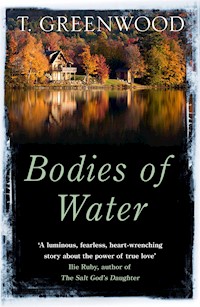
Bodies of Water
“A complex and compelling portrait of the painful intricacies of love and loyalty. Book clubs will find much to discuss in T. Greenwood’s insightful story of two women caught between their hearts and their families.”
—Eleanor Brown, New York Times bestselling author of The Weird Sisters
“A wrenching look at what happens when two people fall in love in the wrong place at the wrong time . . . Beauty and tragedy at the same time, darkness then light—those are Greenwood hallmarks. She’s terrific with characters, with the multiple textures that make someone seem human on the page. She has some interesting things to say here about memory, and the ending is as moving as anything she’s written.”
—The San Diego Union-Tribune
“Bodies of Water is no ordinary love story, but a book of astonishing precision, lyrically told, raw in its honesty and gentle in its unfolding. Here is a complex tapestry of lives entwined, a testimony to the fact that a timeless sort of love does exist—one that sustains memory, derails oppression, and with its striking ferocity can cause human beings to relinquish love and yet also to recover it. T. Greenwood has rendered a compassionate story of people who are healed and destroyed by love, by alcoholism, by secrets and betrayal, and yet she offers us a certain shade of hope that while the barriers between people can make a narrow neighborhood street seem as wide as the ocean, soul mates can and do find each other—sometimes more than once in a lifetime. A luminous, fearless, heart-wrenching story about the power of true love.”
—Ilie Ruby, author of The Salt God’s Daughter
“Greenwood’s [eighth] novel, a tale of love and loyalty, owes its success to the poetic prose, as well as the compelling chronology she employs . . . This compassionate, insightful look at hope and redemption is a richly textured portrait. This gem of a story is a good choice for those who enjoy family novels.”
—Library Journal
“T. Greenwood’s Bodies of Water is a lyrical novel about the inexplicable nature of love, and the power a forbidden affair has to transform one woman’s entire life. By turns beautiful and tragic, haunting and healing, I was captivated from the very first line. And Greenwood’s moving story of love and loss, hope and redemption has stayed with me, long after I turned the last page.”
—Jillian Cantor, author of Margot
Breathing Water
“A poignant, clear-eyed first novel . . . filled with careful poetic description . . . the story is woven skillfully.”
—The New York Times Book Review
“A poignant debut . . . Greenwood sensitively and painstakingly unravels her protagonist’s self-loathing and replaces it with a graceful dignity.”
—Publishers Weekly
“A vivid, somberly engaging first book.”
—Larry McMurtry
“An impressive first novel.”
—Booklist
“Breathing Water is startling and fresh . . . Greenwood’s novel is ripe with originality.”
—The San Diego Union-Tribune
Grace
“Grace is a poetic, compelling story that glows in its subtle, yet searing examination of how we attempt to fill the potentially devastating fissures in our lives. Each character is masterfully drawn; each struggles in their own way to find peace amid tumultuous circumstance. With her always crisp imagery and fearless language, Greenwood doesn’t back down from the hard issues or the darker sides of human psyche, managing to create astounding empathy and a balanced view of each player along the way. The story expertly builds to a breathtaking climax, leaving the reader with a clear understanding of how sometimes, only a moment of grace can save us.”
—Amy Hatvany, author of Best Kept Secret
“Grace is at once heartbreaking, thrilling and painfully beautiful. From the opening page, to the breathless conclusion, T. Greenwood again shows why she is one of our most gifted and lyrical storytellers.”
—Jim Kokoris, author of The Pursuit of Other Interests
“Grace is a masterpiece of small-town realism that is as harrowing as it is heartfelt.”
—Jim Ruland, author of Big Lonesome
“This novel will keep readers rapt until the very end . . . Shocking and honest, you’re likely to never forget this book.”
—RT Book Reviews
“Grace amazes. Ultimately so realistically human in its terror and beauty that it may haunt you for days after you finish it. T. Greenwood has another gem here. Greenwood’s mastery of character and her deep empathy for the human condition make you care what happens, especially in the book’s furious final 100 pages.”
—The San Diego Union-Tribune
“Exceptionally well-observed. Readers who enjoy insightful and sensitive family drama (Lionel Shriver’s We Need to Talk About Kevin; Rosellen Brown’s Before and After) will appreciate discovering Greenwood.”
—Library Journal
Nearer Than the Sky
“Greenwood is an assured guide through this strange territory; she has a lush, evocative style.”
—The New York Times Book Review
“T. Greenwood writes with grace and compassion about loyalty and betrayal, love and redemption in this totally absorbing novel about daughters and mothers.”
—Ursula Hegi, author of Stones from the River
“A lyrical investigation into the unreliability and elusiveness of memory centers Greenwood’s second novel . . . The kaleidoscopic heart of the story is rich with evocative details about its heroine’s inner life.”
—Publishers Weekly
“Doesn’t disappoint. A complicated story of love and abuse told with a directness and intensity that packs a lightning charge.”
—Booklist
“Nearer Than the Sky is a remarkable portrait of resilience. With clarity and painful precision, T. Greenwood probes the dark history of Indie’s family.”
—Rene Steinke, author of The Fires and Holy Skirts
“Deft handling of a difficult and painful subject . . . compelling.”
—Kirkus Reviews
“Potent . . . Greenwood’s clear-eyed prose takes the stuff of tabloid television and lends it humanity.”
—San Francisco Chronicle
This Glittering World
“In This Glittering World, T. Greenwood demonstrates once again that she is a poet and storyteller of unique gifts, not the least of which is a wise and compassionate heart.”
—Drusilla Campbell, author of The Good Sister and Blood Orange
“This Glittering World is swift, stark, calamitous. Her characters, their backs against the wall, confront those difficult moments that will define them and Greenwood paints these troubled lives with attention, compassion and hope.”
—Jerry Gabriel, author of Drowned Boy and winner of the Mary McCarthy Prize in Short Fiction
“Stark, taut, and superbly written, this dark tale brims with glimpses of the Southwest and scenes of violence, gruesome but not gratuitous. This haunting look at a fractured family is certain to please readers of literary suspense.”
—Library Journal (starred)
“Greenwood’s prose is beautiful. Her writing voice is simple but emotional.”
—RT Book Reviews
Undressing the Moon
“This beautiful story, eloquently told, demands attention.”
—Library Journal (starred review)
“Greenwood has skillfully managed to create a novel with unforgettable characters, finely honed descriptions, and beautiful imagery.”
—Book Street USA
“A lyrical, delicately affecting tale.”
—Publishers Weekly
“Rarely has a writer rendered such highly charged topics . . . to so wrenching, yet so beautifully understated, an effect . . . T. Greenwood takes on risky subject matter, handling her volatile topics with admirable restraint . . . Ultimately more about life than death, Undressing the Moon beautifully elucidates the human capacity to maintain grace under unrelenting fire.”
—The Los Angeles Times
The Hungry Season
“This compelling study of a family in need of rescue is very effective, owing to Greenwood’s eloquent, exquisite word artistry and her knack for developing subtle, suspenseful scenes . . . Greenwood’s sensitive and gripping examination of a family in crisis is real, complex, and anything but formulaic.”
—Library Journal (starred review)
“A deeply psychological read.”
—Publishers Weekly
“Can there be life after tragedy? How do you live with the loss of a child let alone the separation emotionally from all your loved ones? T. Greenwood with beautiful prose poses this question while delving into the psyches of a successful man, his wife, and his son . . . This is a wonderful story, engaging from the beginning, that gets better with every chapter.”
—The Washington Times
Two Rivers
“In Two Rivers, T. Greenwood weaves a haunting story in which the sins of the past threaten to destroy the fragile equilibrium of the present. Ripe with surprising twists and heart-breakingly real characters, Two Rivers is a remarkable and complex look at race and forgiveness in small-town America.”
—Michelle Richmond, New York Times bestselling author of The Year of Fog and No One You Know
“Two Rivers is a convergence of tales, a reminder that the past never washes away, and yet, in T. Greenwood’s delicate handling of time gone and time to come, love and forgiveness wait on the other side of what life does to us and what we do to it. This novel is a sensitive and suspenseful portrayal of family and the ties that bind.”
—Lee Martin, author of The Bright Forever and River of Heaven
“T. Greenwood’s novel is full of love, betrayal, lost hopes, and a burning question: is it ever too late to find redemption?”
—Miranda Beverly-Whittemore, author of Bittersweet
“Greenwood is a writer of subtle strength, evoking small-town life beautifully while spreading out the map of Harper’s life, finding light in the darkest of stories.”
—Publishers Weekly
“T. Greenwood’s writing shimmers and sings as she braids together past, present, and the events of one desperate day. I ached for Harper in all of his longing, guilt, grief, and vast, abiding love, and I rejoiced at his final, hard-won shot at redemption.”
—Marisa de los Santos, New York Times bestselling author of Belong to Me and Love Walked In
“Two Rivers is a stark, haunting story of redemption and salvation. T. Greenwood portrays a world of beauty and peace that, once disturbed, reverberates with searing pain and inescapable consequences. A memorable, powerful work.”
—Garth Stein, New York Times bestselling author of The Art of Racing in the Rain
“A complex tale of guilt, remorse, revenge, and forgiveness . . . Convincing . . . Interesting . . .”
—Library Journal
“In the tradition of The Adventures of Huckleberry Finn and To Kill a Mockingbird, T. Greenwood’s Two Rivers is a wonderfully distinctive American novel, abounding with memorable characters, unusual lore and history, dark family secrets, and love of life. Two Rivers is the story that people want to read: the one they have never read before.”
—Howard Frank Mosher, author of Walking to Gatlinburg
“Two Rivers is a dark and lovely elegy, filled with heartbreak that turns itself into hope and forgiveness. I felt so moved by this luminous novel.”
—Luanne Rice, New York Times bestselling author
“Two Rivers is reminiscent of Thornton Wilder, with its quiet New England town shadowed by tragedy, and of Sherwood Ander-son, with its sense of desperate loneliness and regret . . . It’s to Greenwood’s credit that she answers her novel’s mysteries in ways that are believable, that make you feel the sadness that informs her characters’ lives.”
—Bookpage
Books by T. Greenwood
The Forever Bridge
Bodies of Water
Grace
This Glittering World
The Hungry Season
Two Rivers
Undressing the Moon
Nearer Than the Sky
Breathing Water
First published in the United States in 2015 by Kensington Books, an imprint of Kensington Publishing Corp., New York.
First published in e-book in Great Britain in 2017 by Corvus.
Copyright © T. Greenwood, 2015
The moral right of T. Greenwood to be identified as the author of this work has been asserted by her in accordance with the Copyright, Designs and Patents Act of 1988.
All rights reserved. No part of this publication may be reproduced, stored in a retrieval system, or transmitted in any form or by any means, electronic, mechanical, photocopying, recording, or otherwise, without the prior permission of both the copyright owner and the above publisher of this book.
This novel is entirely a work of fiction. The names, characters and incidents portrayed in it are the work of the author’s imagination. Any resemblance to actual persons, living or dead, events or localities, is entirely coincidental.
10 9 8 7 6 5 4 3 2 1
A CIP catalogue record for this book is available from the British Library.
E-book ISBN: 978 1 78649 094 0
Printed in Great Britain.
Corvus
An imprint of Atlantic Books Ltd
Ormond House
26–27 Boswell Street
London
WC1N 3JZ
www.corvus-books.co.uk
For Mikaela
Acknowledgments
With gratitude to Peter Senftleben, Vida Engstrand, Henry Dunow, and the rest of my team for their hard work. To my writing friends for their ears and shoulders (especially Miranda Beverly-Whittemore, Jillian Cantor, and Amy Hatvany). To my family for believing in me. And, as always, to Patrick and the girls, who give me a zillion reasons to be grateful.
There is a land of the living and a land of the dead and the bridge is love, the only survival, the only meaning.
—Thornton Wilder, The Bridge of San Luis Rey
Love is the voice under all silences, the hope which has no opposite in fear; the strength so strong mere force is feebleness: the truth more first than sun, more last than star . . .
—E. E. Cummings
Contents
Acknowledgments
Sunday
Monday
Tuesday
Wednesday
Thursday
Friday
Saturday
Sunday
After the Storm
Here is the night the world changes, your world changes. The night when certainties are shattered, and you are left with shards of your old truth, hunched over and picking up the broken pieces, wondering that they ever made anything whole. And the pieces are sharp, and the pieces will hurt you again and again and again.
Here is a bridge. Here is a river. Here is rain and a family and a car: a brown sedan that has seen better days. The leather seats that were a luxury to the original owner are now cracked, tears duct-taped and cold. It is late autumn in Vermont. It is too dark to see this, but you know that the corridor of trees that make a tunnel as you travel down the bumpy dirt road have turned from green to blazing crimson and yellow. That this is the beautiful burst of flames that occurs before everything dies.
Here, inside the car, the mother, Sylvie, does her lipstick in the greasy mirror in the passenger-side visor. Here is the father, Robert, fiddling with the dial on the radio, attempting to get the game to come in and stay in. The first Celtics game of the season is on and Boston is down by seven against the Cavs after the first quarter. Here are two kids in the backseat. Ruby is nine and Jess is seven. They both have thick mops of brown hair. They both have a pair of startlingly green eyes. They are beautiful children. This is what Sylvie thinks. Robert is more concerned with the boy’s ability to throw balls, with their heights, which he records on the Sheetrock in the unfinished room he is building for Ruby now that she is getting older. They can’t afford the addition, but he also knows that part of his job is to not ask questions. It is to build this room and not complain. His job is to mark the kids’ heights on the wall, to worry about the strength of the boy’s arm. Let their mother be the one to worry about puberty and privacy. Let him just be the father.
He is preoccupied tonight as he is most nights. When the rain comes, he thinks not about the bald tires, about the bad brakes, but about something his brother said to him while they were snaking a backed-up toilet earlier in the day. You’re your own worst enemy, Bunk said as the electric snake rattled and whirred. What the hell’s that supposed to mean? he’d asked. Nothing. Sorry I said anything. Looks like we got it. Robert’s whole chest was hot with shame and rage, but he just said, Got what? Paper towels, Bunk said. Goddamn people and their goddamn paper towels. It’s like putting cement in the pipes.
He still feels the anger in his shoulders. He rolls his neck to try to loosen them up.
Sylvie is thinking about the parent-teacher conference they are going to. She knows what to expect for Ruby. She is her brilliant shining star. (This girl, here in the backseat, so absorbed in her book she has forgotten where she is. Who she is even.) She is gifted, the teacher will say: a word which conjures up holidays. Makes Sylvie imagine pretty wrapped packages. Ruby is special, the teacher in her sensible shoes and cardigan sweater will say with a nod. And this will make Sylvie blush with pride. And then feel terrible, because Ruby is not her only child. Because Jess, the little one, is sweet and gentle, but he struggles, and it seems there is little she can do to help him. She has watched him cry in frustration over the words on the page, the numbers, the problems. She tells herself that all that matters is that he is good and kind. Still, it breaks her heart a little, the way the whole world seems, already, to be disappointed in him. She tilts the mirror to look at him, this sweet boy, face pressed to the glass, looking at the rain that is starting to come down now in patterned sheets. He is mesmerized by the world. Captivated. It is enough for him, she has to remind herself, and there is something so good about that.
Sharp, sharp slivers.
What if you were simply able to rearrange them, to build something from these remains, reassemble the broken pieces into something new? Something stronger? Something both similar to what was and yet entirely different? What if you were able to make something indestructible? Something permanent?
But here is the new truth: the pieces are chipped and broken, some of them lost. A shattered glass on a tile floor. Some of them working their way already under your skin. Shards that will burrow there, that sometimes will not bother you at all, but other times will make you wince with recollection. With the undeniable and unbearable pain of it all.
Here: the look on Sylvie’s face when she turns to ask if she looks okay. And none of them know whom she is asking, whose opinion matters the most. She is asking each of them and all of them. Because they are not only father, son, daughter, they are a family, and so they nod a collective nod of approval. They all love her more than she can know.
Here: Robert’s sigh when he resigns himself to nothing but static on the radio and clicks it off, filling the car with a peaceful silence.
Here: Ruby lost inside her book and Jess, hot cheek pressed to the glass, the rain making patterns on the window, and he watches, transfixed.
Here: the bridge, the covered bridge you’ve traveled a million times. The one on which you have closed your eyes and held your breath as you crossed over, the superstitions of childhood as powerful as God.
Here is the moment before it slips and shatters. Here is the river. Here is the bridge.
SUNDAY
In the morning Sylvie is startled awake, as she is always startled awake. But usually it is the banging clanging of her own brain, the electric shock of her own fear, that acts as an alarm. It takes her several moments of heart-banging, neck-sweating delirium to realize that the sound she hears is not coming from her own imagination but rather from outside her window.
She is afraid to move. Afraid to breathe even. And so she holds her breath, worried that her own inhalations and exhalations will confuse her ears. Her head aches from the effort of separating the sounds she knows (birdsong, the wind, the river) from this new and unfamiliar one. It is like separating two intertwined necklaces from each other; she knows there are two distinct silver strands, but the chains are tangled together.
She thinks of the grocery boy, but it’s only Sunday; he won’t be here until tomorrow. Once, on a Sunday a long time ago, a pair of women in ill-fitting dresses (girls really, with glasses and heavy shoes, clutching their Watchtowers) arrived and stood on her screened porch for nearly ten minutes. She watched them through the cracked vinyl shade in the living room. They giggled and whispered and knocked again and again, until finally they shrugged and left.
But this voice is low. A man’s. Slowly, she rises out of bed, noting the stitch in her side. It’s a new pain on her list of pains, and it is sharp. She clutches at her rib cage as if she can quell the cramp by containing it, and she stands. Her robe is waiting for her on the hook at the back of the door, and she slips into it as she slips into it every morning, grateful for both its comfort and familiarity. It is like the Superman cape Jess used to wear when he was three, a talisman.
She shuffles across the worn floorboards to the living room, to the window, which, if it were not battened down, would look out over the front yard. She recalls walking through the unfinished house, the timber skeleton, with Robert and Bunk more than ten years ago. The smell of sawdust was thick, as Robert pointed out the views they would have from all these unfinished windows, promising her rooms filled with light. They’d bought this land enticed by the expansive front yard and, behind the house, the river and woods. She didn’t know, when she stood there nodding and smiling, that the view wouldn’t matter one day. That all that lovely green, those deep verdant woods, would instead become the stuff of nightmares. That most days she would leave the blackout shades closed, curtains on a stage of an old life drawn shut. Show over.
She carefully tugs at the bottom of the roller shade, feels its weight and magnetic resistance. It is fragile. She worries the whole thing might just crumble in her hands if she’s not careful, that it will expose her. She gently pulls, just until it begins to show a will of its own, as though it wants to rise up and let in the light. Finally, she is able to reveal just an inch or two of the outside world, of that view that once was enough to make her think she could live here. That they could make a home.
She sits down in the straight-backed chair by the window, the place where she usually sits to put on her socks and shoes, and she peers through that sliver. The morning glories she planted so many years ago have been left to proliferate, covering the whole front of the house and filling this window. She spies through the violet flowers, squinting as though this effort will make the thick leaves and indigo blossoms transparent. She needs to lift the shade higher in order to see. Her fingers tremble as she allows it to release just a couple inches more. Finally, there is a gap in the foliage that is strangling her house, and she looks through the peephole it makes.
Through the vines, she sees someone walking up the overgrown front walkway. He’s got a phone, but he is talking at it, not into it; there’s no cell reception out here. “Goddamnit,” he mutters, looking at the useless phone, and then shoves it in his pocket. In the driveway, she can see the white van, and suddenly she is overcome by a flush of hot relief. Bunk. It’s just Bunk, her brother-in-law. But why on earth is he coming to the house? Usually he drives by to check on her once a week, but he never comes in: never even comes up the drive. But now here he is, in his filthy work coveralls, walking toward her house. He’s got a cigarette in the corner of his mouth which he finishes, crushes under his boot, and then picks up and deposits in one of his shirt pockets. He looks up, as if just remembering where he is.
By the time he makes his way up the steps and opens the screen door to the porch, her entire body is trembling again. She feels like she might faint, the edges of her vision vignetting like an old photograph. His knock feels like fists against her chest.
She considers ignoring him, just as she ignored the Jehovah’s Witnesses, the lost tourists, the salesmen and the Girl Scouts. But he knows she’s inside. And if she doesn’t answer, he will worry. She tries not to think of the bad news he could be delivering, of all of the terrible things he could tell her, of all the possible futures that she might be forced to face by simply answering the door. She is paralyzed, every muscle in her body momentarily atrophied.
It’s only Bunk, she tells herself. It’s okay, as she beckons every bit of courage she has, mustering the will from some primitive place, and makes her way to the kitchen where she unlocks the door.
Bunk stands on the porch, and she knows he is trying not to look around at the mess. The inside of the house is immaculate, but she has given up on anything beyond the front door. She knows he is silently assessing the disaster, and so she beckons him in.
“Morning, Syl,” he says, stepping into the dim kitchen.
She nods and motions for him to sit at the table.
“You got any coffee going yet?” he asks, and she shakes her head.
“Is something . . .” she begins, and is startled by the crackling sound of her own voice. When was the last time she spoke? “Did something happen?”
“No,” he says, shaking his head. Smiling. Bunk’s easy smile has always calmed her. Her body remembers this, and she sighs, her fear dissipating.
“You sure?” she manages. “Ruby?”
“Everything’s good. Ruby’s doing great.”
Still, she is trembling as she goes to the counter to make a pot of coffee. She runs the cold water into the carafe and pours it into the machine. Her hands recollect this ritual. Coffee, filter, mugs. It steadies her.
“And Robert?” she asks. She can’t look at him when she asks this, and so she simply watches the coffee drip into the pot. But she can feel his eyes on her back, and she knows he is reading the pain of Robert’s name in the defeated curve of her spine, regret revealed in her slumped shoulders.
“He misses you,” Bunk says, and she feels her throat close.
She turns to him, realizing, after it’s too late, that her face is wide open, her hope exposed like an open wound.
“We all miss you,” Bunk says, looking down at his hands. He’s said too much.
As the coffee brews, she sits across from Bunk at the table. The stitch in her side persists, and she winces slightly as she sits.
“Listen, Syl,” Bunk says. “I am actually here about Ruby. Rob and I were hoping she might be able to come stay with you for a week or so. Just still school starts up again.”
She is confused. Ruby hasn’t stayed with her for months. The last time had been a disaster. The last time, Ruby had to call 911. The memory of it is excruciating, embarrassing.
“I know you’re still having a rough time,” Bunk says, his eyes filled with concern. “But she’s eleven now. Spends most of her time with her nose in a book or out riding her bike. She’s an easy kid, Syl, mature. And she misses you too.”
“Why now?” she asks in that strange, rusty voice.
Bunk smiles again. She notices that his teeth are worse than the last time they spoke. That whatever issue he’s had with that canine tooth has gotten bad. She wishes he had the money to see a dentist. That he could take care of it.
“It’s Larry,” he says.
Larry is his and Robert’s little brother. He lives on some tiny island off the coast of North Carolina. The last time she saw him, that anyone saw him, was at Jess’s funeral almost two years ago.
“He’s in a bad way,” he says. “Which I’m sure ain’t no surprise.”
And Sylvie recalls Larry’s glassy stare and trembling hands at the funeral. And she’d known it wasn’t grief, wasn’t sorrow that made him that pale and thin, that had turned him into a shadow of himself.
“It’s kind of funny actually,” Bunk continues. “We been talking about getting down there. Try to get him some help. ‘Course the issue’s been money. Ain’t it always? But then Rob goes and wins five hundred dollars in one of those scratch-off lottery things. Up at Hudson’s? So we thought, maybe it’s a sign.”
None of this makes any sense to her. For one thing, Robert hasn’t won a thing in his life. He used to joke about his bad luck, back when misfortune meant silly things like locking himself out of the car or losing his house key in the snow. Before bad luck meant accident, meant disaster.
“Ruby can’t come with us, for obvious reasons. We asked Gloria already, but she’s got her hands full next week. And Rob and I both think it would be good for her to stay here with you. Good for both of you.”
She is shaking her head, despite herself.
Bunk reaches across the table for her hand. His knuckles are big, knobby things. His nails bitten to the quick. “Please, Syl. It’s just a week. It’ll be fine. She needs her mother. You know that, right?”
She nods, despite the fact that she knows that she is exactly what an eleven-year-old girl does not need.
Everyone thinks it began that night at the river. That the paralysis was instantaneous instead of a slow crippling that actually began years and years before. It’s easier to explain this way, to blame the accident; this is something even the most callous people can understand. Believing that her life is what it is now, that she is who she is now, as a direct result of what happened to Jess elicits pity rather than disgust: sympathetic bemusement rather than horror.
Here is her life: a cave of leaves, a house strangled by morning glory vines, perched at the edge of a river. (That same river as the one under the bridge, only here it narrows and slows. Here it is a quiet, benevolent thing.) Inside the house, there are five rooms strung together like beads, though she only uses four of them anymore: bedroom, kitchen, living room, bath. There is a screened porch as well, the only place of commerce, of contact: three plastic boxes left outside her front door on the warped wooden floor. One for groceries. One for books. One in which she puts her recyclables. All other debris is composted or burned. Every Monday the grocery delivery boy brings food and leaves it, like someone leaving scraps out for a feral cat. He can’t seem to run fast enough back to his car afterwards and once safely inside, he revs the engine, blasts his stereo, and peels out of the long driveway backwards, as if afraid to turn his back. The books come every other Friday, selected from the lists she makes. The bookmobile driver, Effie, leaves the books and takes away her recycling and sometimes brings in the mail which accumulates in the mailbox at the end of the drive, shoving it through the rusty slot in the door. In the fall, a man drops off a cord of wood, already split, which keeps her warm until the following spring. Bunk comes by every week or so. When she sees his van idling at the end of the drive, she flicks the porch light on so he knows she’s okay. There are no other visitors. She hasn’t seen a doctor since the accident. Her teeth, unlike Bunk’s, are good. She doesn’t leave the property anymore. Except for the visit to the hospital last spring, she hasn’t left in well over a year.
It’s quiet here with only her and the other strange creatures that have sought refuge in these dark woods. And in this almost silence, she can, finally, hear the world speaking. It hums to her its dangers. Sings to her its risks, reminds her of her vulnerability. Without anyone to interrupt, it is possible to hear its premonitory song. It is her reveille. Her alarm.
She does not sleep well, despite the physical exhaustion of it all; the million raw nerves, the electric currents that inform every muscle and vein, refuse to desist. She depends on the pills the doctor prescribed to shut her body down each night. But despite this drug-induced respite, each morning just before the sun rises she is shaken awake like someone in a burning house, the whispered promise of all the potential disasters hissing hot in her ear.
Each day begins with a scalding shower, a sulfurous baptism. She washes her hair and body, enduring the nearly blistering assault until the water grows cold. As the sun rises, she eats alone: dry toast and black coffee. After breakfast, she scours the sink and counters and floors. She vacuums and sweeps and dusts. She boils her sheets and strings them out to dry on her back porch. She feeds the birds. She buries her coffee grounds and eggshells in the compost. By then it is time for lunch and this makes the kitchen dirty again and, on hot summer days, the sheets will have dried and she makes her bed. She irons clothes she no longer wears. She polishes Robert’s old shoes, which makes her heart ache like something bruised. In the summer she tends to her garden, in the winter she shovels snow. These are her rituals, and this is her church. She relies on this domestic liturgy, on these quotidian sacraments, though she knows they are ultimately futile. Because hers is the religion of the damned.
But she can’t blame the accident for this life, no more than she can blame the river, the rain, the bridge. No more than she can blame the other set of headlights that disappeared into that terrible night. No more than she can blame Robert even. Because all of this started so long ago, she isn’t even sure anymore what the first vague rumblings felt like.
The cracks, the fault lines, may have been there even when she was child, but were too small to register: the seismic rumblings so deep under the surface that she didn’t even notice them. Not until she became a mother. Not until that one morning, just three days home from the hospital when she lay with Ruby in the bed (this bed), studying her miniature features, her tiny hands and feet, as her fingers stroked her feathery hair, and then stumbled at the boney ridge. Locating the soft spot, the abyss between the two boney plates of Ruby’s skull, she was overwhelmed by a crushing realization. For the first time, those quiet quivers, that tremulous feeling she sometimes felt, now shook and quaked with a violence she could barely comprehend, and she felt herself splitting in two, her life splitting in two. Because in this moment, as her fingers skipped across the fontanel, that fleshy undefined place bridged by the certainty of bone, of skull, she realized that she had not only the obligation to protect this child, this life, but also the power to destroy it.
It shook her to her core, the epicenter of this convulsion located deep in her chest. But instead of relief, the stillness that followed brought only further unease. And every single day afterwards, until the accident, provided a series of startling and painful aftershocks. She had spent her entire life waiting for that cataclysm which would render her powerless. In this way, the accident seemed not accidental at all, but rather inevitable, simply confirming what she’d been dreading all along.
She knows what people think, what people say about her. That she’s lost her mind. That she’s gone off the deep end. But they forgive her her eccentricities, because what else can they do? They try to empathize, to imagine how they might respond to this same loss. A little boy. God, he was just a little boy. But it is an impossible kind of imagining. There is no way to understand, and patience and tolerance go only so far. People expect you to eventually pick yourself up and move on. Grief has a shelf life, and hers expired long ago. And so she has exiled herself, alone and trembling in this chasm between before and after.
Ruby does not belong here.
Why can’t Bunk understand this? But here he is, waiting for her to answer, as though this is not her life. As though there is any sort of normalcy to any of this. It’s not as though he can’t see with his own eyes what she has become. How the terror of every single moment has laid claim to her. Perhaps he still believes she might pull through this. But she is a rope trying to fit in the eye of a needle. There is no pulling through.
She’s always liked Bunk, always respected him as a man. He works hard. He is loyal to his brothers. A good uncle to Ruby and Jess. He was the first one, the only one after the accident who thought to say, I believe you, when she tried to explain that there was another car, that the headlights were blinding as they entered the covered bridge. Why else would Robert have steered them over the edge? Robert, who could remember nothing afterwards except for the score of the Celtics game, blamed himself for being distracted by the radio. By the rain. Ruby recollected nothing either; she’d been so lost inside her book. Bunk was the only one who would listen when Sylvie insisted that someone else was there. That someone else had caused the accident and then backed away into the night. I believe you, he’d said, sitting across from her at this same kitchen table nearly two years ago. We’ll find them, Syl. He was the only one who knew exactly what she needed to hear, even if it was an impossible promise, a futile one.
And now he sits across from her with his imploring eyes and this proposition, and she tries to imagine having Ruby home again. She thinks of how it would feel to tuck her into bed. She thinks about the sound of her voice. Of the softness of her skin. God, how she misses her, nearly as much as she misses Jess. She misses every single thing about her, the missing like a living thing. It breathes. But this is no place for a child, and she is no mother. Not anymore.
And here again is the fissure, the breaking. It starts in her center, as it always does. And that stitch, that cramp in her side spreads, splitting her. Bifurcating her. And her heart, banging hard in her chest, does not know which way to go. One part of her resists, protests. And the other, the one that controls that corroded voice box in her throat, relents.
“Isn’t there some sort of storm coming that way?” she asks. She doesn’t have a television anymore, but she does have a radio, and they’ve been talking about a hurricane that’s supposed to hit the East Coast. Irene. That’s what they’re calling this one.
Bunk shrugs. “We’ll be fine. Storm’s way out in the Caribbean right now. Probably blow over by the time we’re driving back home. It’s just a week.”
“One week,” she says. Neither agreement nor refusal, but Bunk hears what he needs to hear.
“It’ll be okay, Syl. I promise.”
But after Bunk disappears down the road and she is alone again, she wonders at what she has done.
Things haven’t been right with her mom in a while. Not since the accident. Ruby knows that. Still, it doesn’t change the way her stomach bottoms out when Uncle Bunk, Daddy, and she pull into the driveway today and she sees the house.
She lives with her dad and her Uncle Bunk in town at Bunk’s now. She used to come sleep at her mom’s on the weekends, but since last time, the time the ambulance had to come and her mom had to go to the hospital, her mom’s stopped asking her to stay with her. It’s too hard, she thinks. Ruby reminds her of too many things that hurt her heart. The last time she even saw her mom it was spring, Easter, but here in the woods there was still snow up to her waist. They could barely see anything but the top bit of the house: the faded blue metal siding, the tar paper roof. But now that the snow is gone, now that they’re nearing the end of summer, she can see what all that snow was hiding.
The first thing Ruby notices is the mailbox, which is lying on its side in the driveway. She bends down and tries to right it, but the post is wedged into the ground and won’t budge. She opens the metal lid and a bunch of pincher bugs scramble in the sunlight. The envelopes and flyers inside are wet. She grabs them, and they disintegrate in her hands. She sees there’s a card from her stuck against the back, one she sent almost two months ago with her spring class picture inside. She lifts the flap and realizes the whole thing is glued together, and so she tries to tear the envelope away, to salvage the picture, but it just peels her whole face off the paper. It was a good picture; she wasn’t making that stupid face she usually makes in her class pictures, the one where she smiles with her mouth closed tight and her eyes bugged wide open. She was wearing the dress her mom likes, even though she never wears dresses anymore, the one her mom says brings out the green in her eyes.
Bunk is helping Daddy get out of the van. He’s got Daddy’s wheelchair out, and now he’s leaning into the car to scoop him up. Ruby turns away. Daddy doesn’t like her to watch this part. She doesn’t blame him. There’s no dignity in your little brother having to carry you like a baby. Once Ruby can hear the familiar grunt that means he’s settled into the chair, she turns and motions for them to follow her to the house.
That’s when she notices that all that waist-high snow has been replaced with hip-high weeds and grass. There is a path worn through the middle of it, probably from the guy who delivers groceries and the lady from the library who brings her mom books, but it still feels like the jungle. It is August, and the mosquitoes and horseflies are thick. She slaps them away from her ankles as she makes her way toward the house. She can hear Bunk struggle to push Daddy’s chair through the weeds; the path is barely wide enough for a single person, never mind a wheelchair.
“Jesus Christ,” Daddy mumbles, but Ruby doesn’t turn around to look at him. She already knows what his expression looks like.
The driveway is longer than she remembers. It feels like a mile of twists and turns before they finally see the house.
“I warned you,” Bunk says. Bunk came up last Sunday to talk to her mom about Ruby staying with her. Ruby heard him and Daddy talking about it when they thought she was asleep, their voices as soft and low as music in the kitchen over the shuffling of cards. They don’t know she listens.
Ruby feels her mouth twitching in the way it does just before she’s going to cry, so she sucks in a breath to stop it.
Bunk and Daddy built this house before she was even born. They put up these walls with their own hands. They plumbed and wired it. They dug the well, put in the septic tank. They raised the roof and installed the windows. They insulated and painted. They put in the light fixtures, the toilet, the cabinets, the sink. And before the accident, Daddy started to build the addition that was supposed to be her new room, which now sticks out from the side of the house like an abandoned husk. It’s framed up of course, with warped and faded Tyvek paper wrapped around it like a gift. But there’s no roof over the top, and the woods beyond the house seem to want to reclaim this little piece of land. A sapling has worked its way up through the unfinished floor. There is a tree in the middle of this room, her room, its branches reaching out through the windows. The new green leaves climbing the unfinished walls.
The front porch is the same as it’s been since Ruby and her dad left, bamboo shades rolled down, their pull strings rotten. The three steps leading up to the door are missing one of the treads now. She suspects it’s probably buried somewhere in the overgrown grass. The screen door hangs from one hinge, and there’s a blanket tacked to the back of the door, so you can’t see in.
“How the hell am I supposed to get into the house?” Daddy asks.
“I can carry you,” Bunk says and then realizes that won’t happen in a million years. “Here,” he says, quickly realizing he needs to come up with another solution, and goes to the side of the house where there is a stack of plywood sheets leaning against the wall.
Bunk fashions a sort of ramp for Daddy’s chair over the broken steps, though as soon as he puts the chair on, they all know it’s probably going to just snap in half like a cracker. Still, he somehow manages to get Daddy up the ramp and through the broken door onto the porch.
Ruby can’t help it now. Her mouth is twitching something fierce as she looks at the wicker loveseat where her mother used to sit with her and Jess on summer nights to read them stories and watch the fireflies. The wicker is ragged, as though something’s been chewing on it, and the rose-covered cushions are torn, the stuffing pulled out. She moves closer and sees that the stuffing is mixed in with a pile of straw. It’s some sort of nest, and wriggling inside are three baby raccoons. She closes her eyes and concentrates on pushing the lump that’s in her throat back down. Neither Bunk nor Daddy says a word, but it doesn’t matter, because Ruby knows exactly what they’re thinking. They’re thinking there’s no way on earth they can leave her here for a whole week. They’re thinking about how they’re going to tell her mom that this is no place for an eleven-year-old kid to be. They’re trying to figure out if a heart that’s already broken can be broken all over again, wondering what would be left.
Daddy wheels himself up to the door and bangs his fist against the glass three times. Ruby hears scurrying and think it’s the raccoons, but they’re still sleeping. Maybe it’s the mama raccoon. Or maybe it’s something else altogether.
Her mom doesn’t answer the door right away. And every second they wait makes Ruby nervous. She tries to imagine what she’s doing inside the house. The last time they were here, it took her mom almost five whole minutes before she answered the door. But then when she finally did, she laughed and apologized and said she’d just been in the bathroom. That day Ruby gave her one of the cream-filled chocolate Russell Stover eggs she always used to like, and everything was okay. But this feels different. This feels scary. The twitchiness of Ruby’s face moves down into her chest. She feels shaky all over, like there’s a nest of baby raccoons stirring inside her ribs.
She can see the cracked vinyl shade in the door’s window move a little, and this is enough to settle her down a little bit. And then when her mom opens the door, she feels most of that awful trembling feeling go away.
It’s just her mom. The same mom she’s known for eleven years, with her pretty twinkling dark eyes and soft hands which reach for her, and then she is hugging her, smelling the same familiar smell that makes her feel both happy and so sad she can’t keep the tears inside anymore. And so Ruby lets them come, hot and certain, but her mom has her pressed so tightly against her chest it’s like she’s a sponge just sucking them all away.
When her mom pulls away, she holds on to Ruby’s shoulders and pushes her back to look at her. She’s almost as tall as she is now, and her mom notices that first. She frowns and shakes her head. “You look like you’ve grown a foot,” she says, smiling sadly. “I’m not ready for you to grow up yet. Can you please just stay little for a while longer?”
Then it’s like she’s noticing for the first time that Ruby didn’t come alone. “Hi, Bunk,” her mom says, smiling at Bunk, who leans in and gives her a little hug.
“Robert,” her mother says, nodding at her dad, and then she reaches out awkwardly and takes his hand. They hold hands like this for a minute before Daddy spoils everything.
“Syl, you got raccoons living out here.” He motions to the loveseat.
Her mom looks at the loveseat, and her face turns red. She brushes her hand as if she could just make it go away. “I know, I know. The mama came in through the broken screen this winter, I think. To get warm. And now we’ve got this.”
Bunk says softly, “Syl, you can’t have wild animals living in the house. You know that, right?”
She nods up and down, too many times. “I know. I’ll get somebody to take care of it.”
Daddy snorts.
“I will, Robert,” she says, and now she’s the one with tears in her eyes. “I’ll call him tomorrow.”
Her mom is a terrible liar, though, and they all know she can’t call anybody. Her phone went out during the last big storm this summer, and she never got it fixed. Every time Ruby’s tried to call her, she’s just gotten a busy signal. There’s no cell reception up here either, so even if she had a cell phone she wouldn’t be able to use it.
“I don’t know about this,” Daddy says suddenly to Bunk. “Maybe this isn’t the best idea.”
Ruby sees her mom’s hands clench into fists at her sides. She’s like a little girl, she thinks. She’s seen her best friend, Izzy, do the same thing when she gets mad. She half expects her to stomp her foot. But she just keeps nodding.
“It’s fine,” she says. “I’ll call somebody. And I’ll get the screen fixed.”
She reaches for Ruby again with her tiny hands. And Ruby remembers all of a sudden the way she used to lie down next to her in her bed when she was little and stroke her hair until she fell asleep at night. How big her hands seemed then.
“You want to stay, don’t you, Ruby?” she asks. Her voice sounds like two voices, one that is strong and deep. The voice she remembers singing in the shower. But it’s like it’s split into two now, like a thread that’s been separated. And the other strand is high and fragile and scared.




