


1,99 €
Niedrigster Preis in 30 Tagen: 1,99 €
Niedrigster Preis in 30 Tagen: 1,99 €
Mehr erfahren.
- Herausgeber: Booksell-Verlag
- Kategorie: Lebensstil
- Sprache: Englisch
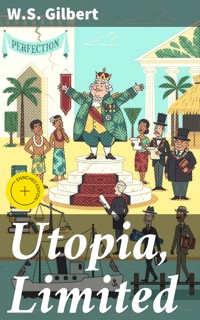
W.S. Gilbert'Äôs 'Utopia, Limited' is a satirical examination of societal norms and governance, cleverly interlaced with musical whimsy characteristic of the Victorian operatic style. This comic operetta, first performed in 1893, is notable for its sharp critique of colonialism and the absurdities of utopian governance. Through a series of humorous and absurd scenarios, Gilbert explores themes of freedom, morality, and the often incongruent aspirations of society versus its realities, all wrapped in his signature wit and clever wordplay. W.S. Gilbert, known for his dynamic partnership with composer Arthur Sullivan, was deeply influenced by the socio-political landscape of Victorian England, which stirred his imagination and critical eye. His earlier works had already begun to unravel pretensions within society, making 'Utopia, Limited' a natural progression in his exploration of the absurdities inherent in both institutions and ideals. Gilbert's background as a prolific playwright and poet undoubtedly fueled his penchant for blending comedy with incisive social commentary. Readers who appreciate sharp satire and insightful humor will find 'Utopia, Limited' an enduring work that remains relevant today. The operetta invites reflection on current societal structures, making it a compelling read for those intrigued by the interplay of comedy and critique. Its clever lyrics and unique perspective encourage audiences to ponder the nature of utopia itself, proving Gilbert's brilliance as a satirist and playwright. In this enriched edition, we have carefully created added value for your reading experience: - A succinct Introduction situates the work's timeless appeal and themes. - The Synopsis outlines the central plot, highlighting key developments without spoiling critical twists. - A detailed Historical Context immerses you in the era's events and influences that shaped the writing. - An Author Biography reveals milestones in the author's life, illuminating the personal insights behind the text. - A thorough Analysis dissects symbols, motifs, and character arcs to unearth underlying meanings. - Reflection questions prompt you to engage personally with the work's messages, connecting them to modern life. - Hand‐picked Memorable Quotes shine a spotlight on moments of literary brilliance. - Interactive footnotes clarify unusual references, historical allusions, and archaic phrases for an effortless, more informed read.
Das E-Book können Sie in Legimi-Apps oder einer beliebigen App lesen, die das folgende Format unterstützen:
Veröffentlichungsjahr: 2021
Ähnliche








Utopia, Limited
Table of Contents
Introduction
A sunlit island tries to perfect itself by importing the habits of a modern empire, only to discover that “improvement” can be its own kind of disorder.
Utopia, Limited is a classic not because it offers an escapist paradise, but because it treats the very idea of paradise as a social experiment subject to law, fashion, and human self-interest. W. S. Gilbert’s comic method—precise, argumentative, and unsentimental—turns political ideals into theatrical action. The work endures for its ability to make systemic questions feel immediate: how institutions shape character, how slogans replace thought, and how reform can be captured by the people meant to benefit from it. Its combination of wit and civic concern has kept it in view for readers of satire and for audiences of comic opera.
The piece was written by W. S. Gilbert, with music by Arthur Sullivan, as part of the celebrated series of Savoy operas that defined their long collaboration. It was first performed in 1893, at a moment when Britain’s public life was crowded with debates about commerce, governance, and the proper reach of “progress.” As a stage work, it belongs to the late Victorian era, yet it looks outward beyond Britain, using a distant setting to reflect back on familiar institutions. That indirectness is central to its artistry: it makes the critique sharper while keeping the tone buoyant and theatrical.
Gilbert’s central premise is straightforward and fertile: the Kingdom of Utopia, an idyllic island realm, decides to reorganize itself on “English” lines by bringing in advisers and adopting contemporary British practices. The story begins after the island’s ruler has already embraced the idea of reform, and the action follows the consequences of applying imported models to local life. Because it is a comic opera, its arguments are carried by character types, public ceremonies, and social misunderstandings rather than by narrative suspense. The interest lies in watching a theoretical program encounter everyday motives—ambition, vanity, loyalty, and the desire to belong.
The “limited” of the title signals one of Gilbert’s characteristic targets: the language of business and administration, which can make moral questions sound like accounting. The operetta uses that language to examine how modern forms—companies, regulations, professional expertise—promise efficiency while also creating new incentives and blind spots. Gilbert’s satire is not aimed only at individuals but at systems: rules that reward the appearance of virtue, structures that turn civic duty into career advancement, and bureaucratic habits that survive even when their purposes are forgotten. The island setting supplies distance, but the mechanisms feel recognizably close to home.
Gilbert’s literary impact rests in part on how he made serious constitutional and economic ideas theatrically legible. His comic writing is tightly engineered: arguments become scenes, and abstract principles are embodied in interactions between rulers, officials, and ordinary people. That skill helped shape English-language musical theatre’s expectation that comedy can carry intellectual weight. Utopia, Limited also demonstrates how satire can be both entertaining and diagnostic, offering not merely ridicule but a map of how institutions misbehave. Later writers and dramatists working in comic satire have drawn on this model of brisk plotting, pointed social observation, and carefully balanced tone.
Another reason the work retains classic status is its treatment of reform as a lived experience rather than a slogan. It refuses the simple opposition of “tradition” versus “modernity” and instead shows how each can borrow from the other, often in unintended ways. The operetta questions whether adopting admired foreign practices ensures justice, and whether good intentions can survive contact with political incentives. Because it is a theatrical piece, it can stage competing voices without turning the whole into a treatise. The result is an enduringly readable, performable argument about governance, legitimacy, and the mismatch between ideals and administration.
The late Victorian period supplied Gilbert with abundant material: expanding corporate life, public institutions that were both proud and self-critical, and a political culture adept at turning values into catchphrases. Utopia, Limited belongs to a tradition that uses imagined lands to test real-world assumptions, yet it avoids mere fantasy. Its targets are not exotic customs but familiar habits given a slight twist, so that the audience can recognize the logic of the joke and the seriousness beneath it. That is one key to its longevity: the satire bites because it is anchored in patterns of behavior that recur across eras.
The collaboration with Sullivan matters to the book’s standing because the work was conceived for performance, where music amplifies irony and sentiment simultaneously. Even when encountered as a libretto on the page, the writing retains a stage-aware momentum: public announcements, ceremonial language, and collective opinion become forces as tangible as any single character. Gilbert’s style is particularly well suited to this form, since he can juxtapose the dignity of official rhetoric with the smallness of private motives in a single exchange. The operetta’s classic reputation owes much to this fusion of theatricality with civic inquiry.
Readers coming to Utopia, Limited as a “book” should remember that its primary medium is dramatic dialogue and lyric verse, designed to be heard as well as read. That does not make its ideas lighter; it makes them faster. The operetta’s humor often depends on precision: definitions, procedures, and titles are treated with a seriousness that exposes their absurdity. Yet the comedy also protects complexity, allowing multiple interpretations of what “improvement” means and who gets to define it. Without revealing outcomes, it is enough to say that the experiment in national redesign becomes a test of whether imported systems can be mastered—or whether they master their adopters.
Its influence can be traced less through direct imitation than through a broader permission it granted to later writers: the permission to be intellectually exacting while being funny, and to treat institutions as characters with appetites of their own. Satirical fiction and theatre after Gilbert frequently adopt his method of making policy personal and making the machinery of state or business visible in everyday speech. Utopia, Limited also contributes to the continuing conversation about the costs of modernization, a theme that has remained central in literature across the twentieth century and beyond. Its classic status reflects this sustained usefulness as a lens for public life.
Today, the operetta’s concerns retain their sharpness: societies still chase models of “best practice,” organizations still rebrand virtue as a product, and public debate still oscillates between principled reform and performative compliance. Utopia, Limited remains appealing because it does not demand cynicism, only attention—attention to how systems reward behavior and how language can disguise power. Its comedy makes the critique approachable, and its form invites repeated encounters, whether read or staged. That combination of theatrical pleasure and clear-eyed social analysis explains why it continues to be read, performed, and recognized as a classic long after its 1893 debut.
Synopsis
Utopia, Limited is W. S. Gilbert’s comic opera libretto (first performed in 1893) written for music by Arthur Sullivan, and it continues the satirical project of the Savoy operas by turning contemporary British institutions into a theatrical thought experiment. The work is framed around an island kingdom, Utopia, whose rulers and courtiers present their state as orderly and enlightened yet remain vulnerable to vanity, fashion, and bureaucratic imitation. From the outset, the narrative sets up a contrast between an idealized self-image and the practical strains of governance, inviting the audience to watch how imported “improvements” can complicate a society’s internal balance.
paragraphs
The early scenes establish Utopia’s court and its ceremonial life, introducing a young princess who has been educated in England and now returns home carrying strong admiration for British public life. Her perspective becomes a catalyst for change, because she is convinced that Utopia’s institutions can be made more modern, efficient, and reputable by adopting British models. The king and his advisers, for their part, are attracted to any plan that promises prestige and stability, even when they do not fully grasp the details. Gilbert uses this setup to pose a central question: what happens when a nation attempts to legislate virtue and success by copying another country’s systems wholesale?
paragraphs
To put these ideas into motion, the princess brings with her a group of English “Flowers of Progress,” representatives of various respectable professions and civic roles. Their presence supplies both practical guidance and satirical contrast, as they embody the self-confidence of Victorian institutional culture while also appearing as outsiders in a different political and social environment. Through their interactions with Utopian officials, the opera stages debates about law, administration, and public morality without turning into a treatise; it remains driven by character motives, court rivalries, and the lure of fashionable reform. The narrative momentum comes from the court’s decision to invite these figures into the machinery of the state.
paragraphs
As reform proposals take shape, Utopia begins to reorganize aspects of its governance along lines associated with British constitutional and commercial life. The changes are presented as orderly improvements meant to secure the monarch’s position, strengthen public confidence, and bring international respect. Yet Gilbert’s satire points to the ambiguity of “progress,” showing that even well-intentioned administrative devices can produce new incentives and new conflicts. The English advisers encourage systems that depend on competition, publicity, and procedural regularity, while Utopian leaders hope the same systems will deliver harmony without friction. The story therefore foregrounds the tension between ideals and incentives, and between imported rules and local custom.
paragraphs
Alongside institutional reform, the opera maintains a continuous thread of personal and social complications within the court. Questions of rank, marriageability, and courtly favor shape how characters respond to the proposed changes, since modernized institutions threaten established privileges as much as they promise collective gain. Gilbert balances the political plot with a romantic and domestic undercurrent, using courtship and family expectations to show how public policy and private interest intertwine. The English presence also alters social dynamics, because their categories of respectability and expertise implicitly judge Utopian traditions. As a result, the reforms become not only administrative but cultural, challenging the court’s identity as much as its procedures and titles.
Historical Context
Utopia, Limited (1893) was written for the late-Victorian British stage, when London theatre was a major commercial and cultural institution and when political debate over empire, class, and economic policy saturated newspapers and public life. The operetta’s imaginary South Pacific kingdom, “Utopia,” is framed by British constitutional ideas and by the prestige of British expertise in law, finance, the military, and the civil service. That framing reflects a period in which Britain possessed a vast empire, celebrated its institutions as models for others, and simultaneously worried about the social strains produced by industrial capitalism and mass politics.
The work belongs to the long-running collaboration between librettist W. S. Gilbert and composer Arthur Sullivan, whose “Savoy Operas” were produced under impresario Richard D’Oyly Carte. From the mid-1870s through the 1890s, these operas became staples of middle-class entertainment, blending topical satire with accessible music and comparatively “respectable” staging. Utopia, Limited premiered in London in 1893 at the Savoy Theatre, a venue associated with modern production values and with an audience attentive to current affairs. Gilbert’s method was to dramatize contemporary institutions through caricature rather than through direct party politics.
Gilbert himself had matured as a writer during decades of social and legal change. Born in 1836, he lived through the expansion of the franchise, the growth of the popular press, and the transformation of the British economy into a finance- and service-heavy system alongside manufacturing. Trained in law and called to the bar, he drew repeatedly on legal and bureaucratic procedures for comic effect. In Utopia, Limited, the importation of “official” British expertise into an overseas kingdom uses that familiarity to question the self-confidence of Victorian governance, especially when applied as a universal template.
The operetta’s central conceit—exporting British “institutions” to an ostensibly dependent or emulative polity—echoes common assumptions of imperial ideology. In the late nineteenth century, British officials and commentators often presented parliamentary government, common-law procedures, and professional administration as hallmarks of “civilization.” At the same time, Britain ruled many territories through varied arrangements: settler colonies with responsible government, crown colonies with appointed officials, and protectorates with indirect control. Gilbert’s satire draws power from this diversity, exposing the gap between idealized institutional rhetoric and the messy realities of power, local conditions, and self-interest.
Imperial politics were especially salient in the early 1890s. The period followed the formal consolidation of British control in several regions during the “Scramble for Africa,” and it coincided with intensifying public discussion about the costs and benefits of empire. While Utopia, Limited does not dramatize specific wars or treaties, it plays on the assumption that distant islands and “native” monarchies could be reformed—or remade—by importing British models. The operetta’s comedic distance from real colonies mirrors how popular culture often treated imperial spaces as stages for experimenting with British identity rather than as communities with their own histories.
The narrative’s emphasis on constitutional monarchy and ministers reflects the actual constitutional settlement that structured British politics. By the 1890s, Britain’s monarch reigned within constraints set by cabinet government and parliamentary confidence, while political parties competed to form ministries. The era’s debates focused less on monarchic authority than on how representative institutions should adapt to a broader electorate and new social demands. Gilbert’s Utopian court adopting British-style state machinery echoes Victorian belief in the stability of the constitutional model, but the operetta’s humor also points to how procedure can become an end in itself.
Franchise expansion was a defining political movement behind the period’s self-image of progress. Britain’s Reform Acts of 1867 and 1884, together with the Redistribution of Seats Act of 1885, broadened male voting rights and reshaped constituencies, strengthening mass politics. This did not create universal suffrage, but it did enlarge the electorate and increase pressure on parties to court working- and lower-middle-class voters. Utopia, Limited reflects a political world increasingly attentive to “public opinion,” where governing required managing numbers and narratives. Its satire of officialdom resonates with anxieties about whether expanded participation produced wiser governance or merely new forms of manipulation.
The operetta’s attention to “company” organization and limited liability connects directly to nineteenth-century economic transformation. Britain’s Companies Act of 1862 consolidated earlier measures and helped normalize incorporation with limited liability, enabling investors to risk capital without unlimited personal responsibility. This facilitated expansion in banking, railways, manufacturing, and overseas ventures, while also provoking concern about speculation, fraud, and moral hazard. The title Utopia, Limited itself invokes this corporate logic, treating a state as if it were a modern enterprise. Gilbert’s critique draws on contemporary debates about whether corporate forms promoted prosperity or undermined older ideals of duty and accountability.
Related to the corporate theme was the prominence of finance and the City of London in late-Victorian life. Britain’s economy relied heavily on global trade, shipping, insurance, and investment, and the language of dividends and balance sheets entered everyday discourse. Economic cycles and financial scandals kept the public aware that “success” could be engineered through paper transactions as much as through production. Gilbert’s operetta uses the absurdity of national administration reduced to commercial calculations to reflect this shift. By presenting institutional reform as a managerial “scheme,” it echoes a society negotiating the boundaries between public service and private profit.
Civil service reform and the rise of professional administration also form an important background. Following the Northcote–Trevelyan Report of 1854, competitive examinations and merit-based recruitment gradually replaced patronage in many areas of the British civil service. By the late nineteenth century, the idea of an efficient, impartial bureaucracy staffed by trained experts had become a point of national pride. Utopia, Limited plays on that pride by depicting “official” competence as portable and automatically beneficial. The satire, however, also touches a Victorian concern: that bureaucratic rationality could become rigid, self-protective, and detached from human consequences.
Legal culture, another key Victorian institution, appears in Gilbert’s broader oeuvre and informs Utopia, Limited’s tone. Nineteenth-century Britain saw extensive codification and procedural modernization in certain areas, alongside enduring reliance on common-law traditions and the prestige of the courts. The public followed notable cases through newspapers, and the legal profession carried social authority. Gilbert, with legal training, could mimic legalistic language and expose how it can obscure ethical questions. In the operetta, formal rules and offices become objects of comedy, reflecting a society both impressed by legality and wary of legalism as performance.
Industrial and technological developments shaped the operetta’s world even when not explicitly staged. By the 1890s, Britain had long been connected by railways and telegraphs, and urban life depended on complex systems of transport, communications, and mass production. The Savoy Theatre itself was associated with modernity; it became famous earlier for early adoption of electric lighting, emblematic of the era’s fascination with technological progress. Such progress contributed to the belief that systems could be engineered—whether machines, companies, or governments. Utopia, Limited’s institutional “upgrade” premise mirrors that managerial faith in design and efficiency.
The operetta also reflects Victorian gender norms and debates, though it does so within the conventions of comic opera rather than programmatic advocacy. The late nineteenth century saw organized campaigns for women’s suffrage and expanded educational and professional opportunities, alongside persistent legal and social constraints. Middle-class ideals of respectability and domesticity remained influential even as “New Woman” discourse attracted attention in the press and literature. Gilbert’s stage worlds often satirized manners, courtship, and social role-playing. In Utopia, Limited, the public performance of propriety and rank echoes a society negotiating changing gender expectations within a still-hierarchical moral framework.
Religion and established institutions formed another layer of Victorian public life. The Church of England retained formal establishment, but the century featured significant religious diversity and debate, including Nonconformist political influence and controversies about science, biblical criticism, and education. Moral rhetoric often accompanied arguments about governance, imperial mission, and social reform. Gilbert’s satire is typically less theological than institutional: it mocks the ways official piety and moral language can become part of public performance. Utopia, Limited’s treatment of “model” institutions draws on a culture accustomed to justifying policy through claims of moral and civilizational superiority.
Class structure and social mobility were central to the audience’s lived experience. Late-Victorian Britain was marked by stark inequalities alongside expanding clerical and professional employment and a self-conscious middle class. Debates over labor organization, wages, and social welfare intensified, and trade unions had become significant political actors by the end of the century. While Utopia, Limited is not a labor drama, its humor about offices, titles, and professional expertise reflects the period’s obsession with status and credentials. The operetta’s portrayal of institutional importation also mirrors how class authority was reproduced through education, manners, and “proper” administration.
Party politics and the Irish question were among the most divisive issues of the 1880s and early 1890s. Disputes over Irish Home Rule split the Liberal Party in 1886 and continued to dominate parliamentary contests, shaping coalitions and public rhetoric about constitutional integrity. Although Utopia, Limited avoids direct treatment of Ireland, its preoccupation with constitutional arrangements and with the exportability of British political forms resonates with a Britain wrestling over the limits of the union and the meaning of self-government. Gilbert’s oblique approach suited comic opera, where topicality was safer when refracted through allegory.
Cultural life in the 1890s was also characterized by a sophisticated press and a taste for satire. Mass-circulation newspapers and periodicals amplified political debate and created shared references for theatre audiences. Comic opera, operetta, and musical theatre competed with other entertainments but remained a prominent forum for commenting on public life without the solemnity of parliamentary speech. Gilbert’s wit relied on audiences recognizing institutional jargon and contemporary fashions in management and reform. Utopia, Limited’s comedy thus draws strength from a media environment in which bureaucratic and financial language had become common public currency, ripe for parody and critique.




