


1,99 €
Niedrigster Preis in 30 Tagen: 1,99 €
Niedrigster Preis in 30 Tagen: 1,99 €
Mehr erfahren.
- Herausgeber: DigiCat
- Kategorie: Poesie und Drama
- Sprache: Englisch
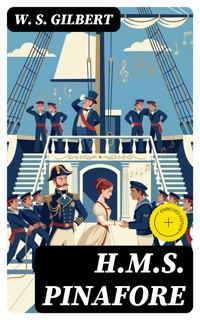
H.M.S. Pinafore, penned by W. S. Gilbert and first performed in 1878, is a brilliantly orchestrated comic operetta that satirizes the British class system and naval traditions of the time. Utilizing Gilbert's signature wit, the narrative unfolds aboard the titular ship and revolves around the romantic entanglements of a captain's daughter and a lowly sailor, interspersed with sharp commentary on social status and political pretensions. Gilbert's ingenious use of rhymed couplets and clever dialogue intertwines humor with musicality, creating an engaging performance that remains relevant in its critique of societal norms. W. S. Gilbert was not only a prolific playwright but also a prominent figure in the Victorian theatre scene, known for his collaborations with composer Arthur Sullivan. His experiences in law and theater deeply informed his work, allowing him to craft narratives that challenged hypocrisy and celebrated the absurdities of human behavior. Gilbert's own social awareness and artistic ambitions led him to create Pinafore, a work that epitomizes his unique blend of lightheartedness and incisive social commentary. Recommended for both theatre enthusiasts and literary scholars, H.M.S. Pinafore offers an enduring exploration of class and identity wrapped in a delightful blend of humor and melody. Its timeless themes and engaging characters make it a must-read, or better yet, a must-see for anyone interested in the evolution of musical theatre and satirical literature. In this enriched edition, we have carefully created added value for your reading experience: - A succinct Introduction situates the work's timeless appeal and themes. - The Synopsis outlines the central plot, highlighting key developments without spoiling critical twists. - A detailed Historical Context immerses you in the era's events and influences that shaped the writing. - A thorough Analysis dissects symbols, motifs, and character arcs to unearth underlying meanings. - Reflection questions prompt you to engage personally with the work's messages, connecting them to modern life. - Hand‐picked Memorable Quotes shine a spotlight on moments of literary brilliance. - Interactive footnotes clarify unusual references, historical allusions, and archaic phrases for an effortless, more informed read.
Das E-Book können Sie in Legimi-Apps oder einer beliebigen App lesen, die das folgende Format unterstützen:
Veröffentlichungsjahr: 2022
Ähnliche



















H.M.S. Pinafore
Table of Contents
Introduction
H.M.S. Pinafore delights in the comic collision between duty and desire, exposing how rank and reputation can founder on the shoals of human feeling. From its opening moments, the work invites readers to savor the absurdities that arise when rigid social codes confront the unpredictable tides of personal affection. The tension between what characters owe to their uniforms, offices, and reputations, and what they owe to themselves, supplies a buoyant engine for satire. That conflict remains both playful and pointed, a source of melody and mischief rather than bitterness. As an introduction to Gilbert and Sullivan’s world, it shows how laughter can pry loose the bolts of convention.
A comic opera with libretto by W. S. Gilbert and music by Arthur Sullivan, H.M.S. Pinafore premiered in London in 1878, during the Victorian era. The setting is a Royal Navy ship moored at Portsmouth, a compact world where lines of authority are visible in every ritual and response. The genre mixes sparkling dialogue with tightly rhymed lyrics and ensemble numbers, designed for clarity, speed, and wit. Even on the page, the piece carries musical lift and theatrical precision. Readers encounter a lean, efficient dramatic machine whose scenes and choruses advance with seaworthy regularity, keeping satire and sentiment in lively balance.
The premise is simple and fertile: aboard the ship, a dutiful captain oversees his crew as a high-ranking government figure pays a ceremonious visit, while a tender attachment emerges that challenges the strict allotments of class. The cast’s crosscurrents of admiration, ambition, and obedience generate misunderstandings, pledges, and comic indignation. The chorus functions as a bright, collective voice that frames private dilemmas in public terms. Reading the libretto offers brisk movement from dialogue to song cues, with verbal rhythms that seem to sound themselves. The tone stays jaunty even as it jabs at institutional pomposity, ensuring that barbs are cushioned by grace and good humor.
Gilbert’s style here is a model of satiric economy. He favors crisp diction, topsy-turvy logic, and playful literalism, creating lines that pivot on a single word or social nicety. Rapid patterns of repetition and escalation build momentum without exhausting the joke, while stage directions sketch a choreography of order that characters diligently uphold or inadvertently subvert. Sullivan’s contribution, though not present on the printed page, is legible in the pacing and structure of the scenes, which anticipate ensemble interplay and quicksilver exchanges. Together, the collaborators shape a voice at once decorous and destabilizing, bending official language until it reveals its own contradictions.
Key themes gather around hierarchy and the question of merit. The opera tests whether birth and office deserve the reverence they claim, and whether affection or competence can unsettle entrenched precedence. It scrutinizes patriotism as both sincere feeling and theatrical performance, noting how public ritual can mask private insecurity. It also examines the responsibilities of leadership and the comfort of following rules, showing how both can drift into absurdity when detached from human sense. Without breaking the buoyant tone, the work asks what fairness looks like within a system that ranks people by accident of position rather than by character or ability.
For contemporary readers, the satire retains bite because its targets endure: bureaucracy that talks past common sense, class markers that masquerade as virtue, and public figures who confuse visibility with wisdom. The piece demonstrates how comedy can interrogate power without sourness, inviting audiences to notice how institutions rely on role-playing as much as on principle. Its language still crackles, and its ensemble dynamics model a community negotiating rules, roles, and desires in real time. In a cultural moment attuned to status, performance, and accountability, the opera’s cheerful insistence on looking beneath surfaces remains bracing and timely.
Approached on the page, H.M.S. Pinafore rewards readers who imagine the stage pictures and let the rhythms guide the eye. Attending to the chorus as a civic character, and to the measured entrances of authority figures, clarifies how the drama tests and teases official order. The libretto’s clarity makes it accessible even without musical notation, and its verbal music invites reading aloud. It is not merely a relic of Victorian entertainment but a deft instrument for thinking about rank, responsibility, and the stubborn independence of feeling. The ship may be moored, yet the ideas aboard it continue to travel widely.
Synopsis
H.M.S. Pinafore is an 1878 comic opera with libretto by W. S. Gilbert and music by Arthur Sullivan, premiered at the Opera Comique in London. Set on the quarterdeck of a Royal Navy ship anchored at Portsmouth, it combines brisk melody with pointed satire of class and bureaucracy. Captain Corcoran presides amiably over crew and visitors, while his daughter Josephine attracts admiration beyond her social rank. Among the sailors is Ralph Rackstraw, honorable and ardent, and among the ship’s vendors is Little Buttercup, whose genial manner hints at concealed knowledge. Sir Joseph Porter, the First Lord of the Admiralty, looms as an emblem of rank.
Early scenes establish the shipboard community’s routines and loyalties. The crew express contentment under Corcoran’s courteous command, while Buttercup flirts lightly and shadows her cheer with vague allusions to a past that may matter. Ralph privately acknowledges a deep love for Josephine, yet understands the barrier posed by his humble station. Josephine, aware of his devotion, presents a dutiful exterior, mindful of expectations that she accept a socially advantageous match. The captain speaks with paternal pride of prospects for his daughter, unaware of the tension he presides over, and the deck becomes a stage where affection and hierarchy begin to collide.
Sir Joseph Porter arrives in resplendent pomp, trailed by a retinue that underscores his office and foibles. He advances a genial creed that officers must treat sailors with scrupulous politeness, a doctrine that, however comic, subtly undermines rigid barriers of rank. His presence thrills the crew and preoccupies the captain, who contemplates an alliance that would elevate Josephine. Encouraged by the atmosphere of stated equality, Ralph resolves to voice his affection openly. His messmates rally him with camaraderie, though the sardonic Dick Deadeye warns of consequences when love disregards station. The deck’s gaiety now frames a real test of resolve.
Josephine’s inner struggle takes center stage as public expectation collides with private feeling. The captain gently urges her toward the prestigious match that would please the Admiralty, while Sir Joseph, brimming with confidence, assumes her assent. Alone, she weighs security, duty, and the intoxicating appeal of genuine affection, knowing that choosing a sailor would defy the order to which she has been bred. When she and Ralph meet, confession becomes inevitable; a mutual pledge emerges that gives shape to their hopes. The comic surface remains lively, yet the stakes are clarified: love and hierarchy cannot both prevail unchanged aboard this ship.




