


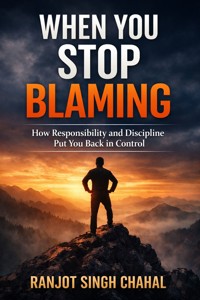
When You Stop Blaming: How Responsibility and Discipline Put You Back in Control E-Book
Ranjot Singh Chahal
3,99 €
Mehr erfahren.
- Herausgeber: Rana Books India
- Kategorie: Ratgeber
- Sprache: Englisch
Most people don’t fail because they lack talent, intelligence, or opportunity.
They fail because they give away their power—slowly, quietly—by blaming everything outside themselves.
Blaming circumstances.
Blaming people.
Blaming luck, timing, childhood, the system, or the world.
This book is about what happens when you stop.
When You Stop Blaming is a practical, mindset-shifting guide to reclaiming control over your life through responsibility, discipline, and intentional action. It doesn’t offer motivation that fades in a week or shortcuts that don’t work. Instead, it shows you how real change actually happens—through small choices, daily discipline, and the courage to face discomfort.
Inside this book, you’ll learn:
Why taking responsibility is not a burden, but the fastest path to freedom
How small, consistent actions compound into massive life changes
Why comfort keeps you stuck and how strategic discomfort builds strength
How your habits, reactions, and beliefs quietly shape your results
How to stop waiting for motivation and start creating momentum
This book isn’t about perfection. It’s about ownership.
It’s about understanding that while you can’t control everything that happens to you, you can control how you respond—and that response changes everything.
If you’re tired of feeling stuck, frustrated, or powerless…
If you’re ready to stop making excuses and start making progress…
If you want clarity, discipline, and control over your own life again…
This book is your turning point.
Because the moment you stop blaming is the moment you take your power back.
Das E-Book können Sie in Legimi-Apps oder einer beliebigen App lesen, die das folgende Format unterstützen:
Veröffentlichungsjahr: 2025
Ähnliche












Ranjot Singh Chahal
When You Stop Blaming
How Responsibility and Discipline Put You Back in Control
First published by Rana Books (India) 2025
Copyright © 2025 by Ranjot Singh Chahal
All rights reserved. No part of this publication may be reproduced, stored or transmitted in any form or by any means, electronic, mechanical, photocopying, recording, scanning, or otherwise without written permission from the publisher. It is illegal to copy this book, post it to a website, or distribute it by any other means without permission.
First edition
Contents
Introduction
Chapter 1: The Power of Radical Ownership
Chapter 2: The Compound Effect of Small Actions
Chapter 3: The Art of Strategic Discomfort
Chapter 4: The Mirror Principle
Chapter 5: The Freedom of Letting Go
Chapter 6: The Power of Present Awareness
Introduction
The Day You Take Your Power Back
There comes a moment in every life when blaming stops working.
Not because the excuses disappear.
Not because the circumstances suddenly improve.
But because, deep down, you realize something uncomfortable:
Blame hasn’t protected you.
It hasn’t fixed anything.
And it hasn’t moved your life forward.
Maybe you’ve blamed your past—how you were raised, what you were given, or what you were denied.
Maybe you’ve blamed people—your boss, your partner, your family, society, or the system.
Maybe you’ve blamed timing, luck, stress, or bad breaks.
And maybe some of that blame is justified.
But here’s the truth most people never want to face:
Even when blame is understandable, it’s still expensive.
It costs you control.
It costs you momentum.
And eventually, it costs you years of your life.
This book is not here to judge you for blaming.
Blaming is human. It’s a defense mechanism. It protects the ego and softens disappointment.
But it also quietly hands over your power.
Because the moment you decide that something outside you is the reason your life isn’t working, you also decide that change is outside your control.
And that’s the real trap.
The most dangerous thing about blame isn’t that it’s wrong.
It’s that it feels right—while keeping you stuck.
Responsibility, on the other hand, feels heavy at first.
It forces you to look in the mirror.
It removes excuses.
It demands action.
But responsibility gives you something blame never can: control.
When you take responsibility, you stop waiting for circumstances to change.
You stop waiting for people to understand you.
You stop waiting for motivation, permission, or the perfect moment.
You start moving.
This book is about that shift—the moment you stop asking “Why is this happening to me?” and start asking “What am I going to do about it?”
It’s about discipline—not as punishment, but as self-respect.
It’s about discomfort—not as suffering, but as growth.
And it’s about freedom—not as ease, but as capability.
You don’t need a new personality.
You don’t need perfect habits.
You don’t need to fix your entire life overnight.
You only need to take back ownership of where you are—and decide where you’re going next.
That decision changes everything.
And it starts here.
Chapter 1: The Power of Radical Ownership
The alarm clock screams at 6 AM. You hit snooze. Again. And again. Finally, at 7:15, you jolt awake, realizing you’re late. You rush through your morning, skip breakfast, and arrive at work frazzled. Your boss makes a comment. Traffic was terrible. Your partner didn’t wake you up. The alarm didn’t work properly. Your phone died. The list of reasons why your morning went wrong grows longer by the minute.
But here’s the uncomfortable truth: every single thing that happened was a result of choices you made. Not waking up when the alarm went off was a choice. Not preparing your things the night before was a choice. Not going to bed earlier was a choice. And blaming everything and everyone else? That’s the biggest choice of all.
This is where most people live their entire lives—in a prison of their own making, built brick by brick with excuses, justifications, and finger-pointing. They are passengers in their own existence, blown about by winds they claim they cannot control. But there is another way. There is a key that unlocks every door, a principle so powerful that it can transform your entire life. It’s called radical ownership.
The Weight of Blame
Think about the last time something went wrong in your life. Maybe it was a failed relationship, a missed opportunity, a financial setback, or a goal you didn’t achieve. Now, think about what you told yourself about why it happened. If you’re like most people, your explanation probably sounded something like this:
“I would have gotten that promotion, but my boss doesn’t like me.” “I would be in better shape, but I don’t have time to work out.” “I would have started that business, but the economy is bad.” “I would be happier, but my childhood was difficult.”
Notice the pattern? Every one of these statements has a “but.” And everything that comes after that “but” is an excuse—a reason why you’re not responsible, why it’s not your fault, why you’re the victim of circumstances beyond your control.
Here’s what’s fascinating: these excuses might even be true. Maybe your boss really doesn’t like you. Maybe you genuinely are busy. Maybe the economy is challenging. Maybe your childhood was difficult. But here’s the question that changes everything: So what?
The truth is, blame feels good in the moment. It feels satisfying to point at something outside yourself and say, “That’s why I’m not where I want to be.” It releases you from the burden of responsibility. It means you don’t have to do the hard work of changing. But blame is a comfortable poison. It might make you feel better temporarily, but it slowly kills your power.
Every time you blame someone or something else for your situation, you give away your power. You essentially say, “I am not in control. I am not capable. I am at the mercy of forces beyond me.” And when you give away your power, you give away your ability to change anything.
The Liberation of Ownership
Now imagine the opposite approach. Imagine looking at that same failed relationship, missed opportunity, financial setback, or unachieved goal, and instead of asking “Whose fault is this?” you asked “What was my part in this? What could I have done differently? What can I learn? What will I do next time?”
This is radical ownership. It’s the decision to take complete responsibility for everything in your life—not because everything is literally your fault, but because taking ownership is the only way to have power over your life.
When you own something, you can change it. When you blame something external, you’re powerless. It’s that simple.
Let me share a story that illustrates this principle. Sarah was a marketing manager at a mid-sized company. For three years, she watched as others got promoted while she stayed in the same position. She was bitter. She complained to her friends that the company played favorites, that her boss was sexist, that the people getting promoted were less qualified but better at office politics.
Everything Sarah said might have had elements of truth. But Sarah was miserable, stuck, and powerless because she had placed all the responsibility for her situation outside herself.




