


1,49 €
Mehr erfahren.
- Herausgeber: Diamond Book Publishing
- Sprache: Englisch
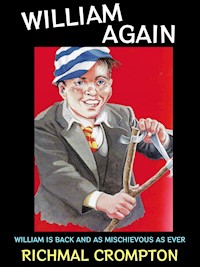
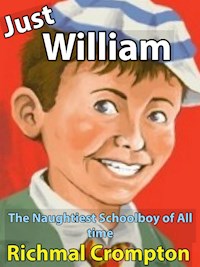
In Richmal Compton's William Again William and his mate Ginger have to endure bankruptcy – they don't even have enough money for sweets. Then William comes up with what he thinks is a fantastic idea! William Again is the third set of stories featuring the endearing and mischievous William Brown; a much-loved character whose adventures have become children's classics. With an introduction by author and comedian Louise Rennison, this funny and endearing collection of fourteen brilliant Just William stories has an engaging contemporary cover look illustrated by Chris Garbutt along with the original inside illustrations of Thomas Henry. There is only one William. This tousle-headed, snub-nosed, hearty, loveable imp of mischief has been harassing his unfortunate family and delighting his hundreds of thousands of admirers since 1922.
Das E-Book können Sie in Legimi-Apps oder einer beliebigen App lesen, die das folgende Format unterstützen:
Veröffentlichungsjahr: 2021
Ähnliche














Richmal Crompton
William Again Preview
William is Back and as Mischievous as Ever
Table of contents
CHAPTER I. WHAT DELAYED THE GREAT MAN
By
Richmal Crompton
Table of Contents
CHAPTER I. WHAT DELAYED THE GREAT MAN
CHAPTER II. THE CURE
CHAPTER III. THAT BOY
CHAPTER IV. WILLIAM THE REFORMER
CHAPTER V. NOT MUCH
CHAPTER VI. WILLIAM AND THE WHITE CAT
CHAPTER VII. WILLIAM'S SECRET SOCIETY
CHAPTER VIII. THE NATIVE PROTÉGÉ
CHAPTER IX. JUST WILLIAM'S LUCK
CHAPTER X. THE GREAT DETECTIVE
CHAPTER XI. THE CIRCUS
CHAPTER XII. WILLIAM SELLS THE TWINS
CHAPTER XIII. WILLIAM'S HELPING HAND
CHAPTER XIV. WILLIAM GETS WRECKED
CHAPTER I. WHAT DELAYED THE GREAT MAN
William, taking his character as a whole, was not of the artistic genre. He had none of the shrinking sensitiveness and delicate imaginativeness of the true artist. But the fact remains that this summer he was impelled by some inner prompting to write a play.
The idea had been growing in his mind for some time. He had seen plays acted by the village amateur dramatic society which was famous more for a touching reliance on the prompter than for any real histrionic talent.
William had considered them perfect. He had decided, after their last performance, to go on the stage. But none of his friends could inform him of the preliminary steps necessary for getting on the stage. It is true that the man in the boot-shop, whose second cousin was a scene-shifter in a provincial music-hall, had promised to use his influence, but when William was told the next week that the second cousin had been dismissed for appearing in a state of undeniable intoxication and insisting on accompanying the heroine on to the stage, he felt that all hopes from that direction must be abandoned. It was then that he had the brilliant idea. He would write a play himself and act in that.
William had great confidence in his own powers. He had no doubts whatever of his ability to write a play and act in it. If he couldn't go on the stage he'd go on a stage. Surely no one could object to that. All he'd want would be some paper and ink and a few clothes. Surely his family—bent as they always were on clouding his moments of purest happiness—couldn't object to that?
"Jus' ink an' paper an' a few ole clothes," he said wistfully to his mother.
She eyed him with a mistrust that was less the result of a suspicious nature than of eleven years' experience of her younger son.
"Won't pencil do?" she said.
"Pencil!" he said scornfully. "Did—did Shakespeare or—or the man wot wrote 'The Red Gang'—well, did they write in pencil?"
Mrs. Brown, having no knowledge of the subject, shifted her point of attack.
"What sort of clothes will you want?" she said.
"Oh—jus' clothes," said William vaguely.
"Yes, but what sort?"
"How can I tell," said William irritably, "till I've wrote the play?"
William's family long remembered the silence and peace that marked the next few afternoons. During them, William, outstretched upon the floor of the summer-house, wrote his play with liberal application of ink over his person and clothes and the surrounding woodwork. William was not of that class of authors who neglect the needs of the body. After every few words he took a deep draught from a bottle of Orange Ale that stood on his right and a bite from an ink-coated apple on his left. He had laid in a store of apples and sweets and chocolates under the seat of the summer-house for his term of authorship. Every now and then he raised a hand to his frowning brow in thought, leaving upon it yet another imprint of his ink-sodden fingers.
"Where is he?" said his father in hushed wonder at the unwonted peace.
"He's in the summer-house writing a play," said his wife.
"I hope it's a nice long one," said her husband.
William had assembled his caste and assigned them their parts. Little Molly Carter was to be the heroine, Ginger the hero, Henry the hero's friend, Douglas a crowd of outlaws, William himself was to be the villain, stage-manager and prompter. He handed them their parts with a lofty frown. The parts were in a grimy exercise book.
"It's all wrote out," he said. "You jus' learn it where it says your names. Molly's Lady Elsabina——"
"Elsabina isn't a name I've ever heard," said that lady pertly.
"I didn't say it was, did I?" said William coldly. "I shu'n't be surprised if there was lots of names you'd never heard of. An' Ginger is Sir Rufus Archibald Green an' Henry is the Hon. Lord Leopold, an' I'm Carlo Rupino, a villain. All you've gotter do is to learn your parts an' Wednesday morning we'll go through it jus' to practise it, an' Wednesday afternoon we'll do it."
"We can't three learn out of one book," said the leading lady, who was inclined to make objections.
"Yes, you can," said William. "You can take turns sitting in the middle."
Lady Elsabina sniffed.
"And such writing!" she said scornfully.
"Well, I don't count on my fingers," said William, returning scorn for scorn, "not so's everyone can see me, at any rate."
At which public allusion to her arithmetical powers, Lady Elsabina took refuge in another sniff, followed by a haughty silence.
The rehearsal was not an unqualified success. The heroine, as is the way of heroines, got out of bed the wrong side. After a stirring domestic scene, during which she bit her nurse and flung a basin of bread and milk upon the floor, she arrived tearful and indignant and half an hour late at the rehearsal.
"Can't you come a bit later?" said the stage-manager bitterly.
"If you're going to be nasty to me," returned the heroine stormily, "I'm going back home."
"All right," muttered the stage-manager, cowed, like most stage-managers, by the threatening of tears.
The first item on the agenda was the question of the wardrobe. William had received an unpleasant surprise which considerably lowered his faith in human nature generally. On paying a quiet and entirely informal visit to his sister's bedroom in her absence, to collect some articles of festive female attire for his heroine, he had found every drawer, and even the wardrobe, locked. His sister had kept herself informed of the date of the performance, and had taken measures accordingly. He had collected only a crochet-edged towel, one of the short lace curtains from the window, and a drawn-thread work toilet-cover. Otherwise his search was barren. Passing through the kitchen, however, he found one of her silk petticoats on a clothes-horse and added it to his plunder. He found various other articles in other parts of the house. The dressing up took place in an outhouse that had once been a stable at the back of William's house. The heroine's dress consisted of Ethel's silk petticoat with holes cut for the arms. The lace curtain formed an effective head-dress, and the toilet-cover pinned on to the end of the petticoat made a handsome train.




