


0,49 €
Niedrigster Preis in 30 Tagen: 1,99 €
Niedrigster Preis in 30 Tagen: 1,99 €
Mehr erfahren.
- Herausgeber: Booksell-Verlag
- Kategorie: Poesie und Drama
- Sprache: Englisch
In "A Calendar of Sonnets," Helen Hunt Jackson masterfully weaves together the intricacies of nature, human emotion, and the passage of time, encapsulated within the formal structure of the sonnet. Each poem not only marks a month of the year but also explores universal themes such as love, loss, and renewal, showcasing Jackson's lyrical prowess. Her work embodies the Romantic tradition while also delving into the emerging trends of the American literary scene, reflecting the cultural shifts of her era through poignant imagery and emotional depth. This collection, characterized by its vivid depictions and philosophical musings, stands as a testament to Jackson's belief in the interconnectedness of natural cycles and human experiences. Helen Hunt Jackson, a prominent figure in American literature and women's rights activism of the late 19th century, drew inspiration from her own experiences of grief and social justice. Her deep empathy for Indigenous peoples, combined with her literary ambitions, propelled her to use poetry as a platform for social commentary. "A Calendar of Sonnets" is both a celebration of nature's beauty and an exploration of the human condition, underscoring her commitment to infusing literature with ethical responsibility. Readers seeking a profound exploration of nature and emotion will find solace and insight in Jackson's eloquent verses. This collection is particularly recommended for those who appreciate the sonnet form and wish to engage with the spiritual and temporal aspects of life. Jackson's unique voice not only enchants but also challenges readers to reflect on their own connections with the world around them. In this enriched edition, we have carefully created added value for your reading experience: - A comprehensive Introduction outlines these selected works' unifying features, themes, or stylistic evolutions. - A Historical Context section situates the works in their broader era—social currents, cultural trends, and key events that underpin their creation. - A concise Synopsis (Selection) offers an accessible overview of the included texts, helping readers navigate plotlines and main ideas without revealing critical twists. - A unified Analysis examines recurring motifs and stylistic hallmarks across the collection, tying the stories together while spotlighting the different work's strengths. - Reflection questions inspire deeper contemplation of the author's overarching message, inviting readers to draw connections among different texts and relate them to modern contexts. - Lastly, our hand‐picked Memorable Quotes distill pivotal lines and turning points, serving as touchstones for the collection's central themes.
Das E-Book können Sie in Legimi-Apps oder einer beliebigen App lesen, die das folgende Format unterstützen:
Veröffentlichungsjahr: 2019
Ähnliche




















A Calendar of Sonnets
Table of Contents
Introduction
This volume presents A Calendar of Sonnets by Helen Hunt Jackson as a unified, complete poetic sequence. Conceived as a cycle that traces the year's passage, the work invites readers to move month by month through a sustained meditation on time, nature, and feeling. The purpose of this collection is straightforward: to offer the entire sequence in its intended order and integrity, allowing the structure and cumulative resonance of the poems to be fully felt. By gathering the sonnets together, the edition emphasizes their interdependence, the subtle echoes among them, and the overarching design that transforms individual lyrics into a coherent whole.
At heart, this is a book of poems, and more precisely a sonnet cycle. Each poem adopts the disciplined, fourteen-line form and stands as a self-contained lyric while participating in the larger calendar design. The text does not include narrative prose, essays, or letters; its focus is singularly poetic. Readers encounter sonnets titled for the months, each bringing distinct seasonal atmospheres and moods. The choice of the sonnet, a form traditionally associated with concentrated thought and feeling, suits Jackson's purpose, shaping compressed reflections that balance description, meditation, and cadence. The result is a unified lyric experience rather than a miscellany.
The unifying themes across the sequence include the cyclical nature of time, the interplay of outer season and inner sensibility, and the quiet drama of change, renewal, and decline. Jackson's sonnets attend closely to weather, light, and landscape as mirrors and measures of thought. Personification, apostrophe, and sensuous imagery bring months to life without overt narrative, while the tone ranges from crisp, bracing clarity to mellow introspection. As a whole, the cycle remains significant for the way it harnesses a classical form to chart a year's arc, revealing continuity within variety and finding in recurring rhythms a language for constancy and flux.
Helen Hunt Jackson was a prominent American poet and prose writer of the nineteenth century, and this sequence exemplifies her lyric craft. While she wrote across genres, including fiction and nonfiction, A Calendar of Sonnets belongs squarely to her poetic achievement. Its concentration, musicality, and poised observation align with the era's interest in nature-inflected reflection and finely wrought forms. The poems stand apart from topical controversy to dwell on elemental experiences of weather and time, thus offering a representative lens onto Jackson's artistic values: clarity, measure, and feeling held in balance. This context helps readers appreciate the sequence as both timely and enduring.
The calendar structure offers several ways of reading. One may follow the year in step, pausing with each month to consider its textures and associations, or read the entire cycle at once to sense the tonal modulation the sequence achieves. The order matters: it builds a cumulative portrait in which images, motifs, and moods recur and subtly evolve. Yet each sonnet remains lucid on its own, an entry point for readers new to Jackson's verse. The design encourages rereading, inviting comparison of parallel turns and closures, and highlighting how repetition and variation, hallmarks of seasonal life, also animate poetic composition.
Stylistically, the sequence is marked by precision of diction, a measured musical line, and imagery that favors clarity over ornament. Jackson's sonnets often set tangible details, shifts of light, textures of air, traces of growth or rest, against reflections on passage and expectation. The formal constraints of the sonnet foster tautness: turns of thought are carefully staged, closures are decisive but not abrupt, and sound patterns support meaning without calling attention to themselves. Throughout, the poems balance the observational with the contemplative, allowing the reader to inhabit a particular moment while sensing the larger cadence of the year that frames it.
Taken together, these sonnets have an enduring appeal because they fuse attentiveness to the natural world with an exacting lyric form, creating a record of time that feels both intimate and widely shareable. Contemporary readers will find in them an invitation to attune to seasonal change and to the measured pace of reflection that the sonnet encourages. Presenting the complete sequence underscores its unity and enables appreciation of its architecture as well as its individual felicities. This edition aims simply to make that experience available and clear, preserving the order and integrity through which Jackson's vision of a year comes fully into view.
Historical Context
Published in Boston in 1880, Helen Hunt Jackson’s A Calendar of Sonnets belongs to an oeuvre that bridges American Romantic nature writing and Gilded Age reform. Jackson (1830–1885), born Helen Maria Fiske in Amherst, Massachusetts, developed a career that moved from lyric poetry and travel sketches to pointed social critique. Formed in the New England literary milieu, she brought a moral seriousness shaped by the Civil War and Reconstruction. The monthly sonnets draw upon the same eye for season, place, and conscience that animates her later exposures of federal Indian policy and her California novel Ramona (1884), situating the volume within national debates about land, belonging, and justice.
Jackson’s early formation in Amherst, home to Emily Dickinson (1830–1886), placed her within a network of exacting readers and editors. Their 1876 exchange—Jackson urging Dickinson toward publication with Roberts Brothers of Boston—highlights a regional culture that prized lyric intensity and formal experiment. Jackson herself published as “H. H.” in The Atlantic Monthly under editors such as William Dean Howells (1871–1881), and circulated in Boston–Cambridge publishing circles that connected authors to national audiences. The New England calendar—its frost and thaw, orchard and river—provided a shared lexicon across her poems, essays, and fiction, while the Amherst-to-Boston corridor supplied the presses, reviewers, and salons that sustained her throughout the 1870s and 1880s.
Jackson’s career unfolded amid the rapid expansion of the American periodical market after 1865. Harper’s, Scribner’s Monthly (later The Century), and The Independent created a monthly rhythm for readers that a cycle of twelve sonnets could readily inhabit. As a widowed mother after 1863, Jackson navigated the professionalizing sphere of women’s authorship, adopting initials (“H. H.”) and the fiction pseudonym “Saxe Holm” to negotiate gendered expectations. Her volumes—Verses (1870), Bits of Travel (1872), and later poetic sequences—addressed a genteel but widening middle-class public. The predictable seasonal march in A Calendar of Sonnets echoes the cadence of the magazines and gift books in which much nineteenth-century poetry first found its audience.
The post–transcontinental railroad era reshaped Jackson’s sense of landscape and nation. Her 1875 marriage to William Sharpless Jackson, a Colorado Springs railroad executive associated with the Denver & Rio Grande, drew her to the Front Range at a time when health resorts, mining camps, and new towns reoriented American geography. From Pikes Peak foothills to New England orchards, she cultivated a transregional vocabulary of mountains, arid winds, and sudden spring bloom. This western vantage sharpened her seasonal poetics while exposing the costs of expansion. The juxtaposition of cultivated calendars with contested territories furnished both descriptive richness for nature poems and a moral horizon that informed her later reform prose and fiction.
Jackson’s most consequential public interventions addressed U.S. Indian policy. A Century of Dishonor (Harper & Brothers, 1881) surveyed broken treaties and agency abuses from the 1830s to the 1870s, drawing on reform voices such as Bishop Henry B. Whipple and events like the 1871 end of treaty-making by Congress. Appointed Special Commissioner with Abbot Kinney in 1882, she investigated the Mission Indians of Southern California, producing a federal report in 1883. Ramona (1884) translated this advocacy into popular narrative. The ethical attention evident in those works also grounds the sonnets’ reverence for place and season: natural cycles become measures of obligation, reminding readers that landscapes hold histories of dispossession as well as beauty.
Formally, A Calendar of Sonnets participates in the nineteenth-century sonnet revival that linked American writers to British contemporaries like Dante Gabriel Rossetti and Christina Rossetti. In the United States, Henry Wadsworth Longfellow’s experiments and Emma Lazarus’s later sonnets signaled renewed interest in the 14-line form’s meditative capacities. The calendar conceit resonated with Victorian almanacs, horticultural guides, and the era’s burgeoning phenology—scientific notes on seasonal timing encouraged by national weather observation networks established in 1870. Jackson’s months, attentive to light, birdsong, and frost, integrate this observational culture with a moralized nature inherited from New England forebears such as William Cullen Bryant and, more quietly, Thoreau’s journal practice of daily noticing.
The book’s material life reflects Boston’s late nineteenth-century publishing ecology. Roberts Brothers—Jackson’s frequent publisher—specialized in attractively bound volumes for the gift-book and parlor market, where gilt-stamped cloth, decorative titlepages, and careful typography signaled respectability and taste. Boston and Cambridge presses supplied high-quality electrotype and stereotyping, enabling uniform reprints and steady distribution through booksellers and subscription libraries. Jackson’s reputation, built in periodicals and reinforced by collected editions, supported reissue and seasonal marketing strategies particularly apt for a calendar-themed book. Thus the cover, titlepage, and text took part in a broader cultural economy that joined literary prestige to commodity appeal, carrying her poetry into parlors from New England to the West.
Jackson died on August 12, 1885, in San Francisco, having spent her final years engaged in Western advocacy; she was memorialized in Colorado Springs, where Helen Hunt Falls still bears her name. Her legacy reverberated through debates that culminated in the General Allotment (Dawes) Act of 1887 and in ongoing critiques of assimilationist policy. Ramona shaped popular memory of the Mission past, while A Century of Dishonor remained a touchstone for reformers. A Calendar of Sonnets persisted in school readers and holiday anthologies, emblematic of a writer who fused lyric precision with civic conscience. Across genres, Jackson’s work locates ethics in attention—month by month, landscape by landscape.
Synopsis
Cover
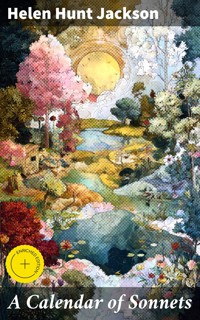
Sets a seasonal, reflective tone for the collection, visually signaling a year-long meditation through poetry.
Titlepage
Introduces Helen Hunt Jackson’s cycle of twelve monthly sonnets and provides author and publication details.
Text
A sequence of twelve sonnets, one for each month from January to December, tracing the year’s progression through vivid natural imagery and concise reflections on time, weather, growth, and decline.




