


0,49 €
Niedrigster Preis in 30 Tagen: 1,99 €
Niedrigster Preis in 30 Tagen: 1,99 €
Mehr erfahren.
- Herausgeber: Booksell-Verlag
- Kategorie: Lebensstil
- Sprache: Englisch
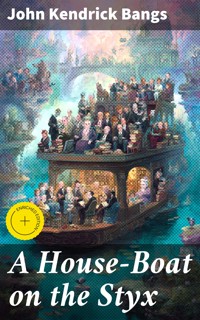
In "A House-Boat on the Styx," John Kendrick Bangs embarks on a whimsical and satirical journey that transports readers to a unique afterlife community where famous literary and historical figures gather aboard an allegorical houseboat. Rich with Bangs's trademark humor and clever wordplay, the narrative is woven through a vivid tapestry of interactions that cleverly comment on both the absurdities of human nature and the literary canon itself. Drawing inspiration from the conventions of the American literary scene at the turn of the century, the novel employs a blend of parody and social critique, ultimately reflecting on the ultimate themes of existence, identity, and art. John Kendrick Bangs (1862-1922), an American author and humorist, was known for his sharp wit and capacity to blend literary reference with humor. His diverse background, encompassing stints as a journalist and editor, led him to cultivate a distinctive voice in American literature, often engaging with both the celebrated and the obscure. His unique perspective on life and death, influenced by contemporary philosophical and literary movements, breathes life into his characters, making the afterlife a comedic yet profound stage. "A House-Boat on the Styx" is a delightful exploration infused with humor and intellect, perfect for readers seeking an engaging blend of satire and reflection on the human condition. It invites literary enthusiasts and casual readers alike to step aboard and experience a buoyant rebirth of classic figures as they navigate the murky waters of life beyond death, revealing the timelessness of literary conversation. In this enriched edition, we have carefully created added value for your reading experience: - A succinct Introduction situates the work's timeless appeal and themes. - The Synopsis outlines the central plot, highlighting key developments without spoiling critical twists. - A detailed Historical Context immerses you in the era's events and influences that shaped the writing. - A thorough Analysis dissects symbols, motifs, and character arcs to unearth underlying meanings. - Reflection questions prompt you to engage personally with the work's messages, connecting them to modern life. - Hand‐picked Memorable Quotes shine a spotlight on moments of literary brilliance. - Interactive footnotes clarify unusual references, historical allusions, and archaic phrases for an effortless, more informed read.
Das E-Book können Sie in Legimi-Apps oder einer beliebigen App lesen, die das folgende Format unterstützen:
Veröffentlichungsjahr: 2019
Ähnliche



















A House-Boat on the Styx
Table of Contents
Introduction
When the illustrious dead form a club on the banks of the afterlife, the business of eternity becomes the art of conversation. John Kendrick Bangs's A House-Boat on the Styx offers a playful, urbane tour of the underworld recast as a gentlemanly resort, where fame, wit, and vanity mingle as easily as smoke in a drawing room. Rather than morbid speculation, the book delights in social comedy, turning myth into a salon and history into a guest list. Its charm lies in watching celebrated personalities encounter one another beyond time, swapping anecdotes, opinions, and gentle barbs while the river of legend glides past.
First published in 1895, the novel belongs to the late nineteenth-century vogue for light, satirical fantasy and helped define what came to be called Bangsian fantasy, tales set in the afterlife featuring notable figures from history and myth. Its setting is the River Styx of classical lore, imagined not as a place of torment but as a civilized waterfront where a well-appointed house-boat is permanently moored. Bangs, an American humorist steeped in magazine culture, brings a crisp, conversational pace and an eye for social ritual, infusing the classical underworld with the manners, clubs, and amusements familiar to readers of his day.
The premise is disarmingly simple: a ferryman known from myth finds his quiet route transformed when a floating clubhouse opens for patrons who can never truly be late. On deck, the most celebrated shades gather to dine, debate, and organize entertainments, their conversations forming a series of scenes that read like minutes from an eternal society's meetings. The narrative proceeds episodically, favoring lively dialogue over spectacle, and letting the humor bloom from contrasts in temperament and reputation. Readers encounter genial mischief, mock-serious procedure, and the cozy rhythms of club life, all filtered through the wry perspective of an amused observer.
Bangs writes in an airy, urbane voice that balances whimsy with neat observation, reveling in the decorum of a well-run club even as he gently lampoons it. The prose is crisp and lightly ironical, built for repartee and quick turns of thought, and the chapters feel like suites of anecdotes rather than machinery driving toward a single crisis. Allusions to classical mythology sit alongside sly nods to contemporary manners, but the humor remains accessible, relying on character and timing more than obscure references. The mood is buoyant and companionable, a comedy of conversation that invites the reader to listen in.
At heart, the book meditates on fame, memory, and the stories we tell about the famous, asking how reputations survive, fray, or flourish when the final pressures of life have ended. By bringing eminent figures into the same room, it stages a playful sociology of greatness, letting vanity and humility, cunning and candor, share the same table. The afterlife setting becomes a neutral ground where achievements can be reexamined with cheerful irreverence, and where the pleasures of civilized talk offer a counterpoint to grand narratives of history. It is satire without bitterness, curious about character and gently skeptical of glory.
Modern readers may find the book timely in its fascination with public personas and cross-era conversation, a precursor to today's mashups and panel-show debates. Its conceit creates space to question who owns ideas, how credit is allocated, and what endures when a life's publicity has faded. The comedy depends less on topicality than on recognizable types - the pedant, the strategist, the dreamer - so it remains approachable without specialist knowledge. For those interested in literary history, it also demonstrates how American humorists adapted classical material to the club culture and periodical style of the 1890s, turning myth into a vehicle for social observation.
Approach A House-Boat on the Styx as an invitation to linger rather than a race to a destination, and the pleasures multiply: the sparkle of talk, the shuffle of rival egos, the steady current of myth beneath modern manners. Bangs offers a comedy of afterlife sociability that prizes civility and play, a fantasy that is less about metaphysics than about how people - freed from urgency - choose to spend their time together. For readers who enjoy urbane humor, literary games, or the idea of history at leisure, this book provides a buoyant embarkation, content to drift, observe, and laugh along the river's edge.
Synopsis
In the comic fantasy A House-Boat on the Styx, the ferryman Charon confronts an unexpected development on the river of the dead: a luxurious club-house moored upon the current. Conceived and operated by eminent souls from every age, the floating retreat becomes a gathering place for the Associated Shades, a society devoted to conversation and leisure. The premise establishes an otherworldly salon where figures long separated by time can meet on equal terms. Early chapters present the boat, its purpose, and the novelty it represents for Hades, setting the stage for a sequence of episodic meetings that explore fame, history, and memory.
Charon, initially bewildered by the intrusion on his route, parries with the club founders over authority and access. Appointed superintendent, he watches as the house-boat is fitted with a library, smoking room, card tables, and a promenade deck overlooking the Styx. Membership is restricted to notable shades, and committees regulate everything from entertainments to archives. The tone is formal yet playful, with bylaws, ballots, and ceremonial welcomes framing the social life aboard. These details establish the club as a structured institution and provide a neutral framework within which the book stages its conversations among scholars, soldiers, poets, rulers, and wits.
With the setting secure, the narrative proceeds through a series of visits and dialogues that bring together celebrated personalities. New arrivals are introduced, longtime residents compare experiences, and the library becomes a favored arena for debate. The episodic chapters follow one conversation to the next, each centered on a theme such as authorship, exploration, or governance. Through these encounters, the boat functions as a crossroads of eras, letting readers observe how renown is made and unmade when contemporaries of different centuries converse. The flow remains light and brisk, emphasizing quick exchanges, comic misunderstandings, and anecdotal recollections rather than extended plot.
Literary questions occupy several scenes. Playwrights and poets address controversies surrounding their works, with the most prominent being the recurring dispute over the authorship of Elizabethan drama. The shades weigh evidence, jest about scholarly fashions, and consider how posterity reshapes reputations. Historians, too, debate methods and sources, asking who controls the narrative of the past. The book presents these topics as conversations rather than verdicts, letting different voices speak in turn. The emphasis stays on the spectacle of celebrated writers meeting their critics and champions face to face, providing context for the broader theme of how fame survives beyond life.
Statesmen and strategists contribute another thread. Commanders from antiquity and modernity compare campaigns, argue over supply lines and luck, and consider the costs of glory. Leaders weigh rival claims about decisive battles, while counselors dispute whether chance or genius shapes victory. The house-boat serves as neutral ground where former opponents can reconstruct events without the pressure of armies or electorates. These scenes broaden the scope beyond literature, aligning the club’s talk with public affairs and the making of empires. Again the narrative favors illustrative anecdotes and pointed exchanges, keeping the pace lively while sketching the outlines of large historical questions.
Philosophers and moralists turn from deeds to ethics. They examine the uses of leisure, the obligations of memory, and the responsibilities that persist after death. Commentators on manners consider biography and reportage, questioning what a subject owes to a chronicler and vice versa. These discussions intersect with the management of the club itself: elections, committees, and procedural motions become occasions to explore principles of justice and order. The pattern preserves the book’s episodic rhythm, linking abstract topics to concrete business aboard the boat. By situating ideas within club governance, the narrative grounds speculation in rules, votes, and shared customs.
Other chapters examine invention and discovery. Navigators discuss routes and instruments, while students of nature review experiments and contested theories. The shades keep informed through tidings brought by recent arrivals, whose reports on new devices and social changes provoke curiosity and caution in equal measure. Questions about progress surface repeatedly: how quickly knowledge alters, how much is forgotten, and how the past is repurposed by the present. The format remains conversational and comparative. Rather than staging demonstrations, the book uses informed talk and brief reminiscence to trace the movement of ideas across centuries and to register the mixed legacy of innovation.
Social life fills out the portrait of the club. Musicians, raconteurs, and actors offer entertainment; explorers host illustrated talks; and the kitchen, cards, and cigars sustain a leisurely routine. Minor frictions arise over precedence, tastes, and practical matters, giving Charon cause to mediate and grumble while earning his place as the indispensable steward. Occasional mishaps punctuate the calm, hinting that even in a carefully managed society surprises occur. These episodes build a sense of continuity aboard the vessel, a shared culture that relies on humor and ritual, and they prepare the reader for the moment when routine is interrupted.
In the closing movement, a sudden development unsettles the Associated Shades and reverses their placid expectations. The house-boat, once a symbol of permanence on the Styx, becomes the focus of a problem that calls for collective response and ingenuity. Without disclosing particulars, the conclusion shifts from convivial talk to coordinated action, positioning the company for further adventures beyond the immediate book. Across its episodes, the work frames the afterlife as a forum for reconsidering earthly renown, using light satire to probe how memory, authorship, and ambition endure. Its central message is continuity of conversation: fame is tested, refined, and shared.
Historical Context
Set not in a historical century but in the Greek underworld, the book unfolds on a club-like house-boat moored to the River Styx, the mythic boundary of Hades. Its locale draws on classical topography—Charon’s ferry, the misty banks of the dead—yet its atmosphere is distinctly late nineteenth century, with committee rooms, bylaws, and amenities modeled after Victorian and Gilded Age gentlemen’s clubs. Time is collapsed: figures from antiquity to the nineteenth century mingle beyond chronology, allowing debates that juxtapose Rome with the Revolution and Elizabethan voyages with modern bureaucracy. The setting thus fuses classical myth with contemporary social architecture familiar to 1890s readers.
The presence of Socrates, Julius Caesar, and Cleopatra invokes pivotal classical events. Socrates’ trial and execution in 399 BCE, held by the Athenian polis after the Peloponnesian War, frames discussions on civic duty and dissent. Caesar’s crossing of the Rubicon in 49 BCE and assassination on the Ides of March in 44 BCE, plus Cleopatra’s alliance with Mark Antony defeated at Actium in 31 BCE, bring the crises of republican collapse and imperial rise to the table. The book uses these personae to stage cross-era colloquies on law, ambition, and sovereignty, refracting nineteenth-century political anxieties through antiquity’s exempla.
Elizabethan and early modern seafaring runs through the figure of Sir Walter Raleigh (1552–1618), who sponsored Roanoke expeditions (1584–1587) and helped define English rivalry with Spain after the 1588 Armada. His execution at Whitehall in 1618 punctuated shifting imperial fortunes. Piracy and privateering are evoked by Captain William Kidd (c. 1654–1701), commissioned in 1696 and executed at Execution Dock on 23 May 1701 for murder and piracy. The book’s plot flirtation with the theft of the house-boat and its sequel’s pursuit draws on such maritime lore, using Raleigh’s courtly colonization and Kidd’s legal gray zones to lampoon authority and adventurism.
The French Revolution (1789) and the Napoleonic era (1799–1815) enter through Napoleon’s shade, whose campaigns—Austerlitz (2 December 1805), the Peninsular War (1808–1814), the Russian invasion (1812), and Waterloo (18 June 1815)—and the Code Napoléon (1804) shaped modern statecraft. His coups—especially 18 Brumaire (1799)—and exiles to Elba (1814) and St. Helena (1815–1821) supply touchstones for ambition’s rise and fall. The book satirizes the cult of the “great man,” contrasting Caesar’s and Napoleon’s claims to glory with clubroom proceduralism, and refracts the century’s debates over centralized power, civil codification, and military grandeur through witty, anachronistic repartee.
Eighteenth-century associational culture informs the work via Dr. Samuel Johnson (1709–1784) and the London club world. Johnson co-founded “The Club” in 1764 with Joshua Reynolds at the Turk’s Head, a milieu that included Edmund Burke and Oliver Goldsmith. Coffeehouses such as Lloyd’s and Will’s incubated debate, translating into formal clubs like the Athenaeum (1824), Garrick (1831), and, in political life, the Reform Club (1836). The Associated Shades replicate this infrastructure—members, committees, minutes, and rules—so that history’s titans are domesticated within a British-influenced civic habit, making the very format of the book a historical artifact of club governance.
Late nineteenth-century Anglo-American club and leisure cultures most decisively shape the book’s design and satire. In London, elite clubs proliferated along Pall Mall and St. James’s; in New York, the Century Association (1847), Union League Club (1863), and Metropolitan Club (1891) exemplified male-only, status-marking institutions. Their rituals—ballots, blackballs, standing committees, lecture rooms—codified hierarchy and sociability. Parallel to clubbability was the rise of yachting and house-boat leisure. The Royal Thames Yacht Club (1823) and the New York Yacht Club (1844) anchored a transatlantic boating culture, while the Henley Royal Regatta (founded 1839) signaled the prestige of river recreation. By the 1880s–1890s, “house-boat” had entered common usage on the Thames at places like Maidenhead and on American rivers, denoting moored, amenity-rich vessels used for social gatherings. This convergence of exclusivist club life and conspicuous aquatic leisure provides the immediate social grammar of the Associated Shades: a floating clubhouse, proximate to a ferry (Charon) yet reserved for members, with procedural wrangles over admissions, entertainments, and jurisdiction. The Gilded Age backdrop—marked by the Panic of 1893, the Pullman Strike of 1894, and the concentration of wealth under trusts like Standard Oil (founded 1870) despite the Sherman Antitrust Act (1890)—heightened public scrutiny of closed elites. Bangs mirrors these conditions by letting emperors, philosophers, and pirates discover that, whatever their earthly rank, they must submit to by-laws, quorums, and chairmen. The club’s comic bureaucracy, committees on everything from refreshments to discipline, and punctilious minutes lampoon the self-importance and procedural fetish of late-Victorian and American upper-class institutions while borrowing their recognizable architecture.




