


0,49 €
Niedrigster Preis in 30 Tagen: 2,49 €
Niedrigster Preis in 30 Tagen: 2,49 €
Mehr erfahren.
- Herausgeber: Booksell-Verlag
- Kategorie: Gesellschafts- und Liebesromane
- Sprache: Englisch
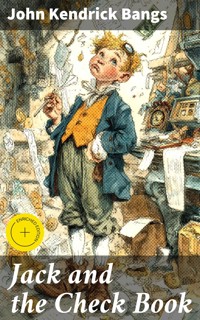
In "Jack and the Check Book," John Kendrick Bangs artfully combines satire and whimsy to explore themes of financial folly and the absurdity of human nature. The narrative unfolds around the hapless protagonist, Jack, who becomes embroiled in a series of comedic misadventures due to his mismanagement of a seemingly innocuous checkbook. Bangs employs a light-hearted yet incisive literary style, interspersing humorous dialogue with sharp social commentary that effectively critiques the rampant consumerism and financial ignorance of his time. This work fits within the broader context of late 19th-century American literature, reflecting the burgeoning middle class's anxieties about wealth and responsibility amidst decadent post-Civil War prosperity. John Kendrick Bangs was a prominent figure in American satire, known for his keen observational humor and penchant for the fantastical. His experiences growing up in a rapidly changing America, alongside his literary ambitions, informed his desire to reflect on societal norms through a comedic lens. The influences of Mark Twain and the proliferation of leisure culture during Bangs's era resonate in this text, showcasing his ability to blend humor with poignant critique. "Jack and the Check Book" is a delightful read that offers not just entertainment but also a lens through which to examine contemporary societal behaviors regarding money and responsibility. Bangs's wit and insight make this work an essential addition to any lover of literary satire, ultimately reminding us to approach our financial affairs with both diligence and a sense of humor. In this enriched edition, we have carefully created added value for your reading experience: - A succinct Introduction situates the work's timeless appeal and themes. - The Synopsis outlines the central plot, highlighting key developments without spoiling critical twists. - A detailed Historical Context immerses you in the era's events and influences that shaped the writing. - A thorough Analysis dissects symbols, motifs, and character arcs to unearth underlying meanings. - Reflection questions prompt you to engage personally with the work's messages, connecting them to modern life. - Hand‐picked Memorable Quotes shine a spotlight on moments of literary brilliance. - Interactive footnotes clarify unusual references, historical allusions, and archaic phrases for an effortless, more informed read.
Das E-Book können Sie in Legimi-Apps oder einer beliebigen App lesen, die das folgende Format unterstützen:
Veröffentlichungsjahr: 2019
Ähnliche












Jack and the Check Book
Table of Contents
Introduction
Through a witty lens, Jack and the Check Book examines how the promise of ready money can nudge conscience, courtship, and community into curious alignments, charting the tension between what people owe themselves and what they think they can purchase, and revealing, with genial mischief, the subtle ways a ledger of credits and debits comes to measure not only transactions at the bank but the more intricate economies of pride, trust, and regard, in a world where appearances carry interest as surely as accounts, and where the inscription of a name on paper can lift or limit a life.
Written by John Kendrick Bangs, an American humorist whose career spanned the late nineteenth and early twentieth centuries, Jack and the Check Book belongs to the author’s vein of comic, satirical fiction. While not anchored to a single famous locale, it reflects the modern social milieu of its era, when banking, credit, and conspicuous display were familiar subjects for playful critique. First published in the early decades of the twentieth century, it speaks in the urbane, lightly ironic register readers associate with Bangs, favoring nimble dialogue, quick reversals, and gently barbed observations over melodrama or moralizing.
The premise is simple to grasp and rich in comic possibilities: a man named Jack finds that the checkbook, an everyday tool, can become an instrument for arranging favors, smoothing obstacles, and testing how people value him. Rather than building toward sensational revelations, the book cultivates a sequence of social encounters that draw humor from misunderstandings, mixed motives, and the etiquette of money. The result is an experience closer to sophisticated comedy than farce, briskly paced and conversational in tone, with episodes that amuse while nudging readers to notice what, precisely, is being counted when accounts appear to balance.
Across its scenes, the book explores the reach and limits of financial influence, contrasting what money can conveniently arrange with what it cannot reliably secure. It considers the performance of respectability, the seductions of ease, and the uneasy arithmetic by which people equate generosity with goodness. Reputation, reciprocity, and self-invention recur as motifs, but the tone remains companionable rather than scolding, allowing readers to laugh at small vanities even as they sense the costs of equating worth with wealth. In this way, the checkbook operates both as a prop in comic business and as a symbol that invites closer reckoning.
Bangs’s humor characteristically favors buoyancy over bitterness, and Jack and the Check Book exemplifies that approach through spry narration, clear setups, and reversals that land with a smile. The prose plays with incongruities between lofty intentions and practical outcomes, trusting wit and timing to carry its critique. Dialogue moves briskly, manners matter, and plot turns serve to expose attitudes rather than to punish them. The craft is economical, attentive to rhythm and surprise, and hospitable to allusive asides that situate the story within a broader conversation about success, civility, and the delicate thresholds where courtesy meets calculation.
Readers today may recognize the book’s questions in new guises: how markers of status circulate, how generosity can be strategic, how credit extends beyond bank ledgers into the currencies of attention and approval. In an era of digital payments, social metrics, and public philanthropy, Bangs’s gentle satire still resonates by separating value from price and companionship from transaction. The narrative encourages a reflective chuckle at the ways people try to buy time, sympathy, or standing, while acknowledging the practical comfort money provides. Its appeal lies in this balance, rendering the theme neither naively celebratory nor dourly condemnatory.
Approached as period entertainment with a clear moral undercurrent, Jack and the Check Book offers a compact, polished window onto the concerns of its time and the perennial foibles of ours. It welcomes newcomers to Bangs with accessible humor and rewards returning readers with the finesse of an established stylist. Without depending on elaborate plotting or heavy sentiment, it sustains interest through voice, observation, and the measured escalation of comic trials. Entering its pages, one encounters a world close enough to recognize and distant enough to enjoy, a reminder that the ledger of character resists tidy arithmetic.
Synopsis
John Kendrick Bangs’s Jack and the Check Book follows a young man who discovers how far a well-supplied checkbook can carry him in a world eager to price everything. Jack is not introduced as a prodigy or a schemer, but as a curious, essentially decent observer who inherits or otherwise acquires means and a ledger of blank checks. Rather than plunge into extravagance, he treats the book as an experiment. He asks what money can accomplish quickly, where it meets resistance, and how it alters behavior. The narrative begins with small errands and everyday encounters, establishing tone, method, and the central question about value.
Jack’s early tests focus on social access. He tips generously, pays fees without complaint, and watches as doors open, maitre d’s brighten, and waiting lists vanish. He enters clubs that had seemed impenetrable, secures seats at functions previously closed, and observes how institutions convert exclusion into a schedule of dues and donations. The chapters chronicle these transactions with mild irony, chronicling the politeness and speed that follow a signature. Yet the text also notes what money cannot manufacture on demand: fellowship, trust, and recognition that outlasts the receipt. Jack concludes his first phase with data about courtesy bought and the silence that follows when the check clears.
Publicity becomes the next arena. Jack retains press agents, buys advertising space, and sponsors events that place his name in print. Invitations multiply, reporters solicit quips, and his portrait circulates as if fame were a bookkeeping entry. Bangs presents the mechanics of image-making: the interplay of headlines, charitable announcements, and strategic philanthropy timed for column inches. Jack is neither satirized as naive nor glorified as masterful; he simply follows the logic of promotion. He notes how narrative can be built around a benefactor’s name, how attention compounds like interest, and how quickly notoriety can eclipse substance when the ledger is open.
The story then moves into civic life. Jack tests whether checks can purchase influence that improves public outcomes. He underwrites lectures, sponsors committees, and contributes to candidates who promise reforms. The machinery of politics reveals itself in appointments, endorsements, and the subtle trade of favors. Jack learns that money accelerates introductions and drafts agendas, but it also invites obligations and mixed motives. Hearings are convened, platforms adjusted, and compromises proposed. The narrative maintains balance, showing how patronage and principle coexist uneasily. Jack begins to see the difference between paying for a promise and earning a policy, and he records where currency meets a counterweight of law and conscience.
Philanthropy offers a counterpoint to politics. Jack writes checks to hospitals, schools, and relief drives, and the book surveys the institutions that convert generosity into programs. He observes naming rights, administrative overhead, and the difficulty of measuring outcomes. A benefit gala dazzles while an understaffed ward strains; a scholarship fund opens doors while an endowment’s rules restrict flexibility. Jack experiments with anonymous giving and personal engagement, comparing the effects of presence versus payment. The episodes emphasize how charity can transform when paired with understanding, and how even large gifts cannot replace organization, expertise, and patience. The checkbook proves potent but imprecise in meeting human needs.
Turning to culture, Jack commissions art, supports a theater production, and funds a literary journal. The narrative traces how money sponsors ambition: an exhibition is mounted, a play is staged, and a magazine launches with bright prospects. Critics appear; tastes shift. Jack notices that applause can be hired for an evening, but critical judgment keeps its own counsel. A celebrated name might guarantee attendance, not merit. The chapters map the boundary between underwriting and authorship, showing the patron’s influence and its limits. Jack records that capital can supply means and platforms, while inspiration, craftsmanship, and time determine enduring worth beyond the opening night’s receipts.
Business ventures test his assumptions in the opposite direction. Jack invests in an enterprise where checks clear obstacles—permits, equipment, expert advice—yet cannot eliminate risk. Market pressures, competition, and error assert themselves. He meets partners who are candid about margins, and others who are tempted by leverage and speed. A tremor in trade exposes weak plans and rewards careful ones. Balance sheets, rather than invitations, decide the day. The narrative refrains from melodrama, presenting a ledger of cause and effect: diligence attracts resilience, speculation magnifies swings. Jack learns that capital is a tool that magnifies both vision and miscalculation, and that prudence cannot be purchased late.
Personal ties bring the experiment to its most sensitive field. Friendships deepen or fade as Jack attempts to isolate affection from advantage. In courtship he considers whether candor about means clarifies or distorts motives, and he tries discretion to test sincerity. The story presents conversations and small misunderstandings, noting how generosity can be mistaken for display, and reserve for indifference. Jack confronts the question that frames the book: what qualities remain when checks are set aside. Without disclosing outcomes, the narrative marks a threshold where trust, humor, patience, and shared experience weigh more than accounts, and where choices carry consequences that ledger entries cannot balance.
A culminating challenge gathers these threads, asking Jack to reconcile the efficiencies of payment with the disciplines of character, time, and responsibility. The resolution maintains the novel’s even tone, steering away from moral lecture while clarifying its central point: money opens routes but does not select destinations. Through society, publicity, politics, charity, art, and trade, the checkbook proves powerful yet bounded. The book’s message is not asceticism but proportion. Wealth, properly used, aids work already rooted in purpose; misapplied, it disorganizes effort and expectation. Jack’s journey closes on the recognition that value must be created, not merely funded, and that worth outlasts the receipt.
Historical Context
Set in the bustling, modernizing cities of the early twentieth-century United States—most recognizably New York—Jack and the Check Book unfolds against an urban landscape of banks, gentlemen’s clubs, hotels, and brokerage houses. The period is the Progressive Era, roughly the 1900s–1910s, when electric lighting, telephones, typewriters, and rapid rail travel created a tempo of business and sociability that favored the quick transaction. The opening of the New York City subway in 1904, the prominence of Wall Street after the Gilded Age, and the codified rituals of club life shape the social environment. Bangs situates his satirical episodes where personal credit, social status, and civic influence intersect, making the checkbook a portable emblem of power.
The consolidation of American industry and finance after 1890 forms a crucial backdrop. Standard Oil (founded 1870) epitomized the national trust, ultimately dissolved by the Supreme Court in 1911 under the Sherman Antitrust Act (1890). J. P. Morgan’s creation of U.S. Steel in 1901 and the formation, then dissolution, of Northern Securities (1901–1904) set precedents for corporate scale and federal “trust-busting” under Theodore Roosevelt. These developments concentrated capital in New York and standardized the etiquette of large transactions—mergers, underwriting, and syndicated loans—that coursed through banks and clubs. The book’s comedic premise—that a well-wielded checkbook unlocks doors—mirrors this age of financial omnipotence, satirizing a culture in which signatures and balances often outweighed character in determining access and authority.
The Panic of 1907, a cascading crisis beginning in October of that year, exposed the fragility of a system without a central bank. A failed stock corner in United Copper by F. Augustus Heinze and Charles W. Morse triggered runs on New York trust companies, notably the Knickerbocker Trust’s collapse on October 22–23. J. P. Morgan, with leading bankers and Treasury Secretary George B. Cortelyou, orchestrated private rescues, clearinghouse loan certificates, and strategic deposits to stem contagion. The episode produced sharp contractions in credit and employment into 1908 and spurred calls for structural reform. Bangs’s emphasis on the checkbook as talisman deftly reflects this volatile reality: liquidity could vanish in days, revealing the absurdity—and peril—of treating money as a universal solvent for personal and civic dilemmas.
Municipal corruption and machine politics—exemplified by Tammany Hall—permeated urban life from the 1890s into the 1910s. Investigations such as the Lexow Committee (1894–1895) exposed police graft and protection rackets in New York City, while reform mayors William L. Strong (1895–1897) and Seth Low (1902–1903) attempted to curb patronage and professionalize services. Under Charles F. Murphy (leader of Tammany from 1902), the machine refined influence over public works and franchise grants for transit and utilities. This history informs Bangs’s satire of “greased” processes and expedited favors: the stories echo a milieu in which a discreet payment, donation, or subscription could hasten permits, secure introductions, or tilt municipal decisions—always with a comic sting that highlights civic costs.
Campaign finance controversies of the era clarified the bargaining power of capital in politics. Mark Hanna’s business-backed orchestration of William McKinley’s 1896 campaign signaled a new scale of corporate giving. The 1905–1906 Armstrong investigations in New York revealed covert political donations by major life insurers, prompting regulation. Congress responded with the Tillman Act of 1907, banning corporate contributions to federal candidates. Bangs’s title metaphor aligns neatly with this trajectory: the checkbook figures as a passport to influence, a satirical stand-in for subscription lists, campaign funds, and “voluntary” civic gifts that bought access. The book caricatures the transactional culture that reformers struggled to disclose and constrain through law.
The explosion of consumer culture and conspicuous display redefined status. Department stores such as R. H. Macy & Co. opened the Herald Square flagship in 1902, while national advertisers like J. Walter Thompson refined mass persuasion. Thorstein Veblen’s The Theory of the Leisure Class (1899) named the practices of status spending that Fifth Avenue mansions, Newport villas, and exclusive resorts dramatized. Elite clubs—the Metropolitan Club (founded 1891 by J. P. Morgan), the Union League, and the Knickerbocker—codified social gates policed by dues, endorsements, and donations. Bangs mines this terrain for comedy: checks buy wardrobes, memberships, and charitable visibility, yet the narratives reveal how etiquette, lineage, and insider rituals complicate any purely monetary ascent.
Behind the title object lay evolving banking practices. The New York Clearing House (established 1853) coordinated interbank settlements; by the early 1900s, New York’s daily clearings regularly reached into the hundreds of millions of dollars, making check usage routine among the middle and upper classes. The Panic of 1907 prompted the Aldrich–Vreeland Act (1908) and the National Monetary Commission (1908–1912), culminating in the Federal Reserve Act (1913), which modernized note issue and later centralized check clearing. Bangs’s emphasis on the checkbook captures this transitional moment: a portable instrument conferred convenience and status, yet it tethered personal fortunes to institutional confidence and clearing mechanisms that, in crises, revealed their ad hoc and oligarchic foundations.
As social and political critique, the book lampoons a culture that mistakes money for merit and transactional ease for civic order. By dramatizing how a signed slip secures audiences, admissions, and favors, it exposes the era’s conflation of philanthropy with influence, reform with public-relations, and citizenship with purchasing power. The humor targets machine patronage, corporate entanglement in elections, and the etiquette of exclusivity that laundered class privilege as “good taste.” In the shadow of panics and trust-busting, its sketches implicitly endorse Progressive skepticism: that unchecked private power distorts public life, that rules must tame wealth’s sway, and that genuine reform requires norms and institutions stronger than any individual’s checkbook.




