



0,49 €
Niedrigster Preis in 30 Tagen: 1,99 €
Niedrigster Preis in 30 Tagen: 1,99 €
Mehr erfahren.
- Herausgeber: Booksell-Verlag
- Kategorie: Krimi
- Sprache: Englisch
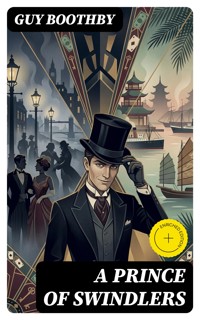
In "A Prince of Swindlers," Guy Boothby weaves a captivating tale that delves into the shadowy world of deception and charm, exploring the life of the enigmatic character, the Prince of Swindlers. Boothby adopts a vibrant narrative style marked by sharp wit and incisive dialogue, reflecting the decadent Victorian society from which the novel springs. As the narrative unfolds, themes of morality, identity, and social stratification emerge, painting a complex picture of a society teetering on the edge of modernity while firmly entrenched in its traditional values. The author seamlessly merges elements of adventure, romance, and psychological intrigue, inviting readers to navigate a labyrinth of charm and cunning alongside the protagonist. Guy Boothby, an Australian author born in the late 19th century, drew upon his own experiences with travel and the vibrant characters he encountered to craft this engaging story. His background in theatre and journalism imbued his writing with a flair for the dramatic, while his keen observations of human behavior inspired his portrayal of swindlers and con artists. Boothby's fascination with the duality of human nature and his expert storytelling skills make this work a poignant exploration of societal facades. "A Prince of Swindlers" is a must-read for those intrigued by the complexities of human nature and the intricate web of deception that often underlies social interactions. Boothby's masterful prose not only entertains but also invites readers to reflect on the moral implications of their own choices and the masks they wear in society. This novel stands out as a significant contribution to the genre of crime fiction and is sure to enthrall both seasoned readers and newcomers alike. In this enriched edition, we have carefully created added value for your reading experience: - A succinct Introduction situates the work's timeless appeal and themes. - The Synopsis outlines the central plot, highlighting key developments without spoiling critical twists. - A detailed Historical Context immerses you in the era's events and influences that shaped the writing. - An Author Biography reveals milestones in the author's life, illuminating the personal insights behind the text. - A thorough Analysis dissects symbols, motifs, and character arcs to unearth underlying meanings. - Reflection questions prompt you to engage personally with the work's messages, connecting them to modern life. - Hand‐picked Memorable Quotes shine a spotlight on moments of literary brilliance. - Interactive footnotes clarify unusual references, historical allusions, and archaic phrases for an effortless, more informed read.
Das E-Book können Sie in Legimi-Apps oder einer beliebigen App lesen, die das folgende Format unterstützen:
Veröffentlichungsjahr: 2021
Ähnliche















A Prince of Swindlers
Table of Contents
Introduction
A brilliant impostor turns the vanities of high society into both his playground and his weapon. Guy Boothby’s A Prince of Swindlers presents a consummate confidence artist who thrives where etiquette and ambition meet. Rather than relying on brute force, this figure manipulates expectations, appearances, and desire, staging schemes that expose the credulity of those who believe themselves beyond deception. The novel’s central fascination lies in how charm and calculation can pass for virtue in the right drawing room, and how easily the symbols of status become tools of theft. It is a tale of nerve, poise, and the art of seeming.
Written by the Australian-born popular novelist Guy Boothby, A Prince of Swindlers belongs to the crime-and-adventure tradition of late-Victorian popular fiction. Set largely amid the clubs, salons, and townhouses of the British elite, it exploits the period’s appetite for sensational yet urbane entertainment. The book emerged in the 1890s, when serialized magazine fiction flourished and intricate capers could be savored episode by episode before being gathered into volume form. In that context, Boothby offers a suave counterpoint to dour detective tales, favoring ingenuity, disguise, and audacity over forensic detail. The result is a stylish performance of mischief staged against the opulent backdrop of the fin de siècle.
The premise is invitingly simple: a master swindler insinuates himself into society, adopting personas as needed to orchestrate elaborate, bloodless thefts and daring deceptions. He studies his marks, leverages manners as much as mechanics, and turns attention itself into a resource. The tension comes not from whether violence will erupt, but from whether his masks will hold under scrutiny and whether timing will break his way. Readers encounter a sequence of capers that showcase sleek planning, near-escapes, and social theater. The experience is that of a smoothly engineered entertainment—witty, brisk, and steeped in the pleasures of watching a plan click into place.
Stylistically, Boothby writes with the propulsive clarity of magazine fiction: clean setups, swift reversals, and vivid set pieces calibrated for momentum. The narrative favors an episodic structure, each adventure tightening the screw of risk while layering the mythology of its protagonist. Dialogue sparkles with irony, description lingers on the trappings of wealth, and the pacing shuttles between measured observation and sudden flourish. The tone is conspiratorial without being cynical, inviting readers to appreciate craftsmanship even as it indicts credulity. This balance between admiration and critique is central to the book’s enduring appeal: we relish the audacity while registering the social blindness that makes it possible.
Beneath the glittering surfaces lie themes that animate much late-Victorian popular writing. Identity is performed rather than possessed; class becomes a costume that money, manners, and audacity can purchase; and the machinery of respectability proves alarmingly easy to hack. The book also probes the authority of the law, suggesting that charisma and spectacle can outpace regulation in a culture enthralled by novelty. Boothby’s swindler exposes a hierarchy as susceptible to flattery as to fear, where reputation shields folly and wealth invites targeted theater. It is not just a contest of wits between rogue and world, but a commentary on the seductive grammar of appearances.
For contemporary readers, the novel’s questions feel strikingly current. In an age attentive to grift, branding, and social engineering, its focus on manipulation through narrative and image resonates beyond its period setting. It invites reflection on why confidence artists captivate us: the thrill of transgression, the elegance of a clean plan, and the unsettling recognition that systems designed to signal trust can be repurposed to exploit it. The book rewards readers who enjoy cleverness without cruelty, suspense without sensational brutality, and satire that pricks rather than bludgeons. It offers a shrewd lens on credulity, complicity, and the economies of attention.
Approach A Prince of Swindlers as a polished caper and a sly comedy of manners wrapped into one. Expect the satisfactions of gentleman-rogue fiction: disguises that test perception, plots that pivot on timing, and revelations that depend on social stagecraft. Boothby’s craftsmanship lies in making each turn feel both inevitable and surprising, all while keeping consequences just distant enough to preserve buoyancy. The novel stands as a lively artifact of the 1890s’ appetite for spectacle and as a nimble meditation on the theater of status. It remains an engaging read for anyone intrigued by wit deployed against power—and by power disarmed through wit.
Synopsis
A Prince of Swindlers, set in late-Victorian London, follows Simon Carne, a cultivated impostor who moves with ease among the wealthy while secretly planning audacious crimes. Guy Boothby presents the tale as a sequence of interlinked episodes, each centered on a scheme that exploits fashion, vanity, and the brittle safeguards of high society. The narrative balances preparation, execution, and aftermath, tracing how Carne’s refined manners and precise organization allow him to outwit guardians of property and reputation. Without endorsing or condemning him, the book depicts an urbane strategist whose greatest tools are disguise, patience, and a keen understanding of public expectations.
The story begins with Carne’s carefully managed arrival in London under a wealthy persona that immediately attracts attention. He secures an elegant residence, surrounds himself with discreet, capable servants, and cultivates influential introductions that open doors in clubs and drawing rooms. Feigning delicacy of health, he appears harmless while quietly assembling the resources needed for complex operations. Boothby highlights Carne’s method: long observation, meticulous rehearsal, and a flexible plan designed to exploit the habits of his targets. With this foundation laid, Carne’s criminal career advances in tandem with his social success, creating a dual existence that is both mutually reinforcing and increasingly perilous.
Carne’s first major exploit unfolds amid the glitter of a fashionable reception, where jewels and titled guests offer opportunity and cover. He orchestrates a theft that depends on timing, misdirection, and the predictable structure of a grand event. Simultaneously, the narrative introduces his most audacious masquerade: an alter ego as a consulting detective named Klimo. From this vantage, Carne can study official reactions, steer inquiries, and assess risks without compromising his social façade. The contrast between the thief and the investigator becomes a recurring device, allowing him to shape public narratives while concealing his authorship of the very crimes under examination.
Subsequent chapters take Carne into the world of art and collecting, where prestige and secrecy create fertile ground for deception. A coveted piece in a private gallery becomes the focus of a scheme involving expert knowledge, duplicate objects, and the careful use of intermediaries. Boothby details the logistics of access—appointments, restorers, carriers—and shows how a single weak link can be turned into a secure chain for the swindler. Insurance arrangements, provenance debates, and auction-room etiquette provide additional layers to the plot, reinforcing the novel’s emphasis on preparation and the subtle manipulation of procedures that respectable institutions trust without question.
From art rooms the narrative moves to moneyed pastimes, where Carne exploits the fever around wagers, tipsters, and speculative ventures. Whether the stage is a racecourse or a boardroom, he leverages rumor, timing, and fabricated credentials to set a profitable trap. Correspondence, coded messages, and decoy transactions maintain the illusion of legitimacy long enough to complete the maneuver. The episode underscores a recurring theme: reputations in high society function as collateral, and once secured, they can be traded with remarkable yield. Public fascination with the detective Klimo grows, ensuring that official attention is split and often redirected at critical moments.
As his notoriety as a host and connoisseur increases, Carne integrates deeper into aristocratic circles. He sponsors entertainments, backs charitable causes, and arranges introductions that enhance his standing. These scenes sharpen the book’s social portrait, showing how appearances—well-staged rooms, impeccable manners, assured conversation—create protective armor. Yet the pressure mounts. A persistent officer begins to connect patterns across seemingly unrelated cases, and some victims bristle at the idea that refined surroundings have been compromised. Carne’s response is greater subtlety: fewer risks in person, greater reliance on trusted aides, and a strengthened detective persona that can publicly challenge suspicions while privately profiting from them.
A centerpiece operation occurs during a heavily guarded public ceremony, where protocols are tight and contingencies numerous. Using official livery, rehearsal of routes, and an acute sense of crowd dynamics, Carne executes a plan that tests the limits of his method. The chapter emphasizes logistics—passes, timing, and the manipulation of communication—and the immediate aftermath features scrutiny from multiple quarters. Klimo’s commentary helps shape the discourse, narrowing investigative focus away from inconvenient details. The episode illustrates the novel’s blend of spectacle and precision, with the city’s enthusiasm for pageantry unknowingly providing a stage on which a flawless illusion can be performed.
Later episodes reveal the strain of maintaining dual identities as vigilance intensifies. Rival interests lay traps, private detectives compare notes, and some of Carne’s allies face moral or practical limits. The schemes grow leaner and more adaptive, built to succeed without leaving traces or to be abandoned cleanly if conditions shift. Carne weighs the future of his London career while arranging contingencies that preserve both freedom and fortune. The narrative sustains its puzzle-driven momentum but allows tension to accumulate, signaling that the balance between audacity and safety is narrowing. Outcomes remain closely guarded, keeping the emphasis on process rather than definitive resolution.
The book’s throughline is the marriage of crime and performance: identity as craft, deception as choreography, and society itself as the willing audience. Boothby presents a protagonist who treats custom and ceremony as instruments, exploiting deference to title, taste, and expertise. The episodes collectively argue that systems built on trust and reputation can be mastered by those who understand their rhythms. Without moralizing, the narrative concludes by reaffirming its central interest in ingenuity and control under pressure. Readers are left with a clear sense of the novel’s essence: a polished sequence of capers that reflects, and critiques, the spectacle of late-Victorian confidence.
Historical Context
Guy Boothby’s A Prince of Swindlers, first appearing in 1897, is set largely in London at the end of Queen Victoria’s reign. The locus is the West End—Mayfair drawing rooms, Belgravia mansions, clubland off Pall Mall, and jewelers along Bond Street—while the City’s banks and brokers supply targets and scenery. Railways, the Underground, and the telegraph knit the metropolis to provincial racecourses and continental ports; electric lighting and plate-glass shopfronts showcase wealth. At the same time, rookeries and police courts are never far away, underscoring stark class contrasts that criminals can exploit. The milieu is one of brittle respectability, elaborate etiquette, and intense surveillance by servants, gossip, and the press.
The novel’s ambiance is inseparable from Britain’s imperial zenith, marked by Queen Victoria’s Diamond Jubilee in June 1897. That year London staged imperial processions of colonial troops and dignitaries along the Strand, Whitehall, and St Paul’s Cathedral, proclaiming a global system that drew bullion, jewels, and new fortunes from India, Africa, and Australasia. Telegraph cables and fast steamers connected Cape Town, Bombay, Sydney, and London in days rather than months. Boothby himself, born in Adelaide in 1867 and widely traveled through Asia before settling in England, understood this traffic of people and lucre. The book channels such imperial cosmopolitanism, portraying a swindler who moves through transnational networks where titles, accents, and colonial reputations open doors.
The financial tremors of the Baring crisis (1890) form a crucial backdrop. When Baring Brothers overexposed itself to Argentine debt, a panic threatened the City of London until Governor William Lidderdale orchestrated a rescue pool with the Bank of England and Rothschilds in November 1890. Aristocratic families and landowners, heavily invested in overseas bonds, saw incomes wobble, while creditworthiness and social standing became entangled. This climate normalized the figure of the plausible financier and the persuasive confidence man. Boothby’s protagonist exploits precisely this nexus of credit and class, cultivating references, letters, and a show of capital to penetrate drawing rooms where investment gossip and the lure of safe returns blur prudence and vanity.
Late-Victorian anxieties about policing and scientific detection also saturate the setting. The failure to catch the Whitechapel murderer in 1888 (the Jack the Ripper case) discredited aspects of the Metropolitan Police under Commissioner Sir Charles Warren and sharpened later reforms under Sir Edward Bradford (1890–1903) and Assistant Commissioner Robert Anderson. The Criminal Investigation Department (created 1878) professionalized inquiry, while Francis Galton’s Finger Prints (1892) advanced identification science; yet Scotland Yard did not adopt fingerprinting until 1901, and forensics remained uneven. In this gap between new science and old procedure, Boothby’s gentleman thief, Simon Carne, thrives. His calculated disguises and his alter ego as a consulting detective satirize a culture in which expertise could be performed, credentials faked, and officialdom outpaced.
High-society scandal furnished vivid templates for elite duplicity. At Tranby Croft, near Hull, in September 1890, a baccarat party with the Prince of Wales led to accusations that Sir William Gordon-Cumming cheated; the sensational 1891 libel trial exposed illegal gambling, perjury, and the code of silence among the titled. Newspapers printed witness lists and floor plans of country-house rooms, turning private vice into public spectacle. Such episodes revealed how prestige shielded wrongdoing until scandal broke. Boothby’s episodes in clubs, salons, and country houses mirror this environment: jewels lie on dressing tables, fortunes change at cards, and reputations—rather than locks—guard the treasure, making the aristocratic milieu uniquely vulnerable to polished fraud.
The late-century South African mineral boom shaped London’s obsessions with portable wealth. Diamonds from Kimberley (discovered from 1867) were consolidated under De Beers by Cecil Rhodes in 1888, while the Witwatersrand gold rush (from 1886) made Johannesburg a meteoric city. Speculation culminated in the ill-fated Jameson Raid (December 1895–January 1896), an armed incursion from British Bechuanaland into the Transvaal, which embarrassed the Salisbury government and exposed collusion between mining magnates and imperial adventurers. Figures like Rhodes and Barney Barnato symbolized fortunes transmuted into tiaras, necklaces, and City scrip circulating through Bond Street and auction rooms. Boothby’s swindles of diamonds and other compact valuables directly echo this culture: gems are both imperial trophies and perfect targets for stealthy redistribution.
Metropolitan modernity provided both tools and stagecraft for crime. London telephone exchanges had operated since 1879, the Underground linked West End and City, and electric lighting brightened theaters and shopfronts while casting deep shadows in mews and side streets. Safe-making advanced, but so did skilled lock-picking and the use of portable drills; early burglar alarms existed, yet household security still relied on servants’ vigilance. Meanwhile, mass-circulation papers—such as the Daily Mail (founded 1896)—practiced New Journalism’s appetite for crime, society, and sensation. A canny swindler could plant stories, manipulate rumor, and vanish into the crowd. Boothby situates his protagonist within this mediated city, where timing trains, telegraphs, and social columns becomes as decisive as brute force.
As social and political critique, the book exposes a regime in which appearance is capital. It indicts deference to titles, the credulity of investors seeking colonial-scale returns, and philanthropic rituals that mask self-interest. By letting a criminal pass as both invalid grandee and expert investigator, Boothby dramatizes how the institutions of class, credit, and policing can be performed and thus fooled. The targets are rarely the poor; rather, the swindles strip complacent elites of jewels and standing, implying a moral rebalancing in an age of bailouts, imperial pageants, and private vice. In foregrounding systemic vulnerabilities, the narrative critiques late-Victorian governance that protected prestige while failing to confront its own incentives for corruption.
A Prince of Swindlers
CHAPTER I.
A CRIMINAL IN DISGUISE.
After no small amount of deliberation, I have come to the conclusion that it is only fit and proper I should set myself right with the world in the matter of the now famous 18--swindles. For, though I have never been openly accused of complicity in those miserable affairs, yet I cannot rid myself of the remembrance that it was I who introduced the man who perpetrated them to London society, and that in more than one instance I acted, innocently enough, Heaven knows, as his Deus ex machinâ[1], in bringing about the very results he was so anxious to achieve. I will first allude, in a few words, to the year in which the crimes took place, and then proceed to describe the events that led to my receiving the confession which has so strangely and unexpectedly come into my hands.
Whatever else may be said on the subject, one thing at least is certain--it will be many years before London forgets that season of festivity. The joyous occasion which made half the sovereigns of Europe our guests for weeks on end, kept foreign princes among us until their faces became as familiar to us as those of our own aristocracy, rendered the houses in our fashionable quarters unobtainable for love or money, filled our hotels to repletion, and produced daily pageants the like of which few of us have ever seen or imagined, can hardly fail to go down to posterity as one of the most notable in English history. Small wonder, therefore, that the wealth, then located in our great metropolis, should have attracted swindlers from all parts of the globe.
That it should have fallen to the lot of one who has always prided himself on steering clear of undesirable acquaintances, to introduce to his friends one of the most notorious adventurers our capital has ever seen, seems like the irony of fate. Perhaps, however, if I begin by showing how cleverly our meeting was contrived, those who would otherwise feel inclined to censure me, will pause before passing judgment, and will ask themselves whether they would not have walked into the snare as unsuspectedly as I did.
It was during the last year of my term of office as Viceroy, and while I was paying a visit to the Governor of Bombay, that I decided upon making a tour of the Northern Provinces, beginning with Peshawur, and winding up with the Maharajah of Malar-Kadir[5]. As the latter potentate is so well known, I need not describe him. His forcible personality, his enlightened rule, and the progress his state has made within the last ten years, are well known to every student of the history of our magnificent Indian Empire.
My stay with him was a pleasant finish to an otherwise monotonous business, for his hospitality has a world-wide reputation. When I arrived he placed his palace, his servants, and his stables at my disposal to use just as I pleased. My time was practically my own. I could be as solitary as a hermit if I so desired; on the other hand, I had but to give the order, and five hundred men would cater for my amusement. It seems therefore the more unfortunate that to this pleasant arrangement I should have to attribute the calamities which it is the purpose of this series of stories to narrate.
On the third morning of my stay I woke early. When I had examined my watch I discovered that it wanted an hour of daylight, and, not feeling inclined to go to sleep again, I wondered how I should employ my time until my servant should bring me my chota hazri, or early breakfast. On proceeding to my window I found a perfect morning, the stars still shining, though in the east they were paling before the approach of dawn. It was difficult to realize that in a few hours the earth which now looked so cool and wholesome would be lying, burnt up and quivering, beneath the blazing Indian sun.
I stood and watched the picture presented to me for some minutes, until an overwhelming desire came over me to order a horse and go for a long ride before the sun should make his appearance above the jungle trees. The temptation was more than I could resist, so I crossed the room and, opening the door, woke my servant, who was sleeping in the ante-chamber. Having bidden him find a groom and have a horse saddled for me, without rousing the household, I returned and commenced my toilet. Then, descending by a private staircase to the great courtyard, I mounted the animal I found awaiting me there, and set off.
Leaving the city behind me I made my way over the new bridge with which His Highness has spanned the river, and, crossing the plain, headed towards the jungle, that rises like a green wall upon the other side. My horse was a waler[2] of exceptional excellence, as every one who knows the Maharajah's stable will readily understand, and I was just in the humor for a ride. But the coolness was not destined to last long, for by the time I had left the second village behind me, the stars had given place to the faint grey light of dawn. A soft, breeze stirred the palms and rustled the long grass, but its freshness was deceptive; the sun would be up almost before I could look round, and then nothing could save us from a scorching day.
After I had been riding for nearly an hour it struck me that, if I wished to be back in time for breakfast, I had better think of returning. At the time I was standing in the center of a small plain, surrounded by jungle. Behind me was the path I had followed to reach the place; in front, and to the right and left, others leading whither I could not tell. Having no desire to return by the road I had come, I touched up my horse and cantered off in an easterly direction, feeling certain that even if I had to make a divergence, I should reach the city without very much trouble.
By the time I had put three miles or so behind me the heat had become stifling, the path being completely shut in on either side by the densest jungle I have ever known. For all I could see to the contrary, I might have been a hundred miles from any habitation.
Imagine my astonishment, therefore, when, on turning a corner of the track, I suddenly left the jungle behind me, and found myself standing on the top of a stupendous cliff, looking down upon a lake of blue water. In the center of this lake was an island, and on the island a house. At the distance I was from it the latter appeared to be built of white marble, as indeed I afterward found to be the case. Anything, however, more lovely than the effect produced by the blue water, the white building, and the jungle-clad hills upon the other side, can scarcely be imagined. I stood and gazed at it in delighted amazement. Of all the beautiful places I had hitherto seen in India this, I could honestly say, was entitled to rank first. But how it was to benefit me in my present situation I could not for the life of me understand.
Ten minutes later I had discovered a guide, and also a path down the cliff to the shore, where, I was assured, a boat and a man could be obtained to transport me to the palace. I therefore bade my informant precede me, and after some minutes' anxious scrambling my horse and I reached the water's edge.
Once there, the boatman was soon brought to light, and, when I had resigned my horse to the care of my guide, I was rowed across to the mysterious residence in question.
On reaching it we drew up at some steps leading to a broad stone esplanade, which, I could see, encircled the entire place. Out of a grove of trees rose the building itself, a confused jumble of Eastern architecture crowned with many towers. With the exception of the vegetation and the blue sky, everything was of a dazzling white, against which the dark green of palms contrasted with admirable effect.
Springing from the boat I made my way up the steps, imbued with much the same feeling of curiosity as the happy Prince, so familiar to us in our nursery days, must have experienced when he found the enchanted castle in the forest. As I reached the top, to my unqualified astonishment, an English man-servant appeared through a gate-way and bowed before me.
"Breakfast is served," he said, "and my master bids me say that he waits to receive your lordship."
Though I thought he must be making a mistake, I said nothing, but followed him along a terrace, through a magnificent gateway, on the top of which a peacock was preening himself in the sunlight, through court after court, all built of the same white marble, through a garden in which a fountain was playing to the rustling accompaniment of pipal and pomegranate leaves, to finally enter the veranda of the main building itself.
Drawing aside the curtain which covered the finely-carved doorway, the servant invited me to enter, and as I did so announced "His Excellency the Viceroy."
The change from the vivid whiteness of the marble outside to the cool semi-European room in which I now found myself was almost disconcerting in its abruptness. Indeed, I had scarcely time to recover my presence of mind before I became aware that my host was standing before me. Another surprise was in store for me. I had expected to find a native, instead of which he proved to be an Englishman.
"I am more indebted than I can say to your Excellency for the honor of this visit," he began, as he extended his hand. "I can only wish I were better prepared for it."
"You must not say that," I answered. "It is I who should apologize. I fear I am an intruder. But to tell you the truth I had lost my way, and it is only by chance that I am here at all. I was foolish to venture out without a guide, and have none to blame for what has occurred but myself."
"In this case I must thank the Fates for their kindness to me," returned my host. "But don't let me keep you standing. You must be both tired and hungry after your long ride, and breakfast, as you see, is upon the table. Shall we show ourselves sufficiently blind to the conventionalities to sit down to it without further preliminaries?"
Upon my assenting he struck a small gong at his side, and servants, acting under the instructions of the white man who had conducted me to his master's presence, instantly appeared in answer to it. We took our places at the table, and the meal immediately commenced.
While it was in progress I was permitted an excellent opportunity of studying my host, who sat opposite me, with such light as penetrated the jhilmills[3] falling directly upon his face. I doubt, however, vividly as my memory recalls the scene, whether I can give you an adequate description of the man who has since come to be a sort of nightmare to me.
In height he could not have been more than five feet two. His shoulders were broad, and would have been evidence of considerable strength but for one malformation, which completely spoilt his whole appearance. The poor fellow suffered from curvature of the spine of the worst sort, and the large hump between his shoulders produced a most extraordinary effect. But it is when I endeavor to describe his face that I find myself confronted with the most serious difficulty.
How to make you realize it I hardly know.
To begin with, I do not think I should be overstepping the mark were I to say that it was one of the most beautiful countenances I have ever seen in my fellow-men. Its contour was as perfect as that of the bust of the Greek god Hermes, to whom, all things considered, it is only fit and proper he should bear some resemblance. The forehead was broad, and surmounted with a wealth of dark hair, in color almost black. His eyes were large and dreamy, the brows almost pencilled in their delicacy; the nose, the most prominent feature of his face, reminded me more of that of the great Napoleon than any other I can recall.
His mouth was small but firm, his ears as tiny as those of an English beauty, and set in closer to his head than is usual with those organs. But it was his chin that fascinated me most. It was plainly that of a man accustomed to command; that of a man of iron will whom no amount of opposition would deter from his purpose. His hands were small and delicate, and his fingers taper, plainly those of the artist, either a painter or a musician. Altogether he presented a unique appearance, and one that once seen would not be easily forgotten.
During the meal I congratulated him upon the possession of such a beautiful residence, the like of which I had never seen before.
"Unfortunately," he answered, "the place does not belong to me, but is the property of our mutual host, the Maharajah. His Highness, knowing that I am a scholar and a recluse, is kind enough to permit me the use of this portion of the palace; and the value of such a privilege I must leave you to imagine."
"You are a student, then?" I said, as I began to understand matters a little more clearly.
"In a perfunctory sort of way," he replied. "That is to say, I have acquired sufficient knowledge to be aware of my own ignorance."
I ventured to inquire the subject in which he took most interest. It proved to be china and the native art of India, and on these two topics we conversed for upwards of half-an-hour. It was evident that he was a consummate master of his subject. This I could the more readily understand when, our meal being finished, he led me into an adjoining room, in which stood the cabinets containing his treasures. Such a collection I had never seen before. Its size and completeness amazed me.
"But surely you have not brought all these specimens together yourself?" I asked in astonishment.
"With a few exceptions," he answered. "You see it has been the hobby of my life. And it is to the fact that I am now engaged upon a book upon the subject, which I hope to have published in England next year, that you may attribute my playing the hermit here."
"You intend, then, to visit England?"
"If my book is finished in time," he answered, "I shall be in London at the end of April or the commencement of May. Who would not wish to be in the chief city of Her Majesty's dominions upon such a joyous and auspicious occasion?"




