


0,49 €
Niedrigster Preis in 30 Tagen: 1,99 €
Niedrigster Preis in 30 Tagen: 1,99 €
Mehr erfahren.
- Herausgeber: DigiCat
- Kategorie: Abenteuer, Thriller, Horror
- Sprache: Englisch
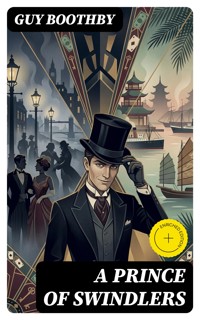
Set against the vivid backdrop of Edwardian London and the sultry allure of the Far East, Guy Boothby's "A Prince of Swindlers" is a masterful exploration of deception, identity, and moral ambiguity. The narrative follows the enigmatic figure of the conman, the charmingly self-styled Prince of Swindlers, who captivates with his wit and daring escapades. Boothby's prose seamlessly blends adventure, humor, and psychological insight, reflecting the literary zeitgeist of the late 19th century, where themes of class and societal norms were increasingly scrutinized. Through sharp dialogue and richly constructed settings, the novel offers a satirical lens on both the gullibility of society and the art of the con, elevating the criminal to a position of complex admiration. Guy Boothby, an Australian author with a flair for captivating storytelling, drew from his own experiences in England and the exotic locales of his travels. He was influenced by the burgeoning interests of the time in sensationalism and the criminal underworld, often incorporating elements of his life as a traveler and a keen observer of human nature into his work. His diverse career in publishing and journalism ensured that his writing was imbued with psychological depth, offering readers not just a tale of deceit but a commentary on societal values. I highly recommend "A Prince of Swindlers" to readers who enjoy sharp humor intertwined with rich character study. This novel is not only a thrilling adventure but also a keen exploration of the complexities of morality in a changing world. Boothby's work invites us to question our perceptions of right and wrong, making it a compelling read for fans of classic literature and modern psychological exploration alike.
Das E-Book können Sie in Legimi-Apps oder einer beliebigen App lesen, die das folgende Format unterstützen:
Veröffentlichungsjahr: 2022
Ähnliche



















A Prince of Swindlers
Table of Contents
Introduction
Charm can be as coercive as force when it is wielded by someone who treats society’s rules as mere suggestions.
Guy Boothby’s A Prince of Swindlers belongs to the late-Victorian tradition of popular crime and adventure fiction, a mode fascinated by imposture, international movement, and the thin line between respectability and criminality. Boothby was known for brisk, plot-driven storytelling, and this novel reflects the period’s appetite for sensational narratives in which money, reputation, and identity circulate as precariously as rumors. Read today, it offers a clear window into a culture both enthralled by modern mobility and anxious about the ease with which appearances can be manufactured and sold.
The story centers on a master confidence man whose operations extend beyond petty deception into elaborate schemes that depend on social access, quick intelligence, and a keen understanding of human vanity. Rather than focusing on a single trick, the novel follows the swindler’s shifting engagements with victims, allies, and pursuers, building momentum through reversals and narrow escapes. The pleasure of the premise lies less in forensic detail than in watching performance become a weapon: each new situation asks how far a practiced persona can travel before it collapses under scrutiny.
Boothby’s narrative voice emphasizes pace and incident, sustaining interest through clean turns of event and a tone that balances excitement with a cool appraisal of risk. The reading experience is shaped by a fascination with surfaces—manners, dress, documents, and introductions—where small signals can open doors or close them decisively. Without lingering on psychological introspection, the novel delivers its effects through movement, confrontation, and the constant pressure of exposure. That briskness, paired with the theatricality inherent in confidence games, makes the book feel closer to a succession of set pieces than to a slow-burn study, and it rewards attentive readers of plot.
At its core, A Prince of Swindlers explores identity as something performed and negotiated rather than fixed, asking what remains of character when social recognition can be counterfeited. It also probes the moral ambiguity of admiration: the swindler’s skill can provoke a reluctant respect even as his actions reveal the costs of treating people as instruments. Intertwined with this is the vulnerability of institutions that rely on trust—banks, clubs, and households—where credibility is often conferred by familiarity and class-coded signals rather than by proof. The novel’s tensions arise from this unstable ecology of belief.
The book still matters because its central mechanism—fraud enabled by confidence—has only changed in its tools, not in its logic. Contemporary readers will recognize how narratives, credentials, and curated impressions can produce real-world power, whether in finance, media, or everyday social life. Boothby’s emphasis on mobility and access also resonates in an era where borders and networks can be navigated by those who understand the right languages of status. By dramatizing how quickly trust can be exploited, the novel invites reflection on vigilance, complicity, and the social incentives that reward seeming over substance.
Approached now, A Prince of Swindlers can be read both as an entertaining crime-adventure and as a document of cultural unease about modernity’s accelerating exchanges. Its pleasures are immediate: momentum, ingenuity, and the suspense of near-discovery, all delivered with the clarity expected of popular fiction aimed at a wide readership. Yet its questions linger beyond the final page, because the story’s world is built on the same fragile materials that structure ours: reputations that can be engineered, systems that must assume good faith, and audiences eager to be impressed. That combination of brisk entertainment and durable insight accounts for its continued appeal.
Synopsis
Guy Boothby’s A Prince of Swindlers presents a fast-moving tale of late‑Victorian intrigue centred on an exceptionally capable confidence man whose schemes span social classes and national borders. The novel introduces readers to a world where money, reputation, and access can be manufactured as readily as they can be destroyed, and where the polished surfaces of respectable society conceal vulnerabilities a determined operator can exploit. Boothby frames the action around the pursuit and observation of this elusive figure, establishing at once the fascination he exerts and the anxiety he provokes among those who suspect that legality and morality are being outpaced by invention.
The narrative proceeds by drawing the swindler into sharper focus through a series of encounters that emphasize method over mere sensationalism. His success depends on careful reconnaissance, psychological insight, and an ability to adopt convincing roles, allowing him to enter drawing rooms, offices, and other guarded spaces with minimal friction. Boothby balances the swindler’s ingenuity with the mounting consequences for victims and bystanders, keeping attention on the practical stakes of fraud as well as its theatricality. The tension arises from a central question: whether intelligence and audacity can indefinitely outmaneuver scrutiny and retribution.
As the story advances, connected episodes reveal how a single operator can leverage networks of information and complicity. Boothby depicts social trust as a kind of currency, exchanged through introductions, references, and appearances that can be forged or manipulated. Each new stage widens the scale of the conflict, shifting from isolated deceptions to patterns that suggest a deliberate, sustained campaign of exploitation. At the same time, the narrative underscores how institutions meant to protect the public—law enforcement, finance, and polite society’s informal gatekeeping—can become tools in the hands of someone who understands their procedures and blind spots.
Opposition to the swindler strengthens as those affected attempt to compare notes, test alibis, and trace money and identities that continually slip out of reach. Boothby keeps the contest dynamic by allowing the pursuers to learn, adapt, and occasionally close in, while the swindler responds with new stratagems and misdirection. The novel’s interest lies not simply in whether a crime is committed, but in how certainty is assembled from partial evidence and unreliable appearances. Suspense is sustained through reversals of advantage, the exposure of false trails, and the ever-present possibility that a familiar figure is not who he seems.
Boothby also explores the social conditions that make such swindling plausible: the hunger for quick gain, the prestige attached to titles and connections, and the reluctance of the respectable to acknowledge they can be deceived. The swindler’s operations depend as much on others’ desires and fears as on his own talent, creating a moral pressure that extends beyond a single villain. Characters must weigh the costs of disclosure against embarrassment and scandal, and the narrative repeatedly shows how secrecy enables wrongdoing. Through these dilemmas, the book probes the fragility of reputation and the ease with which public narratives can be manufactured.
The later movement of the plot tightens the net around the central figure while simultaneously complicating the reader’s sense of agency and responsibility. Boothby maintains uncertainty about what can be proved, what can only be suspected, and which relationships are grounded in loyalty versus expedience. The swindler’s charisma and competence remain in uneasy tension with the harm his actions cause, preventing the story from collapsing into simple admiration or simple denunciation. Without disclosing decisive turns, the novel escalates toward confrontations and reckonings that test the limits of surveillance, evidence, and personal courage in the face of calculated deception.
In closing, A Prince of Swindlers endures as a study of fraud as both performance and systems problem, dramatizing how modern life’s speed and complexity can be turned into opportunities for exploitation. Boothby’s narrative invites reflection on the interplay between individual cunning and collective credulity, and on the way institutions confer legitimacy through forms, signatures, and social proof. By keeping its ultimate outcomes and key revelations in reserve, the story preserves its suspense while still offering a coherent arc of pursuit, improvisation, and risk. Its resonance lies in its cautionary portrait of trust—how it is granted, abused, and defended.
Historical Context
Published in 1899, Guy Boothby’s A Prince of Swindlers belongs to the late-Victorian “fin de siècle,” when London was the administrative and financial hub of a global empire. The period saw rapid urban growth, expanding middle-class consumption, and a dense press culture that popularized crime reporting and sensation literature. Fiction about detection and deception flourished after the success of Sherlock Holmes and earlier urban mysteries. Boothby sets his con-man protagonist against this metropolitan backdrop, where reputations, titles, and money circulate through clubs, hotels, theatres, and markets that were becoming increasingly interconnected.
The decades before 1900 were marked by intensifying global mobility. Steamships and telegraph cables shortened travel times and allowed information and capital to move quickly between Britain, Europe, and colonial territories. International exhibitions, tourism, and business travel brought foreign elites into regular contact with London society. Such conditions also encouraged transnational crime, including confidence tricks and frauds that exploited distance and jurisdictional gaps. Boothby’s cosmopolitan settings and quick scene changes mirror the era’s new rhythms of movement and communication, in which a skilled impostor could operate across borders with relative ease.
Victorian Britain was also experiencing major financial development and periodic anxiety about speculation. The London Stock Exchange had become central to investment, while joint-stock companies and modern banking broadened participation in markets. At the same time, late-century scandals and frauds kept public attention on swindling and the vulnerability of investors, especially those tempted by high returns. Debates over commercial morality and the social consequences of “get-rich-quick” schemes were common in newspapers and parliamentary discussion. Boothby’s focus on elaborate financial and social deceptions draws on these widely reported concerns about credit, trust, and the porousness of safeguards.
Law enforcement and the culture of investigation form another key context. The Metropolitan Police, founded in 1829, had by the late nineteenth century developed specialized detective functions, and the Criminal Investigation Department (CID) operated from 1878. Identification practices were changing: fingerprinting was introduced in British policing in 1901–1902, and earlier methods such as photographs and anthropometric records were debated and used. Popular interest in detectives, surveillance, and modern “scientific” policing fed into fiction. Boothby uses institutional authority and investigative pursuit as an important counterweight to criminal ingenuity, reflecting public fascination with order confronting sophisticated fraud.
Social hierarchy and the performance of status were especially visible in late-Victorian London. Aristocratic titles and gentlemanly codes still carried power, yet new wealth from commerce and empire challenged older distinctions. Clubs, drawing rooms, and fashionable resorts served as stages where accent, dress, and manners signaled belonging. Anxiety about imposture—someone “passing” as a gentleman or member of the elite—was a recurrent theme in journalism and popular culture. A Prince of Swindlers exploits this environment, where a confidence man can weaponize social conventions, and where the desire to believe in respectability creates openings for manipulation.
The period’s print marketplace shaped how such stories circulated. Cheap periodicals, serialized fiction, and mass-produced books expanded readership, while illustration and advertising promoted sensational themes. Crime narratives and “New Woman” and decadent-literature controversies coexisted with adventure and imperial romance, creating a competitive field in which novelty and pace mattered. Boothby had already gained attention with adventure fiction, and his work appeared in an atmosphere that rewarded fast-moving plots and recognizable modern settings. The novel’s episodic feel and emphasis on clever schemes align with publishing practices that favored dramatic set pieces and cliffhanger-like turns.
Imperial politics and late-century tensions also formed the broader background. The “Scramble for Africa,” conflicts over trade routes, and rivalries among European powers contributed to a sense of international competition. In 1899, the same year as Boothby’s book, Britain entered the Second Boer War, highlighting both imperial reach and controversy. While A Prince of Swindlers is not a war narrative, its international scope and encounters with foreign locales and figures reflect a world in which Britain’s interests were global and in which cosmopolitan networks—commercial, social, and criminal—were increasingly visible to the reading public.
Against these conditions, Boothby’s swindler tale engages late-Victorian questions about modernity: whether institutions can keep pace with mobile, intelligent offenders; how easily social signs can be forged; and how financial systems depend on confidence. By centering deception within respectable spaces rather than the urban underclass alone, the novel echoes contemporary fears that crime could be sophisticated and socially embedded. It also participates in the era’s pleasure in ingenuity and masquerade, even as it underscores the fragility of reputations and the moral ambiguities of a society built on credit, performance, and expanding global connections.
A Prince of Swindlers
CHAPTER I.
A CRIMINAL IN DISGUISE[1q].
After no small amount of deliberation, I have come to the conclusion that it is only fit and proper I should set myself right with the world in the matter of the now famous 18--swindles[1]. For, though I have never been openly accused of complicity in those miserable affairs, yet I cannot rid myself of the remembrance that it was I who introduced the man who perpetrated them to London society, and that in more than one instance I acted, innocently enough, Heaven knows, as his Deus ex machinâ[2], in bringing about the very results he was so anxious to achieve. I will first allude, in a few words, to the year in which the crimes took place, and then proceed to describe the events that led to my receiving the confession which has so strangely and unexpectedly come into my hands.
Whatever else may be said on the subject, one thing at least is certain--it will be many years before London forgets that season of festivity. The joyous occasion which made half the sovereigns of Europe our guests for weeks on end, kept foreign princes among us until their faces became as familiar to us as those of our own aristocracy, rendered the houses in our fashionable quarters unobtainable for love or money, filled our hotels to repletion, and produced daily pageants the like of which few of us have ever seen or imagined, can hardly fail to go down to posterity as one of the most notable in English history. Small wonder, therefore, that the wealth, then located in our great metropolis, should have attracted swindlers from all parts of the globe.
That it should have fallen to the lot of one who has always prided himself on steering clear of undesirable acquaintances, to introduce to his friends one of the most notorious adventurers our capital has ever seen, seems like the irony of fate. Perhaps, however, if I begin by showing how cleverly our meeting was contrived, those who would otherwise feel inclined to censure me, will pause before passing judgment, and will ask themselves whether they would not have walked into the snare as unsuspectedly as I did.
It was during the last year of my term of office as Viceroy, and while I was paying a visit to the Governor of Bombay, that I decided upon making a tour of the Northern Provinces, beginning with Peshawur, and winding up with the Maharajah of Malar-Kadir. As the latter potentate is so well known, I need not describe him. His forcible personality, his enlightened rule, and the progress his state has made within the last ten years, are well known to every student of the history of our magnificent Indian Empire.
My stay with him was a pleasant finish to an otherwise monotonous business, for his hospitality has a world-wide reputation. When I arrived he placed his palace, his servants, and his stables at my disposal to use just as I pleased. My time was practically my own. I could be as solitary as a hermit if I so desired; on the other hand, I had but to give the order, and five hundred men would cater for my amusement. It seems therefore the more unfortunate that to this pleasant arrangement I should have to attribute the calamities which it is the purpose of this series of stories to narrate.
On the third morning of my stay I woke early. When I had examined my watch I discovered that it wanted an hour of daylight, and, not feeling inclined to go to sleep again, I wondered how I should employ my time until my servant should bring me my chota hazri[3], or early breakfast. On proceeding to my window I found a perfect morning, the stars still shining, though in the east they were paling before the approach of dawn. It was difficult to realize that in a few hours the earth which now looked so cool and wholesome would be lying, burnt up and quivering, beneath the blazing Indian sun.
I stood and watched the picture presented to me for some minutes, until an overwhelming desire came over me to order a horse and go for a long ride before the sun should make his appearance above the jungle trees. The temptation was more than I could resist, so I crossed the room and, opening the door, woke my servant, who was sleeping in the ante-chamber. Having bidden him find a groom and have a horse saddled for me, without rousing the household, I returned and commenced my toilet. Then, descending by a private staircase to the great courtyard, I mounted the animal I found awaiting me there, and set off.
Leaving the city behind me I made my way over the new bridge with which His Highness has spanned the river, and, crossing the plain, headed towards the jungle, that rises like a green wall upon the other side. My horse was a waler[4] of exceptional excellence, as every one who knows the Maharajah's stable will readily understand, and I was just in the humor for a ride. But the coolness was not destined to last long, for by the time I had left the second village behind me, the stars had given place to the faint grey light of dawn. A soft, breeze stirred the palms and rustled the long grass, but its freshness was deceptive; the sun would be up almost before I could look round, and then nothing could save us from a scorching day.
After I had been riding for nearly an hour it struck me that, if I wished to be back in time for breakfast, I had better think of returning. At the time I was standing in the center of a small plain, surrounded by jungle. Behind me was the path I had followed to reach the place; in front, and to the right and left, others leading whither I could not tell. Having no desire to return by the road I had come, I touched up my horse and cantered off in an easterly direction, feeling certain that even if I had to make a divergence, I should reach the city without very much trouble.
By the time I had put three miles or so behind me the heat had become stifling, the path being completely shut in on either side by the densest jungle I have ever known. For all I could see to the contrary, I might have been a hundred miles from any habitation.
Imagine my astonishment, therefore, when, on turning a corner of the track, I suddenly left the jungle behind me, and found myself standing on the top of a stupendous cliff, looking down upon a lake of blue water. In the center of this lake was an island, and on the island a house. At the distance I was from it the latter appeared to be built of white marble, as indeed I afterward found to be the case. Anything, however, more lovely than the effect produced by the blue water, the white building, and the jungle-clad hills upon the other side, can scarcely be imagined. I stood and gazed at it in delighted amazement. Of all the beautiful places I had hitherto seen in India this, I could honestly say, was entitled to rank first. But how it was to benefit me in my present situation I could not for the life of me understand.
Ten minutes later I had discovered a guide, and also a path down the cliff to the shore, where, I was assured, a boat and a man could be obtained to transport me to the palace. I therefore bade my informant precede me, and after some minutes' anxious scrambling my horse and I reached the water's edge.
Once there, the boatman was soon brought to light, and, when I had resigned my horse to the care of my guide, I was rowed across to the mysterious residence in question.
On reaching it we drew up at some steps leading to a broad stone esplanade, which, I could see, encircled the entire place. Out of a grove of trees rose the building itself, a confused jumble of Eastern architecture crowned with many towers. With the exception of the vegetation and the blue sky, everything was of a dazzling white, against which the dark green of palms contrasted with admirable effect.
Springing from the boat I made my way up the steps, imbued with much the same feeling of curiosity as the happy Prince, so familiar to us in our nursery days, must have experienced when he found the enchanted castle in the forest. As I reached the top, to my unqualified astonishment, an English man-servant appeared through a gate-way and bowed before me.
"Breakfast is served," he said, "and my master bids me say that he waits to receive your lordship."
Though I thought he must be making a mistake, I said nothing, but followed him along a terrace, through a magnificent gateway, on the top of which a peacock was preening himself in the sunlight, through court after court, all built of the same white marble, through a garden in which a fountain was playing to the rustling accompaniment of pipal and pomegranate leaves, to finally enter the veranda of the main building itself.
Drawing aside the curtain which covered the finely-carved doorway, the servant invited me to enter, and as I did so announced "His Excellency the Viceroy."
The change from the vivid whiteness of the marble outside to the cool semi-European room in which I now found myself was almost disconcerting in its abruptness. Indeed, I had scarcely time to recover my presence of mind before I became aware that my host was standing before me. Another surprise was in store for me. I had expected to find a native, instead of which he proved to be an Englishman.
"I am more indebted than I can say to your Excellency for the honor of this visit," he began, as he extended his hand. "I can only wish I were better prepared for it."
"You must not say that," I answered. "It is I who should apologize. I fear I am an intruder. But to tell you the truth I had lost my way, and it is only by chance that I am here at all. I was foolish to venture out without a guide, and have none to blame for what has occurred but myself."
"In this case I must thank the Fates for their kindness to me," returned my host. "But don't let me keep you standing. You must be both tired and hungry after your long ride, and breakfast, as you see, is upon the table. Shall we show ourselves sufficiently blind to the conventionalities to sit down to it without further preliminaries?"
Upon my assenting he struck a small gong at his side, and servants, acting under the instructions of the white man who had conducted me to his master's presence, instantly appeared in answer to it. We took our places at the table, and the meal immediately commenced.
While it was in progress I was permitted an excellent opportunity of studying my host, who sat opposite me, with such light as penetrated the jhilmills falling directly upon his face. I doubt, however, vividly as my memory recalls the scene, whether I can give you an adequate description of the man who has since come to be a sort of nightmare to me.
In height he could not have been more than five feet two. His shoulders were broad, and would have been evidence of considerable strength but for one malformation, which completely spoilt his whole appearance. The poor fellow suffered from curvature of the spine of the worst sort, and the large hump between his shoulders produced a most extraordinary effect. But it is when I endeavor to describe his face that I find myself confronted with the most serious difficulty.
How to make you realize it I hardly know.
To begin with, I do not think I should be overstepping the mark were I to say that it was one of the most beautiful countenances I have ever seen in my fellow-men. Its contour was as perfect as that of the bust of the Greek god Hermes, to whom, all things considered, it is only fit and proper he should bear some resemblance. The forehead was broad, and surmounted with a wealth of dark hair, in color almost black. His eyes were large and dreamy, the brows almost pencilled in their delicacy; the nose, the most prominent feature of his face, reminded me more of that of the great Napoleon than any other I can recall.
His mouth was small but firm, his ears as tiny as those of an English beauty, and set in closer to his head than is usual with those organs. But it was his chin that fascinated me most. It was plainly that of a man accustomed to command; that of a man of iron will whom no amount of opposition would deter from his purpose. His hands were small and delicate, and his fingers taper, plainly those of the artist, either a painter or a musician. Altogether he presented a unique appearance, and one that once seen would not be easily forgotten.
During the meal I congratulated him upon the possession of such a beautiful residence, the like of which I had never seen before.
"Unfortunately," he answered, "the place does not belong to me, but is the property of our mutual host, the Maharajah. His Highness, knowing that I am a scholar and a recluse, is kind enough to permit me the use of this portion of the palace; and the value of such a privilege I must leave you to imagine."
"You are a student, then?" I said, as I began to understand matters a little more clearly.
"In a perfunctory sort of way," he replied. "That is to say, I have acquired sufficient knowledge to be aware of my own ignorance."
I ventured to inquire the subject in which he took most interest. It proved to be china and the native art of India, and on these two topics we conversed for upwards of half-an-hour. It was evident that he was a consummate master of his subject. This I could the more readily understand when, our meal being finished, he led me into an adjoining room, in which stood the cabinets containing his treasures. Such a collection I had never seen before. Its size and completeness amazed me.
"But surely you have not brought all these specimens together yourself?" I asked in astonishment.
"With a few exceptions," he answered. "You see it has been the hobby of my life. And it is to the fact that I am now engaged upon a book upon the subject, which I hope to have published in England next year, that you may attribute my playing the hermit here."
"You intend, then, to visit England?"




