


Erhalten Sie Zugang zu diesem und mehr als 300000 Büchern ab EUR 5,99 monatlich.
- Herausgeber: IVP Academic
- Kategorie: Religion und Spiritualität
- Serie: New Explorations in Theology
- Sprache: Englisch
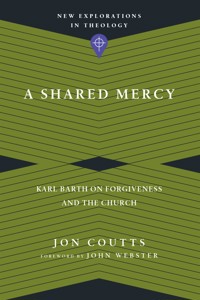
Christians regularly ask God to "forgive us our debts, as we forgive our debtors," but tend to focus on the first half and ignore the second. Something is missing if Christians think of mission only in terms of proclamation or social justice and discipleship only in terms of personal growth and renewal—leaving the relational implications of the gospel almost to chance. It is vital both to spiritual life and mission to think of the church as both invitation and witness to a particularly merciful social dynamic in the world. As a work of constructive practical theology and a critical commentary on the ecclesiology of Karl Barth's unfinished Church Dogmatics, A Shared Mercy explains the place and meaning of interpersonal forgiveness and embeds it within an account of Christ's ongoing ministry of reconciliation. A theologian well-practiced in church ministry, Jon Coutts aims to understand what it means to forgive and reconcile in the context of the Christ-confessing community. In the process he appropriates an area of Barth's theology that has yet to be fully explored for its practical ramifications and that promises to be of interest to both seasoned scholars and newcomers to Barth alike. The result is a re-envisioning of the church in terms of a mercy that is crucially and definitively shared. Featuring new monographs with cutting-edge research, New Explorations in Theology provides a platform for constructive, creative work in the areas of systematic, historical, philosophical, biblical, and practical theology.
Sie lesen das E-Book in den Legimi-Apps auf:
Seitenzahl: 539
Veröffentlichungsjahr: 2016
Das E-Book (TTS) können Sie hören im Abo „Legimi Premium” in Legimi-Apps auf:
Ähnliche










NEW EXPLORATIONS IN THEOLOGY
A SHARED MERCY
KARL BARTH ON FORGIVENESSAND THE CHURCH
FOREWORD BYJOHN WEBSTER
To Angie,Elijah, Brady, Jesse and Mattias.Thank you.
Contents
Foreword
JOHN WEBSTER(1955-2016)
A SHARED MERCY IS A STUDY of Barth’s theology of forgiveness as it is to be found in the work of his greatest maturity, the doctrine of reconciliation in the fourth volume of the Church Dogmatics. Writing about Barth well is no easy matter. Most of all, it requires command of Barth’s lengthy and complex texts—in the case of the Church Dogmatics, of a text on which Barth was at work for over thirty years, and that contains all manner of shifts of style, attitude, conversation partners and content. Because the texts are so discursive and often rhetorically as well as spiritually demanding, readers need uncommon presence of mind to absorb, appropriate and reach judgments about what Barth has to say. Alongside this, there is the need to make sense of the setting and development of Barth’s theology, without being swamped by genetic and evolutionary questions, and the need to master an enormous secondary literature and a conflicted history of the reception of Barth’s work. The best studies of Barth combine awareness of the large structural principles of his theology with sensitivity to the details of his writing; they avoid both deference and suspicion, and demonstrate a free gratitude toward this most generous of theologians; they meet Barth’s long-windedness with determined clarity of thought and economy of expression; and, more than anything, they respond to Barth’s invitation to take up the theological task in his wake and to think with and on occasions beyond him.
This book has all these virtues. Though other students of Barth have gestured toward the importance of forgiveness in Barth’s conception of Christian faith and teaching, the topic has until now received no full or adequate treatment. Beyond this substantial enrichment of the literature, the significance of A Shared Mercy is threefold. First, it makes a distinguished contribution to the understanding and reception of Barth’s ethical thought. Long considered indifferent or even hostile to moral theology, Barth is now widely recognized to have demonstrated a deep and abiding concern for human life and activity in relation to God. The book’s study of the human work of forgiveness and its ground and exemplary cause in the divine work of reconciliation provides further confirmation that Barth’s theology (especially, but by no means exclusively, in its later reaches) presents inter alia a lengthy reflection on God and creatures as agents in an ordered moral history. Second, the book takes Barth’s ecclesiology seriously. If Barth’s theology is sometimes considered to lack a sufficient sense of the church as human reality, this reading of the ecclesiology of Church Dogmatics IV demonstrates just how ample, complex and humanly dense Barth’s teaching about the Christian community in fact is. For Barth, the goods of the Christian gospel are not to be detached from the common life and activities of the reconciled people of God in whom forgiveness is embedded. Third, as A Shared Mercy unfolds what Barth has to say, it also invites its readers to reflect on the theology and practice of forgiveness. Barth hoped that his writings would provoke further work on the doctrinal and practical-theological work by which he was himself so deeply engaged. Those seeking to consider the ecclesial work of forgiveness in relation to the church’s troubled cultural locations will find much profit in what follows.
In short: this book is both a sure-footed and perceptive study of a largely undiscovered element of Barth, and an astute and at times moving essay in doctrinal, moral and pastoral theology.
Abbreviations
CD
Karl Barth. Church Dogmatics. Translated by Geoffrey W. Bromiley and Thomas F. Torrance. 4 vols. in 13 parts. Edinburgh: T&T Clark, 1956–1975.
ChrL
Karl Barth. The Christian Life: Church Dogmatics, IV/4: Lecture Fragments. Translated by Geoffrey Bromiley and Thomas F. Torrance. Edinburgh: T&T Clark, 1981.
KD
Karl Barth. Die kirchliche Dogmatik. 4 vols. in 13 parts. Zurich: Theologischer Verlag, 1932–1970.
Introduction
THIS IS A BOOK ABOUT FORGIVENESS, and as such it is about the church. To some this statement may seem exclusive, to others even contrary to experience, but by the time this book has been read hopefully the statement will not only make sense but also be found compelling. It is certainly not a new idea. Not only did Jesus tie divine forgiveness closely together with interpersonal forgiveness, but he also made it central to the life and identity of his followers. Thinking about this for a dozen years at varying degrees of intensity as both a student and a pastor has been personally transformative. It is difficult to tell whether it has had a greater effect on my personal life or on my approach to the church. Perhaps it is a good sign that, as a result of this study, I have found it more and more difficult to separate the two. Again, this is a book about forgiveness, and as such it is also a book about the church.
There have been a number of turning points for me in the study of this topic, not the least of which being my years as a seminary student under the teaching of David Guretzki, which in turn led to my encounter with the theology of Karl Barth. So invigorating and insightful was this encounter that it became imperative for me to try to articulate and to share what I was learning from him. This led me to PhD studies under the supervision of John Webster and, finally, to the book in front of you. In this book I believe I have some constructive things to add that should be most evident in the final chapters, but to get there it is best first to analyze the account of forgiveness, ethics and the church that is offered in Karl Barth’s Doctrine of Reconciliation (Church Dogmatics IV). This is, in my view, an aspect of his work that has not yet been fully appreciated by Barth scholars or, more importantly, by the church at large. Some readers may wish to skip to chapter four—and I think they will get the thrust of what is being put forward—but beginning with Barth in chapter one will provide the best backdrop for the argument that follows. We go back to Barth, not for novelty or popularity, but because we listen with the saints and the Scriptures to what the Spirit has to say to the churches today. Because this could be some readers’ first substantive interaction with Barth, allow me to begin with a brief introduction.
Karl Barth is best understood on his own terms: as a witness to Christ and a servant of the church. Born in 1886 in Switzerland to Fritz and Anna, Karl grew up in the home of a professor and former minister and began a pastorate in Safenwil at the age of twenty-five. There he married Nelly Hoffman, and with her served the church into his mid-thirties. During that time, spurred on by friendship with nearby pastor Eduard Thurneyson, he began exploring afresh what he had in one lecture called “The Strange New World of the Bible.” In the latter years of that ministry he wrote a commentary on Romans that would spark much discussion and propel him into full-time scholarship. With the acceptance of a professorial position in Göttingen in 1921, Karl Barth began an influential teaching and writing career that spanned five decades and brought him to three more universities. After Göttingen, Barth served half a decade each in Münster and Bonn before his resistance to Hitler forced him back to Switzerland, where he landed in Basel for the teaching post that would take up the remainder of his career. He became a prolific writer, considering his books less as finalized manifestos and more as ongoing projects—contributions to churchly deliberation at the lead of the living and active Word of God.
From early on Barth exemplified this commitment to an ever-reforming, communal process of faith seeking understanding by revising his Romans commentary for a second edition in 1922, just three years after the first edition had been completed. While revising it even further, Barth moved on to other projects.1 One of these was a short book on the Apostles’ Creed that, in reflection on the third article of faith contained therein, evocatively declared, “The forgiveness of sins or justification of the sinner by faith is the gift of the Holy Spirit. . . [and] the common denominator, so to speak, upon which everything that can seriously be called Christian life must be set.”2 Time would tell whether this was rhetorical flourish or whether it was something that Barth could explicate further. But it is notable that by 1940, with early works such as Credo and the Romans commentary in hand, Paul Lehmann had already called Barth’s theology “a reaffirmation of the great original theological treatise on the gospel of forgiveness. . . and an analysis of its effects upon contemporary culture and religion.”3 We might be tempted to call this hyperbole, except that Barth’s subsequent work actually bears the statement out. In the decades that followed, while Barth did not go on to produce a practical theology of forgiveness per se, the culmination of his life’s work had much to offer in this regard.
After some stops and starts (beginning in Göttingen with what he called Christian Dogmatics), in 1932 Barth published the first part-volume of the theological epic he would work on the rest of his life—Kirchliche Dogmatik, or Church Dogmatics (as it was gradually translated into English). With the help of assistant Charlotte von Kirschbaum, by the time of his death in 1968 Barth had seen almost four of the planned five volumes (thirteen part-volumes) through to publication. Although he had already broached these topics under other headings, it was in the fourth part—The Doctrine of Reconciliation—that Barth followed his christocentric theology through and focused squarely on salvation, sin, the church and mission. Unfortunately the volume went unfinished, but not before three massive part-volumes (and the baptismal portion of another part-volume) had been produced. Together with fragments of what was to be his “ethics of reconciliation”—published posthumously as The Christian Life—the approximately three thousand pages of Barth’s Doctrine of Reconciliation will be the focus of our study on the practical theology of forgiveness.
One could certainly perform this study on other parts of Barth’s corpus (or perhaps upon the entirety of it), but our goal is to follow Barth’s work through to its most practical, ecclesial ramifications. Thus we will perform a close reading of the most acutely pastoral sections of the Church Dogmatics, where we see Barth working up a compelling picture of what Christ’s reconciling work looks like as it comes to bear on Christian life and community. It is with a certain sense of loss that we read the posthumously published fragments and see Barth’s work trail off only a third of the way into the Lord’s Prayer, but in the final pages of Barth’s magnum opus it can justifiably be said that we see him fine-tuning what he had been describing (or at least gesturing at) all along. When it comes to the task of tracking down the conclusions he seemed to be reaching, it is not as if Barth left us with a shortage of material! While this book will be constructive in nature, its conclusions are not to be considered a speculative reconstruction of what Barth was about to say, but an accountably close reading of Barth’s work that builds on what he left us. What it endeavors to show is that contained within the sprawling ecclesiological vision of Barth’s Doctrine of Reconciliation there is a coherent theology of forgiveness that, though scattered and often implicit, offers itself up to be extrapolated and appropriated. Indeed, as I will argue, Barth prompts us to form an understanding of Christ’s ministry of reconciliation within which the practice of forgiveness most properly finds its home.
In its simplest terms, our goal is to better apprehend what on earth it means to ask our Father in heaven to forgive as we forgive, and our task is to do so from within a systematic theology particularly attuned to the task (see Mt 6:12 and Lk 11:4). What follows, then, is a critical commentary on the fourth volume of Barth’s Church Dogmatics that will assess and articulate his account of the place and meaning of forgiveness in Christian life and community. Given that there has been little direct study on this particular question, chapter one will begin with a brief review of some key literature pertaining to Barth’s ethics and ecclesiology, wherein gains will be noted and cautions heeded. With this in place, chapters two and three will provide a section-by-section analysis of The Doctrine of Reconciliation with a view to the topic at hand, weaving through the first three part-volumes in order to assess what it has to offer. This will lead to chapters four and five, which work out a Christian definition of forgiveness by embedding it along with other aspects of the church’s ministry of reconciliation in Christ. There we will see the imperative of sharing forgiveness as a free gift of God in Christ, will explore its connection to other acts of grace and will espouse a definition wherein forgiveness finds its telos in full reconciliation. The sixth and final chapter will then return to Barth’s Doctrine of Reconciliation, viewing it from the perspective of its unfinished ethics sections in order to read between the lines of the Lord’s baptism, Supper and Prayer, spelling out ramifications for the church’s common life.
Before we proceed any further, a note about gendered language is needed. Given that much of the source material for this project comes from a culture wherein masculine language was understood to represent both genders, many of the quotations will not be up to today’s standards of inclusivity. Where possible, I have abbreviated or paraphrased quotes to match contemporary convictions on the matter, but in many cases the alterations required would have proved awkward and distracting and have thus been left undone. To balance this out to some degree, other third-person pronouns have been employed in the feminine. In any event, let the reader understand that the retained masculine language is in no way meant to communicate or condone patriarchal thinking. In fact, the material content we are discussing should prompt us to an ever-greater vitality of mutual submission between Christian brothers and sisters, springing from a common reverence for Christ (Eph 5:21).
Finally, as this book represents work that spanned nearly a decade, allow me to express some thanks to those who were either intentionally or inadvertently drawn in by its gravitational pull. Their support took many forms, including encouragement, financial backing, prayerful solidarity and substantive counsel. It was in a small town with an early morning reading group in the middle of the Canadian prairies that I was first introduced to Karl Barth. As mentioned, it is David Guretzki whom I have to thank for guiding me to those invigorating discussions and opening up vistas for me to track down and further explore. If it was in the prairies that this project took off, it was in the highlands that it landed and found its legs. I consider myself incredibly fortunate to have had the opportunity to track down my questions in the company of a collegial rather than competitive group of scholars at King’s College in Aberdeen, Scotland. For helpful conversations too many to count, I thank Adam Nigh, Darren Sumner, Justin Stratis, Joe McGarry, Graham MacFarlane, Martin Westerholm, Scott Prather, Ben Rhodes, Josh Malone, Geordie Ziegler and Leon Harris, as well as a handful of others. Behind this vibrant research community stood Francesca Murphy, Philip Ziegler, Don Wood, Brian Brock and Chris Brittain, whom I have to thank not only for their excellent questions, but for showing me how to ask them. Most of all I am grateful for John Webster’s encouraging, patient and perceptive supervision. For him to say such kind things about this book is almost as much as I could have hoped for. I am glad to have thanked him in a meaningful way at his Festschrift last year. It was the last time I would see him. He is deeply missed.
As this project gathered momentum and at times threatened to snowball out of control, I found myself frequently benefiting from the support of churches and family and friends. It is impossible to name everyone, but in this regard I express appreciation to Terry Jackson, Jamie Davies, Aaron Gerrard, Chris Smith, Clayton and Tamara Puddicombe, Dale and Dani Harris, the extended Coutts family, everyone at The Mission in Aberdeen, and the good people of Selkirk, Beverly and Richmond Alliance Churches. Special thanks also to Anne Wilma, Andrew, Keziah and Naomi Louden, Melody and Brian Kilbank, Darlene and Fred Zelensky, Dorothea and Stewart Coutts, and all of my brothers and sisters. For reviewing some early drafts I thank David Robinson, Phil Stewart, Dot Coutts, Angie Coutts and Micah Smith. For supporting this work I also give my thanks to colleagues at Trinity College Bristol, and to everyone at InterVarsity Press.
All told, it has been the collaboration and commitment of my wife, Angie, that has made the most indelible impression on me. I am deeply grateful to her and to our sons, Elijah, Brady, Jesse and Mattias, for their sacrifices and solidarity on this journey, and am so glad for the wonderful surprises that awaited us. This book is dedicated to them.
1
What Is It About Forgiveness?
TENSIONSINTHE STUDYOF FORGIVENESS
In recent decades the topic of forgiveness has seen increased attention in the fields of philosophy, psychology, sociology and political science, owing largely to the prevalence of complex interpersonal and geopolitical conflict in the twentieth century. In these studies one often sees Christian theology mined for illustrative and effective content but underutilized in forming premises and reaching conclusions. This shortcoming applies often enough within practical theology as well. Given the centrality of forgiveness to Christianity, it should be of utmost concern to understand and appropriate this rightly.
One of the landmarks in contemporary forgiveness studies came in Hannah Arendt’s The Human Condition, where she rather famously labeled Jesus the “discoverer” of the human “faculty” of forgiveness, and thereby offered a qualified recommendation of its usefulness in social progress.1 Building on this in his book Before Forgiveness: The Origins of a Moral Idea, David Konstan explores examples of pre-Christian forgiveness and argues that, actually, not even Jesus had the same moral action in view that modern Westerners have today. Tracing back to “differences in the ancient and modern conceptions of the self,” Konstan claims that before Immanuel Kant the “ideology of forgiveness” was more general—concerned more with “assuaging anger” than initiating or sealing a reconciliatory exchange.2
It would seem that Konstan underappreciates both the New Testament’s influence on and its resonance with contemporary concerns, but his distinction of modern from premodern and ancient emphases is apropos. According to Charles Griswold’s analysis, “forgiveness is not seen as a virtue by the ancient Greek philosophers,” mainly because their “perfectionist views” of the moral field obscured the possibility of naming something virtuous that depended upon the presence of imperfection in order to be enacted.3 In the classic period, John Milbank observes “no real recommendation of forgiveness in a post-Christian sense,” noting instead the predominance of “a gesture of pure negative cancellation”—a gesture that could easily succumb merely to “a pragmatic ignoring of [faults] for self-interested reasons, or else to the taking into account of mitigating circumstances and involuntary motions.”4 Such generalizations and gestures are certainly not foreign to the hyperindividualized interpersonal encounters of today. Perhaps the more things change the more they stay the same.
When it comes to the appropriation of forgiveness in church history, Rodney Petersen succinctly relays the mixed legacy we inherit in that regard:
In the history of the church the practice of forgiveness has been clearly tied to penitence, most often privatized as a part of individual religious practice since the early medieval period. Throughout what became recognized as “Christendom,” the public significance of forgiveness often languished as more retributive conceptions of justice dominated social theory, power politics, and practice. Forgiveness was often “spiritualized” and removed from the practice of everyday life. While forgiveness might happen between God and an individual penitent, among persons and groups in society only some lesser form of condoning, dismissal, or forgetting appeared possible. The recovery of particular patterns of religious behavior and theology in the Protestant reforms caused Christians to rethink the topic.5
The difficulty has always been to find the right relation of forgiveness to repentance and reparation. In the face of lethargy toward the imperatives of grace, the tendency has been to motivate repentance by fear of punishment; in the face of oppressive legalism the tendency has been to emphasize the freedom of God’s love. As Carl Bråkenhielm reports, Peter Lombard called for contrition as the perfect repentance that arose from the love of God, while seventeenth century Pope Alexander VII declared fear-induced attrition acceptable as well, reckoning “imperfect repentance” nonetheless apt for God’s gracious appropriation.6 On either side of this tension lies the possibility for abuse.
As will be seen in this book, Karl Barth sought both to retain emphasis on divine mercy and to resist the descent of grace-invoking penitence into self-serving penance. This is no mere Protestant polemic: Barth vociferously warns against the assumption that the Reformation made anyone immune to the temptation to self-manage grace. Indeed, the similarities between pre- and post-Reformation impulses are not difficult to trace. Anachronistic caricatures of the sacrament of penance should not obscure the nuances of grace and accountability that, at the best of times, it aimed to observe. Despite the rise of indulgences and the threats of purgatory, pastoral handbooks show that good intentions and ideas coexisted with and preceded those more infamous church practices. For instance, medieval pastoral advisor Guido of Monte Rochen called penance a God-given way to mend the scars of sins already forgiven, promoting both the meritorious nature of contrition and the belief that it must take place within the activity of God.7 No doubt looking to retrieve some premodern impulses, John Milbank argues that for thinkers like Aquinas divine forgiveness was freely given but “realized through repentance,” thus when “mediated by the Church through the sacrament of penance, it was to some extent the case that. . . to forgive someone was actively to bring about reconciliation through the provision to the other of a positive means of recompense.”8 One must be careful not to overstate retrieval at the expense of the gains of reform, but it is worth noting that, for all the abuses, the proper impulse was to embed forgiveness within Christ’s ongoing work of reconciliation via the church.
Indeed, Christians overreacting to institutionalized forms of penance may take it up again in individualistic forms instead. This reality was felt early on in Martin Bucer’s attempt to replace priestly mediation with the establishment of Christlichen Gemeinschaften. By all accounts the post-Reformation attempts at thriving mutual accountability ran into obstacles and faltered as people found themselves still caught up not only in the power struggles of church and state but also the tensions of personal and corporate interest.9 As time wore on, these tensions would only be exacerbated by the fragmentations implicit in Enlightenment notions of freedom and the resultant heightening of individuality. Whether institutionalized or privatized, the temptation remains to try to manage grace by manipulating penitence.
Of course, the modern focus on individuality has not been entirely negative. It has also had the advantage of spurring new reflection on the personal and interpersonal implications of divine forgiveness and reconciliation. The most prominently recognized example of this turn has become a pair of sermons preached by Bishop Joseph Butler in 1718 at Rolls Chapel, London, titled “Upon Resentment” and “Upon Forgiveness of Injuries.”10 As explained by Griswold, Butler previewed the way “resentment and forgiveness are routinely linked in modern discussions,” signaling an emphasis on inner and interpersonal dynamics that would resound in the social sciences for centuries to come.11 This focus would only intensify in the twentieth century as the rise of global transport and communication coincided with the fallout of colonial injustices and surges in violence the scope of which the world had never seen.12 Concurrent with this was also an increased sensitivity to psychology and personal healing, which brought questions of forgiveness and reconciliation close to home. In this regard Everett Worthington considers Lewis Smedes’s 1984 Forgive and Forget to have been a formative influence: it triggered the interest of psychotherapists with its compelling depiction of forgiveness as a benefit to forgivers.13
In the developments of the last century, what Anthony Bash finds most notable is the fact that forgiveness garnered a wide range of attention apart from religious conviction. Desperate for alternate modes of conflict resolution in light of the visibly downward spiral of violence and retribution, more and more people have found the idea of forgiveness profoundly pertinent to interpersonal and sociopolitical affairs.14
What should be clear from this brief sketch is that forgiveness is at the same time both elemental and complicated. The notions and practices of forgiveness found in any time or place may present parables (or forgeries) of Christian forgiveness. In any case, one must understand forgiveness Christianly in order to see where the similarities begin and end. When George Soares-Prabhu observes analogies to Christian forgiveness in the Buddhist tradition, he rightly maintains that even if mercy and compassion “are not exclusively Christian attitudes, the importance given to them in the teaching of Jesus, and the concrete forms they assume in the New Testament, give them a specifically Christian significance.”15 With Barth, our goal is to better understand forgiveness within Christ’s mission of reconciliation.
THE FOREGROUNDINGOF FORGIVENESSIN BARTH’S THEOLOGY
More than a decade before Barth began the fourth volume of his Church Dogmatics, Paul Lehmann wrote a book called Forgiveness: Decisive Issue in Protestant Thought, which spent a considerable portion of its latter half tracing the trajectory of Barth’s thought. Without really delving into practical matters, it certainly promoted serious study of forgiveness in Barth’s theology. In Lehmann’s view, if Roman Catholics thought forgiveness to be available to humanity naturally, then Reformers had taken the opposite view—only to let the far-reaching implications of this fundamental conviction get temporarily pressed out by other matters.16 Attending to its retrieval, Lehmann pointed to the assertion of Albrecht Ritschl, who said, “The immediate object of theological cognition. . . is the community’s faith that it stands to God in a relation essentially conditioned by the forgiveness of sins.”17 With Barth, Lehmann detected both a renewal and a sharpening of focus. What Barth highlights for us, he observed, is that Ritschl’s object of theological reflection is not the God revealed in Christ, but the faith of the community and the “consciousness of those who believe in Him.”18 This distorts the picture considerably, turning us from apprehension of Christ’s mercy to the practice of “self-forgiveness.”19
As Lehmann saw it, Barth posed a powerful question to Roman Catholics and liberal Protestants alike—namely, “Is forgiveness fundamentally an unheard-of miracle, or is it something other, something less than that?” Well before Barth wrote his Doctrine of Reconciliation, Lehmann detected his trajectory and began to track it down: “New horizons of forgiveness open to the eye that inquiringly follows Barth’s answer to this question”: “What is the significance of the grace of God in Christ for the man to whom it comes?”20
Breaking this query into three parts, first Lehmann asked how this grace is “to be thought of as coming to man” and suggested that Barth’s “answer is that the grace of forgiveness comes to man as the crisis of his existence.”21Second, Lehmann asked what this grace tells us about those to whom it comes, and postulated Barth’s answer as follows:
Man exists altogether by the grace of God. When man is forgiven, he is forgiven in toto and from moment to moment. The consequence of the discontinuity between God and man is that God forgives man as the sheer miracle of his love and that when he forgives, man’s whole existence is changed. Changed?—yes, but not as the simple moving from one house to another. Forgiveness. . . is the paradox of a futuristic indicative, of a forgiveness that is present as a hope, as a promise, and which in spite of its being a promise is at the same time an event for the man to whom it comes. We have grace. Yes, but in no sense as a possession of our own.22
Third, Lehmann moved from the language of crisis to the language of Christian faith and asked how this grace comes in Christ. For him, Barth’s answer was simple: “Just as the Cross is significant because it is that event which is followed by the resurrection. . . forgiveness is an event in which. . . I actually am that which I actually am not. In Christ, I am a new creature because I am forgiven.”23
So it was that in 1940 Paul Lehmann thought it possible to indicate the “structure” of Barth’s doctrine of forgiveness, even though he himself had not made it explicit.24 For Barth, forgiveness is provided once and for all by Christ, and as it comes to us in Christ it perpetually intersects with everyday life as an event wherein we are freed from the old self and freed for the new. In comparison with the more robust expression of his later work, it appears that early on Barth’s view of the role of the community in this life of faith was still underdeveloped—but the foundations were in place for what was yet to come.
In the decades since Barth’s Doctrine of Reconciliation, the ecclesial ethic of forgiveness entailed in his final volumes has been broached generally but has not garnered direct analysis of its own. Reflecting mainly on The Doctrine of Creation, Gerald McKenny observes that, for Barth, forgiveness is a Christ-given “refusal to treat sin as the final word, and thus, in the form of the ethical imperative, it demands an ethos in conformity to it.”25 Analyzing Barth’s politics, Todd Cioffi hearkens to his view of church as a “sympathetic communion” in which there is a “straight line” from God’s mercy to our “very definite political problem and task.”26 Writing about Barth’s account of agape, Caroline Simon suggests that he comes to lean heavily on Augustine’s portrayal of the church as a place of mutual forgiveness.27 Insights such as these gesture at something about which so much more could be said.
For Barth, the church as such shares an imperative of mercy, and in every encounter and endeavor looks to resound with John’s refrain: “Look, the Lamb of God, who takes away the sin of the world!” (Jn 1:29 NIV). Above Barth’s desk famously hung Mathias Grünewald’s painting of the crucifixion, which shows John the Baptist pointing to Christ. Barth considered this image an encapsulation of his Church Dogmatics.28 The consistency with which Barth follows this through is worthy of our attention. Our analysis will show that for Barth the imperatives of forgiveness and reconciliation find genuine place and meaning in the context of a christological ecclesiology set within the mission of God. Before we begin, it may be helpful to say a word or two more about the ecclesiology and ethics of his final volumes.
KARL BARTHON CHRISTIAN LIFEAND COMMUNITY
Any approach to the question of Karl Barth’s theology of forgiveness must first recall that for Barth it is Jesus Christ who focuses every doctrine. Some reckon the results rather “constrictive,” suggesting a christomonistic distortion of other doctrinal loci, but Daniel Migliore is right that Barth’s christocentrism is meant to be more about “precedence” than “exclusion.”29 The result is a theological approach that is not immune to error but is certainly more properly illuminating than that which is consciously or unconsciously rooted in anthropology. It is the resurrection of Jesus and not an abstract principle with which Barth is trying to grapple when he focuses doctrines through a christocentric lens. This is well illustrated in his unfinished ethics of reconciliation, in which he insists that the ethical task cannot be generalized or reduced to legalism or casuistry, but must expound the “ever-new event” of “encounter with the living God.”30
Differentiated in this way, Barth’s “special ethics” has a definite appeal to it, but it is worth noting that his approach put him at odds with Catholic and Protestant theologians alike. Some question not only his ethics but also his ecclesiology for offering what appeared to be a diminished account of the continuity (and thus the reliability and accountability) of Christian life and community. While it is not the goal of this book to resolve these questions, it may be helpful to give a positive account of Barth’s approach before we proceed.31 Barth’s answer, in short, is that continuity is provided by Christ himself, so that the Christian life is a matter of perpetual renewal in God’s grace rather than a possession of achieved virtues or timeless truths. Not only does this construal bring forgiveness into the foreground of Barth’s ethics, but it also impacts our understanding of what a forgiving community does. Thus it will do us well to briefly situate ourselves in the ongoing conversation of Barth’s ethics and ecclesiology.
In 1981 William Werpehowski addressed two complaints that had come to (and still) typify the concerns over Barth’s ethics.32 Even if they are aptly rebutted, these complaints continue to offer correctives to misapplication. The first, attributed originally to James Gustafson, was that Barth so construed ethics in terms of God’s commanding that when it came to moral discernment the human agent was rendered either wholly passive or privately self-assured. The charge (sometimes labelled “occasionalism” or “intuitionism”) was that Barth became something of an existential fideist, isolating ethics to the realm of private preparation for an unaccountable message from God.33 The second (not unrelated) complaint, associated with Stanley Hauerwas, was that Barth’s “command-obedience-model” excluded the community to such an extent that Christian life lost its sense of continuity and character.34 In what remains of this first chapter we will address these complaints in three parts, beginning with Barth’s account of human and divine agency, then of the centrality of invocation in ethics, and then of the place of continuity and character in Christian community.
Divine and human agency: Self-control as Spirit’s fruit. A careful reader of Barth’s Dogmatics is led to believe that the paradigmatic tension in Christian ethics might be found in Galatians 5:22-23, where one of the fruits of the Spirit is said to be self-control. As verse 25 indicates, “we live by the Spirit”—even in self-control. If it is our sinful trajectory to work this out on our own, it is Barth’s concern to describe how it remains a work of God.
Barth’s attentiveness to this point might be attributed to his particular historical moment: aghast that his mentors in Protestant liberalism did not seem to have the theological equipment to resist the German call to war, Barth turned to Scripture for reorientation.35 As a result, Joseph Mangina observes, if “Kant and Schleiermacher inaugurated a theological turn to the subject,” Barth proposed to steer “away from the human and toward the divine Subject” in the conviction that only there could humanity get its bearings.36 This determination to ground ethics in divine agency of course led to the question of whether human agency was swallowed up in God’s. But Eberhard Jüngel summed up the logic of Barth’s claim rather to the contrary: by commanding invocation as “the basic act of the Christian ethos,” God “purges himself from the base suspicion that he is [a] deity whose divine nature condemns him to be the only one at work.”37 Similarly addressing the charge of “divine monergism,” Sheila Greeve Davaney points out that for Barth “God’s determining knowledge and will do not cancel worldly self-determination but rather establish it.”38
On this account, it seems that for Barth there are two expressions of human freedom: there is the designated freedom of living in obedience to the Creator, and there is the permitted shadow freedom in which humanity can opt not to so live. Humanity is ontologically determined by and for the creaturely freedom of obedience, but entailed in this is the freedom to reject the relationship as given. Daniel Migliore reckons that living outside of God’s designs is a given prerogative, but that it sells the notion short to call this freedom.39 Indeed, for Barth it amounts to an “impossible possibility”—apart from divine givenness humanity’s freedom becomes tragically ironic; it assumes autonomy and ends up in slavery to what Barth calls “lordless powers.”40 As John Webster puts it, humanity “loses its proper agency in grasping after omnicompetence”—and “suffers.”41 In Barth’s words, “God is indeed everything but only in order that man may not be nothing.”42
What about the objection, then, that in this construal the human agent disappears altogether? This is, of course, not a problem unique to Christian theology. As Charles Taylor noted, all accounts of human freedom come against the problem of “relating freedom to a situation,” so that the most thoroughgoing arguments for “complete freedom” tend to render the human subject cut off and “situationless.”43 With this in view Joseph Mangina avers, “By grounding human identity solely and exclusively in Jesus Christ, Barth exposes the lie at the heart of both modernity’s self-absorbed hubris (I can/must be everything) and postmodernity’s self-absorbed despair (I am after all nothing).”44 In Barth’s statement that “God does not will to be God without us,” Webster says, we should not hear “the limitation of divine freedom, but rather its specification”: it is a freedom that “specifies rather than hems in the creature”45
This account of human freedom is certainly not original to Barth, but it does stand to be more fully appreciated for what Webster calls its “ethical import” for the “reciprocal active life of humanity.”46 With a view toward critical appropriation of Barth’s ethic of forgiveness and reconciliation, we must thus attend briefly to his chosen rubric of invocation, and then to what Mangina refers to as the “social character” of the in-breaking kingdom of God.47
Invocation and moral discernment: A tale of two trees. One of the most provocative lines in Barth’s Dogmatics has to be in the first part of volume four, when he gestures toward the Garden of Eden and suggests that what the tempting serpent had in mind was “the establishment of ethics.”48 We will misread this rhetoric, however, if we hear in it a degrading of ethical discernment rather than a denouncing of ethical presumption, or its mastery apart from invocation of God. As David Clough observes, Barth is often misunderstood on this score in three ways: he is thought either to be recommending “a voice in our head telling us what to do,” to be denying the activity of discernment, or to be perpetuating postures of moral superiority.49 In Clough’s view, Barth’s account does not shut up but enlivens the ethical endeavor by insisting “that we never stop seeking out God’s word to us”:
It is straightforward to concede the point that ethicists do not speak with the voice of God, and so may make errors in their method or conclusions. It is harder to let go of an ambition for Christian ethics to develop solid and reliable principles and values that will in turn generate conclusions that can be depended upon. Barth maintains in this second claim that Christian ethics must not aim so high. We must free ourselves of the temptation “to win clear of the occurrence, the freedom and the peril of this event, to reach dry land, as it were, and to stand there like God, knowing good and evil.”50
For Barth, God’s command is always freshly discerned. This construal may sound disconcertingly open to arbitrariness and abuse, but is this not the case with any ethical system? As Nigel Biggar observes, it is just as easy to pour “the dictates and pronouncements of [one’s] own self-will into the empty container of a formal moral concept.”51 Attuned to the voice of the living Lord who is trusted to be self-consistent, Barth contends, the church is most prepared to resist both fixed traditionalism and fickle trendiness.
For all his resistance to making an “anticipatory judgment,” Barth does not think that the “ethical event” of the day-to-day Christian life is left to be tackled apart from “instructional preparation.”52 Christians trust that God’s commands will not be ultimately discontinuous with what has been relayed in Scripture and heard by the church. Barth certainly emphasized the “final mystery of the encounter” with God, but in the face of this he also sought to counter the notion that there could be “no definitive statements” made or “certain lines” taken.53 In fact, Barth said, “To draw these lines, to give these directives, is, in a general way, the task and theme of special ethics.”54 Thus there is license given by Barth himself for the final chapters of this book, wherein the implicit shape of his ethic of reconciliation will be drawn out more explicitly and built upon.
Before venturing into this, however, it is worth returning to the conditions Barth places on such an ethic. For him, Christian obedience means attending to biblically traditioned imperatives without freezing them in prescriptions or digging beneath them to secure timeless principles. As Simon puts it, this calls for “prayerful, open inquiry concerning how to be God’s lovers in. . . concrete places and shifting times.”55 None of this need completely preclude the use of reason, the place of social norms, or the tutored reflection upon lives well lived, but it does embed these things within the primary activity of asking and listening for God’s command together.56 Barth did not think we could reason our way to God’s command, but he did think we could reason with it.57 As Werpehowski explains, our understanding of the “givens” of daily life and history will surely be challenged by God’s self-revelation, but those “givens” will still be relevant. While it may offend presuppositions, Christ’s command will be knowable to those seeking understanding in faith, and even intelligible to those seeking understanding without.58 Nonetheless, in the “ethos” of the Lord’s Prayer, believers are freed for action in a manner that in a vital sense “can never at any stage or in any form be anything but the work of beginners.”59
Furthermore, because it takes place in a sphere that is not only contingent but fallen, Biggar is right that such an ethic is “epistemologically erroneous” when it abstracts moral discernment from both the condition of creaturely freedom and the situation of human sin.60 For this reason it is especially interesting to note that before deciding to use the Lord’s Prayer as a framework for his ethics of reconciliation, Barth considered utilizing the rubric of the “pardoned sinner.”61 Surely the move was a step up rather than sideways, since the content of the latter is well contained in the former. For our purposes, Joseph Mangina captures the import that remains: “To act morally is not to step into a vacuum, but into an ontological space defined by the events of the cross and resurrection. . . . To ground ethics in prayer is therefore to set it under the mark of the forgiveness of sins.”62
For this reason Stanley Hauerwas rightly insists that “there can be no ethical use of scripture unless we are a community” that is “morally capable of forgiveness”—but in Barth’s view it is precisely at this point that we must be careful not to be thrown back on our own capacities and conventions.63 Such would be the ethic of the forbidden tree in Eden rather than the emptied cross of Calvary. One of the fruits of the Spirit is certainly self-control, but Barth’s point is that if it does not remain a fruit of the Spirit the self-control in question may stem more from the First than the Second Adam’s tree.64
For Barth this is no reason for ethical paralysis. In everything it does the church “will always need the forgiveness of the sins which it commits,” but it is better to do “something doubtful or over bold, and therefore in need of correction and forgiveness, than nothing at all!”65 On this account, Christ’s mercy is to be invoked in the church’s common life not only in the event of its potential failures but as a constitutive propellant in the ethical pursuit itself. Before we set our teeth into Barth’s Doctrine of Reconciliation it will be helpful to consider how he approaches questions of continuity and character as it regards that common life.
On church growth: Continuity, character and mission. At the outset of the Dogmatics’ fourth volume Barth indicates that “God with us” is “not a state, but an event.” As such the church must not “degenerate into. . . an ecclesiastical form” that is “self-resting and self-motivated,” or an “ethical system” that is “self-justified and self-sufficient,” because “when this happens, the Christian message as such will no longer have anything individual or new or substantial to say.”66 This “event” characteristic is highly relevant to the way we construe the church’s inner life, not to mention its witness.
The most prominent early attempt to grapple seriously with Barth’s ecclesiology came from Hans Urs von Balthasar. The Church Dogmatics were only half-finished when he called fellow Catholics to take note of this theology that presented the “deepest drive” of the Reformers’ protest with “immense constructive power.”67 For his part, von Balthasar’s reservations revolved around the question of how the church’s life might be viewed analogously to Christ’s. Where analogia entis located the analogy at the level of form, Barth’s analogia fidei located it at the level of orientation, such that revelation remains reliant on God’s revealing, and action on God’s activity. With this von Balthasar did not entirely disagree. He wrote that “the essence of the Church is the promise of salvation and not its ‘guarantee.’”68 However, where von Balthasar pointed to the incarnation as the establishment of sin-cleansed forms of human life, Barth pointed to the resurrection as the validation of the incarnate Son’s perpetual submission to the Father.69
So it is that Barth read the body of Christ metaphor in terms of ongoing reliance on a living Head, and von Balthasar in terms of solidity of representation on earth. As the latter theologian puts it, a “body simply cannot consist of isolated moments of actuality”; God is “free enough” to endow social structures with a form analogous to himself rather than make moments and individuals the locus of his reconciling work.70 In reference to another metaphor, von Balthasar explains, “the Church is not only the Body of Christ but also his Bride”; for all her dependence on Christ she has still been given the integrity of “relational otherness.”71 To some it may seem like splitting hairs, and to others an overreaction to the problems of the sixteenth or the twentieth century, but in contrast with von Balthasar, Barth rigorously maintains God’s freedom in the church’s enablement, insisting that the church retain the character of an event, not an institution. God freely binds God’s self to humanity in the person of Jesus Christ, without instituting or establishing a secondary mediator. This self-binding retains the fundamental character of an ongoing relation in history. God is no more inclined to hand over the reins at any point than to have Adam and Eve take for themselves from the tree of the knowledge of good and evil. In other words, the Bride is Bride precisely as she submits to her Groom, and the Body is Body inasmuch as it relies on its Head.72
After von Balthasar, theologians have tended to defend Barth’s ecclesiology by highlighting how it applies christological correctives to good effect.73 In this, the working premise is not that the hypostatic union has natural parallels in creation, but that divine self-consistency leads us to see in the relation of Christ’s divinity and humanity a pattern for perceiving the relation of Christ and his church. It is not unusual to make the point that just as Jesus is born to a virgin, so the church is divinely initiated. What Barth presses further is the point that just as Jesus is the Christ in submission to the Father by the Spirit’s power, so the church is the church precisely in its submission to Christ. The origin and nature of the church are not treated as two separate aspects but one. Barth speaks of the church in historical terms “as an event that must be constituted again and again through the work of the Holy Spirit.”74 This is the mystery he refuses to explain away: the church by definition has duration not in itself but from outside itself.
Kimlyn Bender traces this theme from Barth’s Epistle to the Romans right through to his Calvin lectures and Church Dogmatics: in the former the true church on a sin-soaked earth is pictured as a tangent touching a circle, and in the latter it is depicted as a vertical line perpetually intersecting a horizontal.75 In retrospect, each of these images is probably best when they are held together. Since one could theoretically zoom in on such a mathematical point indefinitely without ever seeing a point of contact, the tangent illustration can lend itself to Docetism. Thus the image may be best combined with that of vertical intersection, especially if it is imagined as a motion picture rather than a snapshot. To explain, Bender helpfully appropriates von Balthasar’s counterpoints in order to argue that the church’s “recognition that it lives only in constant dependence upon a divine power” is precisely what gives vitality to its “confidence even in the precariousness of its historical existence.” Thus it must “commit itself to ordering its external life in correspondence to its inner reality.”76
One can see why the question is repeatedly raised as to whether Barth leaves himself any room to speak of the church in terms of an enduring form. For his part, Bender acknowledges a potential deficiency in Barth’s work on this point, while maintaining that it was occasioned by a contextualized need to be adamant against the reduction of theology to sociology.77 When the church forgets this, its efforts tend to be “emptied of their divine power and thus profane: preaching becomes instruction; sacraments become religious rites; theology becomes philosophy; and mission becomes propaganda.” Extending the still-relevant caution forward, then, we may find space to further specify Christian practices of forgiveness and reconciliation while nonetheless heeding Bender’s (Barthian) reminder that there is no “intrinsically sacred sociology.”78 Such is the explicit endeavor of this book’s final chapters.
In Nicholas Healy’s view, Barth’s theology pushes us not to settle for “abstract ecclesiology” at the point when it calls for specificity.79 Retaining Barth’s adage that it is the world that “exists in self-orientation” and the church that “in visible contrast cannot do so,” Healy nonetheless suggests we “retrain ourselves to. . . still talk about the configurations of practices that make us who we are.”80 Without this our account of the visible church might look less like the “rock” Jesus pictured in Matthew 16:18 and more like a piece of driftwood furtively popping up in the rapids. Joseph Mangina sees the latter “occasionalistic” reading as a failure to account for Barth’s “unsparing. . . rejection of ecclesial docetism,” not to mention his construal of the sacraments as God-ordained shapers of the church’s common life.81 With particular relevance for the argument of this book, Mangina explains,
To paraphrase Stanley Hauerwas only slightly, the eucharist does not just imply a social ethic, it is a social ethic. . . . Implicitly, we would have to go on from an account of the eucharist to what may be called the church’s “politics of forgiveness,” the enactment of reconciliation in its common life, and to talk about possible parables of such reconciliation in the wider world.82
With comments like these in mind one can see why, in the chapters that follow, I explain Barth’s theology of forgiveness within the context of his ecclesiology, and the practices of forgiveness within the ministry of reconciliation. Neither is properly understood without the other.
Before we proceed, it is worth highlighting how integral all of this is to Barth’s missiology. For Barth, the church is nothing if not a witness to Christ. Furthermore, if we divide the external witness of the church from its internal identity and action, the church quickly becomes a mediator in too strong a sense. As missiologist J. C. Hoekendijk explained, we run into problems of the sort where “God is recognized in an almost deistic fashion as the great Inventor and Inaugurator of the Mission, who has since withdrawn and left the accomplishment of the mission to His ground personnel.”83 The church looks to its own inner life as the thing to be duplicated, rather than conceiving of that life within the eccentric movement of God. As Nate Kerr has argued, this kind of thinking leads the church to conceive of its set-apartness in terms of distance or superiority rather than particularity of its “ongoing solidarity with the world” in the event of Christ’s reconciliation.84 In Barth’s view, as this book will argue and further explain, the grace and love of Christ are shared and received in the same motion.
Hopefully it is clear that the topic of interpersonal forgiveness makes for an ideal point at which to test the reach of Barth’s special ethics and ecclesiology, and that the latter gives context for a better understanding of the former. In the chapters that follow my contention is that practices of forgiveness and reconciliation are right at the heart of Barth’s “ever-new” and eccentric view of Christian life and community. Decades ago Paul Lehmann rightly identified forgiveness as a vital theme in Barth’s theology. What this book aims to do is further explicate its place and meaning in the church’s common life and witness.85 We begin in the next chapter with a thematically attentive guide to The Doctrine of Reconciliation.
2
Forgiveness inChurch Dogmatics IV
IN ORDER TO ASSESS Karl Barth’s understanding of interpersonal forgiveness within the life and witness of the Christian community, it is crucial to recognize how he set it in the context of the divine forgiveness central to God’s reconciliation of the world to himself in Christ. Thus in this chapter we will investigate The Doctrine of Reconciliation (Church Dogmatics IV) by being attentive to the internal logic of Barth’s account, following the outline paralleled within each of the three completed part-volumes (and echoed loosely in the posthumously published ethics section as well). As illustrated in table 1, Barth told the story of reconciliation by cycling three times through Christology, hamartiology, soteriology, ecclesiology and spirituality.1 In this thrice-repeated fivefold arrangement Barth gave mutually complementary portrayals of each topic under consideration, building a systematic theology more symphonic than linear.
In order to retain Barth’s rhythms of thought without being overly confined to them, this chapter and the next will weave freely through Barth’s five recurring themes—Christ, sin and salvation in this chapter, church and spirituality in the next—before gathering up, explaining and building on what has been found. This formal adherence to the flow of Barth’s argument does not require material restriction to each section. I will take into account the relevant nuances of each part-volume as appropriate so that theological commitments can be traced to church imperatives. Indeed, by tracing forgiveness back to its roots in divine election and through to its telos in final redemption, we will see why Barth thought that only in the context of Christology could forgiveness be properly understood.
Table 1. Arrangement of Church Dogmatics IV
Volume
IV/1
IV/2
IV/3
IV/4
Overview
§57–§58
§74
§75 The Lord’s baptism
§76 Invoking “Our Father”
§77.1/78.1 Honoring God with us
§77.2/78.2 Revolt against false peace and lordless powers
§77.3/78.3 We hallow the Name and pray God’s kingdom will come
§77.4/78.4 Hear God’s command, seek God’s justice
(§__ The Lord’s Prayer)
(§__ The Lord’s Supper)
Christology
§59 Lord as Servant: Jesus Christ, true God (priest)
§64 Servant as Lord: Jesus Christ, true human (king)
§69 Jesus is Victor: Promise of life with humanity (prophet)
Hamartiology
§60 Sin as pride and fall, seen in light of obedience of Son of God
§65 Sin as sloth and misery, seen in light of active reign of Son of Man
§70 Sin as false-hood and condemnation, seen in light of True Witness
Soteriology
§61 Justification: Jesus frees from sin, as Judge judged in our place
§66 Sanctification: Jesus frees for life of discipleship and self-giving
§71 Vocation: Jesus calls to serve as witnesses to ends of God
Ecclesiology
§62 Holy Spirit gathers for Christian community
§67 Holy Spirit builds, grows and orders the community
§72 Holy Spirit sends, tasks community for the world
Spirituality
§63 Holy Spirit awakens for life of faith
§68 Holy Spirit quickens for self-giving love
§73 Holy Spirit enlightens life in hope
Note: The fourth column does not correlate with the rest, although some patterns can be detected. Sections in italics were posthumously published. Sections in parentheses were never written.




