


10,49 €
Mehr erfahren.
- Herausgeber: Elliott & Thompson
- Kategorie: Wissenschaft und neue Technologien
- Sprache: Englisch
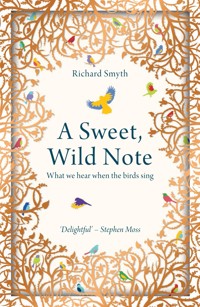
A Guardian 'Readers' Choice' Best Book of 2017 Birdsong is woven into our culture, our emotions, our landscape; it is the soundtrack to our world. We have tried to capture this fleeting, ephemeral beauty, and the feelings it inspires, for millennia. In this fascinating account, Richard Smyth asks what it is about birdsong that we so love. Exploring the myriad ways in which it has influenced literature, music, science and our very ideas of what it means to be British, Smyth's nuanced investigation shows that what we hear says as much about us, our dreams and desires, as it does about the birds and their songs. At a time when our birdsong is growing quieter, with fewer voices, more thinly spread, A Sweet, Wild Note is a celebration of the complex relationships between birds, people and the land; it is also a passionate call to arms lest our trees and hedgerows fall silent.
Das E-Book können Sie in Legimi-Apps oder einer beliebigen App lesen, die das folgende Format unterstützen:
Seitenzahl: 207
Veröffentlichungsjahr: 2017
Ähnliche
















Praise forA Sweet, Wild Note
‘Well worth a read . . . hits many sweet notes’
– Mark Avery, author of Remarkable Birds and Inglorious: Conflict in the Uplands
‘A delightful meditation on the wonders of nature’s best free show – birdsong – and how it has seeped into our culture through the ages’
– Stephen Moss, author of Wild Hares and Hummingbirds and Wild Kingdom
‘Between the fibrillating throats of birds and the human mind lies an extraordinary landscape, a place created by the intersection of culture, biology, and literature. Richard Smyth is a brilliant, insightful, and witty guide in this fascinating terrain’
– David George Haskell, author of The Songs of Trees and the Pulitzer finalist, The Forest Unseen. Professor of Biology, University of the South
‘This is a delightful book that does exactly what it says on the cover: it plays a sweet wild note. If you are already tuned in to bird song you will learn a lot more and if you aren’t you will want to be. Reading it honestly seems to have improved my (ornithological) listening and hearing as well as cheering my heart’
– Sara Maitland, author of Gossip from the Forest: The Tangled Roots of Our Forests and Fairytales
For Frin
Contents
Prologue
1. An Infinity of Possibilities
2. A Song of Many Parts
3. Coming Home
4. An Elusive Song
5. A Captive Melody
6. A Hush Descends
Further Reading
Acknowledgements
Index
The language of birds is very ancient, and, like other ancient modes of speech, very elliptical; little is said, but much is meant and understood.
– Gilbert White, letter to Daines Barrington, September 1778
These are brand-new birds of twelve-months’ growing, Which a year ago, or less than twain, No finches were, nor nightingales, Nor thrushes, But only particles of grain, And earth, and air, and rain.
– Thomas Hardy, ‘Proud Songsters’ (1928)
Prologue
My feelings about birdsong – no, my problems with birdsong – were crystallised for me in, appropriately enough, a tweet, one day in 2011:
@BrianGittins1: The birds are talking to one another in their stupid language.
It was the comedian David Earl, tweeting in the guise of his alter ego Brian Gittins. It was a joke, of course. But for me, it felt liberating – like reading an article about how Futurama really was a better show than The Simpsons, or meeting someone who says that no, they don’t really get Radiohead’s later albums either.
My name is Richard and I was a birdsong sceptic.
I’d better explain myself. I’m a birdwatcher;* I have been, on and off, since I was little (I inherited it from my granddad, along with skinny ankles and a love of Test cricket). The thing was, as a kid I didn’t do a great deal of actual birdwatching. In theory, I was all for it; in practice, it turned out that the countryside, once you got there, was just so full of diverting alternative pastimes (playing army, going on rope swings, falling out of trees, general fighting, shouting, etc.) that the birds didn’t get a look-in. One just didn’t have the time.
But I was a studious reader of nature books, field guides, the magazines sent out by the Young Ornithologists’ Club – anything, really, as long as birds were involved. The nineteenth-century naturalist Charles Waterton (who lived just down the road from where I grew up in Wakefield, West Yorkshire) warned about people like me: young amateur naturalists ‘who spent more time in books than in bogs’.
This explains, I think, why for a long time my experiences of the bird-life around me – the way I saw it, identified it, thought and felt about it – were missing a dimension.
When I was twelve or so, I could identify practically any bird in my bird book by sight (give or take the odd wandering warbler or far-off winter gull). Here is a full list of birds I could identify by sound alone at that age:
(1) Some sort of crow
I knew a caw when I heard it. It meant there was definitely a crow or a rook or a jackdaw or possibly a magpie in the vicinity.
(2) (a) A woodpigeon, unless it was a collared dove
(2) (b) A collared dove, unless it was a woodpigeon
I knew a coo, too. It’s strange to think that collared doves were unknown in the UK until the 1950s; when I was a boy, in 1980s suburbia, they were all over the place, like pale-grey pebbles balanced on roof-ridges and half-hidden in leylandii.
(3) A duck
Well, come on.
(4) A herring gull
The twanging pyah pyah pyah bawled from a fishing-village chimney was – and still is – the sound of a summer holiday on the Yorkshire coast, no less than the marvellous ching, chunk, whirr and bleep of Corrigan’s seafront arcade in Scarborough.
(5) A peacock
Surprise entry at Number 5. Our suburban cul-de-sac was bounded on one side by Mr Andrassy’s smallholding. It can only have been an acre or two, but at one time or another he kept geese, deer, guinea fowl, goats and peacocks. They were often on our back lawn, confusing the cat. Andrassy’s smallholding is all houses now.
Birdsong wasn’t part of my world. No, that’s not quite right: it was, but – like my parents’ mortgage, or the government’s education policy, or the electronics of my GameBoy – I couldn’t make anything of it; it didn’t mean anything to me. I was shut out of the birds’ conversation.*
This book is about what I’d been missing – partly, at least. It’s also about what people – poets, bird fanciers, composers, film-makers, ornithologists, you, even me – have been hearing. It’s about skylarks and nightingales (much harder to avoid in poetry than in real life), but it’s also about magpies and wagtails, chaffinches and sparrows; it’s about the tuts and sneezes of the wren, the booee of the starling’s swanee-whistle, the blackbird’s burble, the woodpigeon’s somnolent coo (‘take two cows, Taffy,’ they’re supposed to say); the squeaky hinge of the great tit, the chiffchaff’s unending two-step, the jay’s B-movie screams in the oak canopy. All the stuff I never really paid attention to.
The funny thing is that I wasn’t alone in my cluelessness about birdsong. In 1935, the biologist Walter Garstang – of whom more later – lamented that ‘the number of our countrymen and women who can pick out an individual song from the orchestra of spring and correctly identify it is extraordinarily small’. Even way back in the 1760s, the naturalist Gilbert White (one of the great listeners) found that the yeomen of his Hampshire village believed that the reeling call of the grasshopper warbler was made by an insect: ‘The country people laugh when you tell them that it is the note of a bird.’
It’s not that they didn’t care, exactly. They just didn’t listen.
Percy Edwards, who went on to find fame on the radio as a peerless and painstaking bird-imitator, recalled the music-hall ‘bird whistlers’ with whom he’d often shared a bill in the early days of his career. Many would just stick their fingers in their mouths and whistle, making a noise like no bird ever made; to impersonate a thrush, one of them told Edwards, ‘I just do the same noise I do for them all.’ The audiences, presumably, didn’t know what sort of noise a thrush (or a skylark, or a blackbird) actually makes – but they’d still paid for a ticket. Perhaps the general idea was something along the lines of ‘I don’t know much about birdsong, but I know what I like.’
On the website of the University of Aberdeen’s ‘Listening to Birds’ project – a fascinating study of our relationship with birdsong – researcher Andrew Whitehouse posts comments from members of the public recalling memorable birdsong experiences. It’s wonderful: an in-their-own-words archive of how we listen to birds, and what it is we hear. One contributor remembers scraping a living as a songwriter in north London, skint and unhappy:
Each night I would go for a long walk around Islington, and even in January of 1992–3 I could hear nightingales singing their beautiful songs. There are not many things on a bleak January night to cheer you up but I always noticed this.
It’s an experience with which, I think, a lot of us can identify: the way a bright bird song on a lonely street can lift our mood, or leaven our loneliness, or bring a little bit of countryside into the brick canyons and concrete precincts of urban N5.
Only the thing is, there aren’t any nightingales in Islington; there aren’t any nightingales north of Egypt in January. What the skint songwriter heard were almost certainly robins. That doesn’t spoil a sweet and touching story (everyone loves a robin); it just makes the point that we can have important relationships with birds’ songs without knowing very much about them. Our relationships with birdsong are, as they say on Facebook, complicated. That’s what this book is about.
Elsewhere in his autobiography, Percy Edwards recalls hearing a greenfinch calling mary, mary :
I felt as though I’d never heard a bird before. I had, of course. They’d been chirruping away in the background all the time . . . but I’d somehow managed to shut the birds out of my consciousness. Now one had forced his way through, and suddenly my ears were opened and birdsong of every kind poured in.
I can’t say it’s exactly been that way for me. In the last few years I’ve tried to unstopper my ears and listen, really listen, to what the birds are saying. But it hasn’t been about just one bird – they’ve all chipped in, the wrens by the river, the goldfinches chinking like a pocketful of pound coins in next door’s laburnum, the sibilant dunnocks in the front yard. Best of all have been the blackcaps. The cock-blackcap is a dull grey scrap of a bird with a smart, forward-tilted black cap; it’s occasionally called the ‘northern nightingale’,* because unlike the actual nightingale it’s found north of the Humber.
I love the blackcap’s song. I love it so much that I can give you a list of my top three singing blackcaps: (3) at Bingley, beside the Leeds–Skipton canal on a sunny, blustery day, perhaps three years ago, feathers fluffed, the wind spiking up his crest; (2)at Eccup reservoir one May, with the roadside foliage thick and wild; he was elusive, flitting here and there on urgent blackcap business, loosing off the song in reckless, intermittent volleys; (1)on my local patch, in ash-and-alder woodland by the Aire, intrepid on a looping stem above a hedgerow, and giving it some welly in the teeth of a bitter April wind.
The blackcap’s song is completely mad. Gilbert White called it ‘a sweet, wild note’; wild is right – or rather, wild isn’t the half of it. Cracked, drunken, loud, littered with chitters and whistles, and generally all over the shop – it doesn’t sound at all like music to me, and I think that’s sort of the point. The blackcap doesn’t give a damn what it sounds like to me. Birds never do.
There’s a gap, I think, between the noises the birds are making and the songs we’re hearing. Birdsong belongs to the birds, but we’ve spent an awful lot of time trying to make it ours, too: we’ve translated it into poetry and crowbarred it into music; we’ve caged it and recorded it, copied it and studied it. We’ve transformed the way we hear it; we’ve even changed the way they sing it (and if we go on as we are we may end up silencing it – but that’s something for the last chapter). In a thousand different ways, birdsong has inspired us.
Between the drumming tympanums of a bird’s syrinx and the processing centres of the human brain, something fascinating is going on. It’s been going on for thousands of years: us, the birds, their stupid language and what it says to us.
* A birdwatcher but not, I think, a birder: that term suggests something a bit more hardcore, a bit more camo-jacketed and scope-toting and let’s-go-sit-at-Spurn-Point-in-a-March-blizzard-and-see-what-turns-up (and I’m certainly not a twitcher, an elevated state of being that is something between an alternative lifestyle choice and an untreated neurosis).
* Anyway, according to Douglas Adams in Life, the Universe and Everything their conversation is ‘fantastically boring. It was all to do with wind speed, wing spans, power-to-weight ratios and a fair bit about berries. Unfortunately, he discovered, once you have learnt birdspeak you quickly come to realise that the air is full of it the whole time, just inane bird chatter. There is no getting away from it.’
* Historically, though, the term has been applied mainly to the song thrush, the redwing and many a touring Scandinavian opera-singer.
1
An Infinity of Possibilities
Three lovely notes he whistled, too soft to be heard If others sang; but others never sang In the great beech-wood all that May and June.
– Edward Thomas, ‘The Unknown Bird’ (1915)
To the best of my knowledge, I’ve never heard a buck fart. But I have heard a cuckoo sing, if you can call it a song, so I have a rough idea of what the author of ‘Sumer is Icumen in’ had in mind. The song, also known as the Reading Rota,* is about the arrival of summer – so it’s about a singing cuckoo, a farting buck, a starting bullock, calves and lambs, ‘springing’ woodlands and sprouting seeds. It was written in the middle of the thirteenth century, and is the oldest known song of its kind (that is, the oldest known polyphonic round) in English. In translation from the Wessex dialect, it begins:
Summer is a-coming in
Loudly sing cuckoo
Groweth seed and bloweth mead
and springs the wood anew
Sing cuckoo!
Even back then – when Dafydd ap Llywelyn was rising up against the English in Wales, Roger Bacon was compiling his scientific masterpiece Opus Majus in Oxford and Paris, construction was beginning on the ‘new’ abbey at Westminster – the English were writing songs about the birds singing.
But it wasn’t just us. At around the same time, for instance, the Persian-language poet Jalāl al-Dīn Rūmī was also celebrating birdsong: ‘Birdsong brings relief / to my longing / I’m just as ecstatic as they are, / but with nothing to say!’ And it all goes back a lot further than the 1200s: we find birdsong in the Bible – ‘flowers appear on the earth; the time of the singing of birds is come, and the voice of the turtle* is heard in our land’, says the Song of Solomon – and in the millennia-old poetry of the ancient world. This thing has deep roots.
Why? Why is poetry so noisy with birdsong?
Birdsong is a wonderfully malleable material. We can make of it what we like; it’s putty for the poet. And like putty or paint or music or ink, it can be put to work as an artist’s medium, as a means of expressing ourselves. What we hear in birdsong, in other words, is more often than not the resonant echo of our own feelings.
The end of the poem isn’t the end of this process. Birdsong has shaped our poetry, yes – but poetry, in its turn, has shaped the way we listen to birdsong, and what we think it’s saying to us.
I heard my first cuckoo in the early summer of 2016, at the RSPB Otmoor reserve, a little way north of Oxford (I heard my first turtle dove – like a sort of soft, woolly power-drill – there too, that same sunny day, almost as soon as I’d climbed out of the car; it was my first time birding south of the Peaks, and it felt as though Otmoor had parcelled up the lowland English pastoral tradition, just for me).
On hearing the cuckoo’s call, I didn’t exactly throw back my head and cry Lhude sing cuccu!, but I’m sure I cracked a smile. It was a bright, warm day; I had a summer’s morning to myself, and I’d just heard my first cuckoo; what was more, I would be attending the wedding of our dear friends Sam and Jeremy later on (that was why I found myself at such a dangerously southern latitude). I was, in short, happy – as was that thirteenth-century songwriter, as he anticipated the shortening of the shadows, the warming of the days, the greening of the land and the flatulence of the male deer.
But these things are subjective; how I felt on hearing that June cuckoo depended on me being me. Someone else might have felt something different. And had I been a dunnock – or a reed warbler, or a pied wagtail, or a meadow pipit – I wouldn’t have heard anything in that lowing cu-coo but threat and menace.
Cuckoos are, of course, brood parasites. Cuckoo nestlings, born in the nests of other birds, destroy the eggs and young of those birds, and grow fat – we’ve all seen the picture, at once ludicrous and heartbreaking, of a tiny parent bird perched on the shoulder of a fledgling cuckoo five times its size, feeding it caterpillars – on their scarce and hard-won resources. Cuckoos visit horror on their hosts. That’s what a dunnock or a warbler hears in the cuckoo’s call.
It’s a curious noise, the call of the cuckoo. It has a slightly hollow, woodwindish quality, suggestive of someone blowing across the top of a bottle; it’s unhurried, almost complacent – pretty rare in birdsong – and low in pitch. I can, without too much effort, detect a note of languorous menace in it; if I were a breeding dunnock, I’m sure I would hear it loud and clear. And yet at the same time it does, as in the Reading Rota, have a meadowy, sun-steeped joyousness about it, too – it is the sound of sumer icumen in. The fact is, it’s a cipher. What we find in it depends on us: on who we are, where we are, what day it is, perhaps even the books we read or the music we enjoy. It’s as variable as the weather; it can shift with the orbit of the earth, and the changing of the seasons.
Consider the robin. The robin sings all year round, give or take a few embarrassed weeks of moulting in midsummer. Its music has long been well thought of: ‘It is the opinion of some’, wrote Nicholas Cox in 1674, ‘that this little King of Birds for sweetness of Note comes not much short of the Nightingale.’ The robin has, to my ear, a musical song – perhaps I think that because of the rather stately pauses the robin leaves between phrases, just like you hear in ‘proper’ music. You can hear robin-song in December as well as in May; there’s some uncertainty, however, as to whether the song you hear is the same from one month to the next. Does the robin change the way it sings, or do we change the way we listen?
David Lack, author of the landmark 1943 study The Life of the Robin, states definitively that the ‘autumn song’, performed from September to late December, is ‘thinner and less rich’ than the ‘spring song’, which the robin uncorks around New Year and sings until mid-June.
Edward Grey, though, wasn’t sure. Grey – properly 1st Viscount Grey of Fallodon – served as Foreign Secretary for nine years before the First World War. In 1927, towards the end of a life that had been busy with birdsong and much else, he published The Charm of Birds ; it has hardly been out of print since. It’s an idling and delightful book. Grey makes it clear right from the off that song is, if not the one thing that birds do best, then certainly the one thing that they do better than anyone else (except us, of course).
Of the robin’s autumn song, Grey agrees with Lack that it has ‘something thin and acid in its tone’. But he wonders if, hearing the robin amid the greys and browns of autumn, ‘our own minds are attuned to a minor key, and we hear it in the robin’s song’. Perhaps on a warm day in April, ‘when sap is rising and we are full of anticipation, with ears a-tiptoe [what a turn of phrase] for the first note of a blackcap’, we hear it differently.
‘We used,’ said a Conservative who was cutting my hair soon after the war, ‘we used to think Mr Lloyd George was everything that was bad. Now we admire him. Is it he or is it we that have changed?’ And so I ask, listening to a robin in spring and comparing the impression remembered of the autumn, ‘Is it the song or is it I that have changed?’
Traditions in poetry and folklore can influence our perceptions of birdsong just as much as a wintry turn in the weather. Often, these traditions can persist for many generations. Sometimes, though, they break, or are broken; time-worn ways of thinking are flipped on their heads, and we find new ways of listening, and thinking, and feeling – we hear a new sort of music.
The work of one of England’s most celebrated Romantic poets offers a good illustration of how this happens.
Samuel Taylor Coleridge’s first nightingale poem, ‘To the Nightingale’, appeared in 1796. It’s a work that seems to establish the poet in a direct line of literary nightingale-worship that ran back through Milton and Sir Philip Sidney to the fourteenth-century poet Petrarch* and beyond – into the ancient world, where the nightingale was said to be Philomel, daughter of an Athenian king, raped and mutilated by her brother-in-law Tereus and transformed by the gods into a bird (the Greeks said it was a swallow, the Romans a nightingale). The bird’s song – Philomel’s lament – pervades ancient literature: Sophocles wrote of the ‘sweet, sojourning nightingale’, singing in the sacred grove; Aeschylus had the prophetess Cassandra speak sadly of the ‘shrill-voiced nightingale’; the song of the musician Orpheus for his lost wife Eurydice is compared by Virgil to ‘the nightingale grieving in the poplar’s shadows’ (though in Virgil the nightingale mourns not her own ordeal but the loss of her chicks, stolen by a ploughman).
So impossibly sad was the nightingale’s song to the ears of these ancient listeners that it came to be believed that the bird pressed its breast up against a thorn when singing, so as to get an additional throb of anguish into her music. Richard Barnfield, in Shakespeare’s day, wrote that the nightingale ‘all forlorne, / Lean’d her Breast up-till a Thorne; / And there sung the doleful’st Ditty’.
Coleridge, in his 1796 poem, sticks dutifully with the same tradition: he addresses the bird as ‘Philomel’, and assumes that it is female (though female nightingales, unlike female robins, seldom sing); he even offers a quotation from Milton’s Il Penseroso : ‘most musical, most melancholy!’ He heard the same sorrow in Philomel’s song as all the other poets had – or perhaps he heard what he’d been told to hear.
Coleridge’s second nightingale poem appeared in 1798, by which time he’d gone off that idea completely. Coleridge was a wildly curious poet, forever plunging – metaphorically speaking – into thickets in search of nightingales (he described himself as a ‘library-cormorant’, a wonderful allusion to the rakish seabird’s reputation for diving deeply and devouring gluttonously). He knew his literary history, of course – but nightingales built from ink and sentiment weren’t enough for him.
Coleridge’s relationship with real-life nightingales is knotted up with his relationship with Dorothy Wordsworth. He’d fallen in with the Wordsworths – Dorothy and her older brother William – in the late 1790s. On one occasion, the essayist William Hazlitt described visiting the trio at Alfoxden in Dorset and finding ‘Coleridge explaining the different notes of the nightingale to [ Wordsworth’s] sister’ (scholars have suggested – pretty plausibly – that it was attentive, clever Dorothy who is more likely to have been doing the explaining, assuming that she could get a word in edgeways); later, in the spring of 1802, the pair went walking to nearby Stowey: ‘Heard the nightingale; saw a glow-worm,’ reports Dorothy’s journal. Coleridge, with Dorothy’s help, was learning a little more not only about nightingales but about nature.
In his 1798 poem, ‘The Nightingale: A Conversational Poem’, it’s clear that Coleridge is seeing the world – and hearing the nightingales – differently. He bemoans the poets who spend all their time ‘building up the rhyme’ when they ought to be stretching their legs in the countryside and immersing themselves in the ‘shapes and sounds and shifting elements’ of wild nature (both specialities of the Wordsworths; few writers of the time can have been as robustly outdoorsy as Dorothy was).




