


Erhalten Sie Zugang zu diesem und mehr als 300000 Büchern ab EUR 5,99 monatlich.
- Herausgeber: Dosdoce
- Kategorie: Geisteswissenschaft
- Sprache: Englisch
Following the excellent reception of the first two editions of the AC/E Digital Culture Annual Report (2014 and 2015) – more than 5,000 copies of each have been distributed over the past two years – we are pleased to share with culture sector professionals the third edition, which sets out to analyse the impact of new technologies on artistic creation and their use at cultural festivals. To achieve this aim, the broad-ranging content of the third edition of the report has been divided into two main sections to make it easier to read for the different audiences at which it is aimed. 'Smart Culture' is the overarching theme established by the Advisory Committee of the AC/E Digital Culture Annual Report 2016 as a basis for choosing the six articles that make up the first part of this year's edition. Just as the first report's Focus dealt with the impact of the Internet on the performing arts (theatre, opera, dance, ballet, etc.) and that of the second edition analysed the use of new technologies in the world of museums, for this third edition it conducts a thorough analysis of the use of new technologies at some 50 Spanish and foreign cultural festivals.
Sie lesen das E-Book in den Legimi-Apps auf:
Seitenzahl: 355
Veröffentlichungsjahr: 2016
Das E-Book (TTS) können Sie hören im Abo „Legimi Premium” in Legimi-Apps auf:
Ähnliche






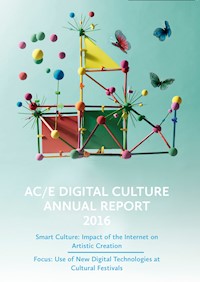
AC/E DIGITAL CULTUREANNUAL REPORT2016
Smart Culture: Impact of the Internet on Artistic Creation
Focus: Use of New Digital Technologies at Cultural Festivals
‘A more open, egalitarian, participatory, and sustainable culture is profoundly worth championing, but technology alone cannot bring it into being. Left to race along its current course, the new order will come increasingly to resemble the old, and may end up worse in many ways. But the future has not been decided.’
Astra Taylor, The People’s Platform: Taking Back Power and Culture in the Digital Age (Metropolitan Books, 2014)
Following the excellent reception of the first two editions of the AC/E Digital Culture Annual Report (2014 and 2015) – more than 5,000 copies of each have been distributed over the past two years – we are pleased to share with culture sector professionals the third edition, which sets out to analyse the impact of new technologies on artistic creation and their use at cultural festivals.
AC/E, a public agency whose purpose is to facilitate the promotion, development and internationalisation of Spain’s creative and culture sector, has teamed up with Dosdoce.com, a private organisation specialised in studies on adapting the sector to the digital environment, to analyse in the three editions of the report the main technological trends that cultural managers will need to bear in mind in the coming years in order to have a better understanding of the impact of new technologies on their culture organisations.
To achieve this aim, the broad-ranging content of the third edition of the report has been divided into two main sections to make it easier to read for the different audiences at which it is aimed. ‘Smart Culture’ is the overarching theme established by the Advisory Committee of the AC/E Digital Culture Annual Report 2016 as a basis for choosing the six articles that make up the first part of this year’s edition. Just as the first report’s Focus dealt with the impact of the Internet on the performing arts (theatre, opera, dance, ballet, etc.) and that of the second edition analysed the use of new technologies in the world of museums, for this third edition it conducts a thorough analysis of the use of new technologies at some 50 Spanish and foreign cultural festivals.
Both sections of the AC/E Annual Report speak of a hybrid realm halfway between technology and art; of blending between the physical and digital words; of vanishing boundaries between industries; and of the use of smart analyses and algorithms to give value and meaning to the often too much but never enough data. The chosen topics explore the pathways of the new collaborative economy; analyse its impact on artistic creation; examine the new space for interaction between people, machines and industries; and explain the changes that have taken place in markets and in how artworks are produced and sold.
One of the cross-cutting themes of this year’s report is the use of smart devices in artistic creation. The Internet of Things is going to pervade many aspects of our lives, and culture is no exception. As well as benefitting industrial processes, it has begun to yield visible results in the field of artistic creation. An example is the wearable musical gloves mentioned by Pepe Zapata in his article on the impact of the Internet on the performing arts, which allow musicians to interact with computers through gestures. Should we envisage a robot audience? he wonders.
Other themes enthusiastically analysed in this year’s report are the maturity of 3D printing, robotics, drones, augmented reality, new interfaces and the popularity of virtual reality devices. Their use is illustrated with many examples by Lara Sánchez Coterón in her in-depth analysis of new practices in videogames and by Montecarlo in his study on the new ways of telling audiovisual stories in the digital age.
But it is not all technology. The report also deals with issues such as the digital access gap, an issue explored in Iván Martínez’sarticle on the emergence of Wikipedia. Mariana Santos takes a different approach to a different rift – the digital gender gap – in her article on the impact of the Internet on artistic creation and introduces readers to Chicas Poderosas, the community she heads with the aim of closing it.
The economy of subscription is, as stated earlier, another theme that cuts across many of the articles in the report. This phenomenon is not alien to cultural enterprises, which, in some fields such as content distribution, have pioneered the concept of culture as a service, headed by digital startups such as Spotify and Netflix. In his study on the art market, Pau Waelder shows us similar formulas adopted by enterprises that currently offer new forms of collecting art on digital picture frames and define themselves as the iTunes and Spotifys of art collecting.
Questions, answers and unanswered questions that readers of this year’s report will find
The authors of this year’s annual report pose various questions about the fascinating future that digital culture holds in store:
Who is the stage creator nowadays?
One of the most futuristic articles of the report, Pepe Zapata’s, introduces readers to a world of automatons, drones and robots on stage that leads the author to ask: who is the spectator now? This shift in roles is illustrated with many examples of the new interactions between spectator and spectacle that have been made possible by smartphones, drones, robots and all kinds of hybrid realities.
‘How the Performing Arts are Changing in the Digital Age’ stresses the blends of digital and real, and off and on, and speaks of the fading of the boundaries between human, machine and nature. It provides many examples such as the Body project which, to quote the author, ‘experiments with biointeraction between body and technology with the aid of light sensors that respond to the dancer’s biological functions’.
This author ends by analysing the digital processes needed to support these new models on the stage, which involve new forms of authorship, and calls for reflection on the possible uses of digital technology in the production of the performing arts to achieve more spectacular results and broader experiences for a lower cost by analysing phenomena such as DIY and maker culture.
How is digital art marketed, made profitable and disseminated in the subscription economy?
Pau Waelder’s article ‘The Art Market in the Age of Access’ begins with a survey of the history of digital collecting, which began to catch on in a big way in the late 2010s. It examines the new ways of collecting, exhibiting and selling digital art in the new economy; digital editions, market platforms for digital art and the contradictions that can arise over the consideration of the artwork as a unique object.
The analysis provides guidance on cloud collecting and the implications of exhibiting art through streaming. It examines the various connected canvas technologies that allow us to consume art on demand and digital art. A survey based on a number direct questions put to a group of artists concludes that most feel that the art market does not have a significant impact on their work. This article clearly advocates what the author calls the third art market and the need to accept media art as a specific category.
Where are the limits in videogame design?
Lara Sánchez Coterón takes a twofold approach in ‘Videogame Design and Disruptive Praxis’ in order to analyse the influence of videogames and the meta-products that have emerged in other arts too, such as painting, as well as the most innovative digital praxis for developing new games that leads them to become artworks themselves.
Her detailed survey of the history and models of development and evolution of videogames includes self-hacking, mods and countergaming and explains how videogames are redefining interaction with users through the use of sensors and smart devices of the non-spectator as one of the elements of the game – by establishing a new space for creation with ‘games that are more contingent and open to players’ interpretation of them’, to quote the author. It makes interesting reading for anyone wishing to understand the continuous reinvention of an art that was born digital and is growing digitally day by day.
How to design a new human-centred and smart style of journalism?
Writing from a very personal approach, in ‘The Impact of the Internet on Cultural Creation’, Mariana Santos, director of interactive at Fusion, analyses the changes involved in designing a new type of journalism and the role of new journalists. This broad perspective spans the use of new technologies for analysing the mood of social media users, the process of building flows and clusters from data, and techniques for interactive visualisations.
The author emphasises the need to apply human-centred design techniques – design thinking – to give rise to a new style of socially committed journalism that encourages outsiders to the profession, such as lawyers, NGOs, activists and digital thinkers to analyse and tackle new problems, and cites as an example an interesting experience of empowerment and networking among young women journalists called Chicas Poderosas that aims to close the gender gap in Latin America – an initiative that is rapidly spreading.
How to manage crowdsourcing in the evolution of digital encyclopaedic knowledge
Fifteen years of collective history are analysed by Iván Martínez in ‘The Wikipedia Phenomenon in Today’s Society: Fifteen Years On? How do they manage to maintain a resource that services a whopping 17 million pages every month? How is the volunteer work organised? Can digital grow old? Can we speak of a crisis in Wikipedia? What is an editatona? What organisations regulate the work and how have they evolved?
These fascinating questions are asked in an article on crowdsourcing and the challenges of organising and regulating collaborative work. The article ends with an important question on the future of the encyclopaedia, which no doubt needs to make a huge effort to adapt to more recent technological challenges, such as the prevalence of mobile Internet access, and to close the digital access gap between the most underprivileged parts of the world, as well as the gender gap that exists today, as only one out of every ten Wikipedians is a woman.
What are the languages and formats for creating new transmedia audiovisual and how is it produced and funded?
Montecarlobegins his article on ‘Data, Interfaces & Storytelling: Audiovisual in the Digital Age’ with the battle cry that ‘Everything is data’. He speaks of augmented reality and how it adds layers to physical reality, virtual reality, 3D and the role of new interfaces in building recent audiovisual stories, the dystopic use of these technologies and the impact of new digital supports and changes in consumption habits. He also examines technologies such as video-mapping, 360-degree video, MMROPGs and interactive audiovisual to help readers understand the production of new experiences in which there is no distance between spectator and work.
Web series, YouTubers, online micro stories and webdocs are some of the new storytelling formats transformed by audiences into memes and fan fictions.
Focus 2016: impact on artistic creation
As stated at the beginning of this introduction, just as the Focus section of the first year’s report examined the impact of the Internet on the world of the performing arts (theatre, opera, dance, ballet, etc.), and the second edition analysed the use of new technologies in the museum world, in this third edition the Focus thoroughly analyses the use of new technologies at cultural festivals.
In this section readers will find a broad description of all kinds of new technologies employed at more than 50 festivals, both in Spain and abroad. Literary, music, performing arts or multi-genre festivals can offer insights into how to apply these technologies in day-to-day tasks or at specific times. These ideas can provide practical tools for festivals, artistic events or even online action and enhance visitor experience and communications. For example, beacons can be used indoors to detect Bluetooth-enabled devices within their range and also creatively to develop a new type of music composition. They can also improve our understanding of how cultural spaces are used, by analysing how people move around crowded festivals, such as the creativity and advertising fair Cannes Lions International Festival, the yearly SXSW in Austin, Coachella Music and Bonnaroo Festival. They have all devised highly original ways of using them – for example to help friends who have become separated at these macro-events find each other.
There are no instruction manuals or route maps explaining how to use all aspects of the tools or even which tools are best for each festival, but there are specific examples to go on. In a sense, this opens up a whole field for discovering new paths; we all have the means and capability to experiment and be creative with these new tools, mercilessly – but intelligently and pragmatically – combining old formulas and methods such as public relations and face-to-face with the latest wearables. For, as we are seeing throughout the post-digital wave, the revolution does not consist in going in for the newest of the new but rather incorporating it, like parts of a mechanism, into others that might well be analogue.
We hope that the publication of this new edition of the Focus of the AC/E Digital Culture Annual Report succeeds in offering managers of cultural festivals a calmer and fuller overview of the developments in the new digital world, the challenges we face, and the many opportunities they bring.
Conclusion
Looking ahead to the future – for this report sets out not only to provide information on what is being done today but also to predict as far as possible what will be done in the coming years – this brief overview of digital technologies applied to culture in 2015 also points to the consolidation of many ideas related to concepts that have lain dormant for several years, such as artificial intelligence, machine learning and cognitive computing. Though it will be quite some time before we have machines as intelligent as humans, and it will take longer still for humanoids and robots to be as creative as humans… or maybe not.
In conclusion, 2016 looks set to be one of the most exciting technological moments of the past two decades in which the new digital acceleration technologies are going to have a particular impact on the cultural sector. Expectations are high and savvy digital disruptors have their digital knives well sharpened and ready to carve out a share of the market for themselves in all sectors, including culture.
The new digital technology stimulates our dream of achieving a shared goal or smart culture project that is explored in this edition and today seems just around the corner: new interactions based on data science and the use of smart devices that ‘hack’ our senses; deconstructions of artworks tailored to our tastes; and extended cultural experiences – all these things are no longer expectation and fantasy but part of a new hybrid, interactive, shared and proactive digital cultural reality.
In one word, smart.
The AC/E Annual Report is intended as a reference work that can be consulted by cultural managers wishing to discover the advantages that new technologies can offer the world of culture. To facilitate their access and consultation, all the annual reports are published free of charge under a Creative Commons ‘Attribution – Non Commercial – No Derivatives licence, which allows users to copy and distribute them in any medium provided that they give appropriate credit, do not use them for commercial purposes and do not modify them in any way.
Elvira Marco, director general of AC/E
Javier Celaya, academic director of the AC/E Annual Report and founding partner of Dosdoce.com
2016 Advisory Committee of the AC/E Annual Report:
Isabel Fernández Peñuelas Grace Quintanilla José de la Peña Aznar José Luis de Vicente
Index
THE WIKIPEDIA PHENOMENON IN TODAY’S SOCIETY: FIFTEEN YEARS ON
Iván Martínez · @protoplasmakid
THE IMPACT OF THE INTERNET ON CULTURAL CREATION
Mariana Moura Santos · @marysaints
THE ART MARKET IN THE AGE OF ACCESS
Pau Waelder · @pauwl
HOW THE PERFORMING ARTS ARE CHANGING IN THE DIGITAL AGE
Pepe Zapata · @PepeZapata
VIDEOGAME DESIGN AND DISRUPTIVE PRAXIS
Lara Sánchez Coterón @laracoteron
DATA, INTERFACES & STORYTELLING: AUDIOVISUAL IN THE DIGITAL AGE
Montecarlo @Imastranger
FOCUS: USE OF NEW DIGITAL TECHNOLOGIES AT CULTURAL FESTIVALSElisabet Roselló Javier Celaya
INTRODUCTION
1. NEW TECHNOLOGIES AS CONTENT
1.1. New media festivals
1.2. Multi-genre festivals that are opening up to new media
2. NT BEFORE AND DURING THE FESTIVAL
2.1. Social media and communities
2.2. Own apps
2.3. Crowdsourcing, crowdfunding and participation
2.4. Online content (digitisation) and use of streaming
2.5. Beacons
2.6. Wearables and payment wristbands
2.7. Drones
2.8. Other technologies: responsive websites, QR codes (reflection), Big Data and VR
3. A POST-DIGITAL AND CONTEXTUALISED APPROACH
4. CONCLUSIONS
ORGANISED AND PUBLISHED BY
ACKNOWLEDGEMENTS
THE WIKIPEDIA PHENOMENON IN TODAY’S SOCIETY: FIFTEEN YEARS ON
IVÁN MARTÍNEZ · @PROTOPLASMAKIDAVAILABLEUNDERA CREATIVE COMMONS ATTRIBUTION-SHAREALIKE 4.0 LICENCE
Iván Martínez (1983) studied history at the UNAM and is a journalist and Wikipedian. Since 2012, he has been president of Wikimedia México A.C., the local representative of the Wikimedia Foundation which owns Wikipedia. He was chief coordinator of the 11th international Wikimania conference held from 15 to 19 July 2015, and is a member of the foundation’s Funds Dissemination Committee and a volunteer for Wikipedia in Spanish.
As a lecturer, he has given talks on free knowledge in seven Mexican states and at some 50 university, business and cultural institutions. He has taken part in international events related to the Wikimedia movement in France, Germany, Poland, Israel, China, Argentina, Chile and the United Kingdom, where he has delivered four lectures on his projects.
Since 2013 he has conducted the only Wikipedia-based radio show in the world: Moebius 909, broadcast by Ibero 90.9 FM, a public radio station of the Universidad Iberoamericana. He wrote for the FayerWayer, Código Espagueti and El Diario.es blogs. His opinions have been taken up by international media such as the South China Morning Herald, Radio Netherlands, Radio Amherst Massachusetts and Yorokobu and by the leading national television, radio and Internet media.
1. Wikipedia: the free Internet encyclopaedia.
Premises: daughter of free software and French encyclopaedists.
Nearly 15 years since it was created, Wikipedia, the self-styled free encyclopaedia, is a resource that serves 16 billion pages per month. Its self-regulated ecosystem, its editorial standards and its capacity to enlist nearly 75,000 volunteers1 who extend and modify it daily is the subject of research, criticism and everyday comments in the main environments of cultural reproduction and transmission of knowledge: the family, the mass media and schools. It is one of the most dynamic, ambitious and collaborative Internet projects (Ortega: 2009).
The Wikipedia universe is a dense web of volunteers who exploit this diversity. It embraces a variety of trends, influences, motivations and opinions from all over the world and is following a steadily upward course. Nearly 500 academic writings are produced year after year, including exercises, quantitative and qualitative analyses, comparative studies and above all criticism of the project. They attempt to find answers to and predict a phenomenon which, although having a few significant actors, bears on its shoulders the weight of an encyclopaedia that has undoubtedly had a social impact on Internet users worldwide, probably with the exception of China, where it was totally forbidden at the end of 2015.2
Wikipedia is a living resource that is part of millions of people’s lives. And as such, its relationship with society, like that of many other resources for reproducing knowledge and information, is not without controversy. The clash between the poles of production and reproduction of traditional knowledge with their global industries, associations, universities, schools, organisations and cultural secretariats and a ‘bunch of nobodies’, as Wikipedian and journalist Andrew Lih affectionately calls the community in his book The Wikipedia Revolution, is a living fact in the process of finding common ground.
The direct precedents of Wikipedia are Richard Stallman’s GNUpedia project (Lih: 2009) and, in particular, his free software philosophy that has developed intensely since the 1980s and is now an irreversible factor in part of the hardware and software that make the technological world possible. As Peter Burke has pointed out, there is a direct link between the French encyclopaedia and Wikipedia’s current level of dissemination at the start of the twenty-first century. Its model of entries is predominantly based on the structure established by the French in the eighteenth century, preserving the classification standards of the latter practically intact, albeit possibly enriched by the famous Britannica, with which it is often associated and compared.3
The early Internet saw the explosion of replicas of electronic likenesses ranging from the ‘real’ world to that of the Web 1.0: virtual museums, virtual walks, virtual marketplaces, email, ebooks. And the new big bang triggered by the Web 2.0. gave rise to the creation of the collective power of the predicted prosumption (Toffler: 1980), that is, creation and emergence based on collective, dynamic content generated by people.
Wikipedia’s direct precedents are the philosophy of free software, collective content generated by people and the eighteenth-century French encyclopaedia.
This went hand-in-hand with a type of organisation which, as Yochai Bechler pointed out (Lih: 2009), was already being practiced in computational environments in free software communities: peer production of knowledge based on fruitful interaction between the notion of common good or, rather, the commons, and technology (Lafuente: 2008), all in an environment where tools are relatively easy to learn and the meritocracy spurs an almost egocentric personal satisfaction.
This survey aims to provide an overview of the project as of 2015 – an undertaking which, I should point out, triggers a conflict of interests in this author, as my track record as of today includes 10,000 Wikipedia edits and 23,000 for the projects of the Wikimedia Foundation. I have also headed my country’s Wikimedia chapter since 2011.
The five pillars
Wikipedia has five main rules that apply to its current editions in 288 different languages. They are called the ‘five pillars’, in allusion to the structural elements that support an edifice. There are hundreds of policies, recommendations, guidelines and essays that regulate the encyclopaedia, but only five basic rules. Wikipedians use these five rules to argue their case and there is seldom consensus when, as in legal practice, they consider one to be more valid than another.
These five rules, as published in English, are:
1. Wikipedia is an encyclopedia: It combines many features of general and specialized encyclopaedias, almanacs, and gazetteers. Wikipedia is not a soapbox, an advertising platform, a vanity press, an experiment in anarchy or democracy, an indiscriminate collection of information, or a web directory. It is not a dictionary, a newspaper, or a collection of source documents, although some of its fellow Wikimedia projects are.
2. Wikipedia is written from a neutral point of view: We strive for articles that document and explain major points of view, giving due weight with respect to their prominence in an impartial tone. We avoid advocacy and we characterize information and issues rather than debate them. In some areas there may be just one well-recognized point of view; in others, we describe multiple points of view, presenting each accurately and in context rather than as “the truth” or “the best view”. All articles must strive for verifiable accuracy, citing reliable, authoritative sources, especially when the topic is controversial or is on living persons. Editors’ personal experiences, interpretations, or opinions do not belong.
3. Wikipedia is free content that anyone can use, edit, and distribute: Since all editors freely license their work to the public, no editor owns an article and any contributions can and will be mercilessly edited and redistributed. Respect copyright laws, and never plagiarize from sources. Borrowing non-free media is sometimes allowed as fair use, but strive to find free alternatives first.
4. Wikipedia editors should treat each other with respect and civility: Respect your fellow Wikipedians, even when you disagree. Apply Wikipedia etiquette, and don’t engage in personal attacks. Seek consensus, avoid edit wars, and never disrupt Wikipedia to illustrate a point. Act in good faith, and assume good faith on the part of others. Be open and welcoming to newcomers. Should conflicts arise, discuss them calmly on the appropriate talk pages, follow dispute resolution procedures, and consider that there are 5,060,896 articles on the English Wikipedia to improve and discuss.
5. Wikipedia has no firm rules: Wikipedia has policies and guidelines, but they are not carved in stone; their content and interpretation can evolve over time. The principles and spirit matter more than literal wording, and sometimes improving Wikipedia requires making exceptions. Be bold but not reckless in updating articles. And do not agonize over making mistakes: every past version of a page is saved, so mistakes can be easily corrected.
It is striking that in connection with this pillar Wikipedia should provide an additional explanation of ‘What Wikipedia is not’. Notability and neutrality are two of the points that tend to be interpreted most diversely by those who find that these policies are applied to their modifications.
Notability
This is a topic of discussion and lengthy arguments – a sort of entelechy built of various conceptions and reasoning. If Wikipedia’s notability policy – that is, what should and should not remain on its pages – is examined carefully, it can be found to be vague and relative.
Despite the established aim to include and fully cover a particular subject in Wikipedia, and the fact that the free encyclopaedia seeks to break away from the structured model of what an encyclopaedia can or should include, as it has surpassed the coverage of a twentieth-century encyclopaedia, there are different methods for judging what should and should not go in it. As Famiglietti points out (2011), concern about physically restricting content as a main guideline has shifted to concern about the permanence of information that is trivial or seeks to convey a particular viewpoint. Editorial criteria, formerly determined by physical factors in knowledge-related projects, are thus subject to a completely different dismissal rule in Wikipedia.
Discussions and explanations given to people who approach the encyclopaedia with different interests and reasons as to why their article should be deleted are everyday matters. Above all, behind the people who keep the project running – jobs without duration, not subject to a recruitment process – is the awareness that Wikipedia is vast but not infinite. It does not aspire to be a boundless resource. It has its bounds, but is more integrating and inclusive of what culture, in the most open and elementary sense of the word, has produced in humans.
Policies and style guides
Wikipedia has its own collectively compiled Manual of Style.4 On what, or what rules, could it base its initial precepts? The people who collaborate on the Spanish-language edition are scattered around the world from the United States to Patagonia and across Spain, which in 2015 was producing the most edits. This is no easy decision as it must meet the linguistic needs of a region whose relationship with the language dates back five centuries, marked by interaction with another dense web of languages.
Wikipedia has its own collectively compiled Manual of Style and its entire content is decided on by common consent to ensure continuous improvement.
Naturally there needs to be a basic style manual with guidelines on how to express certain words, terms, neologisms, contextual or specific words, scientific terms and chemical formulas, and Wikipedia is based on and constantly interacts with another project of the Wikimedia Foundation called Wiktionary (Wikcionario in Spanish) made up of entries providing further knowledge on a particular word.
Some years ago there was a paradigmatic debate among Spanish-speaking Wikipedians on the use of mouse versus ratón.5 Which is the correct name in Spanish for this computer device? Spaniards defended their usual ratón [derived from the Spanish name for the animal].The contributors from other Spanish-speaking countries argued that Spain was the only country in the world to use the term, while Spanish Wikipedians cited the Diccionario de la Real Academia de la Lengua in support of their claim. But using a term not generally employed in the so-called Latin American countries was of no benefit to Spanish-speakers in countries other than Spain. Such divergences arise in a variety of areas: place names, euphemisms, names for the same event – all these are daily topics of discussion among Wikipedia’s collaborators to reach agreement on how to present the information to the public at large.
Discussions among the community on various issues are characterised by their exhaustiveness, detail and heated nature. When a piece of data or a whole article is revised it may or may not survive, and may or may not be modified, but it will emerge with changes for the better after a session that may last for months.
Ultimately, this ‘mediated production’ carried out for the common good, despite not being conducted in a subtler or even more civilised manner, nonetheless encourages the ongoing improvement of the knowledge of which Wikipedia is a repository.
Systemic bias
There are certain factors that determine Wikipedia’s version of the facts. Despite its principle of openness and inclusiveness, in its capacity to generate revisions and criticisms of its non-permanent knowledge, the encyclopaedia depends on an element that even in 2015 is a factor of economic and social exclusion, despite the efforts to reduce these situations even in emerging societies: the Internet. Access by region has a discriminating effect on their opportunities to learn, and to obtain and consume information. In short, what for Wikipedia is a social vehicle for disseminating knowledge to a general public is a hindrance in another context: without the Internet there’s no Wikipedia.
The digital and gender gaps are impairments that hinder Wikipedia’s activity as a social vehicle for disseminating knowledge. It aims to progressively reduce them.
This discrimination, which establishes a difference not only between people but between whole societies and the so-called information society, creates a gap, resulting in a systemic bias that Wikipedia is striving to reduce progressively.
An anonymous survey6 conducted by the Wikimedia Foundation on volunteers worldwide in 2012 revealed that international Wikipedia editors are typically white, with an average age of 33, live in the United States or Europe, have jobs and devote their free time to the encyclopaedia. They also have degrees that enable them to work and carry out related digital volunteer work.
A contributor’s conclusions and handling of a particular subject may even unwittingly condition a version or vision that aspires to be diverse in today’s world. Certain issues of Spanish-speaking societies are dealt with in different depth and may not even exist in other editions. Idiosyncratic subjects are much more popular in a particular encyclopaedia edition than in others. Or they can be laden with much more prejudice than in other societies, or give prominence to a particular piece of information over another because a volunteer with the same interest in the subject will then check the version.
Technical disadvantages in Internet connections make some countries more vulnerable than others. Such is the case of Bolivia, where the Internet service is one of the poorest and most expensive in the world. This naturally leads to lower participation in the project and discourages or reduces the number of Wikipedia editors. Countries’ social conditions also determine their enthusiasm for collaborating on a project based on volunteer work. Interest and participation are not the same in countries where people have more time to collaborate on voluntary initiatives – that is, giving away time that can potentially devoted to paid work as opposed to volunteer work (though the latter could probably satisfy other aspects and be psychologically rewarding for collaborators).
Reference sources likewise condition the coverage and availability of the documentation needed to build Wikipedia. In the case of remote countries, despite interest in coverage, it is absolutely essential today to travel to other cities or countries to obtain reliable sources of this information.
Gender gap: heteronormative history
The results of the abovementioned survey dramatically confirmed something that was suspected: one of the most significant biases was the very scant presence of women in Wikipedia. An overwhelming nine out of every ten Wikipedians are men.
This fact basically defines how the encyclopaedia’s subjects are covered and displayed, how final content is established and reproduced, validated or maximised by the prevailing heteronormativity. Sue Gardner, former executive director of Wikimedia Foundation, took the first steps towards raising awareness of this situation7 and described it as intolerable.
The knowledge environment that underpins it is the paradigm of uncertainty, as it is no longer possible to trust any resource implicitly.
The reasons why women do not take part in Wikipedia are usually diverse. One is the harassment and violence that are characteristic not only of this project but of many other Internet initiatives,8 where these situations are common to women of all ages. Likewise, women are generally busier than men owing to the gender roles traditionally imposed by heteronormativity. Women have to overcome more social hurdles to be able to devote their time freely to volunteer work and to addressing new technology challenges that many people still regard as men’s business.
The past year has been decisive in tackling this phenomenon in Mexico. Wikimedia Mexico launched a strategy for reducing the gender gap in Wikimedia projects based essentially on editatonas (from the word editathon, linguistically adapted to create a feminine version): spaces where women can gather, shielded from violence and harassment, to share sessions of writing and rewriting a more inclusive history.
At these events women can learn and edit Wikipedia, overcoming as a group the most common restrictions that discourage them. There are now more female experts willing to help, others are learning and, above all, they can seek support when they are harassed and/or suffer discrimination on the grounds of gender. This is all part of a broader underlying problem which is rife in the technological sector, where men have better jobs and are paid more than women and where sexism9 and sexual harassment are a reality that goes beyond the technology environment and industry.
Based on the abovementioned statistics on the characteristics of the average Wikipedian, incidents of sexism and discrimination against women are common. Initiatives such as Ada Lovelace are designed to combat this reality and help boost women’s involvement in the free and open software sector and other related initiatives.
Usage in Mexico and Spanish America
Fifteen years on, Wikipedia’s usage and editing figures are growing globally and performing differently compared to the early years. Wikipedia in Spanish (http://es.wikipedia.org) is the most commonly used and edited resource in the Spanish American countries.
Wikimedia’s servers recorded 87 million visits in Mexico, a country where 44 million people have an Internet connection, in August 2015.10 Spain, Argentina and Chile are the biggest readers of Wikipedia. Spain is the leading country in number of edits, 23,000 per month.
There are known Wikimedia communities in Argentina, Bolivia, Brazil, Colombia, Chile, Ecuador and Venezuela.
2. Chief criticisms of the project
Reliability
The Wikipedia model allows anyone to edit and people do not need to prove their knowledge, academic qualifications, membership of societies or other credentials in order to write for it. Critics commonly question to what extent it is a reliable resource for the students wishing to consult it.
The quality, breadth and development of the articles found in Wikipedia is uneven and diverse owing to its very nature, as we shall examine in detail in the following paragraphs. Comparative studies have been conducted taking random samples of articles related to school programmes to check their reliability. One of the most notable was carried out in 2005 by Nature magazine,11 in which 42 articles of the English edition were approved in quality and length, and in 2012 a team of researchers from Oxford University carried out a comparative study of Wikipedia and other online encyclopaedias such as the Britannica. They reported favourably on the reliability of Wikipedia.12
Decentralised and non-academic authorship has its advantages, as it asserts the idea of knowledge permanently under construction.
In future, in a knowledge environment underpinned by the paradigm of certainty (Wallerstein: 1999), it will not be possible to fully trust a resource like Wikipedia. But this is equally true of other knowledge resources, though Wikipedia is the most visible and popular (Wikipedia, according to Alexa, ranks 10th in the Spanish-speaking world, the RAE 2868th).13
Collaboration and decentralised authorship
Around 1977 the Encyclopaedia Britannica commissioned Emir Rodríguez Monegal to write the article on author Jorge Luis Borges: a scholar with a particular fondness for encyclopaedias and whose literary and critical reasoning advocated decentralised authorship, the automation of processes and the fantasy of a library rewritten in the eternity of a Babelian dream of knowledge. Scholars have even pointed out the similarities between Borges’s thought and the Internet and its new collaborative age (Sassón-Henry: 2007).
Borges was also fond of conceiving works not as authors’ products but as rewritable summae, as in a virtual palimpsest that can be improved and written as knowledge grows, shrinks or expands – like Wikipedia itself, which for this purpose has a policy of detachment from what is written. Contributions are permanently donated, with the exception that they can be improved, modified or replaced by new knowledge stemming from the academic community who carry out research day by day.
In a world of wikinomic production, it was free software that showed the rest of knowledge production the advantages of collaboratively revised and manufactured production. ‘Weapons of mass production’ (Tapscott: 2006) helped a new platform like Wikipedia to function as a diffuse author in which millions of people all over the world were nevertheless placing their trust. Will Wikipedia need to be have its certainty assured by part of the academy? And if so, how could it be granted such status?
Such decentralised authorship has its advantages, which can help improve people’s perception of scientific certainty by widely advocating the idea of a knowledge that is permanently under construction. Any omission or misinformation generated by a Wikipedian can be remedied by that Wikipedian or by others. In science, however, a mistake can be the downfall of a career or cause endless discredit. ‘Wikipediacontributors receive much less benefit than scientists for getting things right and suffer much less cost for getting things wrong’, notes K. Brad Wray (quoted by Fallis: 2009).
The decentralised authorship model makes it forbidden for an article to be signed by just one contributor. And this convention appears to destabilise the paradigm of certainty that science has upheld with rationalistic fervour since the eighteenth century. Perhaps this is because Wikipedia is absolutely dependent on science, on which its truthfulness is based, and because it pursues aims different from what we take certainty to mean when we assess an original research product. Wikipedia draws on conventional material available to everyone. Is it, then, omission of knowledge of new sources that permits erroneous knowledge in Wikipedia? How can we assess confidence in the project – through what it hasn’t got or because what it has got doesn’t reflect the current status of the matter in question?
Model of encyclopaedic answer
The inherited model of encyclopaedic question that underpins Wikipedia’s structure has remained practically unchanged. As such, following this reasoning, Wikipedia is not an innovative product; its historical roots are embedded in this semantic structure and it answers questions in the same manner as its predecessors. There are other online knowledge resources with different aims such as Quora, which bases its experience on questions.
The reasoning behind Wikipedia’s structure functions on the principle of this is this. And from there it leads to a broad explanation. There are testimonies telling how Jimmy Wales and Larry Sanger established the basic guidelines for defining truthfulness and neutrality according to their philosophical understanding (Lih: 2009). But these testimonies do not make it clear whether this model was questioned or how both men decided to make it that way.
Wikipedia, vandalism and gonzo journalism
In the Wikipedia world, vandalism means purposely including in the encyclopaedia content that is known to be erroneous, generally for ‘amusement’, to launder information that is uncomfortable or to exaggerate attributions of phenomena or people. Even so, the percentage of vandalism is lower than that of good edits.
By ‘amusement’ we mean when somebody who is not committed to Wikipedia’s values realises that anyone can edit it and changes dates or information or gives an object or person fictitious attributes.
It is based on a collective model of donations and funds through the Wikipedia Foundation, a not-for-profit organisation that provides technical, administrative and financial support.
Intentional vandalism can also extend to activism. For example: in Mexico, in 2015, the word ‘criminal’ was added to the article on Javier Duarte, governor of Veracruz, to describe his profession, following the murders of a journalist and activist of Veracruz, to suggest that he was implicated. This vandalism lasted a couple of minutes.
There are more controversial cases of modifications of this kind, which bring to mind Hunter Thompson and his gonzo journalism, as some media have been discovered to have modified articles in order to stand out. One of the most notorious cases was in Argentina in 2010, when the daily newspaper Clarín vandalised the article ‘La noche de los lápices’ in order to be able to publish on its cover (http://edant.clarin.com/diario/2006/09/14/um/m-01271296.htm) that Wikipedia supported the coup d’état.14
All data for which there are no references is deleted; that is why actions of this kind make extra work for the community of people who build Wikipedia.
3. Fifteen years on
Wikipedia/Wikimedia
Since 2003 Wikipedia has been supported by a not-for-profit foundation. Jimmy Wales and Larry Sanger decided to make the radical switch from the original profits-based model to a donations-based model. Up until then Wales’s company, Bomis, had borne the costs of the online encyclopaedia. The establishment of the Wikipedia Foundation was the first step towards shaping the model of donations and collective fundraising. By 2005 the foundation had raised its first million dollars, and this amount had increased to 75 million for 2014–15.15 According to the foundation, individual readers give most of the money received by the global foundation, though the United States and Canada were the largest donors in the 2014 fundraising campaign. A total of 4.9 million people worldwide donated money to the Wikimedia projects.
The foundation, based in San Francisco, California, has nearly 280 employees, both male and female. As usual, there is a contrast between number of employees and the size of the online project. The number was almost tripled when Lila Tretikov took over as executive director of Wikimedia Foundation in May 201416 and started hiring personnel from the Bay Area, focusing on technical aspects such as reader experience, improving editing tools and developing more advanced mobile capabilities.
The Wikimedia movement as it stands in 2015 can be divided into three main categories:




