


7,19 €
Mehr erfahren.
- Herausgeber: Krishnamurti Foundation America
- Kategorie: Geisteswissenschaft
- Sprache: Englisch
The passages in this Study Book have been taken directly from Krishnamurti’s talks and books from 1933 through 1967. The compil- ers began by reading all the passages from this period which contained the word action—the theme of this book. This would not have been possible without the use of a full text computer database, produced by the Krishnamurti Foundation Trust of England. Over 750 passages were studied in all, and the aspects of “action” most frequently addressed by Krishnamurti were noted. These aspects then formed the outline for the contents of this book.
The material selected has not been altered from the way it was originally printed except for limited correction of spelling, punctua- tion, and missing words. Words or phrases that appear in brackets are not Krishnamurti’s, but have been added by the compilers for the sake of clarity. Ellipses introducing a passage, or ending it, indicate that the passage begins or ends in mid-sentence. Ellipses in the course of a passage indicate words or sentences omitted. A series of asterisks between paragraphs shows that there are paragraphs from that talk which have been omitted. Captions, set off from the body of the text, have been used with many passages. Most captions are statements taken directly from the text, with some being a combination of phrases from the passage.
Krishnamurti spoke from such a large perspective that his entire vision was implied in any extended passage. If one wishes to see how a statement flows out of his whole discourse, one can find the full context from the references at the foot of each passage. These refer primarily to talks which have been published in The Collected Works of J. Krishnamurti. This seventeen-volume set covers the entire period from which this study book has been drawn. A complete bibliography is included at the end of this book. Students and scholars may also be interested in additional passages on action not used in the book, available for study upon written request, in the archives of the Krishna- murti Foundation of America.
This Study Book aims to give the reader as comprehensive a view as possible, in 140 pages, of the question of action as explored by Krishnamurti during the period covered. Most of the material presented has not been previously published, except in the Verbatim Reports which were produced privately, in limited numbers, primarily for those who attended Krishnamurti’s talks.
Das E-Book können Sie in Legimi-Apps oder einer beliebigen App lesen, die das folgende Format unterstützen:
Seitenzahl: 254
Veröffentlichungsjahr: 2012
Ähnliche
Contents
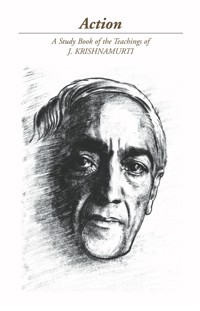
Action
A Selection of Passages from the Teachings of J. Krishnamurti
©1990 by the Krishnamurti Foundation of America
Revised edition, 2013
Editor: Albion W. Patterson
eBook conversion by M-Y Books
Publisher: Krishnamurti Publications of America
All rights reserved. Printed in the United States of America. No part of this book may be used or reproduced in any manner whatsoever without written permission except in the case of brief quotations embodied in critical articles and reviews. For information and a complete catalogue of Krishnamurti books, videotapes, and audio tapes write:
Krishnamurti Foundation of America
P.O. Box 1560, Ojai, California 93024
www.kfa.org
Foreword
The passages in this Study Book have been taken directly from Krishnamurti's talks and books from 1933 through 1967. The compilers began by reading all the passages from this period which contained the word action—the theme of this book. This would not have been possible without the use of a full text computer database, produced by the Krishnamurti Foundation Trust of England. Over 750 passages were studied in all, and the aspects of "action" most frequently addressed by Krishnamurti were noted. These aspects then formed the outline for the contents of this book.
The material selected has not been altered from the way it was originally printed except for limited correction of spelling, punctuation, and missing words. Words or phrases that appear in brackets are not Krishnamurti's, but have been added by the compilers for the sake of clarity. Ellipses introducing a passage, or ending it, indicate that the passage begins or ends in mid-sentence. Ellipses in the course of a passage indicate words or sentences omitted. A series of asterisks between paragraphs shows that there are paragraphs from that talk which have been omitted. Captions, set off from the body of the text, have been used with many passages. Most captions are statements taken directly from the text, with some being a combination of phrases from the passage.
Krishnamurti spoke from such a large perspective that his entire vision was implied in any extended passage. If one wishes to see how a statement flows out of his whole discourse, one can find the full context from the references at the foot of each passage. These refer primarily to talks which have been published in The Collected Works of J. Krishnamurti. This seventeen-volume set covers the entire period from which this study book has been drawn. A complete bibliography is included at the end of this book. Students and scholars may also be interested in additional passages on action not used in the book, available for study upon written request, in the archives of the Krishnamurti Foundation of America.
This Study Book aims to give the reader as comprehensive a view as possible, in 140 pages, of the question of action as explored by Krishnamurti during the period covered. Most of the material presented has not been previously published, except in the Verbatim Reports which were produced privately, in limited numbers, primarily for those who attended Krishnamurti's talks.
A final note: The term heuristic, used in the heading of section VI, is defined by the Chambers Twentieth Century Dictionary as "serving or leading to find out" or "the method in education by which the pupil is set to find out things for himself" and not "depending on assumptions based on past experience."
Albion W. Patterson, Editor
1Chambers Twentieth Century Dictionary, New Edition, Edinburgh, Chambers, 1972, p. 612
Introduction
Talking things over together as two friends...
In a few days we are going to have discussions, and we can start those discussions this morning. But if you assert and I assert, if you stick to your opinion, to your dogma, to your experience, to your knowledge, and I stick to mine, then there can be no real discussion because neither of us is free to inquire. To discuss is not to share our experiences with each other. There is no sharing at all; there is only the beauty of truth, which neither you nor I can possess. It is simply there.
To discuss intelligently, there must also be a quality not only of affection but of hesitation. You know, unless you hesitate, you can't inquire. Inquiry means hesitating, finding out for yourself, discovering step by step; and when you do that, then you need not follow anybody, you need not ask for correction or for confirmation of your discovery. But all this demands a great deal of intelligence and sensitivity.
By saying that, I hope I have not stopped you from asking questions! You know, this is like talking things over together as two friends. We are neither asserting nor seeking to dominate each other, but each is talking easily, affably, in an atmosphere of friendly companionship, trying to discover. And in that state of mind we do discover, but I assure you, what we discover has very little importance. The important thing is to discover, and after discovering, to keep going. It is detrimental to stay with what you have discovered, for then your mind is closed, finished. But if you die to what you have discovered the moment you have discovered it, then you can flow like the stream, like a river that has an abundance of water.
Saanen, 10th Public Talk, August 1, 1965 Collected Works, Vol. XV, p. 245
I. An Overview
In learning there is no end and that is the beauty…the sacredness of life.
So you and I will go into this together. You are not going to learn anything from me, you are not going to gather something here and go away with it, because if you do that, it will be merely an accumulation, something which you store up to remember. But as I am talking, please listen with your whole being, with your full attention, with eagerness, as you would listen to something which you really love—if you ever do love. Because here you are receiving no instructions and you are not a pupil. You are learning an art—and I really do mean that. We are learning together and therefore the division of the teacher and the disciple has completely gone. It is immature thinking to regard somebody as a teacher who knows and yourself as one who does not know. In that relationship both lack humility and therefore both cease to learn. This is not just a verbal expression, a temporary statement, as you will see for yourself if you listen without merely looking for instructions as to what to do and what not to do. Life is not understood through a series of instructions. You can apply instructions to a dynamo, the radio, but life is not a machine, it is an ever living, ever-renewing thing. So, there is no instruction—and that is the beauty of learning. The mind that is small, instructed, taught, only strengthens memory—as happens in all the universities and schools where you merely cultivate memory in order to pass examinations and get a job. That is not acquiring intelligence. Intelligence comes when you are learning. In learning there is no end, and that is the beauty of life, the sacredness of life. So you and I are going to learn, to explore, think together and communicate with each other about action.
To most of us life is action, and by action we mean something which has been done, is being done, or will be done. Without action you cannot live. Action does not mean only physical movement, going from here to there; there is also the action of thought, the action of an idea, the action of a feeling, of environment, of opinion, the action of ambition, of food and of psychological influences—of which most of us are totally unaware. There are the actions of the conscious mind and the actions of the unconscious mind. There is also, is there not, the action of a seed in the earth, the action of a man who gets a job and sticks to it for the rest of his life; there is the action of the waves beating on the shore, the action of gentle weather, of rain; there is all the action of the earth and of the heavens. So action is something limitless. Action is a movement both within and out of time. I am thinking aloud with you; I am exploring. I came here with one thought, action, and I want to discuss it with you, go into it, explore it gently, slowly, quietly, so that you and I understand it together.
But when you merely reduce action to: "What am I to do? Should I do this and not do that? Is this right, or that?" then action becomes a very small thing. We do, naturally, have to act within time; I do have to stop at the end of the hour; one has to go to the office, the factory, take meals, at a certain time. There must be action in time, and that is all we know, is it not? You and I really do not know anything else except action which is recognizable and within the field of time. By time we mean yesterday, today, and tomorrow. Tomorrow is the infinite future, yesterday is the infinite past, and today is the present; and the conflict between the future and the past produces a thing which we call action. So we are always inquiring how to act within the field of time, of recognition. We are always asking what to do: whether to marry or not to marry, whether to yield to temptation or to resist, whether to try and become rich or seek God. Circumstances—which are really the same as time—force me to accept a job because I have a family and I have to earn, and so there is all the conflict, turmoil and toil. So my mind is caught in the field of action-within-time. That is all I know; and each action produces its own result, its own fruits, again within time. That is one step, is it not? To see that we are caught in the action of time.
Then there is the action of tension. Please follow this, because we are examining it together. There is the action born of the tension between two opposites, which is a state of self-contradiction— wanting to do this and doing totally the opposite. You know that, do you not? One desire says, do this and another desire says, do not do it. You are feeling angry, violent, brutal, and yet a part of you tells you to be kind, to be gentle, nice. For most of us action is born out of tension, self-contradiction. If you watch yourself you will see it; and the more the struggle, the contradiction, the more drastic and violent is the action. Out of this tension the ambitious man works ruthlessly—in the name of God, in the name of peace, or in the name of politics, of his country, and so on. Such tension produces great action; and the man who is in an agony of self-contradiction may produce a poem, a book, a painting; the greater the inward tension the greater the activity, the productivity.
Then, if you will observe in yourself, there is also the action of will. I must do this and I must not do that. I must discipline myself. I must not think this way. I must reject, I must protect. So there is the positive and the negative action of will. I am just describing and, if you are really listening, you will see that an action of real understanding takes place—which I am going to go through presently. The action of will is the action of resistance, negatively or positively. So there are varieties of action, but most of us know the action of will because most of us have no great tension since we are not great. We are not great writers, great politicians or great saints, so-called; they are not really saints at all because they have committed themselves to a certain form of life and therefore have ceased to learn. We are ordinary people, not too clever. Sometimes we look at a tree or a sunset and smile happily, but for most of us action is born of will; we are resisting. Will is the result of many desires, is it not? You know, do you not, the action of will—I feel lazy and I would like to lie in bed a little longer but I must discipline myself and get up; I feel sexual, lustful, but I must not, I must resist it. So we exercise will to produce a result. That is all we know; either we yield or resist, and yielding creates its own agony which presently becomes resistance. So we are everlastingly in battle within ourselves.
So, will is the product of desire, wanting and not wanting. It is as simple as that, do not let us complicate it—leave that to the philosophers, the speculators. You and I know that will is the action that is born within the field of two opposite desires, and our cultivation of virtue is the cultivation of resistance. Resisting envy you call virtuous. And that is going on always within us—a desire producing its opposite and from the opposite a resistance is created, and that resistance is will. If you watch your own mind you will see it. And as we have to move in this world we exercise this will, and that is all we know, and with this will we say we must find out if there is something beyond. With this will we discipline ourselves, torture ourselves, deny ourselves—and the more you are capable of denying yourself the more saintly you are supposed to be. All your saints, your gurus and gods are the product of this denial, this resistance; and the man who can follow ardently, denying everything, following the ideal he has projected, him you call a great man.
So when you look at this life of action—the growing tree, the bird on the wing, the flowing river, the movement of the clouds, of lightning, of machines, the action of the waves upon the shore—then you see, do you not, that life itself is action, endless action that has no beginning and no end. It is something that is everlastingly in movement, and it is the universe, God, bliss, reality. But we reduce the vast action of life to our own petty little action in life, and ask what we should do, or follow some book, some system. See what we have done, how petty, small, narrow, ugly, brutal our action is. Please do listen to this! I know as well as you that we have to live in this world, that we have to act within time and that it is no good saying: "Life is so vast, I will let it act, it will tell me what to do." It won't tell us what to do. So you and I have to see this extraordinary phenomenon of our mind reducing this action which is infinite, limitless, profound, to the pettiness of how to get a job, how to become a minister, whether to have sex or not—you know all the petty little struggles in life. So we are constantly reducing this enormous movement of life to action which is recognizable and made respectable by society. You see this, sirs, do you not—the action which is recognizable and within the field of time, and that action which knows no recognition and which is the endless movement of life.
Now, the question is this: Can I live in this world, do my job and so on, with a sense of this endless depth of action, or must I, through my petty mind, reduce action to a functioning only within the field of recognition, within the field of time? Am I making myself clear?
Let me put the thing differently. Love is something which is not measurable in terms of action, is it not? I do not know if you have ever thought about it. You and I are talking together now face to face and we are both interested in this and want to find out. We know what this feeling of beauty, of love is. We are talking of love itself, not the explanation of love, not the verbal expression. The word love is not love. Though the intellectual mind divides it into profane love and sacred, divine love, all that has no meaning. But that beauty of feeling which is not expressible in words and not recognizable by the mind—we know that thing. It is really a most extraordinary thing; in it there is no sense of 'the other', and the observer is absent; there is only the feeling. It is not that I feel love and express it by holding your hand or by doing this or that act. It is. If you have ever had that feeling, if you have ever lived it, if you have understood it, expressed it, nurtured it, if you have felt it totally with all your being, you will see that with that feeling one can live in the world. Then you can educate your children in the most splendid manner, because that feeling is the center of action, though within the field of time. But not having that feeling, with all its immensity, passion, and vigor, we reduce love merely to the "I love you" and function only within the field of time, trying to catch the eye of another.
So you see the problem. Love is something that knows no measure, that cannot be put together by the mind, cannot be cultivated, something which is not sentimental, which has nothing to do with emotionalism and nothing whatsoever to do with good works—the village reform and so on. When you have that feeling then everything in life is important, significant; therefore you will do that which is good. But without knowing the beauty, the depth, the vigour of it we are trying to reduce love into something which the mind can capture and make respectable. And the same applies to action, which we are now trying to understand.
Action is an endless movement which has no beginning and no end and which is not controlled by cause and effect. Action is of everything—the action of the sea, of the mango seed becoming the mango tree, and so on. But the human mind is not a seed and therefore, through its action it becomes only a modified reproduction of what it was. In our life there is the constant pressure of circumstances, and although the circumstances are always changing, they are ever shaping our lives. What was, is not; what is, can be broken. So can we not sense, feel, this enormous action of life which ranges from the movement of the little worm in the earth to the sweep of the infinite heavens? If you really want to know what this extraordinary thing is, this action, then you must go through it, you must break through the barrier of this action in time. Then you will know it, then with that feeling you can act, you can go to your job and do all the things that are recognizable within the field of time. But from within the recognizable field of time you cannot find the other. Do what you will, through the petty you will never find the immeasurable.
If you once really saw the truth of this—that a mind functioning within the field of time can never understand the eternal, which is outside of time—if you really saw that, felt it, then you would see that a mind which speculates about love and divides it up as carnal, profane, divine or sacred can never find the other. But if you can feel this astonishing action—the movement of the stars, the forests, the rivers, the ocean, the ways of the animals and of human beings—if you could know the beauty of a tender leaf in spring, the feeling of rain as it drops from the heavens, then with that immense feeling you can act within the field of recognition, within the field of time. But action within the field of time can never lead to the other. If you really understand that, not verbally, intellectually, if you really feel the significance of it, grasp it, see the extraordinary beauty and loveliness of it, then you will see that the will has no place in this at all. All action born of will is essentially self-centered, egocentric, but such action will disappear totally when you have understood it fully, when you have really felt yourself moving in it, with your mind wholly in it. Then you can see that there is no necessity for will at all; there is a quite different movement. The will then is like a knotted piece of rope, it can be undone. That will can be lost; but the other cannot be lost, it cannot be increased or decreased.
So, if you are listening with your whole being, learning with your whole being, which means feeling deeply, not merely listening to words intellectually, then you will feel the extraordinary movement of learning, of God—not the god made by the hand or by the mind, not the god of the temple, mosque or church, but this endless immeasurable thing, the timeless. Then you will see that we can live with astonishing peace in this world; then there is no such thing as temptation, no such thing as virtue, because virtue is merely a thing of society. The man who understands all this, who lives it, is orderly, inwardly at rest; his action is entirely different, much more effective, easier and clearer, because there is no inward confusion, contradiction.
So, a mind that holds to conclusions is never humble. A man who has learned is carrying the burden of his knowledge, but a man who is learning has no burden and therefore he can go to the top of the mountain. As two human beings, you and I have talked of something which cannot be captured through words; but by listening to each other, exploring it, understanding it, we have found something extraordinary, something that is imperishable. Life reduced to the 'me' clinging to life is perishable, but if you can see that extraordinary life from the beginning to the end, if once you have gone into it, felt it, drunk at its fountain, then you can live an ordinary life with utter newness, you can really live. The respectable man is not living, he is already dead; and life is not a thing to be invited by the dead. Life is to be entered and forgotten—because there is no 'me' to remember the living of that life. It is only when the mind is in a state of complete humility, when it has no purpose for its own little existence, when it does not move from a point to a point, from experience to experience, from knowledge to knowledge—only such a mind which is totally, completely, wholly not-seeking knows the infinite beginning and the infinite end of existence.
Bombay, 2nd Public Talk, November 30, 1958 Collected Works, Vol. XI, pp. 109-13
II. What is Action?
Our life is action: going to the market, cooking, breeding children, thinking, going for a drive, looking at a tree, going to the office. All life is tremendous action. If you sit quietly in a forest in springtime, you see that everything is burstingly alive. You know, most of us never die, and therefore we never produce. The trees bring forth new leaves, and when the leaves die they are marvellous to look at. But we live on in the past, we never die, and therefore we never renew, our action is always imitative, conforming, following the pattern of pleasure, and hence there is agony.
Paris, 3rd Public Talk, May 23, 1965 Collected Works, Vol. XV, p. 168
Life—the totality of life—…is action.
We are talking this evening about the question of action. But to understand it, not merely verbally, not merely intellectually, but with a totality of one's whole being, one has to go beyond words. It is only then there is communion, there is sharing, there is partaking together of something vital. And this question of action needs not only a verbal explanation, but rather, and much more, a moving together, feeling our way hesitantly together, into this question of what is action.
* * * * *
Life is existence, is a movement, and this movement is action. Life—the totality of life, not parts of it, the whole state of existence— is action. But when we merely exist, as most of us do, then the problem of action becomes complex. Existence has no division. It is not a fragmentary state of mind or being; in that [state] a totality of action is possible. But when we divide existence into different segments, fragments, then action becomes contradictory.
Bombay, 3rd Public Talk, February 17, 1965 Collected Works, Vol. XV, p. 62
Life is action from the beginning to the end…
I do not know if you have noticed in the morning, high up in the sky, the big vultures, the big birds, flying without a movement of their wings, flying by the current of the air, silently moving. That is action. And also the worm under the earth, eating—that too is activity, that is also action. So also is it action when a politician gets up on the platform and says nothing, or when a person writes, reads, or makes a statue out of marble. That is also action when a man, who has a family, goes to the office for the next forty years, day after day, doing drudgery work without much meaning, wasting his life endlessly about nothing! All that a scientist, an artist, a musician, a speaker does—that too is action. Life is action from the beginning to the end; the whole movement is action.
Rajghat, Banaras, 3rd Public Talk, November 28, 1965 Collected Works, Vol. XV, p. 344
Life is all relationship…action and relationship are synonymous.
We are dealing with action at all the levels of our being—not only the physical act, but the emotional, the psychological, the mental, the unconscious, the conscious act—because that is life. Life is all relationship or action. You cannot escape from these two facts, though action and relationship are synonymous. By "action" we mean that which was done, and that which has to be done, and that which is going to be done. It is a movement, either a continuous movement or a disjointed movement. With most of us, it is disjointed. We live at different levels; there is the office, there is the family, there is public opinion; there are my fears and my gods, my opinions, my judgements, my conditioning; and there are the various pressures, influences of society and so on. We live at different levels, disjointed, unrelated with each other.
Rajghat, Banaras, 3rd Public Talk, December 8, 1963 Collected Works, Vol. XIV, p. 68
Right action comes in understanding relationship…
So relationship is our problem, and without understanding relationship, merely to be active is to produce further confusion, further misery. Action is relationship: to be is to be related. Do what you will—withdraw to the mountains, sit in a forest—you cannot live in isolation. You can live only in relationship, and as long as relationship is not understood, there can be no right action. Right action comes in understanding relationship, which reveals the process of oneself. Self knowledge is the beginning of wisdom; it is a field of affection, warmth, and love, therefore a field rich with flowers.
Poona, India, 4th Public Talk, September 19, 1948 Collected Works, Vol. V, pp. 96-7
How does one come to discover…an action that is total, whole, not partial?
Unfortunately, we have divided action into fragments: noble action, ignoble action, political action, religious action, scientific action, the action of the reformer, the action of the socialist, the action of the communist, and so on and on. We have broken it up, and therefore there is a contradiction between each action, and there is no understanding of the total movement of action.
And in our own lives, the activity in your house is not so very different from the activity in your office. You are equally ambitious in the office as you are at home. At home, you dominate, oppress, nag, drive—sexually and in so many different ways. Also you are doing the same outside the home. There is the action of a mind that seeks peace, that says, "I must find truth." Such a mind is also in action.
Now, maturity is the comprehension of action as a whole, not as fragments. I am not defining maturity, so do not learn the definition by heart, or learn another definition. You can see that as long as action is fragmentary, there must be contradiction and therefore conflict.
So how does one come to discover or to feel or to live in the active present, in an action that is total, whole, not partial? Have I made my question clear? We have to understand this question because our actions are fragmentary—the religious, the business, the political, the family, and so on; each is different, at least in our minds. And so the worldly man says, "I cannot be religious because I have to earn a livelihood." And the religious man says, "You must leave the world to find God." So everything, every action, is in contradiction. And therefore out of that contradiction there is effort, and in that contradiction there is sorrow, fear, misery, and all the rest of it.




