


Erhalten Sie Zugang zu diesem und mehr als 300000 Büchern ab EUR 5,99 monatlich.
- Herausgeber: Nick Hern Books
- Kategorie: Geisteswissenschaft
- Sprache: Englisch
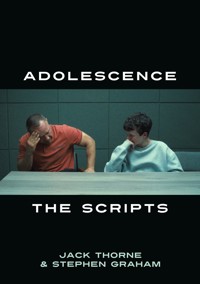
The complete scripts of one of the most urgent and talked-about television series of recent times. Set in a northern English town, Adolescence tracks the aftermath of the brutal murder of a thirteen-year-old schoolgirl. When her classmate Jamie Miller is arrested in a dawn raid for the crime, his family, psychologist and the detective in charge are all left asking: how could this have happened? Adolescence gripped audiences and commentators around the world when it was released on Netflix in 2025, sparking headlines and debate about the difficult and vital issues it confronts head on. Also applauded for its technical ingenuity – with each episode presented in one continuous shot, in real time – it became one of Netflix's most-watched series of all time and won numerous accolades, including eight Emmy Awards and four Golden Globes. This volume contains the full shooting scripts of all four episodes, as well as new insights and commentary from the creators – including writer Jack Thorne, co-writer and star Stephen Graham, and director Philip Barantini – colour photographs, and essays about the issues it explores. A must-read for admirers of this acclaimed series, it's also an invaluable resource for screenwriters and other filmmakers, as well as anyone looking to understand more about the pressures and challenges facing young people today.
Sie lesen das E-Book in den Legimi-Apps auf:
Seitenzahl: 226
Veröffentlichungsjahr: 2025
Das E-Book (TTS) können Sie hören im Abo „Legimi Premium” in Legimi-Apps auf:
Ähnliche











ADOLESCENCE THE SCRIPTS
Jack Thorne & Stephen Graham
NICK HERN BOOKS
London
CONTENTS
INTRODUCTIONS
Jack Thorne
Stephen Graham
Philip Barantini
James Bloodworth
Susie McDonald
A NOTE ON THE SCRIPTS
THE SCRIPTS
Episode One
Episode Two
Colour Photographs
Episode Three
Episode Four
CREDITS
ABOUT THE AUTHORS
COPYRIGHT INFORMATION
JACK THORNE Co-creator and writer
Adolescence was a train ride no one really expected.
When we made it, we believed in it, and were incredibly proud of it, and then suddenly it turned into this madness.
As Stephen and I said to each other in the middle of it all, we’ll never have an experience like this again, and so we’ll enjoy every single moment of it.
It started with a phone call. Now, if you’ve never had a phone call from Stephen Graham before, and I assume most of you haven’t, it’s quite an experience. It starts with one thought, and then that one thought becomes a thousand thoughts, and then those thousand thoughts sprout legs and run off in all sorts of directions. He has an enthusiasm for the possibility of what drama should be that is entirely infectious.
Stephen had an idea for a show about knife crime. He wanted to do it in four single hours. He wanted to do it with director Phil Barantini. He wanted to do it the way that they had made Boiling Point. Each episode in one single shot. He wanted me to write it. I said, ‘Why don’t we try and write it together?’ Stephen had never written anything before, but we had made five shows together (This is England ’86/ 88/ 90, The Virtues and Help) and we trusted each other, and I thought it could work. He has a brain I want to crawl inside, and he had some trust in me.
It never involved sitting together with laptops; it never involved Stephen typing any words at all. It would start with a phone call where we’d lay out all the pieces of the puzzle, then I’d go away and do some research with Mariella Johnson, who works with me, and call him back with some meat to put on those pieces, at which point it became a butcher’s puzzle. We’d talk some more. Then I’d write. And once I was happy with where the script was, I’d share it with him. He’d give some notes, I’d input them, and then I’d send it on to Phil and the producing team. I’d do more notes. Once they were happy, it’d go to Netflix and they’d have thoughts and we’d work on it again. The TV process is one of layers of talking, which is something I love.
The best note Stephen gave to me, and he had to give it a few times, is that the camera doesn’t go anywhere without a story. I’d do it all the time – ‘The camera travels to find Bascombe doing this or that’ – and he’d be like ‘No, that’ll feel shit.’ Do better. And slowly but surely I realised I had to work out the camera path. It rarely ended up being what the camera did, Phil and Matt Lewis, our Director of Photography, are too talented for that to be the case, but it did force me to discover the vocabulary of the one-shot; it forced me to really think about what the snake of the lens can do.
There were two major things that happened during what was a pretty normal writing process. The first came from Mariella. I was struggling with Jamie; something wasn’t quite working. Stephen said we can’t make this easy and blame it on an alcoholic parent or an abusive uncle, and I agreed, but it meant that Jamie was sort of appearing so unlikely that I didn’t think audiences would make the leap. Mariella said you need to look at incel culture. So started a two-year dive into corners of the internet I hadn’t appreciated. It changed everything.
The second major thing that happened was that Stephen and I got bored of waiting on an answer as to whether we were greenlit or not. We wrote Episode One and handed it in and then didn’t hear anything. It wasn’t anyone’s fault – the platform we were with then do a legal process before a conventional commissioning process, and that takes quite a long time. Stephen and Phil had a window in the summer of 2024, and we started to get worried when it got to September 2023 that we weren’t going to hit that window, so we decided to write Episodes Two and Three on spec. ‘On spec’ is basically when you are not sure you’re going to get paid for something. It’s speculative. First episodes are often written this way, second and third episodes rarely. But actually, operating without anyone looking at us was the best thing we could possibly have done. We wanted to make a swing with how the vocabulary of the show worked, and this allowed us to do so.
We were always thinking, always concentrating on Jamie. Who and why he is. Our central conceit was if ‘it takes a village to make a child’, it also takes a village to destroy one. He isn’t the product of the manosphere, he isn’t the product of his parenting, he isn’t the product of a failing school system, he isn’t a product of his friendship group, and he isn’t a product of chemicals in his brain. He is a product of all these things, and the jagged edges of a one-shot system – that doesn’t allow for complete storytelling – that emphasises the partial – meant that we tumbled through his life looking for some questions, without ever answering. As such, to me, it felt a lot like theatre. Where you tell some answers on stage, and rely on the audience to give it an offstage life.
The process of filming also had lots of similarities with theatre. Phil’s brilliant system for making the show was first a week of rehearsal with just the cast and me and Matt, then week two was the technical rehearsal, when everyone else came in, and week three was the shoot week, when we’d shoot the episode once in the morning, and once in the afternoon. Phil creates a kind and happy set, and that first week, being given the opportunity for the actors and me to work through their lines, was just beautiful. It also gave me a window into what he and Matt had to do.
We shot Episode Three first, and in so many ways that was the best proof of how a one-shot could work. Conventionally you’d shoot a conversation like that with one take on one side of it, facing one of the characters, one take on the other side, on the other character, and then multiple takes covering both of them. With our one-take approach, the camera couldn’t catch every line without it swinging back and forth, whizzing between faces like a giddying tennis match. So Phil and Matt would talk for ages over which bits of the conversation would be given to which face. It was amazing to see. At the same time, I watched a combination of Phil and the wonderful Erin Doherty slowly bring Owen Cooper into full bloom. What a wonderful Jamie, what a wonderful cast.
A TV show is not written by a writer, but authored by everyone that works on it. Stephen and I are so grateful to Toby Bentley, Mona Qureshi, Anne Mensah, Ted Sarandos and Bela Bajaria. We are so grateful to Mark Herbert, Emily Feller, Niall Shamma, Peter Balm and everyone at Warp. We are so grateful to Brad Pitt, Dede Gardner, Jeremy Kleiner, Nina Wolarsky and Carina Sposato, and everyone at Plan B. We are so grateful to Hannah Walters and Matriarch. We are so grateful to our producer Jo Johnson, who held us all together through those months of filming, and lived on a yoga farm during it to cope with the stress of it. We are so grateful to all the cast. We are so grateful to all the crew.
We are very proud of what we made, it was an incredible thing to be part of. The summer of 2024 was a beautiful summer and in a little town called Pontefract, outside of Rotherham, we were given the freedom to do something a bit weird. The best responses I’ve had about the project are phone calls or e-mails from old school friends saying they’d just had a conversation that they’d never had before. I grew up watching TV on the sofa with my mum and my sister, talking about what we’d seen. TV is an empathy box; sitting in the corner of the room, it reaches into a conversation. I am so pleased this provoked some.
STEPHEN GRAHAM Co-creator, writer and actor
As is always the case, I couldn’t have put it any better than what Jack has written, but I would just like to add that in my humble opinion there is no one else who could have penned this unique project quite like Jack… and I would like to thank him from the bottom of my heart – for his patience, his kindness and his humility – in helping me realise this wonderful thing which started as a very passionate idea inside of my head.
May we all keep tapping into the consciousness of ideas that can create conversation and allow us to find love and empathy and hope.
The children are our future. We are merely borrowing the world from them.
Loads a love… Namaste.
Philip Barantini and Stephen Graham, courtesy of Netflix © 2024
PHILIP BARANTINI Director
After making the BBC TV miniseries Boiling Point, which was released in 2023, I was eager for my next project to be something different. I didn’t know what exactly, but I wanted it to be a challenge. For me, the challenge is what makes any project fun. Little did I know that a video call with production company Plan B Entertainment was about to offer up exactly what I’d been looking for…
The initial brief was essentially a blank canvas in terms of subject matter and form. I desperately wanted to work again with my Boiling Point collaborator Stephen Graham, one of my closest friends for over twenty years. Having built up such a close understanding, I instinctively knew that whatever the project, we would be able to craft something unique, with its own clear identity, much as we had with Boiling Point. We spoke at length about our mutual love for the Channel 4 docuseries 24 Hours in Police Custody, which keeps the action confined within a police station. In that series, you get to see the full gamut of a police officer’s job, from dealing with the initial arrest, through processing the suspect, to handing them over to the next stage of the criminal justice system.
Stephen had been ruminating on an article he had read on the recent increase in teenage-on-teenage murders, specifically young boys and knife crime. With this subject matter, we knew that there was something tangible and contemporary we could make, which could transfer to the screen in a visceral, character-led way. Stephen reached out to his regular collaborator Jack Thorne to write the scripts, but Jack told Stephen he’d love to co-write it with him. The pair soon returned with a story which, from their initial pitch, hit me right in the guts. As the father of a young child myself, I felt there was an extraordinary urgency and truth to this story, and that I needed to tell it.
The next stage was to establish what the series would be like visually. Having already laid down something of a visual style with Boiling Point, realism felt like the right approach here: with such weighty subject matter, it would be important not to go over the top stylistically. The priority would be to capture the performances, and to keep the audience locked into the scenario, keeping them hooked as the layers of the story are revealed.
It became clear to me and my cinematographer, Matthew Lewis, that our work on Boiling Point would be pushed to the next level here. Each episode would be shot in real time, in a different location, in a single take. Achieving this required an intricate balance: a camera that moves with the restless energy of youth; performances that feel unfiltered and lived-in; and a visual language that evolves alongside the characters. We would aim to create a world in which the actors are immersed in their characters within a real-world setting; where they would drive the story and dictate where the camera should be, as opposed to having the camera dictate to the actors. It was vital that the series should have a fluid feel and a lightness of touch, to let the story breathe and bring the audience in as an observer – at times almost a participant – whilst never overpowering the narrative.
Working with Jack and Stephen, we planned how the locations could be used very simply and naturally to progress the story on a visual level. The opening episode would stay with the family in a whirlwind of confusion, getting to the bottom of what’s going on. Then in Episode Two the story would open up, showing the impact of the crime on Jamie’s schoolmates, teachers and, crucially, the law enforcement officers who are investigating the case. We would begin to dig into the reason why this has happened – and why it is happening – unearthing a much deeper malaise amongst the younger generation as the series progresses. The confrontational Episode Three would delve into Jamie’s psyche, letting the audience glimpse his repressed rage as it eventually boils over; but also showing how the psychologist is tested, how rattled she is when she discovers the truly shocking nature of the situation. Our final episode – whilst not depicting Jamie on screen – leaves his shadow very much hanging over his family. We see them a few months down the line, the family unit deeply fractured, but striving to come to terms with their new reality, as well as their own baffled sense of guilt and responsibility for their son’s actions.
Coming from an acting background myself, I knew that to properly immerse the audience in the world of this story, to keep it as grounded as possible, it was necessary for Jamie to be played by an unknown young actor. Having established performers in the cast too – such as Stephen as Jamie’s father, and Ashley Walters as DI Luke Bascombe – would really help: their supportive presence, both on and off camera, would give the younger actors something to play off, help them to feel their characters come alive in their own organic way. My role as director was to create the strongest possible sense of trust between the performers and the technical crew: they would all be working so closely together throughout the shoot, almost intertwined. Both sides would need the space to breathe, and the freedom to explore moments of spontaneity in order to get to the truth of the project.
Another of my key processes as a director is to allow the actors to build up their own characters in their world, and to be willing to stray from the script at times, be that through dialogue or through action. One of the most notable moments of improvisation occurs in Episode Three, when Owen Cooper (playing Jamie) gives a yawn. It was completely accidental, but Erin Doherty (playing the psychologist) used it as a springboard to add dialogue – and from there we get more of a character insight: Jamie’s nonchalance and his irritation at having to be there; and on the other side, the psychologist asserting her authority.
Moments like these, however, would not have been possible were it not for the extensive rehearsal time – both for the actors, but also for the technical crew. Each episode was given a three-week block in the schedule: the first week was a rehearsal for the actors, where we would break down and then run through each episode, with the crew also establishing a running order of the blocking of the episode and what was needed where and when. The second week would be the technical rehearsal in which we would essentially dry-run the shooting of the episode. This was crucial in ironing out any issues, both technically and from a performance perspective, as it was here that the two would intertwine for the first time on set. The final week would be the official shoot.
With each episode running at around sixty minutes, we would run through each episode twice for five days of the shoot. This would leave us with ten takes in total, which helped in dialling up the focus of everyone involved, whilst also making the days much more structured and ultimately achievable. We were able to find a flow which didn’t wear out our cast and crew, whilst also being able to see the full episode after one day, with time to make any tweaks or suggestions the following day.
Post-production was where the eight-month process crystallised. The episodes were essentially locked – due to them each being a single, unaltered take – so the next stage was intensifying the emotional heft where possible, through sound design and score. Collaborating with my regular composers, David Ridley and Aaron May, we leaned into the emotive narrative beats and the sense of loss: both of life, and also of innocence. The choral soundscape being sung by children emphasised that sense of innocence with regards to the victim of Jamie’s attack. I also had the idea to invite Emilia Holliday (who played Katie in the series) to sing as part of the score, breaking the wall between realities and further enveloping the audience on an almost meta level.
At the time we were making Adolescence, we didn’t anticipate that it would become such a talked-about, globally recognised show. We knew that the story we were telling was important and current, and that we were exploring a scarily relevant and seemingly growing trend. Our first priority was to make an effective drama, one where those urgent issues would have a viable and tangible grounding.
Directing Adolescence was about much more than telling a story; it was about crafting an experience that stays with the audience long after the credits roll. It was a test of stamina, precision and instinct. It has been the most challenging and rewarding eight months of my career to date.
JAMES BLOODWORTH
Insecurity has long been central to the business models of certain industries. Markets don’t simply cater to existing needs but must also create them. The female beauty industry is a case in point. Popular concepts of femininity are bound up with the acquisition of certain consumer items such as make-up, hair products, fillers or more extreme surgical interventions. The UK cosmetics market is estimated to be worth between £8 to 11 billion annually.
One way to understand the manosphere – an array of male-supremacist subcultures that have emerged online in recent decades – is to see it in the context of this insecurity industrial complex. Powered by social media, masculinity entrepreneurs including the malignant influencer Andrew Tate have created multi-million-pound businesses by convincing young men that there is something wrong with them.
The manosphere is a misogynistic online underworld populated by the predatory and the pitiful; but it is also a sales funnel, a giant shakedown that preys on insecurity. This was touched on in Adolescence. During a conversation with the clinical psychologist, Jamie, the teenage protagonist who murders a girl from his school, briefly mentions the ‘eighty-twenty’ rule, a manosphere concept. ‘Eighty per cent of women are attracted to twenty per cent of men.’ In a different episode, another teenager explains it further: ‘You must trick them, because you’ll never get them in a normal way.’
The eighty-twenty rule (sometimes called the Pareto Principle) is the idea that, thanks to feminism and the sexual revolution, a majority of men are destined to end up frustrated and alone. If feminism has denied men their birthright, then the manosphere is intent on wrestling it back. While I was researching my book about the manosphere, I heard one soi-disant masculinity guru – who was running his own $10,000 ‘alpha male’ bootcamp in the Nevada desert – put it as follows:
As we got into monogamous societies, what happened was low- status men got at least one girl that they could have sex with. Then after birth control and the sexual revolution we allowed people to choose more, and what women were choosing was the high-status men, so these men at the bottom became surplus again. That’s why you guys are here.
In other words, women’s liberation has rendered the majority of the male species superfluous. Meanwhile sex and companionship are being monopolised by a small elite.
Fear is the white wallpaper of the manosphere. Fear of obsolescence; fear of being perpetually single; fear of failing to perform adequately in the bedroom; of being cheated on by a woman; of unknowingly raising another man’s child (cuckoldry). Fear of false rape accusations. Fear of losing (or never gaining) the respect of other men. Even ostensibly serious and sober masculinity influencers like the Canadian psychology professor Jordan Peterson have been known to talk in the same histrionic register. ‘Women pick a monogamous marriage and they cheat with high-status guys,’ he told Joe Rogan’s podcast in 2018.
Fear is also a reliable way of converting leads (in this case, audiences of men watching manosphere content on platforms such as YouTube and TikTok) into paying customers. Conspiracy theories like the eighty-twenty rule are enthusiastically propagated by those who stand to profit from the fear and cynicism such ideas generate. A thousand online content mills soften you up with a similar message: it’s eighty-twenty out there, the law of the jungle – there is no common humanity, just winners and losers. Then the masculinity hucksters swoop in for the shakedown. By punching your credit card details into a website and buying a course, you too can avoid the fate of the surplus men.
Teenagers and young adults are particularly susceptible to this kind of emotional blackmail. This is a time in one’s life when insecurity sits at the table uninvited, dressed in a variety of outfits. I speak from experience: I too was susceptible to the snake oil. In 2006 I attended a pick-up artist bootcamp in London. I was twenty-three at the time and at least half-believed the gurus who claimed they could fix my romantic woes with scripts and gambits (and by taking my money).
A few months after the bootcamp I stopped visiting the pick-up forums and went back to my old life again. I decided that I didn’t need that stuff after all. Snake-oil salesmen be damned. But the architecture of the internet was radically different back then. There was no infinite scroll or never-ending feed; no algorithm engineered to exploit every human vulnerability and pull a person deeper into the void. The two worlds (online and offline) were more distinct than they are today.
These days the flattening, utopian drive towards connection has been supplanted by the algorithmic internet: an online world that is saturated with the logic of late-stage capitalism. The social media entrepreneurs of today generate clicks and cash not by promoting connection, but by selling their followers bespoke versions of reality. The prevailing culture is one of stratification and social comparison. The more beauty and abundance on one side of the screen, the greater the sense of material and spiritual impoverishment on the other. You aren’t supposed to feel good enough. If you did, you might never buy anything.
If social media has created a looking-glass world, manosphere influencers have become adept at using it to captivate adolescent men. Telegenic charisma has become the most valuable social commodity of all, a force multiplier on a par with outrage and spectacle. Honesty stands little chance against untruths arrestingly put.
Along with charisma and a rigid code of unreconstructed masculinity, they use it to promote a succession of perfect images. Content is filmed against a glittering and ostentatious backdrop: a world of fast cars, enormous mansions and private jets. The most important status symbol of all is semi-clothed women who function as party prettifiers and commodities. It is a mise en scène designed to elicit feelings of inferiority. The message is that this is how the twenty per cent – the ‘chads’, the alphas, the high-status males – live.
Of course, even the lifestyle is rarely what it seems. As part of their course in Las Vegas, the students were taken out to the Nevada desert for photoshoots next to rented Lamborghinis. ‘When you have a solid social media profile, you’re showing huge evolutionary signs that you’re a high-status male,’ their course leader told them. Those who do acquire wealth usually do so thanks to their ability to extract money from a Pied Piper-like following. They hammer away at young men’s insecurities before presenting themselves as saviours and guides: ‘You are poor and weak; women will laugh at you; other men won’t respect you. Now buy my course for £49.95 a month or stay at home, rotting in your bedroom.’
This is how the manosphere gets you: staring into the luminescent glass rectangle, primed and ready for the next flamboyant sales pitch. It’s how the insecurity industrial complex remakes itself for a new generation.
James Bloodworth is the author of Lost Boys: A Personal Journey Through the Manosphere (Atlantic Books, 2025).
SUSIE MCDONALD
When my charity Tender was approached by Netflix to preview their upcoming drama series Adolescence, it was because the show’s creators, Jack Thorne and Stephen Graham, felt that it could have a wider social impact than most television shows. They thought there might be an educational angle that could be used to open up conversations about the issues it raises. Well, they weren’t wrong!
I was given a heads-up by the Netflix team about the storyline: a young boy is accused of murdering a girl from his school. As I watched the first episode – which begins with the police battering down the door of a family home and making their way into the bedroom of a small boy, who is so frightened by this that he wets himself – I already knew that this drama was going to make a difference. I knew perfectly well that the boy could be guilty of the crime – that, despite his age and appearance, he could be capable of committing a terrible act of violence. And I sensed that this would be the drama that could make society realise, at last, that we must protect our boys from becoming the perpetrators of these horrifying acts.




