


20,00 €
Mehr erfahren.
- Herausgeber: Radosław Więckowski
- Kategorie: Gesellschafts- und Liebesromane
- Sprache: Englisch
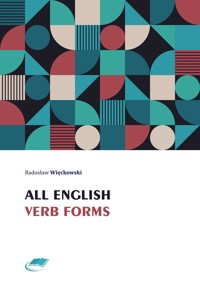
The publication is directed to English learners at all levels who want to get a feel for English verb form usage and who have not yet been able to find a synthetic and concise set of examples in one publication.
• Ebook which has no counterpart on the market
• The most synthetic and concise coverage of all English verb forms
• A full overview of all English verb forms with participle, infinitive and gerund
• Numerous, carefully selected examples set in simple contexts
• Verb forms characteristic of both spoken and written English
• Contrastive sentence patterns
The label is a joint effort, the idea
being
to sign new bands.
The label is a joint effort,
and the idea
is to sign new bands.
It
having rained all day, I decided to take a walk. (Past participle)
Although it
rained all day, I decided to take a walk.
I found the door
to be closed. = I found (by investigation) that the door was closed.
I found the door
closed. = I encountered the door in that condition.
• A comprehensive test equipped with the key at the end of the ebook
• An innovative method for getting a feel for verb form usage
Das E-Book können Sie in Legimi-Apps oder einer beliebigen App lesen, die das folgende Format unterstützen:
Veröffentlichungsjahr: 2024
Ähnliche
















Content
Preface
1. Infinitive with to or without to. The option of omitting to
2. Constructions with the infinitive with to or without to
3. Participle and gerund
4. Participle constructions
5. Gerund constructions
6. Clauses of purpose
Test
Sentences 1 - 20
Key to sentences 1 - 20
Sentences 21 - 40
Key to sentences 21 - 40
Sentences 41 - 60
Key to sentences 41 - 60
Sentences 61 - 80
Key to sentences 61 - 80
Sentences 81 - 100
Key to sentences 81 - 100
Sentences 101 - 120
Key to sentences 101 - 120
Sentences 121 - 140
Key to sentences 121 - 140
Sentences 141 - 160
Key to sentences 141 - 160
Sentences 161 - 180
Key to sentences 161 - 180
Sentences 181 - 200
Key to sentences 181 - 200
Sentences 201 - 220
Key to sentences 201 - 220
Sentences 221 - 240
Key to sentences 221 - 240
Sentences 241 - 260
Key to sentences 241 - 260
Sentences 261 - 280
Key to sentences 261 - 280
Sentences 281 - 300
Key to sentences 281 - 300
Sentences 301 - 322
Key to sentences 301 - 322
Preface
The ebook is the most definitive and synthetic overview of all English verb forms with a participle, an infinitive with or without to and a gerund. These verb forms are worth special attention as they are the cornerstone of both written and spoken English. A practical knowledge of verb forms impacts the verbal skill in everyday communication. The ebook includes all verb forms in example sentences put in simple contexts. The publication is directed to English learners at all levels who want to get a feel for English verb form usage and who have not yet been able to find a synthetic and concise set of examples in one publication. A separate chapter is devoted to clauses of purpose. The overriding aim of the ebook is to equip the learner with a comprehensive and practical overview of a participle, an infinitive with or without to and a gerund.
Radosław Więckowski
1. Infinitive with to or without to. The option of omitting to
Infinitive with to or without to. Present tense. Simple form. Active voice
1.
She prefers to send a text rather than write it.
She prefers to send a text rather than to write it.
She wanted to phone rather than write.
She wanted to phone rather than to write.
There is little choice other than have to do it.
There is little choice other than to have to do it.
2.
She can’t do better than have to do it.
She can’t do better than to have to do it.
She couldn’t do better than have to do it.
She couldn’t do better than to have to do it.
3.
She can do worse than write it.
She can do worse than to write it.
She could do worse than write it.
She could do worse than to write it.
She might do worse than write it.
She might do worse than to write it.
4.
She helped do it.
She helped to do it.
She helped me do it.
She helped me to do it.
5.
I dare do it.
I dare to do it.
I daren’t do it.
I daren’t to do it.
I don’t dare do it. I don’t dare to do it.
6.I would never dare do it.
I would never dare to do it.
I would have never dared do it.
I would have never dared to do it.
7.
I dared do it.
I dared to do it.
I dared not do it.
I dared not to do it.
I didn’t dare do it.
I didn’t dare to do it.
8.
I have known him go a whole day without eating.
I have known him togo a whole day without eating.
He's been known to go a whole day without eating.
Weather experts have never known it rain as heavily as it has this spring.
Weather experts have never known it to rain as heavily as it has this spring.
9.
It is as cheap to buy a new bike as repair the old one.
It is as cheap to buy a new bike as to repair the old one.
It is as cheap to buy a new bike as it is to repair the old one.
Buying a new bike is as cheap as repairing the old one.
10.
I expect to weep as much as laugh.
I expect to weep as much as to laugh.
I expect to weep no less than laugh.
I expect to weep no less than to laugh.
2. Constructions with the infinitive with to or without to
Infinitive without to. Present tense. Simple form. Active voice
1.
Why write it?
Why not go there?
She should write it.
She will do anything, including invite them.
2.
I didn’t see him enter, but I heard him close the door.
I heard them slam the door.
I heard that they slammed the door.
I saw him jump for joy.
He felt something brush his leg.
3.
She let me do it.
She made me do it.
I was made to do it. (the infinitive with to)
She got me to do it. (the infinitive with to)
4.see sth happen - to be the time when an event happens:
Next yearsees the centenary of her death.The twentieth centurysaw dramatic changes in most areas of life.
see sth happen - to be the place where an event happensThis stadiumhas seen many thrilling football games take place.
see sth happen - to be the event where sth happens
The missionsaw the rover land on Mars.
The mission saw the rover land on Mars.
During the mission the rover landed on Mars.
The Ironman triathlon sees competitors complete a 3.8 km swim followed by a 180 km cycle section and finally a 42.2 km run.
During The Ironman triathlon competitors complete a 3.8 km swim followed by a 180 km cycle section and finally a 42.2 km run.
5.
The sector saw a decline average 2%.
The sector averaged a decline of 2%.
The minialbum "Who Says So?" in 1983 saw Dif Juz record for the Red Flame label.
Dif Juz recorded the minialbum "Who Says So?" for the Red Flame label in 1983.
6.
1983 saw Dif Juz record the minialbum "Who Says So?" for the Red Flame label.
7.
Weather experts have never known it rain as heavily as it has this spring.to rain as heavily as it has this spring.
He's been known to go a whole day without eating.
Infinitive without to. Present and future tenses. Continuous form. Active voice
1.
She had better be writing it now.
She had best be writing it now.
She would rather be writing it now.
She could be writing it now.
She might be writing it now.
She should be writing it now.
You should think of yourself rather than be helping them.
He shall be writing it all evening. (promise, threat)
Must you be making so much noise? (anger, displeasure)
2.
I must be writing it. (indecision, delaying a decision)
I should be writing it. (indecision, delaying a decision)
We may be writing it. (indecision, delaying a decision)
Let’s be going. (indecision, delaying a decision)




