


0,49 €
Niedrigster Preis in 30 Tagen: 1,99 €
Niedrigster Preis in 30 Tagen: 1,99 €
Mehr erfahren.
- Herausgeber: Booksell-Verlag
- Kategorie: Gesellschafts- und Liebesromane
- Sprache: Englisch
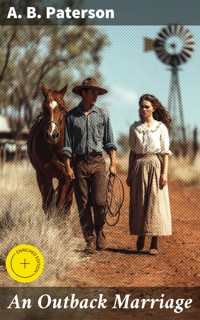
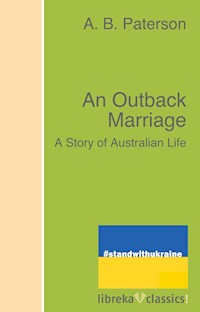
A. B. Paterson's "An Outback Marriage" is a vivid exploration of life in the Australian outback, artfully capturing the rugged landscape and the complexities of rural relationships. Written in a lyrical style that blends humor with poignancy, the novella revolves around the love story of a young woman torn between her life as a pastoralist's daughter and the allure of city life. Paterson's use of rich imagery and colloquial dialogue immerses readers in the realities of Australian frontier life, while the interplay of tradition and modernity reflects the tensions of a post-colonial society. This work situates itself firmly within the Australian bush ballad tradition, highlighting the cultural significance of the outback in shaping national identity. As one of Australia's most celebrated poets and authors, A. B. Paterson was deeply influenced by his experiences growing up in the outback. His background as a bushman, lawyer, and war correspondent informs the authenticity of his characters and settings. Paterson's deep appreciation for the Australian landscape and its people is evident throughout the narrative, which serves as both a personal reflection and a powerful commentary on the social fabric of his time. Readers seeking a profound yet charming glimpse into early Australian society will find "An Outback Marriage" an essential addition to their literary collection. Paterson's masterful storytelling, combined with his keen understanding of human emotions against the backdrop of the outback, renders this novella not only entertaining but also a poignant exploration of love, duty, and cultural identity. In this enriched edition, we have carefully created added value for your reading experience: - A succinct Introduction situates the work's timeless appeal and themes. - The Synopsis outlines the central plot, highlighting key developments without spoiling critical twists. - A detailed Historical Context immerses you in the era's events and influences that shaped the writing. - A thorough Analysis dissects symbols, motifs, and character arcs to unearth underlying meanings. - Reflection questions prompt you to engage personally with the work's messages, connecting them to modern life. - Hand‐picked Memorable Quotes shine a spotlight on moments of literary brilliance. - Interactive footnotes clarify unusual references, historical allusions, and archaic phrases for an effortless, more informed read.
Das E-Book können Sie in Legimi-Apps oder einer beliebigen App lesen, die das folgende Format unterstützen:
Veröffentlichungsjahr: 2019
Ähnliche












An Outback Marriage
Table of Contents
Introduction
In Paterson’s outback, love, livelihood, and reputation are forged and tested on the vast anvil of distance and drought. An Outback Marriage invites readers into a world where social arrangements and personal desires meet the realities of hard country, scarce water, and long memory. The title signals the union at its core, yet the novel reaches beyond courtship to examine how work, honor, and community shape the terms of any promise. In this landscape, choices often carry farther than a rider’s call across a paddock, and the question of who belongs to whom is inseparable from who belongs to the land.
Written by A. B. Paterson—widely known as Banjo Paterson—An Outback Marriage is a work of Australian fiction set across stations, bush towns, and inland tracks. Emerging in the early years of the twentieth century, in the period around Australian Federation, it blends elements of romance, adventure, and social comedy. Paterson, celebrated for his verse about rural life, turns his eye to long-form narrative, transferring the cadence and camaraderie of bush ballads into prose scenes of negotiation, trial, and celebration. The result is a novel rooted in pastoral Australia, attentive to the rhythms of stockwork, travel, and the gatherings that punctuate an isolated world.
The premise is deceptively simple: the paths of station owners, stockmen, and newcomers converge, and the question of marriage becomes entangled with livelihood, reputation, and the terms of survival. Readers follow journeys that crisscross country and class, through musters, races, and town visits where bargains are struck and impressions revised. The novel offers an experience of movement and meeting—letters carried, news exchanged, prospects weighed—rather than a single confined courtship. Its appeal lies in how the personal and the practical intertwine, tracing the way affection is tested by distance and how commitment is measured not only in sentiment but in hard-won trust.
Paterson’s voice is brisk, wry, and fond of the telling detail. He favors lively dialogue and clear action, grounding scenes in the mechanics of horses, dogs, and men at work, while letting humor ease the severity of weather and risk. The tone moves between camaraderie and caution, as characters negotiate pride, debt, and dignity. Readers can expect an episodic pace that mirrors travel itself: stretches of steady going, punctuated by quick turns and memorable encounters. The style is accessible, with the colloquial flavor of bush speech carried by a narrator who keeps the story moving and lets the country’s expansive scale frame every human calculation.
At its heart, An Outback Marriage considers how marriage operates as both a personal bond and a social contract in a frontier society. Themes of class mobility, mateship, and respectability intersect with the bush ethic of competence and fairness. The novel examines authority and obligation—between employers and hands, families and suitors—while suggesting that character is proved where help is scarce and consequences are immediate. It also attends to performance and perception: who appears trustworthy, who earns it, and how reputation circulates in a world connected by tracks and talk. Paterson’s interest lies in the everyday negotiations that define belonging and the future it promises.
Contemporary readers may find the book valuable for the way it illuminates national myths and their making. Its scenes of work, risk, and celebration speak to ongoing questions about community, gender expectations, and the costs and consolations of rural life. As a colonial-era narrative, it reflects settler perspectives common to its time; reading it today invites both appreciation of craft and a critical awareness of context. The novel’s attention to environmental pressure and social cohesion resonates in an age of climatic uncertainty, while its focus on choice under constraint—who pairs with whom, on what terms—continues to prompt reflection on how people form durable lives.
To approach An Outback Marriage is to enter a landscape where every decision is material—measured in miles, money, and sweat—yet never merely calculative. Paterson offers an engaging mixture of vigor and insight: scenes that move briskly, jokes delivered with a straight face, and an abiding curiosity about how people hold together when terrain and fortune pull them apart. For readers new to Australian literature, it provides a gateway to bush storytelling in prose; for admirers of frontier fiction, it offers a clear-eyed, good-humored account of courtship and community. The journey it promises is one of recognition, resilience, and quietly earned regard.
Synopsis
Set in colonial Australia’s grazing country, the novel opens with an outsider—an observant young visitor from Britain—arriving at a vast sheep station to learn how fortunes are made far from the cities. He meets the owners’ circle, a practical station manager, and the men who ride the boundaries, muster mobs, and read the weather as law. Through brisk scenes of shearing sheds, stock routes, and bush hospitality, the narrative establishes its world of risk and self-reliance. The newcomer’s amused respect for the outback’s unwritten rules frames the story’s central tension: how personal honor, rough-country customs, and formal law will collide when lineage and property are put to the test.
At the heart is a pastoral family whose prosperity rests on a prized run. A spirited young woman anchors the domestic sphere; the manager, bushwise and candid, keeps the station moving; the newcomer becomes their guest and ally. Around them stream itinerant shearers, horsemen, and neighboring landholders, each with a stake in the season’s results. Work rhythms establish alliances and rivalries. The narrative balances lively banter with close observation of stock-work, showing the social pecking order—squatters, selectors, hands—and the uneasy truce between them. Beneath this activity, hints of an old scandal surface, suggesting that the station’s title may depend on a marriage performed under unconventional circumstances.
The plot quickens when questions about legal inheritance arise after a death connected to the property’s founding generation. Rumors suggest that a marriage long ago, sealed in the outback with scant documentation, may determine who is entitled to the run. A rival claimant emerges, confident that gaps in records will tip the balance. The family and their allies recognize that memory, not paper, may be the only reliable currency left. The newcomer, intrigued, joins the manager in tracing witnesses, locating a certificate, or confirming a ceremony that many recall but none can conclusively prove. The prospect of litigation looms, sharpening every conversation and exchange.
The search sends the party along stock routes and goldfield remnants, visiting pubs, selectors’ huts, and old camps to find men who rode years before. Episodes of droving, race meetings, and shearers’ tales mingle with careful questioning. The bush yields clues reluctantly: a preacher remembered for marrying couples on the move, a ring said to have changed hands, a birth noted in a station diary. Social boundaries blur as they bargain for cooperation with old rivals and suspect some of cattle-duffing designed to pressure them. Amid the pursuit, a quiet courtship begins to form, shaped as much by shared hardships as by conversation.
Opposition hardens. A neighboring grazier and a shrewd adviser foster doubts about the family’s claim, courting disaffected hands and amplifying every ambiguity. A high-stakes horse race and a perilous muster become flashpoints, where pride and money ride together and hints of foul play surface. The manager’s bush skill and the newcomer’s plain candor steady the group, but their adversaries exploit delays and threaten to draw matters into protracted court battles. The narrative keeps suspense on practical problems—finding reliable witnesses, protecting stock, maintaining morale—while treating romance with restraint, always secondary to the question of whether the law will recognize an outback union.
A shift to the city introduces barristers, clerks, and newspaper men briskly sizing up the dispute. Here the novel examines the gap between metropolitan procedure and bush practice. Counsel debate whether a ceremony conducted far from church or registry, before transient witnesses, can meet statutory demands. The protagonists submit affidavits and chase certified copies; their opponents parse technicalities. Public curiosity grows, turning the case into a talking point about class, legitimacy, and colonial improvisation. Between consultations, the visitors reassess the station’s future, measuring the risks of settlement, sale, or fight. The city’s skepticism throws the outback’s code of honor into sharper relief.
Returning inland, they confront drought and fire, trials that both distract from and illuminate the central conflict. A rescue during a bushfire cements loyalties; a desperate water drive shows leadership under pressure. These chapters reaffirm the station’s economic foundations and the human ties that sustain it. A nearly lost witness is found in unlikely circumstances, and a fragment of documentary proof emerges after dogged persistence. Yet the opposition adapts, seeking to discredit testimony and sow division within the camp. Quiet moments between the would‑be lovers clarify mutual respect, but the story keeps their future contingent on the broader settlement of rights.
The climax gathers in a formal hearing where evidence, rumor, and character are weighed together. Long-buried connections surface; timelines clarify; and an outback ceremony takes center stage as judges test its sufficiency against the letter of the law. Cross-examinations probe motives and memory, while the courtroom watches for any slip that might decide ownership. Outside, supporters wait for word that will affect livelihoods up and down the district. The narrative sustains tension without grandstanding, letting facts and steady voices carry the day. At the same time, a private decision about marriage ripens, bound up with the outcome but not wholly defined by it.
The resolution affirms the novel’s central concern: the possibility of reconciling bush pragmatism with formal justice, and personal loyalty with public duty. Whatever the precise distribution of land and title, the story closes on a settlement that promises continuity without erasing the past. The romantic thread resolves in a way that reflects mutual capability rather than spectacle. An Outback Marriage offers a portrait of Australian life in transition, where old-country hierarchy meets local ingenuity, and where a marriage—literal and symbolic—bridges class and landscape. The message is one of measured confidence in institutions tempered by respect for the lived realities of the outback.
Historical Context
Set across the Australian colonies in the late nineteenth century, An Outback Marriage inhabits a world of vast sheep and cattle stations, coaching roads, new railheads, and frontier townships from New South Wales to Queensland. The period roughly spans the 1870s to the early 1900s, when the interior was tied to coastal ports by telegraph and rail yet still governed by the rhythms of seasons, droving, and shearing. Paterson, born in 1864 and intimately familiar with station life, situates his plot within this pastoral economy, using journeys between homesteads, shearing sheds, and regional courts to convey the social geography of the Outback and its hierarchies.
Pastoral expansion and the squatting era formed the social bedrock of the novel’s world. From the 1820s, squatters took up vast leaseholds on Aboriginal land; by 1891 Australia grazed about 106 million sheep, with the Riverina and Darling Downs as major centers. Land reform reshaped power: the New South Wales Crown Lands Acts of 1861 and Queensland’s Crown Lands Alienation Act of 1868 enabled selection, pitting smallholders against entrenched squatters. This contest forged wealthy station dynasties and precarious selectors. Paterson’s narrative of property, inheritance, and marriage alliances mirrors these conflicts, depicting how land laws and pastoral capital created fortunes, social ranks, and the pressures that drive the novel’s domestic and legal intrigues.
The gold rushes of 1851 to the late 1860s transformed colonial society. Discoveries at Ophir and Turon in New South Wales and at Ballarat and Bendigo in Victoria drew migrants from Britain, Europe, North America, and China. Colonial population surged from roughly 436,000 in 1851 to about 1.7 million by 1871, funding railways, banks, and coastal cities. Anti-Chinese violence at Lambing Flat in 1861 exemplified racial tensions. The economic fluidity and social mobility born of gold wealth ripple into Paterson’s storyworld: characters move between bush and town, fortunes are made or lost outside old family lines, and the novel reflects the mingling of classes that the rushes set in motion.
Frontier conflict and the dispossession of Aboriginal peoples underwrote the pastoral economy. Events such as the Myall Creek Massacre (1838, New South Wales), Hornet Bank (1857, Queensland), and Cullin-la-ringo (1861, Queensland) marked cycles of violence. The Queensland Native Police, established in 1848, enforced settler expansion into districts like the Barcoo and Channel Country. By the 1890s, many stations relied on Aboriginal stockworkers and police trackers, even as legal and social structures denied their rights. Paterson’s Outback milieu—stock routes, homesteads, and bush policing—implicitly rests on this history; brief appearances of trackers and station labor hint at the erasure and exploitation that enable the landed society his plot portrays.
The wool industry’s labor politics culminated in the shearers’ strikes of 1891 and 1894. In 1891, central-west Queensland camps near Barcaldine challenged pastoralists over rates and contracts; arrests and mounted police confrontations followed, and the Australian Labor Party emerged in 1891 from union networks. A second strike in 1894 spread into New South Wales amid depression. Paterson knew this milieu intimately; in 1895 he wrote Waltzing Matilda in western Queensland, a song often linked to strike-era tensions. The novel’s depictions of shearing seasons, hiring, and station discipline echo these industrial conflicts, illuminating how wage disputes, unionism, and employer power shaped relationships and loyalties in the bush.
Bushranging and colonial policing shaped rural law and legend from the 1860s to the 1880s. The Felons Apprehension Act 1865 in New South Wales allowed outlaws to be shot on sight; notable figures included Ben Hall (killed 1865), Captain Thunderbolt (shot 1870), and the Kelly gang, whose final stand at Glenrowan in 1880 ended with Ned Kelly’s capture and execution. Mounted police patrols, magistrates’ circuits, and Aboriginal trackers extended the law into remote districts. Paterson’s narrative interest in stock theft, false identities, and the reputations of station men resonates with this culture of pursuit and notoriety, framing marriage, property, and honor against persistent anxieties about crime and legitimacy.
Economic crisis, drought, and Federation reconfigured the colonies at century’s end. The banking crash of 1893 shuttered financial houses and tightened pastoral credit. The Federation Drought (c. 1895–1902) devastated herds and wool clips, forcing sales and consolidations. Political unification followed: the 1891 and 1897–1898 conventions drafted a federal constitution; referendums in 1898–1900 led to the Commonwealth of Australia on 1 January 1901. The Immigration Restriction Act 1901 instituted White Australia. Railways pushed west—Charleville’s line by 1888—and the Overland Telegraph (1872) linked the interior to global markets. In Paterson’s world, these forces underpin characters’ financial risks, intercolonial travel, and emerging national consciousness that colors their ambitions and alliances.
As social and political critique, the book exposes the inequities embedded in pastoral capitalism and colonial governance. It interrogates how land laws, marriage settlements, and reputations legitimize wealth while marginalizing workers, selectors, and Aboriginal people whose labor and dispossession sustain station prosperity. Scenes of hiring, debt, and legal maneuvering question the justice of a system that secures property before persons. The narrative’s attention to mobility and mistaken identity undermines rigid class claims, while bush policing and summary authority reveal uneven rule of law. In dramatizing who may belong, inherit, or wed across boundaries, the work critiques the racial exclusions and class stratification of the Federation-era society it depicts.




