


7,99 €
Mehr erfahren.
- Herausgeber: ST MAXIM THE GREEK INSTITUTE
- Kategorie: Religion und Spiritualität
- Sprache: Englisch
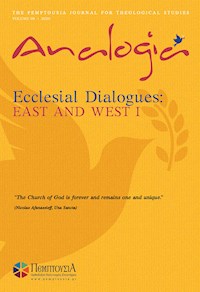
The beginning of the Roman Catholic/Orthodox Theological dialogue during the 20th century raised to some high hopes for an imminent canonical unity between the two Denominations, and this, though premature, is not of course to be blamed; it is impossible for any contemporary Christian theologian not to suffer from the division within this very womb of the ontological unification of all things, which is the Church of Christ—precisely because this division gives to many the impression of a fragmentation of the Church’s very being and subsequently weakens her witness. Contents: 1. Crusades, Colonialism, and the Future Possibility Christian Unity, GEORGE E. DEMACOPOULOS, 2. Approaching the Future as a Friend Without a Wardrobe of Excuses, ADAM A.J. DEVILLE, 3. Anglicans and the Una Sancta, JONATHAN GOODALL, 3. Eucharistic Doctrine and Eucharistic Devotion, ANDREW LOUTH, 4. A Spectre Is Haunting Intercommunion, SOTIRIS MITRALEXIS, 5. The origins of an ecumenical church: links, borrowings, and inter-dependencies, THOMAS O’LOUGHLIN, 6. ‘Unity of the Churches—An Actual Possibility: The Rahner-Fries Theses and Contemporary Catholic-Orthodox Dialogue’, EDWARD A. SIECIENSKI, 7. Schmemann’s Approach to the Sacramental Life of the Church: its Orthodox Positioning, its Catholic Intent, MANUEL SUMARES
Das E-Book können Sie in Legimi-Apps oder einer beliebigen App lesen, die das folgende Format unterstützen:
Veröffentlichungsjahr: 2022
Ähnliche








Analogia is a peer-reviewed academic journal dedicated to the scholarly exposition and discussion of the theological principles of the Christian faith. A distinguishing feature of this journal will be the effort to advance a dialogue between Orthodox Christianity and the views and concerns of Western modes of theological and philosophical thought. A key secondary objective is to provide a scholarly context for the further examination and study of common Christian sources. Though theological and philosophical topics of interest are the primary focus of the journal, the content of Analogia will not be restricted to material that originates exclusively from these disciplines. Insofar as the journal seeks to cultivate theological discourse and engagement with the urgent challenges and questions posed by modernity, topics from an array of disciplines will also be considered, including the natural and social sciences. As such, solicited and unsolicited submissions of high academic quality containing topics of either a theological or interdisciplinary nature will be encouraged. In an effort to facilitate dialogue, provision will be made for peer-reviewed critical responses to articles that deal with high-interest topics. Analogia strives to provide an interdisciplinary forum wherein Christian theology is further explored and assumes the role of an interlocutor with the multiplicity of difficulties facing modern humanity.
annual subscription: Online only. Individuals €18, Institutions €150. A subscription to Analogia comprises three issues. For more information, please go to www.analogiajournal.com
subscription details: To access the content, payment is required in full. Please send all subscription-related enquiries to [email protected]
methods of payment: Payments are accepted via credit card, PayPal, or bank transfer (AlphaBank, IBAN GR71 0140 2260 2260 0200 2008 780).
requests for permissions: All rights reserved. No part of this publication may be reproduced, stored in a retrieval system, transmitted in any form or by any means, electronic, mechanical, photocopying, recording, or otherwise without the prior written permission of the publisher. For requests, please contact [email protected]
The author(s) of each article appearing in this journal is/are solely responsible for the content thereof. The content of the articles published in Analogia does not necessarily represent the views of the editors, the editorial board, or the publisher.
Analogia:The Pemptousia Journal forTheological Studies is issued three times a year. Analogia is the academic arm of the acclaimed web magazine, Pemptousia (www.pemptousia.com, www.pemptousia.gr). Both Pemptousia and Analogia are published by St Maxim the Greek Institute (www.stmaximthegreek.org).
Analogia is generously sponsored by the Holy and Great Monastery of Vatopaidi, Mount Athos.
Cover excerpt from Nicolas Afanassieff, ‘Una Sancta’, in Tradition Alive: On the Church and the Christian Life in Our Time: Readings from the Eastern Church, ed. Michael Plekon (Lanham, MD: Rowan & Littlefield, 2003), 22.
ISSN 2529–0967
Copyright © 2020 St Maxim the Greek Institute
postal address: Analogia, St Maxim the Greek Institute,
Panormou 70–72, 115 23, Athens, Greece
Cover and typesetting by HGMV.
Printed by Open Line.
Guest Editors
Sotiris Mitralexis & Andrew Kaethler
note from the senior editor
The beginning of the Roman Catholic/Orthodox Theological dialogue during the 20th century raised to some high hopes for an imminent canonical unity between the two Denominations, and this, though premature, is not of course to be blamed; it is impossible for any contemporary Christian theologian not to suffer from the division within this very womb of the ontological unification of all things, which is the Church of Christ—precisely because this division gives to many the impression of a fragmentation of the Church’s very being and subsequently weakens her witness. However, indeed, it is the Church that matters, beyond any political, sociological or historical ‘necessity’, which perhaps has ensouled some Church leaders’ wishful thinking, over the centuries, for such an imminent canonical unity. And that means that the unity is a matter of Theology. I think that this was precisely the underlying motive of the organisers of the Syros Conference, the fruits of which are published in this two-volume publication of Analogia. As the Senior Editor of this Journal, but also as a participant in the Syros Conference, and in the ongoing academic dialogue between the Orthodox and the Roman Catholics, I wish to thank both the organisers, and the two Guest Editors, who did their best and put significant work into this enterprise; I hope that this publication will be a particular opportunity for this theological communication, which wishes to build a wiser reciprocal dialogue upon a deeper mutual fathoming.
– Nikolaos Loudovikos, Senior Editor
editorial
We are overjoyed that Analogia’s issues 9 and 10 are dedicated to Ecclesial Dialogues: East and West—that is, to peer-reviewed and revised versions of papers first presented at the international conference exploring this subject and convened in the island of Syros, from the 10th to the 14th of June 2019. This conference would not have materialised without the generous support of Loyola Marymount University’s Revd Professor Cyril Hovorun and the generous support of the University of Winchester (which provided the conference’s academic aegis) and our co-convenor, Revd Reader Andreas Andreopoulos; we extend our cordial gratitude to these individuals and institutions, as we remain with the hope that a particular vision (or rather, perspective) was articulated during those days in Syros, rather than merely yet another ecumenically-oriented scholarly gathering.
The guest editors deem it important that this conference (and the Analogia issues stemming therefrom) did not form part of any level of official ecclesial dialogue and exchange but consisted in a bottom-up scholarly endeavour at ecclesial enquiry, exploration and discovery. The reader shall be spared the guest editors’ theological musings in this editorial note (yet these musings shall return vengefully in the guest editors’ respective papers). We have opted for one introduction to both issues, so that the interested reader will be made aware of the contents of the other issue, apart from the one you are currently holding in your hands.
Ecclesial Dialogues: East and West I (i.e., Analogia 9) opens with Dr Sotiris Mitralexis’ (Orthodox, University of Winchester & University of Athens) ‘A Spectre Is Haunting Intercommunion’, an introduction to the conference’s problematic. Professor Edward Siecienski’s (Orthodox, Stockton University) paper follows, entitled ‘Unity of the Churches—An Actual Possibility: The Rahner-Fries Theses and Contemporary Catholic-Orthodox Dialogue’, highlighting from a contemporary perspective the eight theses that Karl Rahner, SJ and Heinrich Fries proposed in 1983, in the hope of healing Christianity’s many divisions. Revd Professor Thomas O’Loughlin (Catholic, University of Nottingham) then proceeds in his ‘The Origins of an Ecumenical Church: Links, Borrowings, and Inter-dependencies’ to examine the ecclesiology of early churches as nodes within a network, established and maintained by constant contact and by those who saw it as part of their service/vocation to travel between the churches; this culture of links, of sharing and borrowing, could perhaps form a model for a practical way forward today towards a renewed sense of our oneness in Christ. In ‘Crusades, Colonialism, and the Future Possibility of Christian Unity’, Professor George Demacopoulos (Orthodox, Fordham University) presents the historical conditions more extensively laid out in his recent monograph Colonizing Christianity: Greek and Latin Religious Identity in the Era of the Fourth Crusade (New York: Fordham University Press, 2019) in order to develop a more constructive theological argument regarding the ecumenical implications of that historical work. Revd Professor Andrew Louth (Orthodox, Durham University) focuses in his ‘Eucharistic Doctrine and Eucharistic Devotion’ on comparing the Western Rite of Benediction, Exposition of the Host and adoration, with the Liturgy of the Presanctified Gifts in the East; the nature of Eucharistic devotion expressed in these two rites is in most ways strikingly different, and this leads Revd Professor Louth to highlight differences that are rather rarely discussed in ecumenical discussions. Revd Dr Manuel Gonçalves Sumares (Orthodox, Catholic University of Portugal, Braga) centres on the late Fr Alexander Schmemann (and Sergius Bulgakov, among many others) in his ‘Schmemann’s Approach to the Sacramental Life of the Church: its Orthodox Positioning, its Catholic Intent’. Revd Professor Adam AJ DeVille (Catholic, University of Saint Francis) offers an Eastern Catholic perspective in his ‘Approaching the Future as a Friend Without a Wardrobe of Excuses’, including moral questions around marriage and divorce, historiographical and liturgical-hagiographical questions centred on the canonization and commemoration of saints in one communion who left and/or were used in conciliar debates and liturgical texts to condemn the sister communion; and questions of synodal organization and structures in both Catholicism and Orthodoxy in the face of centralizing tendencies. The first issue concludes with a rich Anglican perspective presented by the Rt Revd Jonathan Goodall, Bishop of Ebbsfleet and Archbishop of Canterbury’s Representative to the Orthodox Church: in his ‘Anglicans and the Una Sancta’, Bishop Jonathan stresses the Anglican self-understanding as ‘part of the One, Holy, Catholic and Apostolic Church’.
Ecclesial Dialogues: East and West II (i.e., Analogia 10) starts with the Senior Editor of Analogia, Revd Professor Nicholas Loudovikos (Orthodox, University Ecclesiastical Academy of Thessaloniki, University of Winchester, IOCS Cambridge, Orthodox Secretary of the ‘St Irenaeus’ Joint Catholic-Orthodox International Working Group) and his paper on ‘Christological or Analogical Primacy: Ecclesial Unity and Universal Primacy in the Orthodox Church’, according to which ‘the only way Christ makes himself analogically present as the head of his Church, through a universal Primate, is as manifestation of a consubstantializingSynodality’. Professor Andrew TJ Kaethler (Catholic, Catholic Pacific College), in his ‘Manifesting Persons: A Church in Tension’, begins from a theological notion of personhood in order to provide a broad framework or an imaginative construct to conceive of Church unity, in light of Joseph Ratzinger’s and Romano Guardini’s respective theologies. Kaethler suggests that the East and West will, perhaps, most flourish in a united tension, a coming together of difference rather than a complete dissolving of our respective distinctions. Following this, Professor Jared Schumacher (Catholic, University of Mary) formulates ‘An Ignatian-MacIntyrean Proposal for Overcoming Historical and Political-Theological Difficulties in Ecumenical Dialogue’, focusing on three difficulties in achieving practical unity: the recognition of plurality, the problem of synthesis or integration, and the problem of orientation implicit in any synthesis. Returning ad fontes, Professor Christos Karakolis (Orthodox, University of Athens) examines the character of Simon Peter in the narrative of John’s Gospel in his ‘Simon Peter in the Gospel According to John: His Historical Significance according to the Johannine Community’s Narrative’, in order to help us better understand the biblical foundations of the theological debate on the papal office. Fast-forward to the 6th century with Professor Anna Zhyrkova’s (Catholic, Akademia Ignatianum, Krakow) ‘The Scythian Monks’ Latin-cum-Eastern Approach to Tradition: A Paradigm for Reunifying Doctrines and Overcoming Schism’, which presents the historical case study of the Scythian monks, who united Western and Eastern traditions, seeing both traditions as one and not hesitating to address problems simultaneously of concern to both Rome and Constantinople, putting forward a solution based on a synthesis of Augustine’s and Cyril’s theologies. Escaping doctrinal differences per se and turning our attention to aesthetics —a perspective rarely addressed in East-West dialogues—, Professor Norm Klassen (Catholic, University of Waterloo) offers in his ‘Beauty is the Church’s Unity: Supernatural Finality, Aesthetics, and Catholic–Orthodox Dialogue’ an understanding of beauty vis-à-vis the nature/grace question, inter alia via a reference to Rowan Williams’ thought. The conference’s co-convener Revd Reader Andreas Andreopoulos (Orthodox, University of Winchester) proposes in his ‘Ecumenism and Trust: A Pope on Mount Athos’ a hypothetical scenario, an exercise in imagination, an ecumenical Christian-fi in the manner of sci-fi, according to which a particularly humble Pope of Rome visits Mount Athos, the bastion of Orthodox asceticism, in search of unity and in an ecclesial version of the famous 1971-72 dictum ‘only Nixon could go to China’; the point is that it is necessary to recognize the multitude of levels and dimensions of dialogue and the question of the reunification of the East and the West, well beyond the remit of joint theological commissions, and that establishment of mutual trust among clergy, monastics and laity on both sides is the first necessary step. Remaining on Mount Athos and its attempted Catholic equivalent, Dr Marcin Podbielski (Catholic, Akademia Ignatianum, Krakow) shares in his philosophically-informed ‘God’s Silence and Its Icons: A Catholic’s Experiences at Mount Athos and Mount Jamna’ his ‘bewilderment [that] there seems to be almost no room in contemporary Catholic spirituality for silence and isolation’ and presents Athos and Jamna as two different realizations of an icon given to us by Christ himself, as human instruments which we create to point to true participation in the Divine presence of the New Jerusalem. Whereas the Catholic experience tries to bring everyone into participation in the life of the New Jerusalem, the Orthodox Athos, in its silent uniqueness, testifies to a unique and ineffable transcendence. Returning to more mainstream themes in East-West dialogue, Revd Dr Johannes Börjesson (University of Cambridge) offers in his ‘Councils and Canons’ a Lutheran perspective on the Great Schism and the ‘Eighth Council’ via Lutheran ecclesiology. From a ‘Radical Orthodox’ perspective within Anglicanism and beyond, Professor John Milbank (University of Nottingham) argues in his ‘Ecumenism done otherwise: Christian unity and global crisis’ for a connection of ecumenism to politics, and suggests that any relevant dialogue should theologically assume that Church unity already exists but has been obscured and obfuscated—with our task being to recover and disclose this unity. Completing our Analogia issues, Professor Marcello La Matina (Catholic, University of Macerata) offers the closing thoughts of this collective endeavour from the perspective of a scholar of the philosophy of language in his paper ‘Concluding Reflections on Mapping the Una Sancta: An Orthodox-Catholic Ecclesiology Today’, proposing an understanding of the schism as the stage of the mirror, as Jacques Lacan would have it.
In closing this editorial note, we would like to thank the following institutions and sponsors: again, Loyola Marymount University and the University of Winchester, for making the conference possible; Catholic Pacific College and the Municipality of Syros for their support, as well as His Excellency J. Michael Miller, CSB, the Roman Catholic Archbishop of Vancouver. We are filially grateful to His All-Holiness Ecumenical Patriarch Bartholomew, His Beatitude Ieronymos II, Orthodox Archbishop of Athens and All Greece, to His Eminence Dorotheos, Orthodox Metropolitan of Syros, Tinos, Andros, Kea and Milos, and to His Excellency Petros Stephanou, Catholic Bishop of Syros, Milos, Santorini and Apostolic administrator of the Diocese of Crete, for their kind permission and blessing of the conference. Revd Professor Nikolaos Loudovikos has kindly proposed the publication of the Syros papers in Analogia following successful peer-review; we are most thankful to him for this invitation. We remain with the hope that this collective endeavour forms the beginning, rather than the completion, of an attempt at seeing ecclesial dialogues between East and West from a particular and hopefully fresh perspective.
– Dr Sotiris Mitralexis & Dr Andrew Kaethler, Guest Editors
table of contents
A Spectre Is Haunting Intercommunion
Sotiris Mitralexis
‘Unity of the Churches—An Actual Possibility: The Rahner-Fries Theses and Contemporary Catholic-Orthodox Dialogue’
Edward A. Siecienski
The Origins of an Ecumenical Church: Links, Borrowings, and Inter-dependencies
Thomas O’Loughlin
Crusades, Colonialism, and the Future Possibility Christian Unity
George E. Demacopoulos
Eucharistic Doctrine and Eucharistic Devotion
Andrew Louth
Schmemann’s Approach To The Sacramental Life Of The Church: Its Orthodox Positioning, Its Catholic Intent
Manuel Sumares
Approaching the Future as a Friend Without a Wardrobe of Excuses
Adam A.J. DeVille
Anglicans and the Una Sancta
Jonathan Goodall
A Spectre Is Haunting Intercommunion
Sotiris Mitralexis
Teaching Fellow, University of Athens & Visiting Research Fellow, University of Winchester
As an introduction to the current issue, this paper looks at certain details of the current state of the ecclesial dialogue between East and West, in light of Edward Siecienski’s two important contributions, The Papacy and the Orthodox: Sources and History of a Debate (Oxford University Press, 2017) and The Filioque: History of a Doctrinal Controversy (Oxford University Press, 2010) and of other sources. The core question of the paper is, which Church is the “One, Holy, Catholic and Apostolic Church” that we confess to during each liturgy and mass? Is it one of two divided Churches, or the one Church in schism?
1
Allow me to start with my personal incentives for embarking upon this enquiry. Reading Edward Siecienski’s treatises on the historyof the divide, the recent The Papacy and the Orthodox: Sources and History of a Debate1and his earlier The Filioque: History of a Doctrinal Controversy,2 I saw with considerable clarity that the actual historical trajectories of the Orthodox and the Catholic Church, in all the vertiginous complexity of these trajectories in all their details, look quite different from the simplified, retroactively formulated historical narratives concerning purported clear-cut divisions.
Of course, there is much to be said about which differences are indeed seemingly or currently irreconcilable doctrinal and ecclesiological divisions and which differences are merely legitimate local liturgical, ecclesiological and theological traditions, from the vast pool of theologoumena, of apostolic churches comprised of different peoples and at different points and circumstances in history. It must be remarked that this diversity of legitimate traditions of apostolic churches has also been largely lost within both the Roman and the Byzantine Church, in view of the homogenisation that emerged during the reign of the empires within which each of these churches flourished.
Later I proceeded in the study of works exploring, either directly or indirectly, cognate issues from different angles—for example, Adam DeVille’s Orthodoxy and the Roman Papacy3 and his recent Everything Hidden Shall Be Revealed,4 the 2018 paper Serving Communion: Re-Thinking the Relationship between Primacy and Synodality by the Saint Irenaeus Joint Orthodox-Catholic Working Group,5 or Cyril Hovorun’s books including his recent Scaffolds of the Church, with particularly valuable insights on re-thinking primacy, ecclesiology and synodality: ‘the Church is not hierarchical in its nature. The hierarchical principle is not even its natural property. It was borrowed from outside the Church and remains there as its scaffolding’;6 hierarchy ‘is useful, but not sacred’.7
What, however, truly remains a scandal for me is that we seem to be taking for granted the Orthodox and the Catholic Churches’ claim to being the ‘One, Holy, Catholic and Apostolic Church’, the Una Sancta, even though their participation in bilateral and ecumenical dialogue attests to their conviction that ‘something is missing’, as it were.8 My problem is a historical one rather than a question of being ‘open’ or ‘not open’ to ecumenical relations. When exactly and how, did the Church define that only the Orthodox or the Catholics—that is, the aggregate of all Orthodox or, respectively, Catholic dioceses and parishes—are the Una Sancta in the only way the Church knows in order to confidently proclaim truth—i.e., synodically, in a conciliar manner? In the case of the Catholic Church, we know that she continued to convene councils it proclaimed as ecumenical—and the historical and theological soundness of this decision will, I hope, be part of the discussions of this conference—and we know the normative proclamations and statements she has issued on the matter, as she increasingly often has done since the nineteenth century, not only on doctrine but indeed on most matters, from moral9 and sexual to ecological and political ones.10 It has been demonstrated exhaustively that the ‘Great Schism’ of 1054 was not that great at the time, with various local churches acknowledging both Rome and Constantinople for centuries, and with intercommunion and other contacts continuing their course even well after the eleventh century. We also know that the true Schism came with the Sack of Constantinople in 1204 and the Fourth Crusade, after which the Roman Church forced itself on the Orthodox, installing for example its bishops and its liturgical rite in dioceses. This, however, is a historical matter, not a theological one, and I find this distinction immensely crucial.
However, the Orthodox Church has never synodically proclaimed herself (and herself exclusively) as the Una Sancta. Before returning to this, allow me to underscore the scandalous nature of this ambiguity concerning the Una Sancta. The precise nature of the ‘One, Holy, Catholic and Apostolic Church’ that we confess during each liturgy and mass (this witnessing being the cornerstone of the Eucharistic assembly, particularly given that both the Catholics and the Orthodox insist that the Una Sancta is a visible Church, one we see and know) cannot be an object to individual, free theorizing, in the same way that basic Christology cannot be treated as if it were a theologoumenon. The definition of the visible Una Sancta cannot hang in mid-air, even if this entails the acknowledgement that she indeed finds herself in Schism. If the question whether this Una Sancta is one of two divided Churches, or the one Church in schism (until either the conclusive healing of this schism or the permanence and consolidation thereof that would be declared by a joint council, similar to the councils on the Christological controversies of the first millennium), cannot remain open, as it undermines the witness upon which the Eucharistic assembly, every Eucharistic assembly, materialises. Despite the obvious cheesiness of the title, it is indeed true that a spectre is haunting intercommunion: the spectre of mapping the Una Sancta.
The fact remains that there was no universal council in the case of the Orthodox—up until Crete, ironically, whose reception by the people is at best lukewarm, if not inexistent—proclaiming a particular Orthodox body, an Orthodox sum of actual dioceses and parishes, as the exclusive One, Holy, Catholic and Apostolic church. Thus, we see that certain ‘traditional’ utterances that are taken for granted, such as the Orthodox proclamation that ‘the Una Sancta IS the Orthodox Church’, are rather quite modern innovations, historically speaking.11 While I believe that a similar problem should be (re)thought of in the case of the Catholic Church, I can speak in this paper only about my Church, the Orthodox Church.
Let us take the 2016 Holy and Great Council of the Orthodox Church in Crete in order to elaborate on this. A controversy surrounding it mainly centred on anti-ecumenists harshly criticizing it as an ‘ecumenist’ council. This was due to the Council resolutions employing a terminology of ‘churches’ vis-à-vis, for example, the Catholic Church; critics saw in this an undermining of the certainty that the Orthodox Church is the creed’s ‘one, holy, catholic and apostolic church’ and an indirect adoption of the branch theory and/or the ‘invisible church’ theory in ecclesiology, which mainly emanate from Anglican and protestant communities respectively.
Interestingly, this ostensibly ‘traditional’ criticism presupposes a radical innovation by the anti-ecumenist wing, for example, the notion that the employment of the term ‘church’—ἐκκλησία—always and necessarily refers to the technical content of the term ‘church’ as in the creedal Una Sancta, the one church. Seeing that, historically, this is simply and plainly not the case, given that a plethora of Orthodox documents during the second millennium refer to the Catholics and not exclusively the Catholics by employing the term ‘church’ in a variety of contexts, it has to be identified as an innovation on the part of the ‘anti-ecumenists’ (i.e., as the introduction of a wholly un-traditional use of vocabulary as normative). It is not the first time that notions and ideas presented as the quintessence of tradition turn out to be wholly modern and new;12 however, this is a digression from my main point.




