


0,49 €
Niedrigster Preis in 30 Tagen: 1,99 €
Niedrigster Preis in 30 Tagen: 1,99 €
Mehr erfahren.
- Herausgeber: Booksell-Verlag
- Kategorie: Fachliteratur
- Sprache: Englisch
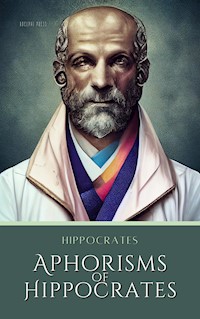
Hippocrates' "Aphorisms" stands as a cornerstone of medical literature, blending concise, poignant observations with philosophical reflections on the art of healing. Written in a classical Greek style, the text captures the essence of Hippocratic thought, emphasizing the interplay between ethics, observation, and diagnosis. Organized into brief, aphoristic statements, the work distills centuries of medical practice and wisdom into accessible insights, making it both a scholarly reference and a meditative guide for practitioners. Its relevance transcends the confines of its historical context, offering timeless wisdom relevant to contemporary medical ethics and practice. Hippocrates, often referred to as the 'Father of Medicine,' was a physician in ancient Greece whose extensive works have profoundly influenced both the study and practice of medicine. Living during a time of significant development in scientific and philosophical thought, his experiences and inquiries into health, disease, and human nature fueled his desire to understand the complexities of the human body. His emphasis on systematic observation and ethical practice reflects a broader commitment to rational inquiry that shaped future generations of medical practitioners. "Aphorisms" is highly recommended for readers seeking to explore foundational principles of medical ethics, expand their understanding of the human condition, or appreciate the profound impact of ancient wisdom on modern medicine. It serves as a vital resource for students, practitioners, and anyone interested in the enduring legacy of Hippocratic thought.
Das E-Book können Sie in Legimi-Apps oder einer beliebigen App lesen, die das folgende Format unterstützen:
Veröffentlichungsjahr: 2021
Ähnliche



Aphorisms
Table of Contents
Section 1
1. LIFE is short, and Art long; the crisis fleeting; experience perilous, and decision difficult. The physician must not only be prepared to do what is right himself, but also to make the patient, the attendants, and externals cooperate.
2. In disorders of the bowels and vomitings, occurring spontaneously, if the matters purged be such as ought to be purged, they do good, and are well borne; but if not, the contrary. And so artificial evacuations, if they consist of such matters as should be evacuated, do good, and are well borne; but if not, the contrary. One, then, ought to look to the country, the season, the age, and the diseases in which they are proper or not.
3. In the athletæ, embonpoint, if carried to its utmost limit, is dangerous, for they cannot remain in the same state nor be stationary; and since, then, they can neither remain stationary nor improve, it only remains for them to get worse; for these reasons the embonpoint should be reduced without delay, that the body may again have a commencement of reparation. Neither should the evacuations, in their case, be carried to an extreme, for this also is dangerous, but only to such a point as the person's constitution can endure. In like manner, medicinal evacuations, if carried to an extreme, are dangerous; and again, a restorative course, if in the extreme is dangerous.
4. A slender and restricted diet is always dangerous in chronic diseases, and also in acute diseases, where it is not requisite. And again, a diet brought to the extreme point of attenuation is dangerous; and repletion, when in the extreme, is also dangerous.
5. In a restricted diet, patients who transgress are thereby more hurt (than in any other?); for every such transgression, whatever it may be, is followed by greater consequences than in a diet somewhat more generous. On this account, a very slender, regulated, and restricted diet is dangerous to persons in health, because they bear transgressions of it more difficultly. For this reason, a slender and restricted diet is generally more dangerous than one a little more liberal.
6. For extreme diseases, extreme methods of cure, as to restriction, are most suitable.
7. When the disease is very acute, it is attended with extremely severe symptoms in its first stage; and therefore an extremely attenuating diet must be used. When this is not the case, but it is allowable to give a more generous diet, we may depart as far from the severity of regimen as the disease, by its mildness, is removed from the extreme.
8. When the disease is at its height, it will then be necessary to use the most slender diet.
9. We must form a particular judgment of the patient, whether he will support the diet until the acme of the disease, and whether he will sink previously and not support the diet, or the disease will give way previously, and become less acute.
10. In those cases, then, which attain their acme speedily, a restricted diet should be enjoined at first; but in those cases which reach their acme later, we must retrench at that period or a little before it; but previously we must allow a more generous diet to support the patient.
11. We must retrench during paroxysms, for to exhibit food would be injurious. And in all diseases having periodical paroxysms, we must restrict during the paroxysms.
12. The exacerbations and remissions will be indicated by the diseases, the seasons of the year, the reciprocation of the periods, whether they occur every day, every alternative day, or after a longer period, and by the supervening symptoms; as, for example, in pleuritic cases, expectoration, if it occur at the commencement, shortens the attack, but if it appear later, it prolongs the same; and in the same manner the urine, and alvine discharges, and sweats, according as they appear along with favorable or unfavorable symptoms, indicate diseases of a short or long duration.
13. Old persons endure fasting most easily; next, adults; young persons not nearly so well; and most especially infants, and of them such as are of a particularly lively spirit.
14. Growing bodies have the most innate heat; they therefore require the most food, for otherwise their bodies are wasted. In old persons the heat is feeble, and therefore they require little fuel, as it were, to the flame, for it would be extinguished by much. On this account, also, fevers in old persons are not equally acute, because their bodies are cold.
15. In winter and spring the bowels are naturally the hottest, and the sleep most prolonged; at these seasons, then, the most sustenance is to be administered; for as the belly has then most innate heat, it stands in need of most food. The well-known facts with regard to young persons and the athletæ prove this.
16. A humid regimen is befitting in all febrile diseases, and particularly in children, and others accustomed to live on such a diet.
17. We must consider, also, in which cases food is to be given once or twice a day, and in greater or smaller quantities, and at intervals. Something must be conceded to habit, to season, to country, and to age.
18. Invalids bear food worst during summer and autumn, most easily in winter, and next in spring.
19. Neither give nor enjoin anything to persons during periodical paroxysms, but abstract from the accustomed allowance before the crisis.
20. When things are at the crisis, or when they have just passed it, neither move the bowels, nor make any innovation in the treatment, either as regards purgatives or any other such stimulants, but let things alone.
21. Those things which require to be evacuated should be evacuated, wherever they most tend, by the proper outlets.
22. We must purge and move such humors as are concocted, not such as are unconcocted, unless they are struggling to get out, which is mostly not the case.
23. The evacuations are to be judged of not by their quantity, but whether they be such as they should be, and how they are borne. And when proper to carry the evacuation to deliquium animi, this also should be done, provided the patient can support it.
24. Use purgative medicines sparingly in acute diseases, and at the commencement, and not without proper circumspection.
25. If the matters which are purged be such as should be purged, the evacuation is beneficial, and easily borne; but, if otherwise, with difficulty.
Section 2
1. In whatever disease sleep is laborious, it is a deadly symptom; but if sleep does good, it is not deadly.




