


20,99 €
Mehr erfahren.
- Herausgeber: John Wiley & Sons
- Kategorie: Wissenschaft und neue Technologien
- Sprache: Englisch
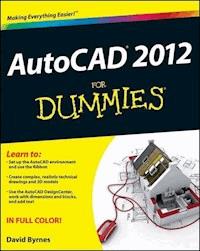
A full-color guide to the #1 architectural draftingprogram--AutoCAD 2012! AutoCAD is the leading software used to create 2D and 3Dtechnical drawings. Used by engineers, architects, and draftingprofessionals, it can be complex and is a perfect subject for thetried-and-true For Dummies format. Full-color illustrationsmake the instructions even easier to follow, because examples inthe book appear exactly as they will on the screen. * Explains AutoCAD and gets readers quickly up to speed on thelatest version * Features full-color illustrations that look the same as theAutoCAD 2012 screens, making the interface and the all-importantModel view easier to understand * Covers all the new features, creating a basic layout, usingAutoCAD DesignCenter, drawing and editing, working with dimensions,adding text, and more Newcomers to AutoCAD will easily master the software with helpfrom this full-color edition of AutoCAD 2012 ForDummies.
Sie lesen das E-Book in den Legimi-Apps auf:
Seitenzahl: 790
Veröffentlichungsjahr: 2011
Ähnliche
















AutoCAD® 2012 For Dummies®
Visit www.dummies.com/cheatsheet/autocad2012 to view this book's cheat sheet.
Table of Contents
AutoCAD® 2012 For Dummies®
by David Byrnes
Foreword by Heidi Hewett
AutoCAD Technical Marketing Manager
AutoCAD® 2012 For Dummies®
Published byWiley Publishing, Inc.111 River St.Hoboken, NJ 07030-5774www.wiley.com
Copyright © 2011 by Wiley Publishing, Inc., Indianapolis, Indiana
Published simultaneously in Canada
No part of this publication may be reproduced, stored in a retrieval system or transmitted in any form or by any means, electronic, mechanical, photocopying, recording, scanning or otherwise, except as permitted under Sections 107 or 108 of the 1976 United States Copyright Act, without either the prior written permission of the Publisher, or authorization through payment of the appropriate per-copy fee to the Copyright Clearance Center, 222 Rosewood Drive, Danvers, MA 01923, (978) 750-8400, fax (978) 646-8600. Requests to the Publisher for permission should be addressed to the Permissions Department, John Wiley & Sons, Inc., 111 River Street, Hoboken, NJ 07030, (201) 748-6011, fax (201) 748-6008, or online at http://www.wiley.com/go/permissions.
Trademarks: Wiley, the Wiley Publishing logo, For Dummies, the Dummies Man logo, A Reference for the Rest of Us!, The Dummies Way, Dummies Daily, The Fun and Easy Way, Dummies.com, Making Everything Easier, and related trade dress are trademarks or registered trademarks of John Wiley & Sons, Inc. and/or its affiliates in the United States and other countries, and may not be used without written permission. AutoCAD is a registered trademark of Autodesk, Inc. All other trademarks are the property of their respective owners. Wiley Publishing, Inc., is not associated with any product or vendor mentioned in this book.
Limit of Liability/Disclaimer of Warranty: The publisher and the author make no representations or warranties with respect to the accuracy or completeness of the contents of this work and specifically disclaim all warranties, including without limitation warranties of fitness for a particular purpose. No warranty may be created or extended by sales or promotional materials. The advice and strategies contained herein may not be suitable for every situation. This work is sold with the understanding that the publisher is not engaged in rendering legal, accounting, or other professional services. If professional assistance is required, the services of a competent professional person should be sought. Neither the publisher nor the author shall be liable for damages arising herefrom. The fact that an organization or Website is referred to in this work as a citation and/or a potential source of further information does not mean that the author or the publisher endorses the information the organization or Website may provide or recommendations it may make. Further, readers should be aware that Internet Websites listed in this work may have changed or disappeared between when this work was written and when it is read.
For general information on our other products and services, please contact our Customer Care Department within the U.S. at 877-762-2974, outside the U.S. at 317-572-3993, or fax 317-572-4002.
For technical support, please visit www.wiley.com/techsupport.
Wiley also publishes its books in a variety of electronic formats. Some content that appears in print may not be available in electronic books.
Library of Congress Control Number: 2011926309
ISBN: 978-1-118-02440-9
Manufactured in the United States of America
10 9 8 7 6 5 4 3 2 1
About the Author
David Byrnes is one of those grizzled old-timers you’ll find mentioned every so often in AutoCAD 2011 For Dummies. He began his drafting career on the boards in 1979, and first learned AutoCAD with version 1.4. Dave is based in Vancouver, British Columbia, where he works as a civil/structural drafter. He taught AutoCAD for fifteen years at Emily Carr University of Art + Design and British Columbia Institute of Technology in Vancouver. Dave has authored or co-authored over a dozen AutoCAD books and has been the sole author of this title since AutoCAD 2008 For Dummies.
Dedication
I left the bohemian lifestyle of the AutoCAD consultant at the beginning of 2008 and rejoined the engineering company I last worked for in 1988 (luckily they’d forgotten all about that chandelier). Working full-time (oh! the horror!) and keeping up with AutoCAD so I can revise this book has made me somewhat inaccessible for 3 months a year, and I’m forever grateful to Annie and Delia, still and always the two women in my life, who remind me there are other things besides keyboards and mice (and sometimes they have to try really hard).
Author’s Acknowledgments
Thanks, first of all, to former author Mark Middlebrook for bringing me into the AutoCAD For Dummies world. Mark asked me to tech edit AutoCAD 2000 For Dummies, then to join him as co-author of AutoCAD 2006 For Dummies, and finally to take over the title altogether. I hope my torch bearing comes close to the high standards that Mark set, and I wish him well in his new career in the world of fine wine (what, me jealous?).
Thanks, too, to colleagues and friends at Autodesk: above all Guillermo Melantoni, Heidi Hewett, and Bud Schroeder, who never seem to mind being asked even the dumbest questions. And speaking of colleagues, thanks to my cubicle-mates at Sandwell for showing me how things are done in the real world of engineering.
At Wiley, Acquisitions Editor Kyle Looper was a reliable source of calm but firm direction. It was a pleasure to work with project editor Pat O’Brien again, and copy editor Barry Child-Helton pointed out where I mixed up my Ps and my Qs. And thanks, finally, to Lee Ambrosius who did his usual sterling job of tech editing.
Publisher’s Acknowledgments
We’re proud of this book; please send us your comments through our online registration form located at www.dummies.com/register/.
Some of the people who helped bring this book to market include the following:
Acquisitions, Editorial, and Media Development
Project Editor: Pat O’Brien(Previous Edition: Blair Pottenger)
Acquisitions Editor: Kyle Looper
Copy Editor: Barry Childs-Helton
Technical Editor: Lee Ambrosius
Editorial Manager: Kevin Kirschner
Media Development Project Manager: Laura Moss-Hollister
Media Development Assistant Project Manager: Jenny Swisher
Media Development Associate Producers: Josh Frank, Marilyn Hummel, Douglas Kuhn, and Shawn Patrick
Editorial Assistant: Amanda Graham
Sr. Editorial Assistant: Cherie Case
Cartoons: Rich Tennant (www.the5thwave.com)
Composition Services
Project Coordinator: Katherine Crocker
Layout and Graphics: Samantha K. Cherolis, Joyce Haughey, Lavonne Roberts, Corrie Socolovitch
Proofreader: ConText Editorial Services, Inc.
Indexer: BIM Indexing & Proofreading Services
Publishing and Editorial for Technology Dummies
Richard Swadley, Vice President and Executive Group Publisher
Andy Cummings, Vice President and Publisher
Mary Bednarek, Executive Acquisitions Director
Mary C. Corder, Editorial Director
Publishing for Consumer Dummies
Diane Graves Steele, Vice President and Publisher
Composition Services
Debbie Stailey, Director of Composition Services
Foreword
If you are completely new to AutoCAD or just feeling a little rusty, this book will help start the wheels turning and keep you rolling in the right direction. Tidbits of historical insight and explanations help you understand not only “how” to perform a task, but “why.” David’s friendly and humorous writing style makes the book easy (and even entertaining) to read. The topics are well organized, enabling you to read it cover to cover or use it as a handy reference tool. It includes a comprehensive Table of Contents and Index to help you quickly locate key topics. Icons scattered throughout the book further aid in your quest for knowledge by identifying important or useful information such as warnings or new functionality. And, the AutoCAD 2012 edition is printed in color making it even easier to visualize and understand key concepts.
Heidi Hewett
AutoCAD Technical Marketing Manager
Introduction
It’s amazing to think that AutoCAD came into being more than a quarter of a century ago, at a time when most people thought that personal computers weren’t capable of industrial-strength tasks like CAD. (The acronym stands for Computer-Aided Drafting, Computer-Aided Design, or both, depending on whom you talk to.) What’s equally amazing to the grizzled old-timer writing these words is the fact that many of today’s hotshot AutoCAD users weren’t even born when the program first hit the street! It’s almost as amazing that, 25 years and counting after its birth, AutoCAD remains the king of the microcomputer CAD hill by a tall margin, making it one of the longest-lived PC programs ever. It’s conceivable that the long-term future of CAD may belong to special-purpose, 3D-based software such as the Autodesk Inventor and Revit programs, but for the present and the near future anyway, AutoCAD is where the CAD action is.
AutoCAD has grown more complex over the years, in part to keep up with the increasing complexity of the design and drafting processes that AutoCAD is intended to serve. It’s not enough just to draw nice-looking lines anymore. If you want to play CAD with the big boys and girls, you need to carefully organize the objects you draw, their properties, and the files in which they reside. You need to coordinate your CAD work with other people in your office who will be working on or making use of the same drawings. You need to be savvy about shipping drawings around via the Internet. You may even need to be a little cognizant of working with AutoCAD in three dimensions.
AutoCAD 2012 provides the tools for doing all these things, but it’s not always easy to figure out which hammer to pick up or which nail to bang on first. With this book, you have an excellent chance of creating a presentable, usable, printable, and sharable drawing on your first or second try without putting a T-square through your computer screen in frustration.
What’s Not (And What Is) in This Book
Unlike many other For Dummies books, this one does sometimes tell you to consult the official software documentation — such as it is. AutoCAD is just too big and complicated for a single book to attempt to describe it completely.
AutoCAD is also too big and complicated for a book like this to cover every feature. I don’t address advanced topics like database connectivity, customization, or programming, in the interest of bringing you a book of a reasonable size — one that you’ll read rather than stick on your shelf with those other 1,000 page tomes!
Autodesk likes to keep its users (and us authors!) guessing about new features in future releases of the software. AutoCAD 2009 surprised users and authors alike with a totally revamped user interface, replacing the drop-down menus and toolbars of previous versions with a Microsoft Office 2007–style Ribbon (happily, Autodesk doesn’t force its users to adopt the new look the way Microsoft does — there’s still an “AutoCAD Classic” interface available). The new interface got some tweaking in AutoCAD 2010 — 2009’s Menu Browser, which essentially duplicated the pull-down menu structure, was replaced with a better-thought-out Application Menu.
AutoCAD 2010 also delivered two significant new features — parametric drawing and organic (or free-form) 3D modeling. The changes in AutoCAD 2012 are relatively minor compared with those: AutoCAD added inferred constraints to its parametric toolbox, and 3D benefitted from the addition of a major suite of surface-modeling tools. But while the program may not have changed that much from the last release, the book you hold in your hands has changed. For years now, I’ve been bemoaning the fact that lack of space prevented virtually any coverage of 3D modeling. I guess the editors at Wiley got tired of my whining, so AutoCAD 2012 For Dummies proudly presents three new chapters on 3D modeling and visualization, written by 3D expert (and AutoCAD 2012 For Dummies technical editor!) Lee Ambrosius.
This book focuses on AutoCAD 2012 and addresses its slightly-less-capable but much-lower-priced sibling, AutoCAD LT 2012. I do occasionally mention differences with previous releases so that everyone has some context and upgraders can more readily understand the differences. I also mention the important differences between AutoCAD and AutoCAD LT so you’ll know what you — or your LT-using colleagues — are missing so far as this book is concerned; the major difference is the almost-total absence of 3D capabilities in AutoCAD LT. This book does not cover the discipline-specific features in AutoCAD-based products such as AutoCAD Architecture 2012 or AutoCAD Mechanical 2012 (except for some general discussion in Chapter 1), but most of the information in this book applies to the general-purpose AutoCAD features in the AutoCAD 2012–based versions of those programs as well.
Mac attack!
Late in 2010, Autodesk released the first non-Microsoft Windows version of AutoCAD in 20 years. AutoCAD For Mac is out there today, but this book covers the Windows versions only. Although the two versions are file-compatible, there are many differences in how they look and what they can do. If you have AutoCAD For Mac, you should be able to gain some understanding of concepts, but you might be better off with a Mac-specific book such as Mastering AutoCAD For Mac by George Omura and Rick Graham (Sybex Publishing).
Who Do I Think You Are?
AutoCAD has a large, loyal, dedicated group of long-time users. This book is not for the sort of people who have been using AutoCAD for a decade or more, who plan their vacation time around Autodesk University, or who consider 1,000-page-plus technical tomes about AutoCAD to be pleasure reading. This book is for people who want to get going quickly with AutoCAD but who also know the importance of developing proper CAD techniques from the beginning.
However, you do need to have some idea of how to use your computer system before tackling AutoCAD — and this book. You need to have a computer system with AutoCAD or AutoCAD LT (preferably the 2012 version). A printer or plotter and a connection to the Internet will be big helps, too.
You also need to know how to use your version of Windows to copy and delete files, create a folder, and find a file. You need to know how to use a mouse to select (highlight) or to choose (activate) commands, how to close a window, and how to minimize and maximize windows. Make sure that you’re familiar with the basics of your operating system before you start with AutoCAD.
How This Book Is Organized
Appearances can be deceptive. For example, had you wandered into my office and seen the apparently random piles of stuff that covered my desk while I was writing this book, you might wonder how I could possibly organize a sentence, let alone an entire book. But — given a suitable degree of concerted thought — I know exactly where to put my hands on that list of new dimension variables, my bag of 1/2" binder clips, or the rest of that bagel and cream cheese I started at coffee break.
I hope you’ll find that the book also reflects some concerted thought about how to present AutoCAD in a way that’s both easy-to-dip-into and smoothly-flowing-from-beginning-to-end.
The organization of this book into parts — collections of related chapters — is one of the most important, uh, parts of this book. You really can get to know AutoCAD one piece at a time, and each part represents a group of closely related topics. The order of parts also says something about priority; yes, you have my permission to ignore the stuff in later parts until you’ve mastered most of the stuff in the early ones. This kind of building-block approach can be especially valuable in a program as complex as AutoCAD.
The following sections describe the parts that the book breaks down into.
Part I: AutoCAD 101
Need to know your way around the AutoCAD screen? Why does AutoCAD even exist, anyway? What are all the different AutoCAD-based products that Autodesk sells, and should you be using one of them — for example, AutoCAD LT — instead of AutoCAD? Is everything so slooow because it’s supposed to be slow, or do you have too wimpy a machine to use this wonder of modern-day computing? And why do you have to do this stuff in the first place?
Part I answers all these questions and more. This part also includes what may seem like a great deal of excruciating detail about setting up a new drawing in AutoCAD. But what’s even more excruciating is doing your setup work incorrectly and then feeling as if AutoCAD is fighting you every step of the way. With a little drawing setup work done in advance, it won’t.
Part II: Let There Be Lines
In this part, you discover some essential concepts, including object properties and CAD precision techniques. I know you’re rarin’ to make some drawings, but if you don’t get a handle on this stuff early on, you’ll be terminally confused when you try to draw and edit objects. If you want to make drawings that look good, plot good, and are good, read this stuff!
After the concepts preamble, the bulk of this part covers the trio of activities that you’ll probably spend most of your time in AutoCAD doing: drawing objects, editing them, and zooming and panning to see them better on the screen. These are the things that you do in order to create the geometry — that is, the CAD representations of the objects in the real world that you’re designing. By the end of Part II, you should be pretty good at geometry, even if your ninth-grade math teacher told you otherwise.
Part III: If Drawings Could Talk
CAD drawings don’t live on lines alone — most of them require quite a bit of text, dimensioning, and hatching in order to make the design intent clear to the poor chump who has to build your amazing creation. (Whoever said “a picture is worth a thousand words” must not have counted up the number of words on the average architectural drawing!) This part shows you how to add these essential features to your drawings.
After you’ve gussied up your drawing with text, dimensions, and hatching, you’ll probably want to create a snapshot of it to show off to your client, contractor, or grandma. Normal people call this process printing, but CAD people call it plotting. Whatever you decide to call it, I show you how to do it.
Part IV: Advancing with AutoCAD
A good CAD user, like a good kindergartner, plays well with others. AutoCAD encourages this behavior with a host of drawing- and data-sharing features. Blocks, external reference files, and raster images encourage reuse of parts of drawings, entire drawings, and bitmap image files. You can create symbols with changeable text or appearance, and you can apply parametric “rules” to drawing objects so they help maintain design intent. This part of the book ends by explaining how to use AutoCAD’s Internet features to enable sharing of drawings well beyond your hard disk and local network.
The drawing- and data-sharing features in AutoCAD take you way beyond old-style, pencil-and-paper design and drafting. After you’ve discovered how to apply the techniques in this part, you’ll be well on your way to full CAD nerdhood. (You may want to warn your family beforehand.)
Part V: On a 3D Spree
In this part, you learn the basics of 3D modeling in AutoCAD 2012. Beginning with the 3D environment — how to change its appearance, how to move around in it, how to examine the model itself in different ways — the chapters introduce different modeling techniques, from solid models, through to the latest surface modeling commands included with AutoCAD 2012.
Part VI: The Part of Tens
This part contains a concise catalog of differences between AutoCAD and AutoCAD LT, and lists of resources and settings that can make the time you spend in AutoCADland more enjoyable. There’s a lot of meat packed into these three chapters — juicy tidbits from years of drafting, experimentation, and fist-shaking at things that don’t work right — not to mention years of compulsive list-making. I hope that these lists help you get on the right track quickly and stay there.
But wait . . . there’s more!
AutoCAD 2012 For Dummies has a companion Web site. Point your browser at www.dummies.com/go/autocad2012fd to find many of the drawing files I use to demonstrate commands and procedures in this book. The drawings are posted to the Web site in ZIP format; just download and unzip them and they’re ready to open in AutoCAD. The ZIP files are named for the chapters and contain one or more drawing files. For example, afd03.zip contains the versions of the drawing for the base plate exercise in Chapter 3 of the book (refer to the downloadable Read Me file for an explanation of the naming conventions used for the drawing files). Note that not all chapters have associated drawing files.
The drawing files are saved in AutoCAD 2010 format and can be opened in AutoCAD 2010, AutoCAD 2011, or AutoCAD 2012 (and, of course, AutoCAD LT 2010, 2011, or 2012). If you’re using this book with an earlier release, you can download Autodesk’s DWG TrueView, a free viewing-and-conversion utility from www.autodesk.com/trueview.
If you don’t have any AutoCAD release and just want to get a taste of the program before you buy, you can also download a free 30-day trial version of either AutoCAD 2012 or AutoCAD LT 2012. Just browse to
www.autodesk.com/autocad or www.autodesk.com/autocadlt
You can also find the cheat sheet that’s mentioned here and there in the book at
www.dummies.com/cheatsheet/autocad2012
Icons Used in This Book
Throughout this book, I point out certain morsels of particularly important or useful information by placing handy little icons in the margin. Naturally, different icons indicate different types of information:
This icon tells you that herein lies a pointed insight that can save you time and trouble as you use AutoCAD. In many cases, Tip paragraphs act as a funnel on AutoCAD’s impressive but sometimes overwhelming flexibility: After telling you all the ways that you can do something, I tell you the way that you should do it in most cases.
The Technical Stuff icon points out places where I delve a little more deeply into AutoCAD’s inner workings or point out something that most people don’t need to know most of the time. These paragraphs definitely are not required reading the first time through, so if you come to one of them at a time when you’ve reached your techie-detail threshold, feel free to skip over it.
This icon points out text that tells you how to stay out of trouble when living close to the edge. Failure to heed its message may have unpleasant consequences for you or your drawing — or both.
There’s a lot to remember when you’re using AutoCAD, so I’ve remembered to remind you not to forget about some of those things that you should remember. These paragraphs usually refer to a crucial point earlier in the chapter or in a previous chapter. So if you’re reading sequentially, a Remember paragraph serves as a friendly reminder. If you’re not reading sequentially, this kind of paragraph may help you realize that you need to review a central concept or technique before proceeding.
This icon points to new stuff in AutoCAD 2012 (and sometimes AutoCAD LT 2012). It’s mostly designed for people who are somewhat familiar with a previous version of AutoCAD and want to be alerted to what’s new in this release. New AutoCAD users starting out their CAD working lives with AutoCAD 2012 will find this stuff interesting, too — especially when they can show off their new book-learnin’ to the grizzled AutoCAD veterans in the office who don’t yet know about all the cool new features.
This icon highlights text that shows the differences between AutoCAD LT and AutoCAD. If you’re using AutoCAD LT, you’ll find out what you’re missing compared to “full” AutoCAD. If your friend is using LT, you’ll know where to look to find stuff in AutoCAD to brag about.
This icon points out places where you don’t have to draw stuff from scratch. Just visit the book’s companion Web site at
www.dummies.com/go/autocad2012
and download the specified file or files.
A Few Conventions — Just in Case
You can probably figure out for yourself all the information in this section, but here are the details just in case.
Commanding from the keyboard
Text you type into the program at the command line, in a dialog box, in a text box, and so on appears in boldface type. Examples of AutoCAD prompts appear in a special typeface, as does any other text in the book that echoes a message, a word, or one or more lines of text that actually appear on-screen. Sequences of prompts that appear in the AutoCAD command line area have a shaded background, like so:
Specify lower left corner or [ON/OFF] <0.0000,0.0000>:
Many of the figures — especially in Chapters 8 through 11 — also show AutoCAD command line sequences that demonstrate AutoCAD’s prompts and example responses.
Many AutoCAD commands have aliases — shortcut (fewer-letter) versions for the benefit of those who like to type commands at the AutoCAD command line. In this book, I show command names in uppercase letters. Chapters throughout the book include tables listing, respectively, the most commonly used drawing and editing commands, and for each table I list both the full command name and its alias in parentheses; for example, LINE (L), ARRAY (AR), and so forth. If you’re using the keyboard to enter commands, this means you can type either LINE or simply L and then press the Enter key to execute the command. You can view a list of all the command aliases in both AutoCAD and AutoCAD LT by clicking Edit Aliases on the Manage tab’s Customization panel — but just look, and be careful not to change anything!
Tying things up with the Ribbon
As you’ve noticed if you’ve skimmed through the book and looked at a few of the figures, AutoCAD 2012 doesn’t look like earlier releases you may be familiar with. Throughout the book, I tell you where to find commands on the new Office 2007–style Application Menu and Ribbon interface. (The Ribbon is organized into a series of task-based tabs, and each tab has a number of panels containing specific tool buttons.)
Where to Go from Here
If you read this Introduction, you’re like me — you like to read. (The cut-to-the-chase people tend to flip to the index right away and look up what they need to know at that instant.) If you’re a total AutoCAD newbie, you can read this book in order, from front to back; it follows a straightforward route from setting up your drawing environment, to outputting your masterworks to hard copy, to sharing your work with others. If you’re an experienced user, you’ll probably be one of those index-flippers looking for the missing information you need to complete a specific task. You can probably find the index on your own, but I encourage you to browse through the book anyway, with highlighter or sticky notes in hand, so you can find those particularly important places when you need them again. If you’re competent in most areas of AutoCAD and pretty familiar with the previous version, look for the New In 2012 icons in the margins to find out the latest features you never knew you couldn’t live without. Whichever route you choose, I hope you enjoy your time with AutoCAD 2012 For Dummies. And . . . you’re off!
Please note that some special symbols used in this eBook may not display properly on all eReader devices. If you have trouble determining any symbol, please call Wiley Product Technical Support at 800-762-2974. Outside of the United States, please call 317-572-3993. You can also contact Wiley Product Technical Support at www.wiley.com/techsupport.
Part I
AutoCAD 101
In this part . . .
AutoCAD 2012 is more than just another drawing program; it’s a complete environment for drafting and design. So if you’re new to AutoCAD, you need to know several things to get off to a good start — especially how to use the command-line area and how to set up your drawing properly. These key techniques are described in this part of the book.
If you’ve used earlier versions of AutoCAD, you’ll be most interested in the high points of the new release, including some newer interface components. The lowdown on what’s new is here, too.
Chapter 1
Introducing AutoCAD and AutoCAD LT
In This Chapter
Getting the AutoCAD advantage
Using AutoCAD and DWG files
Meeting the AutoCAD product family
Using AutoCAD LT instead of AutoCAD
Finding out what’s new in 2012
Maybe you’re one of the few remaining holdouts who continue to practice the ancient art of manual drafting with pencil and vellum. If so, I must tell you that you belong to a dwindling breed. Or maybe you’re completely new to drafting and yearn for the wealth and fame (would I lead you on?) of the drafter’s life. Maybe you’re an engineer or architect who needs to catch up with the young CAD hotshots in your office. Maybe you tried to use AutoCAD a long time ago, but gave up in frustration or just got rusty. Or maybe you currently use an older release, such as AutoCAD 2006 or even (if you’re into antiques) AutoCAD 2000.
Whatever your current situation or motivation, I hope that you enjoy the process of becoming proficient with AutoCAD. Drawing with AutoCAD is challenging at first, but it’s a challenge worth meeting. AutoCAD rewards those who think creatively about their work and look for ways to do it better. You can always find out more, discover a new trick, or improve the efficiency and quality of your drawing production.
Lesen Sie weiter in der vollständigen Ausgabe!
Lesen Sie weiter in der vollständigen Ausgabe!
Lesen Sie weiter in der vollständigen Ausgabe!
Lesen Sie weiter in der vollständigen Ausgabe!
Lesen Sie weiter in der vollständigen Ausgabe!
Lesen Sie weiter in der vollständigen Ausgabe!
Lesen Sie weiter in der vollständigen Ausgabe!
Lesen Sie weiter in der vollständigen Ausgabe!
Lesen Sie weiter in der vollständigen Ausgabe!
Lesen Sie weiter in der vollständigen Ausgabe!
Lesen Sie weiter in der vollständigen Ausgabe!
Lesen Sie weiter in der vollständigen Ausgabe!
Lesen Sie weiter in der vollständigen Ausgabe!
Lesen Sie weiter in der vollständigen Ausgabe!
Lesen Sie weiter in der vollständigen Ausgabe!
Lesen Sie weiter in der vollständigen Ausgabe!
Lesen Sie weiter in der vollständigen Ausgabe!
Lesen Sie weiter in der vollständigen Ausgabe!
Lesen Sie weiter in der vollständigen Ausgabe!
Lesen Sie weiter in der vollständigen Ausgabe!
Lesen Sie weiter in der vollständigen Ausgabe!
Lesen Sie weiter in der vollständigen Ausgabe!
Lesen Sie weiter in der vollständigen Ausgabe!
Lesen Sie weiter in der vollständigen Ausgabe!
Lesen Sie weiter in der vollständigen Ausgabe!
Lesen Sie weiter in der vollständigen Ausgabe!
Lesen Sie weiter in der vollständigen Ausgabe!
Lesen Sie weiter in der vollständigen Ausgabe!
Lesen Sie weiter in der vollständigen Ausgabe!
Lesen Sie weiter in der vollständigen Ausgabe!
Lesen Sie weiter in der vollständigen Ausgabe!




