


9,13 €
Mehr erfahren.
- Herausgeber: KOREAN Lesson 101
- Kategorie: Fremdsprachen
- Sprache: Englisch
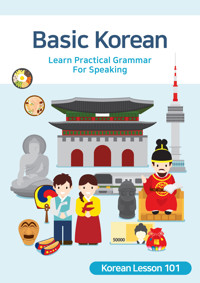
Many Korean learners say that the Korean language is difficult to learn. It is because unlike English, there are many complex endings and particles in the Korean language. For this reason, the existing Korean textbooks for foreigners have mainly covered a large number of "Grammars," which may not be used often in real conversation.
The way you "have been learning" Korean :
Lengthy & Boring, Impractical, Grammar & Text-based
The way you "will learn" Korean with this book :
Simple & Easy, Practical, Conversational-based
Many students have often asked us if there is a book which specifically focuses on real conversational grammar because they put a lot of effort into learning Korean, but they still can\'t even speak a word. The problem was not them, but learning materials and methods because learning a language is not about memorizing a large number of grammars. It is about how to use them in real conversation.
We genuinely hope that through this book, many Korean learners who have difficulty learning Korean can speak Korean with confidence.
Das E-Book können Sie in Legimi-Apps oder einer beliebigen App lesen, die das folgende Format unterstützen:
Seitenzahl: 69
Veröffentlichungsjahr: 2020
Ähnliche





□ About Korean Lesson 101
안녕하세요! Hello!
Korean Lesson 101 is a language school.
We provide the easiest Korean language lessons in the world and work hard every day to improve your Korean.
If you need a video lesson for this book,
please visit : https://www.koreanlesson101.com
□ Preface
Many Korean learners say that the Korean language is difficult to learn. It is because unlike English, there are many complex endings and particles in the Korean language. For this reason, the existing Korean textbooks for foreigners have mainly covered a large number of "Grammars," which may not be used often in real conversation.
The way you "have been learning" Korean :
Lengthy & Boring, Impractical, Grammar & Text-based
The way you "will learn" Korean with this book :
Simple & Easy, Practical, Conversational-based
Many students have often asked us if there is a book which specifically focuses on real conversational grammar because they put a lot of effort into learning Korean, but they still can't even speak a word. The problem was not them, but learning materials and methods because learning a language is not about memorizing a large number of grammars. It is about how to use them in real conversation.
We genuinely hope that through this book, many Korean learners who have difficulty learning Korean can speak Korean with confidence.
□ Table of Contents
1. 한글(Korean Alphabet) & Korean Sentence Structure
2. Self-Introduction
3. Daily Life ①
4. Location & Direction
5. Time & Schedule
6. Daily Life ②
7. Introducing Family
8. Shopping
9. Plans
10. Suggestion & Reason
11. Transportation
12. Weather
13. Request
14. Ability
15. Permission & Prohibition
16. Answers
1. Korean Alphabet(한글) & Sentence Structure
□ Let's get ready!
- Korean Alphabet, Hangeul(한글)
Korean alphabet consists of 40 letters(19 consonants and 21 vowels)
- Syllabic block
The syllabic block is composed of consonants and vowels.
A consonant can be in the first and final position and a vowel will be in the second position.
- 10 Simple Vowels
- 14 Simple Consonants
- 11 Compound Vowels
- 5 Double Consonants
- Final Consonants
□ Korean Sentence Structure
Korean sentences consist of "Subject + Verb" or "Subject + Object + Verb".
Particles are attached to subjects and objects in Korean sentences. The subject particles 이, 가 are attached to the subject of a sentence and the object particles 을, 를 are attached to the object of a sentence.
When the subject is obvious from the context,it can be omitted.
2. Self-Introduction
□ Let's get ready!
1. Let's ask and answer the names of people or objects.
Grammar Focus
Exercise!
다음 물건이 무엇인지 묻고 대답해 보세요.
Ask and name the following objects.
2. Let's introduce people or objects as the topic of a conversation.
Grammar Focus
N + 은/는
은/는 is added to the end of what the speaker wants to talk about or explain in the sentence to designate it as the main idea or topic.
· Words Ending in Vowel : 는
ex) 주디 ‘는’
· Words Ending in Consonant : 은
ex) 에릭 ‘은’
Exercise!
다음 사람들의 직업과 국적을 말해 보세요.
Let's talk about the nationalities and jobs of the following people.
※ Word Ending & Word Stem
□ Let's speak!
▶ 다음 단어들로 대화를 구성해 보세요.
Let's make a conversation using the following words.
▶ 다음 대화를 읽고 말해 보세요.
Let's talk with a dialogue.
김민수 :안녕하세요? 저는 김민수입니다.
주디 :안녕하세요? 저는 주디입니다.
김민수 :어느 나라 사람입니까?
주디 :미국 사람입니다.
김민수 :주디 씨는 요리사 입니까?
주디 :네, 요리사입니다.
김민수 :저는 선생님입니다.
※ 씨 is added to the name to honor the person. It corresponds to "Mr." and "Ms." in English.
□ Let's speak more!
▶ 한국어로 자신을 소개해 보세요.
Can you introduce yourself in Korean?
□ Let's get ready!
3. Let's learn how to make negative sentences.
Grammar Focus
N + 이/가 아닙니다
아닙니다 is the negative form of 입니다.
· Words Ending in Vowel : 가
ex) 김민수는 요리사가 아닙니다.
· Words Ending in Consonant : 이
ex) 주디는 은행원이 아닙니다.
Exercise!
다음을 보고 보기와 같이 말해 보세요.
Let's talk as in the example.
4. Let's read phone numbers in Korean.
- 수(Sino-Korean Numbers) ①
Exercise!
다음을 보고 보기와 같이 말해 보세요.
Let's talk about contact numbers.
□ Let's speak!
▶ 다음 단어들로 대화를 구성해 보세요.
Let's make a conversation using the following words.
▶ 다음 대화를 읽고 말해 보세요.
Let's talk with a dialogue.
나오미 :라이언 씨는 학생입니까?
라이언 :아니요, 학생이 아닙니다. 경찰관입니다.
라이언 :나오미 씨, 직업이 뭡니까?
나오미 :저는 의사입니다.
라이언 :나오미 씨, 전화번호가 뭐예요?
나오미 :공일공 오삼일팔에 이사팔삼입니다.
□ Let's speak more!
▶ 한국어로 전화번호를 묻고 대답해 보세요.
Ask and answer the contact numbers.
3. Daily Life ①
□ Let's get ready!
1. Let's ask and answer what people are doing.
Grammar Focus
A/V + -(스)ㅂ니다, -(스)ㅂ니까?
(스)ㅂ니다 is the present tense of the formal polite style ending.
It is used to state a fact or someone's thoughts.
The interrogative form is (스)ㅂ니까?
· Word Stem Ending in Consonant : -습니다, -습니까?
ex) 먹다 : 먹습니다, 먹습니까?
· Word Stem Ending in Vowel : -ㅂ니다, -ㅂ니까?
ex) 예쁘다 : 예쁩니다, 예쁩니까?
Exercise!
다음을 보고 보기와 같이 말해 보세요.
Let's talk as in the example.
2. Let's say who is doing something or how the object is.
Grammar Focus
N + 이/가
이/가 is added to the end of a subject to designate it as the subject of the sentence.
· Noun Ending in Vowel : 가
ex) 주디 ‘가’, 친구 ‘가’
· Noun Ending in Consonant : 이
ex) 에릭 ‘이’, 선생님 ‘이’
Exercise!
보기를 읽고 문장을 완성하세요.
Read the example and complete the sentence.
3. Let's talk about what you do with the object particle.
Grammar Focus
N + 을/를
The object particle 을/를 is added to a noun to express that the noun is the object of the sentence.
· Noun Ending in Vowel : 를
ex) 친구 '를'
· Noun Ending in Consonant : 을
ex) 선생님 '을'
Exercise!
보기를 읽고 문장을 완성하세요.
Read the example and complete the sentence.
□ Let's speak!
▶ 다음 단어들로 대화를 구성해 보세요.
Let's make a conversation using the following words.
▶ 알아두세요.
요즘 these days
무엇을 합니까? What do you do?
어렵다 to be difficult
하지만 but, however
▶ 다음 대화를 읽고 말해 보세요.
Let's talk with a dialogue.
에릭 :요즘 무엇을 합니까?
주디 :한국어를 배웁니다.
에릭 :한국어 공부는 어렵습니까?
□ Let's speak more!
▶ 주말에 무엇을 하는지 묻고 대답해 보세요.
Ask and answer what you do on the weekend.
□ Vocabulary
공부하다 to study
쉬다 to take a rest
책을 읽다 to read a book
배우다 to learn
숙제하다 to do one's homework
친구를 만나다 to meet friends
□ Let's get ready!
4. Let's talk about where you are going.
Grammar Focus
N + 에 가다/오다 -에(direction)
에 expresses the direction in which a particular behavior proceeds. It is used with the verbs such as 가다(to go), 오다(to come).
ex) 학교 + 에 → 학교에 (가다)
ex) 집 + 에 → 집에 (오다)
Exercise!
보기를 읽고 묻고 대답해 보세요.
Read the example and ask and answer the questions about where you are going.
5. Let's talk about the date in Korean.
날짜(date) & 요일(day of the week)
- 월(Month)
- 일(Day)
- 요일(day of the week)
Exercise!
보기를 읽고 문장을 완성하세요.
Read the example and ask and answer the questions about the date.
□ Let's speak!
▶ 다음 단어들로 대화를 구성해 보세요.
Let's make a conversation using the following words.
▶ 다음 대화를 읽고 말해 보세요.
Let's talk with a dialogue.
에릭 :한국어 시험이 언제입니까?
주디 :4월 20일입니다.
에릭 :4월 20일은 무슨 요일입니까?
주디 :화요일입니다.
□ Let's speak more!
▶ 일정에 대해서 묻고 대답해 보세요.




