


22,79 €
Mehr erfahren.
- Herausgeber: Saqi Books
- Kategorie: Religion und Spiritualität
- Sprache: Englisch
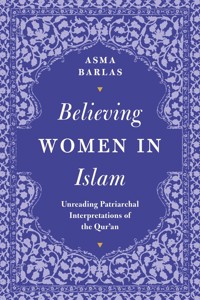
Does Islam call for the oppression of women? The subjugation of women in many Muslim countries is often used as evidence of this, while many Muslims read the Qur'an in ways that seem to justify sexual oppression and inequality. In this paradigm-shifting book, Asma Barlas argues that, far from supporting male privilege, the Qur'an actually affirms the complete equality of the sexes. Offering a historical analysis of religious authority and knowledge, Barlas shows how, for centuries, Muslims have read patriarchy into the Qur'an to justify existing religious and social structures. In this seminal volume, she takes readers into the heart of Islamic teachings on women, gender and patriarchy, offering an egalitarian reading of Islam's most sacred scripture. This revised edition includes two new chapters, a new preface, and updates throughout.
Das E-Book können Sie in Legimi-Apps oder einer beliebigen App lesen, die das folgende Format unterstützen:
Veröffentlichungsjahr: 2019
Ähnliche














BELIEVING WOMEN IN ISLAM
Copyright © 2002, 2019 by the University of Texas Press
All rights reserved
Printed in the United States of America
Revised edition, 2019
Requests for permission to reproduce material from this work should be sent to: Permissions
University of Texas Press
P.O. Box 7819
Austin, TX 78713-7819utpress.utexas.edu/rp-form
The paper used in this book meets the minimum requirements of ANSI/NISO Z39.48-1992 (R1997) (Permanence of Paper).
LIBRARY OF CONGRESS CATALOGING-IN-PUBLICATION DATA
Names: Barlas, Asma, author.
Title: Believing women in Islam : unreading patriarchal interpretations of the Qurʾān / Asma Barlas.
Description: Revised edition.
Austin : University of Texas Press, 2019.
Includes bibliographical references and index.
Identifiers: LCCN 2018012130
ISBN 978-1-4773-1592-7 (pbk. : alk. paper) ISBN 978-1-4773-1593-4 (library e-book) ISBN 978-1-4773-1594-1 (non-library e-book)
eISBN: 9780863564727
Subjects: LCSH: Women in Islam. | Women in the Qurʾān.
Women’s rights—Religious aspects—Islam.
Classification: LCC BP173.4 .B35 2019 DDC 297.1/2283054—dc23
LC record available at https://lccn.loc.gov/2018012130
doi:10.7560/315910
Do they not then Earnestly seek to understand The Qurʾān, or are Their hearts locked up?
THE QURʾĀN (47:24 [ALI 1988, 1385])
With love,
FOR
Ulises Ali, who has made his journey into Islam,
AND FOR
Anwar and Iqbal Barlas, who have completed theirs.
CONTENTS
PREFACE TO THE FIRST EDITION
PREFACE TO THE REVISED EDITION
ACKNOWLEDGMENTS
1. The Qurʾān and Muslim Women: Reading Patriarchy, Reading Liberation
Part I: Texts, Contexts, and Religious Meaning
2. Texts and Textualities: The Qurʾān, Tafsīr, and Ahādith
3. Intertextualities, Extratextual Contexts: The Sunnah, Sharīʿah, and the State
Part II: God, the Prophets, and Fathers
4. The Patriarchal Imaginary of Father/s: Divine Ontology and the Prophets
5. Abraham’s Sacrifice in the Qurʾān: Beyond the Body
Part III: Unreading and Rereading Patriarchy
6. The Qurʾān, Sex/Gender, and Sexuality: Sameness, Difference, Equality
7. The Family and Marriage: Retrieving the Qurʾān’s Egalitarianism
8. Secular-/Feminism and the Qurʾān
POSTSCRIPT
GLOSSARY
NOTES
SELECT BIBLIOGRAPHY
INDEX
PREFACE TO THE FIRST EDITION
The central question I have posed in this book, whether or not the Qurʾān is a patriarchal text, is perhaps not a meaningful one from the Qurʾān’s perspective since its teachings are not framed in terms of the claims made by either traditional or modern patriarchies. However, since the Qurʾān was revealed in/to an existing patriarchy and has been interpreted by adherents of patriarchies ever since, Muslim women have a stake in challenging its patriarchal exegesis.
In writing this book, I have wanted not only to challenge oppressive readings of the Qurʾān but also to offer a reading that confirms that Muslim women can struggle for equality from within the framework of the Qurʾān’s teachings, contrary to what both conservative and progressive Muslims believe. I am always disheartened to hear progressive Muslims claim—(dis)ingenuously, it seems to me—that “Islamism is Islamism,” as a young Algerian feminist puts it in a critically acclaimed film shown recently in the West. To identify Islam inseparably with oppression is to ignore the reality of “misreadings” of the sacred text, as Abdolkarim Soroush (2000, 86) calls them. Every religion is open to variant readings; the Christianity of the Crusades, the Inquisition, and the Conquest that wiped out millions of people in the name of Christ and commerce bears little family resemblance to the liberation theology of today. Confusing Islam with “Islamism” or “Islamists” also ignores that Islam does not sanction a clergy or invest anyone with the right to monopolize religious meaning. To accept the authority of any group and then to resign oneself to its misreadings of Islam not only makes one complicit in the continued abuse of Islam and the abuse of women in the name of Islam but also means losing the battle over meaning without even fighting it, as Abdullahi An-Naim (1990) reminds us.
This is not to say that attempts to rethink our understanding of Islam or to reread the Qurʾān are going to be easy, given the control over religious knowledge of obscurantists and experts alike. Yet more and more Muslims, realizing that “no one has a monopoly over the meaning of what God says,” as Aref Ali Nayed (1992) puts it, are beginning to reclaim their interpretive rights. In fact, the struggle to reclaim such rights may be related proportionally to attempts by some Muslim states and clerics to keep Muslims from reading, a true irony for a people who believe that Revelation to the unlettered Prophet commenced with the single word “Iqra’!” or “Read!”
Although the practice of Islam concerns only Muslims, Muslim practices are of concern to the community of nations in which we live. I have thus written this work with both Muslims and non-Muslims in mind. Writing for such different audiences in a shared vocabulary has proven hard to do, not because I could not always find the right words, but because so many people are invested in the myth of radical difference; that is, the false but comforting idea that they share absolutely nothing with Others. To speak to such people simultaneously and in the same language is to threaten in some very real way the imagined borders that serve as the markers of their identities; it is thus to call forth unrelenting animosity against oneself, as I have discovered over the years.
To conservative Muslims, terms like antipatriarchal, sexual inequality, liberation, and even hermeneutics—all of which I use liberally—smack too much of the epistemology of non-Muslim Others to be safely applied to themselves, let alone used in reading the Qurʾān. Consequently, even though I engage Western/feminist thought only circumspectly, and often to differentiate and privilege what I take to be a Qurʾānic viewpoint, my language and the mere act of engagement are likely to render me a “Western feminist” in the eyes of those Muslims who are prone to hearing in such language—and in any criticism of Muslim men—the subversive voices of Western feminists. Mislabeling Muslim women in this way not only denies the specificity, autonomy, and creativity of their thought, but it also suggests, falsely, that there is no room from within Islam to contest inequality or patriarchy.
Conversely, to feminists and non-Muslim Westerners, terms like liberatory and antipatriarchal are much too self-referential to be applied to, or used meaningfully by, Others, especially Muslims. My use of these terms for the Qurʾān, as well as my favorable reading of it in comparison with Western/feminist discourses, will doubtless render me a “Muslim apologist” in their eyes. To such people, it is inconceivable that Islam (usually labeled “Other/Eastern”) has any truths to offer that may be commensurable with Judaism and Christianity (considered “Western”), much less with insights claimed by secular feminisms. Such views, however, ignore the scripturally linked nature and Middle Eastern origin of all three religions, hence the commonality of some of their truth claims. In positing a hyperseparation between Islam and the West, they also ignore that counterposing Islam to the West is misleading in that Islam is a way of life and not an “imagined geography,” to borrow Edward Said’s (1979) rich phrase; it cannot therefore meaningfully be compared to one. Further, Islam not only exists within the West but also has helped to constitute the West, as Said so compellingly demonstrated two decades ago.
What, then, of my own tendency to refer to “the West” and “Western”? Despite my initial reluctance, I have chosen to retain such terms because of their usefulness in providing descriptive access to an unhappy reality: the asymmetric relationship between a self-defined West and a Western-defined Other (Islam, non-West). It is this process of naming, with its attendant material consequences, that I wish to convey rather than to suggest that the West is absolute, monolithic, or always exclusive of Islam. Nonetheless, if such terms disturb some of my readers, I ask them to read beyond them to get at my intent, which is to address Muslims and non-Muslims, women and men, believers and nonbelievers, the non-West and the West in a broadly shared discourse of meanings. Toward that end, and in the interest of facilitating access by non-Arabic-speaking readers to my work, I have relied on a simplified version of the Library of Congress system of transliterations. (The glossary at the end of this book may also be helpful to readers who are unfamiliar with Arabic.)
PREFACE TO THE REVISED EDITION
In the years since the first edition’s publication, some shifts occurred in my own thinking as well as in the literature on Muslim women’s rights, Muslim family laws, Islamic feminism, Islamic mysticism, and Qurʾānic exegesis—notably, on verse 4:34. I cannot, of course, respond to all this research within the confines of this book’s existing structure and thematic scope but, where possible, I have incorporated new insights into my earlier arguments, and where I could not, I have mentioned the relevant scholarship in the notes and bibliography.
Starting in 2002, certain readings of the Qurʾān, including mine, came to be labeled “Islamic feminism,” though I continue to resist this naming for the reasons I mention in chapter 1 and others I have explored over the years. Even so, I have found it necessary to engage with critics of Islamic feminism who not only re-inscribe the Qurʾān as an incurably patriarchal text, but many of whom also question its own status as God’s word. A new chapter (8) offers a critique of their scholarship that I broached in an essay for a roundtable on “Feminism and Islam” some years ago (Journal of Feminist Studies in Religion, Fall 2016). The other new chapter (5) extends my reading of Abraham’s near-sacrifice of his son in chapter 4 into a rather different direction, one that allows me to contrast Qurʾānic and biblical accounts of the parable. This was published in the proceedings of a conference in Finland, Religion and the Body (2011), and is included in this volume with the permission of the Donner Institute in Helsinki.
Looking back at the first edition, I am struck by the changes that have occurred since then in people’s views of the Qurʾān’s relationship to patriarchy. In 1999, as I was finishing the first draft, the conventional wisdom was that the Qurʾān is patriarchal or, at best, “neutral” toward patriarchy (Wadud 1999), though no one said what they meant by the term itself. It was partly this lack of definitional clarity that I addressed in “Believing Women.” Today, though, many Muslim feminists see their task as separating “patriarchy from Islam’s sacred texts” (Mir-Hosseini 2015, 36); some even agree with me that the kind of authority men claim over women in patriarchies amounts to shirk (a derogation of God’s sovereignty). While such arguments remain marginal, I feel they signify important shifts, no matter how small at the moment. I have kept these changes in mind while revising this book and can only hope that it will continue to be part of the dialogues on how Muslim women can claim certain rights from within the framework of the Qurʾān’s teachings.
ACKNOWLEDGMENTS
Many people have supported me during the process of writing and publishing Believing Women and in many different ways. I am indebted to Amina Wadud and John Esposito for their generous reviews of the first manuscript and to Andrea Stanton for her sharp commentaries on the second. My editors at the University of Texas Press—Jim Burr, Zjaleh Hajibashi, Sarah McGavick, and Amanda Frost—saw me through the trials of publishing a manuscript I once thought would never see the light of day; a special thanks to Jim for proposing a revised edition. I am also grateful to Carolyn Russ and Alexis Mills for copyediting the first and revised editions; to Elinor Aishah Holland and Lindsay Starr for their equally stunning covers for both; and to Ali Houissa for the transliterations.
Zillah Eisenstein’s critiques of my approach to Western feminisms and Naeem Inayatullah’s provoking questions about key aspects of my argument pushed me toward greater clarity, while Kevin Lacey and Howard Erlich gave helpful feedback on segments of various chapters, as did Rubina Barlas Hydri and Tamina Barlas. My students—especially Brendan Cooper, Elizabeth Hanna, Carrie Kessler, and Rashaand Saas, the intrepid group that took my first tutorial on sexual/textual politics in Islam—helped me to develop my ideas by asking maddeningly difficult questions and by reading and writing creatively themselves. I also want to thank the Provost’s Office and the Center for Faculty Excellence at Ithaca College for having given me several grants during the years it took to research and (re)write this book.
I am deeply grateful to both sides of my family—Barlas and Mejias—and to my son, Demir Mikail, for loving and supporting me during the many years of working on this book. Sadly, my father, Iqbal, passed away before the first edition was published, and my mother, Anwar, as well as my father-in-law, Manuel de Jesus Mejia Zepeda, predeceased this one’s release. As I continue to reflect on their lives and deaths, I draw continuing strength from my father’s unfailing, unshakable, and—to others—immoderate pride in my achievements which allowed me to confront life’s challenges without pausing to think I was not up to them as a woman. Through her intellectual example and resolute ethical standards, my mother endures as the most profound and abiding presence in my life.
Ongoing dialogues with my husband, Ulises Ali, and his discerning critiques of my work allow me to find new meanings in it, while his ability to embrace differences in sameness and to value sameness in differences never ceases to remind me of the possibilities of egalitarian modes of “knowing one another.”
Mohammed Arkoun (1994) speaks of “the secret consciences of those who still believe.” Readers will find in this work clear signs of the consciousness of someone who believes, and not so secretly. Indeed, writing this and living with the complexities of having done so have brought me to a fuller appreciation of my faith—in particular, of why Muslims regard the pursuit of knowledge (ʿilm) as a form of worship (‘ibādah) and why we pray to God to “increase” us in knowledge. If this book augments my readers’ knowledge half as much as writing it has done mine, its purpose will have been well, and doubly, served.
January 2001 / January 2018
BELIEVING WOMEN IN ISLAM
The Qurʾān and Muslim Women
Reading Patriarchy, Reading Liberation
It was not God who wronged them, but they wronged their own souls.
THE QURʾĀN (30:9 [ALI 1988, 1053])1
THIS WORK REFLECTS my ongoing engagement with two questions that have both theoretical significance and real-life consequences for Muslims, especially women: First, does Islam’s Scripture, the Qurʾān, teach or condone sexual inequality or oppression? Is it, as critics allege, a patriarchal and even sexist and misogynistic text? Intimately related to that question is the second: Does the Qurʾān permit and encourage liberation for women?
When I ask whether the Qurʾān is a patriarchal or misogynistic text, I am asking whether it represents God as Father/male, or teaches that God has a special relationship with males, or that males embody divine attributes and that women are by nature weak, unclean, or sinful. Further, does it teach that rule by the father/husband is divinely ordained and an earthly continuation of God’s rule, as religious and traditional2 patriarchies claim?
Alternatively, does the Qurʾān advocate gender differentiation, dual-isms, or inequalities on the basis of sexual (biological) differences between women and men? In other words, does it privilege men over women in their biological capacity as males, or treat man as the Self (normative) and woman as the Other, or view women and men as binary opposites, as modern patriarchal theories of sexual differentiation and inequality do?
When I ask whether we can read the Qurʾān for liberation, I am asking whether its teachings about God—as well as about human creation, ontology, sexuality, and marital relationships—challenge sexual inequality and patriarchy. Alternatively, do the teachings of the Qurʾān allow us to theorize the equality, sameness, similarity, or equivalence, as the context demands, of women and men?
It is obvious that much is at stake for Muslims in how we answer these questions, especially in view of the increasing levels of violence against women in many states from Afghanistan to Algeria. What is less obvious—given the widespread tendency to blame Islam for oppressing Muslims rather than blaming Muslims for misreading Islam3—is the possibility that we can answer the first set of questions (Is the Qurʾān a patriarchal or misogynistic text?) in the negative while at the same time answering the second (Can the Qurʾān be a source for women’s liberation?) in the affirmative. Using an interpretive methodology, or hermeneutics,4 derived from the Qurʾān, as well as two definitions of patriarchy (as a tradition of father-rule and as a politics of gender inequality based in theories of sexual differentiation),5 I hope to show not only that the Qurʾān’s episteme is inherently antipatriarchal but that it also allows us to theorize the radical equality of the sexes. (I use the concept of episteme loosely to refer to the Qurʾān’s foundational claims about the nature of God, human beings, and the universe, which provide the moral/ethical framework for its overall teachings.)
This book, then, is as much a critique of sexual/textual6 oppression in Muslim societies as it is a concerted attempt to recover what Leila Ahmed (1992) calls the “stubbornly egalitarian” voice of Islam and to locate it as a legitimate countervoice to the authoritarian voice of Islam about which we hear so much these days, especially in the Western media. If, as Ahmed says, these “fundamentally different Islams” arise in different readings, then it is imperative to challenge the authoritarian and patriarchal readings of Islam that are profoundly affecting the lives and futures of Muslim women.
This is not to say, however, that sexual inequality and discrimination are a function merely of patriarchal readings of Islam, or that one can explain the status of Muslim women “solely in terms of the Qurʾān and/or other Islamic sources all too often taken out of context” (El-Sohl and Mabro 1994, 1). As many recent studies reveal, women’s status and roles in Muslim societies, as well as patriarchal structures and gender relationships, are a function of multiple factors, most of which have nothing to do with religion. The history of Western civilization should also tell us that there is nothing innately Islamic about misogyny, inequality, or patriarchy. And yet all three often are justified by Muslim states and clerics in the name of Islam. This recourse to sacred knowledge—or, more accurately, knowledge that claims to derive from religion—to justify sexual oppression and the resulting misassociation of the sacred with misogyny have motivated my own engagement with Qurʾānic hermeneutics and, I believe, renders such an engagement imperative, and even unavoidable, to all projects of Muslim women’s and men’s liberation.
Even though a Qurʾānic hermeneutics cannot, by itself, put an end to patriarchal, authoritarian, and undemocratic regimes and practices, it nonetheless remains crucial for various reasons. First, hermeneutical and existential questions are ineluctably connected. As the concept of sexual/ textual oppression suggests, there is a relationship between what we read texts to be saying and how we think about and treat real women. This insight, though associated with feminists because of their work on reading and representation, is at the core of revelation, albeit in the form of the reverse premise: that there is a relationship between reading (sacred texts) and liberation. If this were not the case, there would be little point in God’s communicating with us in order to reform us. Accordingly, if we wish to ensure Muslim women their rights, we not only need to contest readings of the Qurʾān that justify the abuse and degradation of women: we also need to establish the legitimacy of liberatory readings. Even if such readings do not succeed in effecting a radical change in Muslim societies, it is safe to say that no meaningful change can occur in these societies that does not derive its legitimacy from the Qurʾān’s teachings, a lesson secular Muslims everywhere are having to learn to their own detriment.
However, even though Muslim women directly experience the consequences of oppressive interpretations of religious texts, few question their legitimacy, and fewer still have explored the liberatory aspects of the Qurʾān’s teachings.7 Yet without doing so, they cannot contest the association, falsely constructed by patriarchal readings of Scripture, between the sacred and sexual oppression. This association serves as the strongest argument for inequality and discrimination among Muslims since many people either have not read the Qurʾān or accept its patriarchal exegesis unquestioningly. Arguably, though, as numerous scholars have pointed out, inequality and discrimination derive not from the teachings of the Qurʾān but from the secondary religious texts, the tafsīr (Qurʾānic exegesis) and the ahādith (sing. hadīth) (narratives purportedly detailing the life and praxis of the Prophet Muhammad). As such, by “returning to a fresh and immediate interpretation of the Holy Book, and by taking a new and critical look at the Hadiths—in other words, by engaging in creative ijtihad8—modern Islamic authority could very well reform and renew the position of Islam on the issue of the status of women” (Stowasser 1984, 38).
A reinterpretation of the Scripture is particularly important because the Qurʾān’s teachings provide Muslims with role models for both women and men. Since different readings of the Qurʾān (and of other texts) can yield what are for women “fundamentally different Islams,” it becomes crucial for them “to reinvestigate the normative religious texts”9 and even to become specialists in the sacred text, as Fatima Mernissi (1986) urged.
Finally, as theorists argue in other contexts, there is “no practice without a theory,”10 and Muslims have yet to derive a theory of equality from the Qurʾān. This is partly because, as Fazlur Rahman (1982, 2) points out, Muslims have yet to resolve “basic questions of method and hermeneutics.” Every new reading of the Qurʾān, by helping to resolve these basic questions of hermeneutics, can also help to generate such a theory. That is why critiquing the methods by which Muslims produce religious meaning and rereading the Qurʾān for liberation are crucial for ensuring sexual equality.
In attempting to do both here, I concentrate on recovering the liberating and egalitarian voice of Islam that is rarely heard today but which we are most in need of hearing. In the rest of this chapter, I explain my arguments regarding the reading of the Qurʾān; how Muslims read sexual inequality and patriarchy into it; how we can read the Qurʾān for liberation; my epistemology and methodology; and, finally, the plan of this book.
I. Reading the Qurʾān
Those who read Islam as a misogynistic and “uncompromising and overtly paternalistic” religion (Hussain 1994, 118) point both to the Qurʾān’s alleged advocacy of sexual inequality and to the long history of discrimination against women in most Muslim societies. My purpose here is not to deny that the Qurʾān can be read in patriarchal modes (as privileging males), or that oppressive practices in many Muslim societies often stem from an uncritical adherence to what are assumed to be Islamic norms and strictures, or that the images of “the woman” in the Muslim unconscious are indeed misogynistic.11 Nor do I deny that “the enveloping maleness”12 of Muslim religious text engenders grave problems for women, as does the legalization of sexual inequality by classical Muslim law, the Sharīʿah. Rather, I argue that descriptions of Islam as a religious patriarchy that allegedly has “God on its side”13 confuse the Qurʾān with a specific reading of it, ignoring that all texts, including the Qurʾān, can be read in multiple modes, including egalitarian ones. Moreover, patriarchal readings of Islam collapse the Qurʾān with its exegesis (divine discourse14 with “its earthly realization”);15 God with the languages used to speak about God (the Signified with the signifier); and normative Islam with historical Islam.16 Thus, “Islam” and “Muslims” are confused on the one hand, and texts, cultures, and histories are collapsed on the other. My purpose is both to critique the methods by which Muslims generate patriarchal readings of the Qurʾān and to recover the egalitarian aspects of the Qurʾān’s episteme. I do this on the basis of two claims whose substantiation provides the subject matter of this book.
My first and relatively simple claim is that, insofar as all texts are polysemic, they are open to variant readings. We cannot therefore look to a text alone to explain why people have read it in a particular mode or why they tend to favor one reading of it over another. This is especially true of a sacred text like the Qurʾān, which “has been ripped from its historical, linguistic, literary, and psychological contexts and then been continually recontextualized in various cultures and according to the ideological needs of various actors” (Arkoun 1994, 5). We need, therefore, to examine who has read the Qurʾān historically, how they have read it—that is, how they have chosen to define the epistemology and methodology of meaning, hence certain ways of knowing (the realm of hermeneutics)—and the extratextual contexts in which they have read it. In particular, we need to examine the roles of Muslim interpretive communities and states (the realm of sexual politics) in shaping religious knowledge and authority in ways that enabled patriarchal readings of the Qurʾān. I address these issues, which impinge on the power and politics of reading itself, in part 1 of the book.
If emphasizing the Qurʾān’s textual polysemy allows me to argue against interpretive reductionism, however, it merely reiterates modern definitions of the text and also a well-known historical fact; it says nothing specific about the Qurʾān itself. And I do want to make a more specific, if also more controversial, claim (in dialogue with recent Muslim and feminist scholarship),17 which is that the Qurʾān is egalitarian and antipatriarchal. This, of course, is a harder claim to establish for at least two reasons. First, while there is no universally shared definition of sexual equality, there is a pervasive (and oftentimes perverse) tendency to view differences as evidence of inequality. In light of this view, the Qurʾān’s different treatment of women and men with respect to certain issues (marriage, divorce, giving of evidence, and so on) is seen as manifest proof of its anti-equality stance and its patriarchal nature. I will argue against this view on two grounds: first, as many feminists themselves now admit, treating women and men differently does not always amount to treating them unequally, nor does treating them identically necessarily mean treating them equally.18 Second, as my reading will show, the Qurʾān’s different treatment of women and men is not based in the claims about either sexual difference or sameness that theories of sexual inequality and oppression make.
Another difficulty with claiming that the Qurʾān is egalitarian and antipatriarchal is that some of its teachings, especially those dealing with polygyny and “wife-beating,” suggest otherwise, as does the fact that the Qurʾān recognizes men as the locus of power and authority in actually existing patriarchies. However, recognizing the existence of a patriarchy, or addressing one, is not the same as advocating it. Moreover, the Qurʾān’s provisions about polygyny, “wife-beating,” and so forth—which have been open to serious misinterpretation—were in the nature of restrictions, not a license. But we can only address these types of issues if, in addition to questioning the textual strategies Muslims have used to read the Qurʾān, we also keep in mind the historical context of its revelation in a seventh-century tribal Arab patriarchy, much like the erstwhile Taliban in Afghanistan.19 Contextualizing the Qurʾān’s teachings (that is, explaining them with reference to the immediate audience and social conditions to which they were addressed) shows that, far from being oppressive, they were profoundly egalitarian; it depends on how we position the Qurʾān and also ourselves in relation to it historically.
If this line of reasoning suggests that the meanings we derive from, or ascribe to, the Qurʾān are unfixable,20 or are fixable only in the context of a given historical period or hermeneutical method, it does not mean we can never know the Qurʾān’s meanings or intent, or that all the meanings we derive from it are equally legitimate. Nor does it mean that the Qurʾān is not universal in its scope, or that its teachings were egalitarian only by the standards of a seventh-century society and are irredeemably oppressive by ours. On the contrary, I will contest each of these propositions on the basis both of a hermeneutical argument and by reading (in parts 2 and 3) the Qurʾān’s teachings on a wide range of issues, extending from the nature of divine self-disclosure (how God defines God) to the Qurʾān’s view of prophets, parents, spouses, human creation, moral agency, sex/gender, and sexuality. My reading draws on some interpretive principles the Qurʾān suggests for its own interpretation, as well as on a comprehensive definition of patriarchy; it is also based in conceptual distinctions that Muslims who read the Qurʾān as a patriarchal text usually fail to make. Prior to specifying my own approach, however, I will discuss how Muslims and their critics read patriarchy, inequality, and even misogyny into the Qurʾān.
II. Reading Patriarchy
They treat men’s oppressionAs if it were the WrathOf God!
THE QURʾĀN (29:10 [ALI, 1031])21
Muslims read patriarchy and sexual inequality into the Qurʾān on the basis of specific verses (āyāt, sing. āyah; literally, “signs of God”) and of the Qurʾān’s different treatment of women and men with regard to such issues as marriage, divorce, and inheritance. From these, they infer that men and women are not only biologically different but also unequal and opposites, a view mirrored in the claim that in Islam the masculine and the feminine principles also are strictly separated. In the readings of conservatives,22 male superiority is both ontological, since the woman is said to have been created from/after man and for his pleasure, and moral-social, since God is alleged to have preferred men in “the completeness of mental ability, good counsel, complete power in the performance of duties and the carrying out of (divine) commands.”23 God also is said to have given men a “degree” above women and to have appointed them guardians (in some accounts, rulers) over women. The woman, on the other hand, is represented as a “tragic being [whose] sex functions and physiology make her unfit for any work or activity except child-bearing,” which is her “biological tragedy” (Maududi, quoted in Khan 1983, 21). Not only do biological and mental functions and capacities differentiate the two sexes, argue Maududi and other conservatives, but they also justify a sexual division of labor in which women must submit to the man “who is responsible for the maintenance of this system be he her husband, father or brother” (61–62). From a conservative viewpoint, it is clear that “The Book of Nature, the sciences and the philosophers of Europe have emphatically proclaimed that though woman may try her best . . . she cannot be the equal of man in physical and intellectual powers. . . . Her natural functions oblige her to be subjected to man, by which alone she can have any meaningful identity” (Vajidi, quoted in Khan, 129). Surpassing the audacity even of Europeans like Freud, some conservative Muslims label a woman’s anatomy her “pre-destiny,” claiming that nature itself “has given man superiority over woman” and made her redundant to civilization (Vajidi, quoted in Khan, 173).
Such misogynistic readings of Islam derive not from the Qurʾān’s teachings, however, but from attempts by Muslim exegetes and Qurʾān commentators “to legitimise actual usage of their own day by interpreting it in great detail into the Holy Book.”24 In fact, one can trace changes in Muslim women’s status “through a comparative study of [Qurʾānic] interpretations such as those of Tabari (d. 923), Zamakhshari (d. 1144), Baydawi (d. 1286) . . . al-Suyuti (d. 1505),”25 and so on, all of whose works today form part of the Sunni canon.26 This is why we need to examine not just the methods by which Qurʾānic exegesis and religious meaning have been and continue to be produced but also the extratextual contexts of their production.
Recent scholarship increasingly makes clear that conservative readings of the Qurʾān are a function of the methods Muslims have used—or have failed to use—to interpret it. In particular, argue critical scholars,27 Muslims have not read the Qurʾān as both a “complex hermeneutic totality”28 and a “historically situated”29 text. Instead, says Mustansir Mir (1986, 1), they have relied on a “linear-atomistic” method that takes a “verse-by-verse approach to the Qurʾān. With most Muslim exegetes, the basic unit of Qurʾān study is one or a few verses taken in isolation from the preceding and following verses.” As a result, the Qurʾān is not read as a text possessing both “thematic and structural nazm [coherence]” (24). As Amina Wadud (1999, 2) also argues, the exegetes of the classical period “begin with the first verse of the first chapter and proceed to the second verse of the first chapter—one verse at a time—until the end of the Book. Little or no effort is made to recognize themes and to discuss the relationship of the Qurʾān to itself, thematically.” Even when they do refer to the relationship of two āyāt, contends Wadud (1999, 2), they do so without applying any “hermeneutical principle” since a method “for linking similar Qurʾānic ideas, syntactical structures, principles, or themes together is almost non-existent.”
Not surprisingly, this method has failed to yield a creative synthesis of Qurʾānic principles30 because it does not recognize the connections between different themes in the Qurʾān. (As my reading will show, recognizing the Qurʾān’s textual and thematic holism, and thus the hermeneutic connections between seemingly disparate themes, is absolutely integral to recovering its antipatriarchal episteme.) By ignoring the fact that the Qurʾān is “a unified document gradually unfolding itself”31 in time, classical exegetes have also ignored that in the Qurʾān, content and context possess one another32 such that one cannot grasp the significance of the
Qurʾān’s teachings without considering the contexts of their revelation.
If we need to keep in mind the historical contexts of the Qurʾān’s revelation in order to understand its teachings, we also need to keep in mind the historical contexts of its interpretations in order to understand its conservative and patriarchal exegesis. The most definitive work—not only in Qurʾānic exegesis but also in law and Islamic/Muslim tradition—is considered by many Muslims to have been produced during the first few centuries of Muslim history. Here it is important to note that what is nominally called “the” Islamic tradition has many, and sometimes contradictory, tendencies within it and is, moreover, “a synthetic rather than a ‘natural’ product, bearing clear signs of selective endorsement,” as al-Ghazali argued in the twelfth century. In this context, he pointed out that traditions do not pass into the present “unprocessed and unmediated. . . . Instead, someone has to make decisions about which aspects of the past are non-essential and thus allowed to drop out, and which elements of the present are consistent with the past and thus eligible for admission into the sanctum of tradition” (quoted in Jackson 2002, 20, 24). The reason Muslims seemed not to recognize this fact, according to al-Ghazali, had less to do with the imitativeness of tradition itself than with “that blindness that condemns people to being led around by others (taqlid)” (Jackson, 88.)
The misogyny of this period, known as the Golden Age of Islam and the Middle Ages of Europe,33 is well known, and it was assimilated34 into Islam via the commentaries and super-commentaries on the Qurʾān (tafsīr), as well as the narratives detailing the life and praxis of the Prophet (ahādith) (Ahmed 1992; Spellberg 1994; Stowasser 1994). In other words, it was the secondary religious texts that enabled the “textualization of misogyny”35 in Islam. These texts have come to eclipse the Qurʾān’s influence in most Muslim societies today,36 exemplifying the triumph not only of some texts over others in Muslim religious discourse but also of history, politics, and culture over the sacred text.37 As a result, the cross-cultural, transnational, and nondenominational ideologies on women and gender in vogue in the Middle Ages have been superimposed on the teachings of the Qurʾān. However, since we often do not distinguish between texts, cultures, and histories when studying Islam, we end up confusing the Qurʾān with its tafsīr, and Islam with patriarchy and the practices of repressive Muslim states that have a history of using Islam for their own political ends (Mernissi 1991, 1996; Khalidi 1994; Marlow 1997; Zaman 1997).
The fact that the Qurʾān “happens against a long background of patriarchal precedent”38 may also explain why its exegesis, the work entirely of men, has been influenced by their own needs and experiences while either excluding or interpreting—“through the male vision, perspective, desire, or needs”—women’s experiences (Wadud 1999, 2). The resulting absence of women’s voices from “the basic paradigms through which we examine and discuss the Qurʾān and Qurʾānic interpretation,” argues Wadud, is mistaken “with voicelessness in the text itself,” and it is this silence that both explains and allows the striking consensus on women’s issues among Muslims despite interpretive differences among them.
However, we know that women participated actively in the creation of religious knowledge in the early days of Islam. As Ahmed (1992, 72) says, women of the Prophet’s community felt they had a right “to comment forthrightly on any topic, even the Qurʾān,” and both God and the Prophet assumed their “right to speak out and readily responded to their comments.” It is therefore necessary to reexamine the details of Muslim history—in particular, the processes of knowledge formation—in order to understand women’s exclusion from interpretive communities over time.
In sum, in order to understand patriarchal readings of the Qurʾān, we need to study the relationship not only between hermeneutics and history but also between the content of knowledge and the methods by which it was/is generated. It is not “enough to ask what we know about religion, but equal attention must be paid to how we come to know what we know” (King 1995, 20). We need to realize that our understanding of the Qurʾān’s teachings is contingent on how we have, or have not, read it; on the sorts of questions we have asked of it; and the voices we have preferred to hear in response to our questions. As such, if we want to read the Qurʾān in liberatory and antipatriarchal modes, we will need to use a different method to read it and also to ask different sorts of questions than we have been willing to ask thus far.
III. Reading Liberation
[E]njoin
Thy people to hold fast By the best in the precepts
THE QURʾĀN (7:145 [ALI, 383])39
Readings of Islam as a religious patriarchy rest on a number of conceptual confusions. The most endemic of these is between the Qurʾān as revelation (divine discourse) and as text (a discourse fixed in writing40 by humans and interpreted by them in time/space—that is, historically). However, collapsing God’s words with our interpretation of those words not only violates the distinction Muslim theology has always made between divine speech and its “earthly realization” but also ignores the Qurʾān’s warning not to confuse it with its readings (39:18 [Ali, 1241]). It is crucial to make this distinction because there are slippages between the Qurʾān and its tafsīr, and also within interpretations and translations of the Qurʾān (inter/ intratextual tensions), which present scholars with a conundrum. As Neal Robinson (1996, 29) confesses, the “striking difference between what can be safely inferred from the Qurʾān itself and what has frequently been read into it presents . . . a serious dilemma.” This disjuncture between the
Qurʾān and its exegesis also explains why many norms and practices that are labeled “Islamic” do not, in fact, derive from the Qurʾān’s teachings.41 This is why we need to make another equally crucial distinction that patriarchal readings of Islam do not make: between Islam in theory and Islam in practice, thus also between Islam and already existing patriarchies on the one hand, and Islam and Muslim history and practices on the other. Among others, W. C. Smith (1981, 30) argues in favor of such distinctions: “To reduce what Islam is, conceptually, to what Islam has been, historically, or is in the process of becoming, would be to fail to recognise its religious quality: the relationship to the divine; the transcendent element. Indeed, Islamic truth must necessarily transcend Islamic actuality.” (As Smith notes, even the ideal of Islam has had a complex history and “has in some measure been different things in different centuries, in different countries, among different strata.”) Although it is not always easy to make these distinctions—between Islam’s actuality and its transcendent truth, between the Qurʾān and its exegesis, and between Islam and Muslim practices (thus between texts, cultures, and histories)—they nonetheless allow us to see that many ideas and practices ascribed to the Qurʾān, including the theme of patriarchy, do not originate in it or have been read into the text in contextually problematic ways.
This only becomes clear, though, if we begin by defining patriarchy itself, which readers of the Qurʾān do not do, including those feminists who condemn Islam as a patriarchy. Even Wadud (1999, 9), who argues that the Qurʾān is neutral toward “social [and] marital patriarchy,” does not say what she means by the term. This may explain why she seems to be unaware that her own work illustrates the Qurʾān’s antipatriarchal episteme by showing that it does not privilege males as males (sex is irrelevant to its definition of moral agency), it does not use males as a paradigm to define women, and it does not even use the concept of gender to speak about humans. In the absence of a definition of patriarchy, however, one cannot know that the Qurʾān’s treatment of these themes undermines the very core of patriarchal ideology. This is why I begin my own reading by defining patriarchy.
DEFINING PATRIARCHY
I define patriarchy in both a narrow (specific) and a broad (universal) sense in order to make the definition as comprehensive as possible. Narrowly defined, patriarchy is a specific mode of rule by fathers42 that, in its religious and traditional forms, assumes a real as well as symbolic continuum between the “Father/fathers”;43 that is, between a patriarchalized view of God as Father/male and a theory of father-right extending to the husband’s claim to rule over his wife and children. I apply this definition in reading the Qurʾān because the Qurʾān was revealed in the context of a traditional patriarchy, and my aim is to see if it endorsed this mode of patriarchy by representing God as Father or by representing the father or husband as a ruler over his wife and children.
Since the Qurʾān’s teachings are universal, and since father’s rule has reconstituted itself, I also define patriarchy more broadly as a secular politics of sexual differentiation that privileges males by “transforming biological sex into politicized gender, which prioritizes the male while making the woman different (unequal), less than, or the ‘Other’” (Eisenstein 1984, 90).44 Patriarchy thus conceived is based in an ideology that ascribes social/ sexual inequalities to biology; that is, it confuses sexual/biological differences with gender dualisms/inequality (in other words, differences based on sex or biology with inequality based on gender dualisms). This “culturalization of nature and the naturalization of culture”45 manifests itself in three claims (as the conservative Muslim position summarized above reveals): that there are essential ontological and ethical-moral differences between women and men, that these differences are a function of nature/biology, and that the Qurʾān’s different, hence unequal, treatment of women and men affirms their inherent inequality (in a series of steps, difference is thus transformed into inequality). In reading the Qurʾān in light of this definition of patriarchy, my aim is to see whether it endorses the concepts of sex/gender differentiation, dualisms, and inequality that are implicit in these claims.
While a definition of patriarchy is fundamental to being able to establish the Qurʾān as an antipatriarchal (or, for that matter, as a patriarchal) text and also for explaining issues of con/textuality (the relationship between texts and the contexts of their reading), it does not address the problem of con/textual legitimacy or the question of what constitutes a proper reading of a text. In fact, I am convinced that one of the primary reasons Muslims have failed to recover the Qurʾān’s antipatriarchal episteme has to do with the fact that we have not systematically addressed this question, particularly in light of the Qurʾān’s own recommended modes of reading it. Indeed, I believe that the failure to consider the criteria for generating a contextually legitimate reading of the Qurʾān is not just a hermeneutical failure but also a theological one. After all, readings of scriptures are as likely to be influenced by theological considerations, especially by one’s conceptions of God, as they are by the use of specific methodological criteria. As such, focusing only on the latter to the exclusion of how a scripture is experienced within the context of a distinctive image of and relationship to God, whose speech it is, cannot be the best way to generate contextually appropriate readings. Yet that is how Muslims have, in fact, tended to read the Qurʾān historically: without making God’s self-disclosure the theological site from which to read it. The failure to connect God to God’s speech (which has resulted in some extremely objectionable readings of the Qurʾān) is inexplicable in view of the fact that the organizing principle of Islam, the doctrine of God’s Unity (Tawhīd), stipulates that there is a perfect congruence between God (divine ontology) and God’s speech (divine discourse). To accept this as a truism is not to confuse God with God’s word; it is simply to recognize that,as God’s word, the Qurʾan also conveys God’s will and reflects some aspects of God’s being. This is why I believe that an appropriately Islamic theology would locate the hermeneutical and theological keys for interpreting the Qurʾān in the nature of divine ontology—or, to put it more accurately, in the nature of divine self-disclosure, since our knowledge of one is contingent on our understanding of the other. This, in any case, is the framework of my own theological hermeneutics.
DEFINING A QURʾĀNIC HERMENEUTICS
Given the unity of divine ontology and divine discourse, I begin my reading of God’s word by connecting it to God. Thus, God’s self-disclosure is intrinsic to my Qurʾānic hermeneutics. Here I will examine three aspects of God’s self-disclosure that I believe have the potential to generate liberatory readings of the Qurʾān: the principles of divine unity, justness, and incomparability.46
The principle of God’s unity (Tawhīd) has the most far-reaching implications for how we understand God and God’s speech. Here I wish to note only its implications for a theory of male rule/privilege that underpins traditional patriarchies. In its simplest form, Tawhīd symbolizes the idea of God’s indivisibility, hence also the indivisibility of God’s sovereignty; thus, no theory of male (or popular) sovereignty that pretends to partake in God’s rule/sovereignty, or be an extension of it, or comes into conflict with it, can be considered compatible with the doctrine of Tawhīd. In fact, this is the axiomatic meaning of the term: that God is absolute Sovereign, and no one can partake in God’s sovereignty. To the extent that theories of male rule over women and children amount to asserting sovereignty over both and also misrepresent men as intermediaries between women and God, they do come into conflict with the essential tenets of the doctrine of Tawhīd and must be rejected as theologically unsound. A reading of the Qurʾān that suggests even subtle parallels between God and men in their capacity as fathers or husbands must then be rejected as an insufferable heresy. (In later chapters, I show how the doctrine of Tawhīd directly undermines theories of father-rule/right.)
A second foundational principle of God’s self-disclosure is that although “severe, strict and unrelenting [in] justice,” God “never does any zulm to anybody” (Izutsu 1964, 77, 129). To do zulm (in the Qurʾān), as Toshihiko Izutsu (1959, 152) points out, is “‘to act in such a way as to transgress the proper limit and encroach upon the right of some other person.’” Divine justice is thus self-circumscribed by respect for the rights of humans as moral agents. However, if God never does zulm to anyone, then it follows that God’s speech (the Qurʾān) also cannot advocate zulm against anyone, at least as an expression of God’s will. To put it simply, if “God by definition, cannot be a misogynist,”47 then it is difficult to see how God’s word would by definition be misogynist or teach misogyny or injustice.
Clearly, reasonable people may disagree about what constitutes zulm and also about the proper definition of human rights. However, it is harder to argue that what we ascribe to the Qurʾan we are not also ascribing to God. It is equally hard to claim, at least with any level of honesty, that theories which assert the incomplete humanity of women or justify their physical or moral abuse and degradation do not violate their rights and therefore do not constitute zulm. In this context, it may be argued that by teaching the precept of the inherent inferiority of women and by justifying their subordination to men, patriarchies sanction sexism, misogyny, and violence against them. As such, we can consider patriarchies to be manifest cases of zulm against women, and to the extent this is so, we must be willing to rethink the Qurʾān’s patriarchal exegesis, which attributes this zulm to God. In fact, as I will argue in later chapters, the Qurʾān’s teachings challenge patriarchy and sexual inequality in concrete ways, and an exegesis that disregards, minimizes, or fails to recover such teachings cannot be taken to represent the Qurʾān accurately. What we may, either out of historical habit or expedience, uncritically read as its support for patriarchal theories of male privilege and sexual inequality must then be reexamined. Among the criteria for doing this would be our understanding not only of God, the totality of the Qurʾān’s teachings, and an ecumenical definition of zulm but also of patriarchy. This seems to me to be imperative to any discussion of the Qurʾān as a patriarchal or antipatriarchal text since, in the absence of a clear-cut understanding of what patriarchy is, people are free to make all manner of unsubstantiated claims about it.
A third principle of God’s self-disclosure with both hermeneutical and theological implications is that God is incomparable, hence unrepresentable, especially in anthropomorphic terms. The Qurʾān’s tireless and emphatic rejections of God’s sexualization/engenderment as Father (male) confirm that God is not a male—or like one. However, if God is not male or like one, there also is no reason to hold that God has any special affinity with males. (The positing of such an affinity allows men to claim God as their own and thus to project sexual partisanship onto God.) Not only should we recover the radically liberatory potential of Islam’s rejection of a patriarchalized God, we should also make it the hermeneutical site from which to read the Qurʾān’s antipatriarchal episteme. (I make this argument more fully in chapter 4.)
All three aspects of divine self-disclosure are much more nuanced and have far richer implications than I have suggested, but even this cursory exploration reveals that the liberatory nature of the Qurʾān’s episteme inheres in the very nature of God’s being. In other words, it is not only in the Qurʾān’s teachings about human creation, ontology, and relationships that we can find liberatory potential but also in the very nature of divine ontology itself.
In addition to these theological principles, the Qurʾān offers us specific methodological criteria for reading it that emphasize the principles of textual holism, searching for the best meanings, and using analytical reasoning in interpretation. The Qurʾān’s emphasis on reading it as a textual unity emerges from its warning that “Those who break the Qurʾān into parts. Them, by thy Lord, We shall question, every one, Of what they used to do” (15:91–93 [Pickthall n.d., 194]). Yusuf Ali (1988) translates this verse (in which God is addressing the Prophet) as:
And say: “I am indeed he
That warneth openly
And without ambiguity,”—
(Of just such wrath)
As We sent down
On those who divided
(Scripture into arbitrary parts),—
(So also on such)
As have made [the] Qurʾān
Into shreds (as they please).
Therefore, by the [Rabb],48
We will, of a surety,
Call them to account,
For all their deeds.
The Qurʾān (15:89–93 [Ali, 653])
Similarly, in a reference to the book given to Moses, God condemns those who make “it into (Separate) sheets for show, While ye conceal much (Of its contents)” (6:91 [Ali, 314]). The Qurʾān’s warning against reading it in a decontextualized, selective, and piecemeal way also emerges from its criticism of the Israelites who broke their covenant with God: “They change the words From their (right) places And forget a good part Of the Message that was Sent them” (5:14 [Ali, 245]). And they “change the words From their (right) times And places” (5:44 [Ali, 255]). Revelation, the Qurʾān emphasizes, is of a continuity and is also internally clear and self-consistent (39:23 [Ali, 1243–44]).
The Qurʾān’s internal coherence and consistency do not, however, preclude us from deriving multiple meanings from it, including ones that may not be appropriate. Thus, while noting its own polysemy, the Qurʾān also confirms that some meanings, and therefore some readings, are better than others. For instance, it praises “Those who listen To the Word And follow The best (meaning) in it” (39:18 [Ali, 1241]), clearly indicating that we can derive more than one set of meanings from the Qurʾān, not all of which may be equally good. Similarly, God tells Moses to “enjoin Thy people to hold fast By the best in the precepts [i.e., the Tablets given to him]” (7:145 [Ali, 383]). (God also tells the Prophet and all believers to reason with unbelievers in the best possible way.) While it may not be easy to say what would be the best meaning of every āyah—especially given the (Sufi) view that each verse in the Qurʾān can be read in up to 60,000 ways—in light of our idea of a just God and of the Qurʾān’s concern for justice, it is reasonable to hold that the best meanings would recover justice (fairness, impartiality) broadly conceived. However, even if one cannot agree on what the best meanings in every case may be, it is less easy to feign ignorance of what is not appropriate inasmuch as the Qurʾān makes this clear in different contexts. First, as noted, it criticizes readings that are decontextualized and selective. The Qurʾān’s emphasis on reading it holistically, hence intratextually, also emerges from its praise for those who say, “‘We believe In the Book; the whole of it Is from our Lord’” (3:7 [Ali, 123]).
Second, the Qurʾān distinguishes between readings that draw on its foundational (clear) āyāt and those that draw on its allegorical (obscure) āyāt. The Qurʾān criticizes those who ignore its “basic or fundamental” āyāt, with their “established meaning,” in order to focus on the “allegorical [āyāt], Seeking discord, and searching For its hidden meanings” (3:7 [Ali, 123]). While allegory has crucial didactic functions in the Qurʾān, it is not meant to obscure the Qurʾān’s meanings, which, says the Qurʾān, are clear. Third, the Qurʾān repeatedly states that God does not love wrongdoing and oppression. As I have argued, we can disagree on what constitutes oppression, but reading into the Qurʾān various forms of zulm as defined by its victims can hardly be considered legitimate. It is thus reasonable to hold that con/textually legitimate readings will cohere with the overall moral objective of the Qurʾān’s teachings, treat the text as a unity, privilege its clear and foundational āyāt over its allegorical ones, and seek to avoid ambiguity.
In the end, of course, a reading of the Qurʾān is just a reading of the Qurʾān, no matter how good; it does not approximate the Qurʾān itself, which may be why the Qurʾān distinguishes between itself and its exegesis. Thus, it condemns those “who write The Book with their own hands, And then say: ‘This is from God’” (2:79 [Ali, 38]). While this āyah was a warning to those among the People of the Book (Jews and Christians) of the Prophet’s time who were engaged in forgeries, it serves also as a warning against confusing divine discourse with its interpretations. In this context, the Qurʾān is clear that “those who are bent on denying the truth attribute their own lying inventions to God. And most of them never use their reason” (5:105 [Asad 1980, 166]). People not only fabricate false meanings, says the Qurʾān, but they also project their own desires into Scripture. As one āyah says, “And there are among them Illiterates, who know not the Book, But (see therein their own) desires, And they do nothing but conjecture” (2:78 [Ali, 38]). For all these reasons, then, we need to read the Qurʾān carefully and scrupulously, and without the hubris of believing that we can exhaust its meanings.
Finally, the Qurʾān also comments on its own revelation in Arabic and clarifies that it is in Arabic because: the Prophet was an Arab; God wanted the Arabs, to whom no “warner” had been sent before, to understand and heed God’s teachings; and God wanted to make the Qurʾān easy for them to understand and remember. The Qurʾān does not suggest, however, that Arabic has any unique or intrinsic merits as a language of revelation, or that it is the only language in which we can understand revelation. Rather, argues Izutsu (1964, 189), the Qurʾānic view of Arabic is based in the very clear cultural consciousness that each nation has its own language, and Arabic is the language of the Arabs. In this capacity, it is only one of many languages, and if God chose it, it was not because it is sacred, or even because of its intrinsic value as a language, but simply because God wished to address Arabic-speaking people.
Consequently, what seems significant is not so much the language in which the Qurʾān’s teachings are conveyed but the need for us “to discover” their meanings by exercising our own reason and intellect (Hourani 1985). Ziauddin Sardar (1985, 167) points out that, compared to 260 āyāt on legislative issues, there are some 750 that instruct believers to “reflect [and] make the best use of reason” in trying to decipher the Qurʾān’s polyvalent semiotic universe.
The principles found within the Qurʾān, then, reveal a preference for reading the text as “a cumulative, holistic process”49—that is, as “a whole, a totality.”50 Traditional Muslim views that the Qurʾān is “its own best interpreter”51 and that we need to “interpret the Qurʾān by the Qurʾān”52 are hermeneutic principles implicit in the Qurʾān itself, which suggests textual holism as the basis of “intrascriptural investigation.”53 However, the Qurʾān also “clearly enjoins an understanding of itself which makes ‘contextuality’ central and fundamental, both to its existence and its relevance” (Cragg 1994, 113). The best method, therefore, would be to read the Qurʾān intratextually, but also with regard to the contexts of its revelation.




