


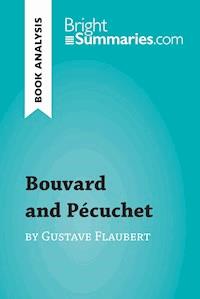
9,99 €
Mehr erfahren.
- Herausgeber: BrightSummaries.com
- Kategorie: Bildung
- Serie: BrightSummaries.com
- Sprache: Englisch
Unlock the more straightforward side of Bouvard and Pécuchet with this concise and insightful summary and analysis!
This engaging summary presents an analysis of
Bouvard and Pécuchet by Gustave Flaubert, who died before completing the novel. It was published posthumously in 1881, the year after the author’s death, in its unfinished form. The novel follows the two eponymous heroes as they embark on a rather unusual journey of scientific discovery, flitting between their constantly changing fields of interest and meeting with nothing but disappointment and failure. Flaubert, who intended this novel to act as a kind of “encyclopaedia of human stupidity” (which he also considered using as the novel’s sub-title), is considered one of the greatest French writers of the 19th century, and one of the pioneers of literary realism.
Find out everything you need to know about
Bouvard and Pécuchet in a fraction of the time!
This in-depth and informative reading guide brings you:
• A complete plot summary
• Character studies
• Key themes and symbols
• Questions for further reflection
Why choose BrightSummaries.com?
Available in print and digital format, our publications are designed to accompany you on your reading journey. The clear and concise style makes for easy understanding, providing the perfect opportunity to improve your literary knowledge in no time.
See the very best of literature in a whole new light with BrightSummaries.com!
Das E-Book können Sie in Legimi-Apps oder einer beliebigen App lesen, die das folgende Format unterstützen:
Seitenzahl: 20
Veröffentlichungsjahr: 2017
Ähnliche



















Gustave Flaubert
French writer
Born in Rouen in 1821.Died near Rouen in 1880.Notable works:Salammbô (1862), novelSentimental Education (1869), novelBouvard and Pécuchet (1881), unfinished novelGustave Flaubert was born in 1821 in Rouen. He was passionate about writing and discovered his literary vocation at a very young age. In 1841, he moved to Paris to begin studies in law, which he quickly abandoned. The author then settled in Croisset, along the Seine, and began frequenting the literary societies of the time. He befriended authors such as Charles Baudelaire (French poet, 1821-1867), Ivan Turgenev (Russian writer, 1818-1883), George Sand (French writer, 1804-1876) and Guy de Maupassant (French writer, 1850-1893), for whom he would be a role model.
An obsessive perfectionist, he defended reflexive literature and dreamed of writing “a book about nothing”. His work, which is also distinguished by the depth of the psychological analysis of the characters, heralds the many developments that the novel would undergo in the 20th century. Flaubert died in 1880, leaving behind several unfinished novels and extensive correspondence.
Bouvard and Pécuchet
A novel about human stupidity
Genre: novelReference edition: Flaubert, G. (1976) Bouvard and Pécuchet. Trans. Krailsheimer, A.J. London: Penguin.1st edition: 1881Themes: stupidity, science, knowledge, failure, timeBouvard and Pécuchet was written between 1874 and 1880, and was published posthumously in 1881, unfinished. Flaubert’s niece Caroline Commanville took charge of her uncle’s manuscripts and oversaw the book’s publication. The end of the novel consists of a series of notes which give the reader a sense of the direction that Flaubert wanted to take the story in.
This novel received very mixed reactions upon its publication due to its form: only the first chapter, which describes how the two protagonists first meet, takes the form of a narrative, while the remaining chapters are devoted to their encyclopaedic obsessions, and have often been likened to excerpts from a catalogue of scientific nomenclature. Flaubert had considered giving the novel the sub-title of “Encyclopédie de la bêtise humaine” (“An Encyclopaedia of Human Stupidity”), as his aim was to portray the pointless vanity of humanity.




