0,00 €
Mehr erfahren.
- Herausgeber: Verlag der österreichischen Akademie der Wissenschaften
- Kategorie: Religion und Spiritualität
- Sprache: Englisch
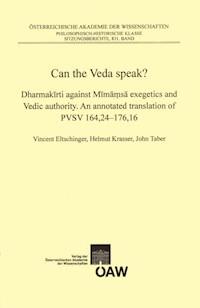
The present volume provides an annotated English translation of the last section of Dharmakirti’s Pramanavarttikasvavrtti (PVSV 164,24–176,16, ad stanzas 1.312–340), which includes his final assault on the Mimamsa doctrine of the authorlessness (apauruseyatva) of the Veda. Dharmakirti draws out the apparently fatal consequences of this doctrine: If the Vedic scriptures are without an author, hence without an underlying intention, they can only be meaningless. Even if they have a meaning, it must be supersensible. But then, claiming that the leading Mimamsaka authorities – Jaimini, Śabara – possessed privileged cognitive access to its supersensible meaning is not an option, since the Mimamsaka denies that humans have any supernatural form of knowledge. In short, Dharmakirti forces his opponent to admit that the Veda is nothing but a mutus liber, a “mute book.” Besides questioning the very possibility of Vedic hermeneutics under Mimamsaka presuppositions, the passage translated contains interesting allusions to Dharmakirti’s linguistic theory, his views on scriptural authority, his critique of the Veda’s reliability, and his understanding of the transmission of the Veda and Vedic śakhas (“schools”, “recensions”). The section includes Dharmakirti’s polemics against a mysterious vrddhamimamsaka (“ancient Mimamsaka”). An introduction (pp. 7–21: “The Place of PVSV 164,24–176,16 in the work of Dharmakirti,” by V. Eltschinger), a synopsis of contents (pp. 23–30) and two independent essays round off the volume. H. Krasser’s “Logic in a Religious Context: Dharmakirti in Defence of agama” (pp. 83–118) sheds new light on Dharmakirti’s conception of scriptural authority and its indebtedness to Dignaga. J. Taber’s “Dharmakirti and the Mimamsakas in Conflict” (pp. 119–149) explores the guiding principles of the Mimamsa system of exegesis and assesses the relevance of Dharmakirti’s arguments against it. A general bibliography and various indices complete the volume.
Das E-Book können Sie in einer beliebigen App lesen, die das folgende Format unterstützt:
Veröffentlichungsjahr: 2012