


Erhalten Sie Zugang zu diesem und mehr als 300000 Büchern ab EUR 5,99 monatlich.
- Herausgeber: Books on Demand
- Kategorie: Religion und Spiritualität
- Sprache: Englisch
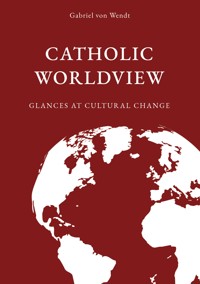
The numerous debates about how culture is changing in many Western societies call Catholics to the scene. In a course for university students seeking to be leaders in society, Gabriel von Wendt has reflected on the implications of cultural change from the standpoint of a "Catholic worldview". Alongside his students, he has explored attitudes to adopt while engaging with culture in a positive and proactive way. This book seeks to make his reflections available to the wider audience of people asking themselves: What is the role of Catholic leaders in our changing culture?
Sie lesen das E-Book in den Legimi-Apps auf:
Seitenzahl: 372
Veröffentlichungsjahr: 2023
Das E-Book (TTS) können Sie hören im Abo „Legimi Premium” in Legimi-Apps auf:
Ähnliche












To my students.
Contents
Preface
Introduction
1. Worldview and Revelation
2. Culture and Change
3. Origins
4. Cultural Evolution
5. Witnesses
6. Religion and Society
7. Church and World
8. Catholicism
9. Evangelization of Culture
10. Embracing Culture
11. Challenges
References
Preface
When the ideas contained in this book first pushed through the surface, I travelled to Paris in search of the necessary setting to start writing them down. Even so, expression evaded me at first. It takes more to make a writer than ideas, I suppose. The ideas must shape a story. Back then, they crowded my mind; they tugged at my imagination, and they lit up like a Christmas tree every time I found myself looking at an expression of culture. But when sitting before a blank page, I couldn’t find a way into the story.
Paris is an inspiring city. Spending a few weeks there with the intention of writing about culture while getting to know a new one was not unfitting. I definitely learned: not only a little bit of French, and not only about the Parisian culture’s grandeur; I also encountered another worldview. The history told by the buildings and artwork, the logic manifested in the infrastructure, the expressions on the faces in the cafés and on the sidewalks—these and a thousand more were indicators of a different view of the world; one that was slightly different from the ones with which I was familiar. If I had thought that I had a holistic understanding of Western culture, I now realized that I was wrong. Considering the incredible richness of its components, I could not possibly claim to capture the quintessence of Western culture at my young age. I thus kept observing what I saw and recalibrating what I thought, and I wondered how I could ever put something down on paper if, with each page I turned in life, I had to constantly recalibrate everything. Would I ever obtain access to a story that would express my ideas?
One day, I walked into Notre Dame Cathedral. It took me a while to get through the line of visitors, all eager to experience the legendary charm of this gothic masterpiece. When I finally strode through the rows of forest-like columns and pointed arcs, my eyes sluggishly adjusted to the dimmed light in the middle nave which was illuminated only by the crisscross of light beams allowed in through the symmetric stained-glass windows. I found myself surrounded by the breathtaking views created by the several layers of space that pulse with the spiritual charge contained in this ancient building. This felt familiar. As a Catholic seminarian, I was no stranger to churches. Moreover, the gothic genius spoke to me of a worldview I knew. For all the diversity that you can find in the different Western nations, there are elements which unite them culturally. More than anywhere else, this unity is embodied in the architectural spirituality of the Catholic churches.
To my surprise, not only the stones spoke of spirituality in Notre Dame. There was also a service going on by the main altar. To be precise, two dozen faithful sang the evening prayers. It struck me how harmoniously the stream of tourists flowed around the praying locals. Prayer and sightseeing coexisted peacefully. In that moment, it even seemed that these two activities were enriching each other. Usually, two things as different as these are prone to adversely affect their respective ends. In the special atmosphere of Notre Dame, however, the tourists instinctively seemed to show due respect, while the faithful must have taken pride in the stunning beauty of their service.
While pacing through that scene pensively—feeling like I belonged to both groups: the faithful searching for the glory of God and the visitors searching for the heights of culture—the Christmas tree lit up in my mind again. This was a furnace of Western culture right here! Prayer and beauty, faithful Christians and secular bystanders, diversity, and encounter: all encapsulated in an atmosphere which clearly affected people’s behavior, relationships, and mood. Faith and culture merged into a whole here, without canceling each other out. They enriched each other harmoniously. In that moment, I discovered my way into the story.
The challenge lay in writing about culture while being yourself thrown into it; fathoming the influence of culture while being yourself influenced by it; deciphering the formation of “worldview” while not being able to escape the calibration process of your own. None of these things can be accomplished in a couple hundred pages because these topics, by definition, are endless. History, philosophy, theology—they are disciplines in which the integration of each new insight requires the revision of the whole. For they all strive to procure a coherent image of the world, that is, of the whole.
Integrating the “new insight” of the Catholic faith into the whole of your view of the world is your entrance into the story of this book; to review your coherent image of the world in the light of the Catholic faith; to practice the Catholic world-view. We can do this by looking at the past: How has the Catholic faith been integrated into the worldview before? Above all, we can ask ourselves how we can integrate the Catholic faith into the world of today and tomorrow.
A book on Western history would seek to present an image of the whole by means of a coherent interpretation of sources; a philosophy book would have to sketch an argument which illuminates reality as a whole; a theology book, for its part, would usually address the content of faith as part of the whole. In the following chapters, I simply want to offer glances at how culture has changed and can change. This is neither a history book nor a systematic treatise of cultural philosophy or theology. Rather, the reflections shall facilitate the question of how the Catholic faith can enrich our worldview; of how it can help to change culture for the better.
To understand the interplay between faith and culture, one first needs to regard the history of Western culture and pay special attention to the role that Christian faith has played in it. This is why some of the chapters have a decisively historical character. In second place, a theological framework is needed to understand Christian faith and assess its potential, intention, and entitlement to influence culture. Most importantly, however, one must reflect on how the two realms of faith and culture merge into one tension field in the life of a concrete person. Whether it be the person standing in the pews during evening prayer, or the one striding through the side aisle of Notre Dame—whoever wants to get in touch with the centerpiece of Western culture must walk into the tension field where faith and culture relate. We could say that a person’s Catholic worldview is the result of how he or she moves through that tension field. This book wants to be a framework to describe that field and a handrail for the journey through it.
Introduction
Dear young Catholic,
There is an immense need for orientation in the world. Culture, which is supposed to be that orientation, presents itself more and more as a force that seeks to dissolve all that could serve as orientation. In today’s light, everything appears to be liquid, temporary, and relative.
It is not the first time in history that this has happened. Each culture periodically undergoes phases in which the old ways of life are put in question and new ways are explored. These are often times in which the horizon of possibilities seems to be endless—either because of revolutionary new opportunities or because of the crisis of an old system.
The wider the horizon, the greater the need for orientation. In ancient times, the most reliable reference on the horizon was the point where the sun rose: the orient. Christians used this image and applied it to Christ, the Rising Sun, whose light would lead the way. This is why Churches are traditionally oriented to the east.
Today, it seems that people do not need nature to illuminate their lives or guide their decisions. Instead, they can rely on technology. Many have also given up on expecting any supernatural light and guidance from Heaven. For culture seems to suggest that this type of light can also be replaced. This is why, right now, society is seeing the rise of so many “new prophets” who are offering orientation along the way into new territory. Have you ever wondered on what these prophets base their vision?
Catholics are remarkably silent in this endeavor. While, in the past, many leaders’ visions have guided culture by drawing from faith, we are getting more and more accustomed to the dichotomy forming between faith and culture. Again, culture is in dire need of orientation as we move into totally unknown territories. When was the last big impact on culture made by Catholics? As we explore the “New World” of the digital content, as we witness the effects of the globalization on migration, as we experience the consequences of the modern concept of liberty in economics, politics, and education, as technological advances enable us to push the frontier of what we can do further and further into the territory of what we ought not do: who is leading the way?
It appears that Catholics are more concerned with commenting and correcting the proposals of others than making ones themselves. Are we only to be correctives? Isn’t there a call for proactively engaging in exploration? A call to exercise cultural leadership on the basis of the rich tradition and wisdom we possess.
The cultural movements of Christians who react against negative tendencies and fight the injustices of our times have their place. The spectrum of cultural engagement ought to be wider than that, however, if we really want to “evangelize culture” as Catholics. What makes a successful cultural leader is, above all, a clear and inspiring vision. Isn’t that precisely what we claim to have as Catholics? A vision for people to live happily and wholesomely? Why is the public image of what Catholicism has to offer so often the opposite of this?
In the cultural discourse, Catholics must not be perceived according to what they are against. We must ask positive questions and encourage creative responses to communicate what we are for. And to do so, we must engage in the needs and tendencies of our time. On first glance, such creativity may stir up the fear of making mistakes, of losing what is essential, of falling into heresy by going with the flow. History shows that there is a way to be creative without betraying one’s roots, though. And history proves that the genuinely Catholic attitude is to be fearless in face of cultural change—to be fearless in living out the faith under new circumstances and in bearing witness to the perennial beauty of the Christian life.
This creative and fearless testimony is an artwork which young faithful can craft better than anyone. If we are honest, the issue of presenting the Christian faith in this new era with a new language has been the core focus of every missionary approach of the past decades. And yet, I cannot overcome the feeling that we are still not asking the right questions, let alone taking the necessary action. In short, the Church-wide discernment of these matters seems imprisoned by the tendency to wrestle constantly with two extremes: reactionary conservatism on the one side and, on the other, an all too indulging progressivism.
Rarely do I find Catholics who are able to embrace the question of our role in culture without being chained to one of these sides. It is not that we are all taking extreme positions. In fact, most of us stand somewhere between the extremes in different shades of a gray scale. Nevertheless, those gray tones only reaffirm the existence of the two extremes which are influencing us in varying proportions. Conservation and progress are the axes which produce the coordination system in which we commonly move.
I believe these coordinates are wrong. In fact, the challenge of the Church is not so much whether she should remain faithful to her traditions; nor whether she should emerge into modern society. Certainly, these are important problems, but they are as old as the Church herself and have mostly found satisfactory answers by now. The ongoing challenge is putting these answers into practice.
The two axes to create our field of reflection and action are not conservation and progress but faith and culture. Culture itself undergoes a constant tension of conservation and progress. But faith as we receive it from God—that is: from someone who transcends culture— is perennial. Therefore, the question is how that faith can be integrated into the constantly shifting reality of culture. The greatest value of faith for the ever-shifting culture is, in fact, that it will not cater to the caprices of a time. On the contrary, it can shed a light on culture which comes from beyond culture. Christian faith is as reliable an orientation as the rising sun.
I perceive the call of our time to be the need to embrace the Catholic faith closely and, as convinced Catholics, to engage in our time as children of our time—creatively, communicatively, proactively. Catholics are called to offer precisely that orientation which the world is lacking.
I also feel that we are not yet up to this call. It will take a new generation of leaders: young, fearless, intentional. You! Someone who knows of today’s needs and speaks today’s language. You! Someone who has experienced Christ’s power while living in today’s world. You! In fact, if you make an authentic experience of the genuine Catholic identity today—well formed, supported by peers, enlightened by the Holy Spirit, and empowered by the institutional Church—you will be the one to proclaim the Gospel to God’s children in the twenty-first century in ways that they can understand. Like thousands of Catholics before you, you will evangelize culture in times of change.
What could that look like? Can you achieve this by sheer willpower or guarantee it through clever strategies? This brings us to the questions which we will ask in the following chapters: What is culture? What is Western culture? Where is it going, and what does it need? How can culture be shaped? What makes a cultural leader? Ultimately, what is the relationship between faith and culture, between the Church and society? Putting it all together, we ask: What is the responsibility of Catholic Leaders in our changing culture?
1. Worldview and Revelation
Students on the Lookout
A Christian college student often experiences the tension between personal faith and mainstream culture. Whether it be the lifestyle of fellow students, the content in the books he studies, the values in the arts, or the various models of happiness—conflicts are everywhere. These conflicts might not only be in relation to society. Often enough, these conflicts affect one’s own conscience, as traditional beliefs seem to become less and less able to give direction to concrete life decisions. Culture changes and the faith often seems to remain behind.
Talented students might bring this situation to an even higher level: What is it that I want to stand for? In what way do I want my faith to shape the leadership that, sooner or later, I will carry on my shoulders? They seek more than direction for their own conscience. They feel the urgency of assuming responsibility in this changing culture in order to avoid further growth of tensions. They are indeed called to be leaders of a reinvigorated Catholic worldview on the cultural horizon. How does one become such a leader? In what way can he or she influence culture?
The following reflections will not provide any prefabricated answers to these questions. Instead of studying Christian doctrine alone, we must first look at the world at large. We will ask philosophically what culture is and will try to understand how it changes. In doing so, we will pay special attention to the role of leaders within cultural change. Along that journey, the reader will then have to answer for himself if that is the kind of leadership he or she wants to live.
The Catholic Worldview Journey
By a Catholic worldview we understand the contemplation of reality from the standpoint of Catholic faith. In order to fill society with the sound of the Gospel, we need to learn how to be instruments of this melody. We call this, “forming apostles”. Like the first apostles, today’s apostles need to be able to present to the world a view on things that is a real and practicable alternative, something truly worthwhile. Sometimes the Gospel is thought to be only about “playing in private concerts” but there is so much more to it! Catholic faith has the potential to reinterpret the world as a whole. It is meant to be a symphony whose beauty can inspire all aspects of reality. In fact, it reveals the deepest truth about the world: God created it, created us, for the purpose of his love and Christ redeemed us in order for us to love him and achieve complete happiness.
This faith changes everything, not in the sense that the Catholic faith takes the place of science, philosophy, arts, or culture, but rather, in the sense of offering the key to playing these strings even better and in harmony with each other. How? What does such a worldview look like? That is precisely what we want to research by looking at reality—history, the present, and the future—from the standpoint of faith.
In order to form, network, and empower talented students to become Catholic leaders and evangelize culture, we do not have to reinvent the wheel. In fact, there have been many great Catholic leaders who have influenced Western culture significantly. When visiting places in Europe, we will not simply see the witnesses of great Christians. Above all, we can follow the tracks of real leaders of the Catholic worldview in Western civilization. We can study people like St. Helena, the mother of Emperor Constantine who lived in Trier; Charlemagne who built a new Christian Empire making Aachen its capital and prototype; St. Thomas Aquinas who studied in Cologne under St. Albert the Great; and also more recent figures like St. Edith Stein, who consecrated her life to God in the Carmel of Cologne before becoming one of the many martyrs during the Third Reich, or Blessed Cardinal von Galen who bravely and publicly condemned the Nazi regime in places like Xanten.
Before diving into these historical times, places, and figures, we need to set a philosophical base for the central concept of our course. What is a worldview?
Philosophical Context of Weltanschauung
The search for a “Weltanschauung” (German for worldview) is fundamentally an existential question, a question about life. Since “life” is far more than vegetative dwelling on this planet, we ask more concretely how one should live in this world. In order to live in this world, we need to relate to it. In order to relate to it, we need to get to know it better. And the better we know it, the better we can engage the world as leaders.
So we think and reflect on the world because we want to live properly. The act of thinking characterizes the human being. Thinking is not just a punctual reflection. It is a way of existing. We not only think, but keep thinking all the time. To say that man’s nature is rational means that he is discursive. Within certain universal axioms— the so-called first principles1—whatever he seeks to grasp, he does so discursively. Every step in his mind is preceded and followed by more steps. In this way, thinking is never really concluded. A discourse consists of a series of affirmations that logically build up. Still, we do not appreciate only the logical link between one isolated affirmation and another but try to grasp the whole of what is being transmitted.
Rational thought, thus, is not just the accumulation of propositions arrayed in logical order; it is the sort of unity that those elements create. Just as reality is more than the juxtaposition of atoms, thinking about reality is more than a logical description of its elements. When man approaches reality in his discursive way of thinking, he seeks to grasp it as his “world.” It is the same with listening to a speech. Instead of taking in proposition after proposition, we allow the discourse to build up the vision, the message, the task or the opinion that the speaker seeks to transmit. In that sense, our “thinking way of life” is not so much the actual dominion of information with which we “work,” it is rather an ongoing process of integrating more and more “steps” into the whole of our thought. This “whole” is what we call a worldview. And as such, it is constantly evolving and shifting.
Worldviews Are Partial, Fragmented, and Self-referential
This means that we cannot understand our life by isolating certain insights. Global comprehension integrates all the elements relating to the world, not only a few thoughts. Moreover, even the strongest rational convictions will struggle to provide a complete overall roadmap, for there is always something else to be said, to be added, to be considered. Everybody experiences this every once in a while. We receive insights—new ideas, experiences, errors—which oblige us to recalibrate our view on things. Sometimes this implies a genuine crisis. Other times it silently matures our convictions.
Thus, our worldview is as dynamic and discursive as our very way of thinking. We grow as we live. And, if we cease to evolve in our views, then we are—intellectually and probably also humanly speaking—as good as dead. In personalities that are more rigid, this dynamism will be less developed. But it is evident that even the most rigid person evolves his or her opinions with time—often after experiencing a sudden crisis in which the built-up defenses give in.
If we take a closer look, our views depend on more than just the steps of our thought. While it is true that “ideas rule the world,” it is also true that there is a lot in between the ideas that also have strong impact, such as feelings, habits, or unconscious tendencies. Even the blind spots in between all those thoughts and feelings—that is to say, all that we do not know or have not yet experienced—have the strongest of influences on our view on things. This makes it even more impossible to claim a static outlook on the world. It shows once more that the actual person’s worldview is not a simple collection of convictions or statements. It is an evolving mixture of different elements.
Returning to the description of man’s discursive way of relating to the world, we need to admit that, of course, not every person formulates his or her view of things in a universal and binding way. Many people do not seem to live “rationally” at all. Many human experiences, actions, and opinions are characterized precisely by the lack of reflection and base themselves on other motivations instead. Still, in every person we find a certain degree of awareness and rational structure to his or her views. It would be wrong simply to call that superficiality. After all, this un-reflected procedure is normal and even essential to human beings. To try and make every little act the result of a conscious syllogism is not only impossible, but it would also become faltering and—brought to an extreme—lifeless. Every person has a worldview. Whatever the proportion between rationality and spontaneity, it is a worldview nevertheless, independent of how conceptualized it may be.
A worldview is not only formed by reflection; it includes multiple other elements. It seems wrong to call these simply “irrational”. For even the unconscious elements touch the mind. We can see as much in the extreme cases of psychiatric illnesses. A neurosis consists precisely in a disordered mind structure (a mind structure nonetheless). Also, the reactive and endogenous defects—representing the assumingly irrational par excellence—manifest themselves precisely by affecting those elements of existence which we call rational. Even the subconscious is a form of consciousness after all. And this is not only true in pathological areas, but also in “healthy” emotions. There is no such thing as a “pure feeling,” meaning a feeling totally independent from reason. For it is a feeling only to the degree in which it becomes conscious and whatever we are conscious of follows the discursive structure of reason.
This all means that there is no such thing as one perfect worldview. By definition, each person relates to the world in a unique way. Thoughts, experiences, and tendencies form a unique view. It will always be partial, fragmented, and, to some degree, self-referential. This statement could lead—and has led—to an entirely relativistic take on human existence. Many philosophers have concluded from the relativity of worldviews the relativity of human knowledge altogether.2 Is there really no way around this relativism?
Relativism and the Condition of Human Worldviews
Relativism is the tendency to consider the variations between people’s opinions, to then trace those variations back to the different ways in which individuals experience reality, and to conclude that between the opinions there is none better than the others. In the same way as there cannot be a claim to judge an experience to be false, relativism suggests that an opinion cannot be false either. This would mean that opinions about reality—judgements, knowledge, moral guidelines—are not only conditioned but practically caused by experiences. According to that logic, just as what we see depends on how our eyes perceive things, what we say about reality depends on how we experience it.
On first glance, this appears quite compelling. If we look at the whole reality of human experience, however, we have to think again. Whereas our sight is, in fact, completely dependent on the one input which our eyes provide, our experience of reality is a polyphony of multiple, almost uncountable sources of input. To start with, there are the five senses that complement each other. They often outright correct each other in painting a vivid picture of reality. Think of when touching an object has surprised you because you had judged it to be different when you had first seen it. Aside from experiencing reality through our senses, we receive input in so many more ways: science, emotions, reflection, deductions, other people’s descriptions, imagination, spiritual experiences. The list is endless. One of the most important characteristics of the human experience of reality is that it consists of multiple sources of input. On the one hand, this explains the unique mixture of input in everyone’s experience; on the other hand, it leads us to the important question of how an individual organizes that myriad of information in order to come up with what we have called an “opinion” about reality.
Man’s opinion about reality is not simply the necessary consequence of his passive experience of it. He also actively selects, organizes, and judges his information. And in that he can take different directions, be more or less exact, allow reality to weigh in to his inner “discourse” more or less objectively. In this sense, a worldview will always be conditioned by a person’s experience, of course, but it will not necessarily always be an equally valid assessment of reality. In the same way, worldviews are not relative in the sense that they are all equally good or correct; rather, they are relative in the sense that they relate to reality from the unique angle of the person who owns it. That angle is, by definition, partial. But this partiality does not impede it from being true or false.
A worldview inherently relies on the fact that human experience consists of the polyphony of different sources of input. A person’s perception of the “world,” in the sense of the totality of his reality, is not just the sum of its parts; it is a unifying whole in which he can live.
In order to see man as a whole, we need to see how his different faculties form a unity. While every faculty—senses, psyche, memory, intellect, will—operate in different ways and on different levels, they merge into the experience of a single person. They transmit the world (or engage in it) in a polyphonic way, so to speak. If we remain within the metaphor, the formation of a person’s worldview is the quest to organize this polyphony into a symphony rather than a cacophony. The symphony, which ideally takes form from the different tunes of experience, is the integral experience that the person has of the world.
That symphony is composed over time. Every new experience in life introduces a new theme to the piece and must be integrated into the existing melody. With every stage in life another movement begins, new and yet as a continuation of the old. Therefore, the interior process of forming and recalibrating one’s worldview occurs in constant “dialogue” between the acquired view and the newly experienced reality.3 A person’s worldview is constantly integrating new experiences. It is his internal processing of the living encounter with the world.
This is why men might reach differing results when looking at the world. They can experience it in various ways and, therefore, form different worldviews.4 As we have mentioned above, even within one person’s experience this view varies and evolves. Sometimes it downright changes. In as far as a person’s worldview is an encounter with the universe, it is conditioned by the degree of knowledge and experience that his or her specific angle has allowed.
It is evident that man relates to the world in multiple ways. When understanding a worldview as a unifying vision of this variety, the challenge consists in considering how the different levels relate to each other and form a unitary awareness of things. The human being unites “his world” within the horizon of his experiences. To define all elements that play into a worldview, one would have to grasp that plurality of levels. This seems to be impossible. Whoever tries it will obviously seek to order the experience by categorizing, dividing, and hierarchizing them. In fact, this is what the different anthropological systems do: Aristotle’s three levels (vegetative, sensitive, rational), Kant’s three parts (phenomenical, categorical, transcendental), Freud’s three areas of the self (subconscious, conscious, superconscious). Their structures seek to bring order into the human experience like a composer orders different melodies into a symphony. Each one of those systems sheds light from a certain perspective on the experience of the world. In that sense, they undoubtedly have a certain truth to them and can convey clarity. But they need to be examined ultimately according to the question of whether they can integrate the levels into a whole; in other words, to what point does this whole grasp the entire worldview, that is to say, the entire experience which forms a person’s existence.
An anthropology can claim a complete image of man only to the degree in which it grasps that integrity of existence. This is the approach of philosophical personalism.5 Its representatives basically argue that the concept of man often only takes certain human dimensions into consideration. Looking at the person seeks to contemplate man in his whole reality instead. Rather than defining man by his actions or faculties, they ask: what is man? How does he experience the world? What meaning does he find in his life? These questions are of utmost importance in order to give man’s life orientation.
Man unites all his experiences into his worldview. By doing so, he is confronted with these existential questions. Hence, a worldview functions as a comprehension of life and of man himself. In it, man seeks to grasp his place in the cosmos.6 This is powerful because man can give an ultimate order to his existence by asking who he is and what the world is. These questions connect to almost every other possible question a man can ask. Here lies the significance of each person’s worldview: it will influence all of his or her answers, including the most important of all, the question about the meaning of life. This is the fundamental characteristic of a worldview.
The prominent role of experience in a person’s worldview underlines yet another important element. Experiences do not rain on man casually. The care and love he enjoys, the education he receives, the environment he lives in—all this depends on his fellow man. Hence, the worldview, while being deeply personal, is also deeply social and cultural. Thus, each person develops a worldview both consciously and subconsciously. At the same time, the experiences provided by the person’s cultural environment influence it.
Worldview, Faith, and Truth
At this point, we need to make an important terminological note about how we use the word worldview and how it differs from other concepts. As we have seen, what we mean by world is the reality in which man lives, perceived as the totality of things to which he relates in some way. Man’s view of that world is formed by all the ways in which he experiences it, relates to it, and constitutes an ongoing effort of synthesis on both a conceptual and a non-conceptual level. Thus, a man’s worldview is the way he looks at reality, not merely in the sense of a remote observer but as an immersed part of the world. The worldview considers one’s place in the world according to the existential experience of relating to it.
Given the strictly subjective way of everyone’s experience of the world, every worldview is unique. To the degree in which experiences are shared, worldviews will coincide between individuals. This happens on a universal basis due to man’s common nature and faculties, on a collective basis due to a common culture, on a selective basis due to shared convictions, and on a casual basis due to shared temperaments, etc.
That means there are some elements which necessarily condition every human worldview. Others can exercise a binding impact but depend on the cultural environment. Due to its ever-present character, the worldview plays a crucial role in a person’s existence, for it strongly influences how he or she conceptualizes, feels, and projects the meaning of life.
On the one hand, a worldview is the result of a variety of factors. They can barely be determined exhaustively and, even less so, completely controlled. On the other hand, the conscious formation of one’s worldview is possible to a certain degree and constitutes an important prism for an integral education. Furthermore, the promotion of a certain worldview in society is the deepest impact which one can exert on culture.
It is crucial to distinguish a worldview—being always a personal synthesis of the experience of reality—from truth. To separate the two completely would lead to saying that all human knowledge is merely subjective (relativism). However, to identify a certain worldview nonchalantly with truth would mean to err on the opposite side. A realist philosophy affirms the capability of man to know the truth. Man is open to truth and capable of it through reason. Nevertheless, man will never be able to embrace the truth exhaustively. Sometimes he errs. So, a certain worldview is not simply the truth. However, it hopefully contains as much truth as possible. Even if a man would not err on the rational side, his worldview includes many other elements besides reason (emotions, unconscious tendencies, physical conditions, etc.), which will be strongly subjective, and many times lack objective truthfulness.
Finally, worldview needs to be distinguished also from another concept: faith. While a non-believer will declare a believer’s faith to be a simple worldview, it really is something essentially different. “Faith is man’s response to God, who reveals himself and gives himself to man, at the same time bringing man a superabundant light as he searches for the ultimate meaning of his life” (CCC 26). While a worldview relies entirely on the individual’s relation to the world, faith relies on the Revelation by God and, thus, on the relation of God to the world.
To be more precise, the Christian faith needs to be distinguished between the act of faith and the content of faith. The content of the Catholic faith is the Word of Revelation which arrives to us by the mediation of experience. But the divine origin consists in the fact that the word really “descended from heaven.” The content of faith did not originate in human reason. While “by natural reason man can know God with certainty, on the basis of his works,” there is still another order of knowledge which man cannot possibly arrive at by his own powers: the order of divine Revelation. “Through an utterly free decision, God has revealed himself and given himself to man. This he does by revealing the mystery, his plan of loving goodness, formed from all eternity in Christ, for the benefit of all men. God has fully revealed this plan by sending us his beloved Son, our Lord Jesus Christ, and the Holy Spirit” (CCC 50). The act of faith is the response of man to this Revelation. “By faith, man completely submits his intellect and his will to God. With his whole being man gives his assent to God the revealer. Sacred Scripture calls this human response to God, the author of Revelation, ‘the obedience of faith’ (cf. Rom 1:5; 16:26).” (CCC 143)
Although one’s worldview can color the act of faith to a certain degree, especially in its expressions, the act of faith itself is not conditioned by it.
Faith is a gift of God, a supernatural virtue infused by him. “Before this faith can be exercised, man must have the grace of God to move and assist him; he must have the interior helps of the Holy Spirit, who moves the heart and converts it to God, who opens the eyes of the mind and ‘makes it easy for all to accept and believe the truth” (Dei Verbum 5). Believing is possible only by grace and the interior help of the Holy Spirit. But it is no less true that believing is an authentically human act. (CCC 153f)
Therefore, faith is a kind of truth that can influence a person’s worldview in the deepest of ways. For it not only gives a key of interpretation for the world and man’s place within it, but it does so with the authority of One who is not himself conditioned by the partial relativity of human experience: God. A person with faith counts on an absolute truth that has the power to shape his or her worldview in a certain and meaningful way. This enables the person to respond to the meaning of life. Moreover, it sets a note for integral personal formation and for cultural engagement. It can create a culture that foments the highest levels of human fulfilment. For it is precisely faith in the Son of God who became man that reveals to the world what man ultimately is. It elevates him to a higher order and calls him to a life of happiness that goes beyond all worldly experiences. This is the reason why the Catholic worldview has so much to contribute to a humane culture. It has been and is called to be the source of divine contribution to culture in the past, present, and future.
The Light of Revelation
We have left the purely philosophical approach behind. There are many philosophical answers to what man is—definitions which claim man to be a ζῷον λογικόν;7 or a “res cogitans;”8 or that which he eats9. Now, precisely in the context of a Weltanschauung, the strong suspicion remains that those answers are, in their own turn, conditioned by a restricted worldview. How does one break out of this vicious circle? This is the scope of a Catholic worldview as the thinker Romano Guardini saw it.10
Guardini explained that, in order to acquire an unbiased view of the world, it is necessary to not be engulfed in it. Man can try to take a step back and look at the world as if from a distance. But that endeavor will evidently be limited as man could never put enough distance between the world and himself. A second condition for a proper view of the world is, according to Guardini, a purity of intention. In the same way as when encountering another person, the encounter with the world will only reveal its truest self if one looks at it with “pure eyes.” The person who seeks to profit from another person will not truly encounter him or her. In the same way, a view on the world which simply seeks to objectify, quantify, or utilize it will not see its totality; such a worldview will simply see objects, quantities, or things which can be used.
Guardini is convinced that the world is more than this and that it bears meaning and depth within it. He shows how there is one view of the world which follows the logic of the pure encounter and, at the same time, stems from a point outside of the world: God’s view of the world. He not only transcends the world; according to the Catholic faith, he encounters it lovingly. In the same way in which a loving look at a person brings out his or her full depth and richness, God’s loving view at the world brings out its entire meaning.
For Guardini, Revelation is the way in which God enabled mankind to view him and the world through that divine lens. Moreover, by becoming man and allowing his disciples to become one with him, Christ offers us the possibility to truly see the world through the divine lens with human eyes.
Whereas an individual will not be able to share in the richness of that view exhaustingly, the community of the Church embraces the many types and degrees of human participation in God’s view. This is why no one individual could claim to be the keeper of God’s Revelation, nor could one time or culture presume to comprehend God’s revealed wisdom by itself and without reference to the Tradition. On the contrary, God has entrusted the lens of his view of the world to the living community of the Church. The Catholic worldview is thus the comprehensive wisdom of the Church about reality—a wisdom spread over the centuries and distributed among thousands and thousands of her members.
As D. Foote puts it: “[The Catholic worldview] alone is a worldview in the purest sense of the term. It is not simply a view of the whole from within the world. It is the view of Christ, the Word from beyond, who achieves the distance from which to see the world in its true totality. Guardini writes, ‘To believe means to go to Christ from that place where one stands. It means to see with his eyes; to measure by his norm. The believer stands beyond the world through him, simply by believing.’ This view comes from the heart of the Church. ‘She is the historical bearer of the full vision of Christ over the world. The Catholic attitude of the individual rests herein, that he lives from the Church.’”11
1 These first principles have been formulated by Aristotle (384-322 BC). They are “first” or “a priori” in the sense that they do not require experience but constitute the functioning of reason itself.
2 See, for example, W. Dilthey (the thinker who first theorized the topic of fundamental worldviews in Die Typen der Weltanschauung und ihre Ausbildung in den Metaphysischen Systemen, 1911) or H.G. Gadamer (who has shown the change and fluctuation of each subject’s worldview and then applied the same dynamism to scientific progress in Truth and Method, 1960).
3 The concept of encounter is at the root of the so called “dialogical philosophy” of M. Buber’s I and Thou (1923).
4 It needs to be noted, though, that some faculties are more subjective than others. In this sense, the reactions of the psyche are, of course, extremely conditioned by each person’s experience. The senses of different persons, while maybe varying in some aspects, generally perceive the world in a fairly equal way. The reason, ultimately, is abstract by definition and, the “purer” the rational process, the less subjective it is. The perception of numbers, to give just one simple example, is certainly objective.
5 Many Christian thinkers of the twentieth century have embraced that school. One of its first figures was Emmanuel Mounier (1905-1950). Among the many Catholic thinkers, we can mention Jacques Maritain (1882-1973), Romano Guardini (1885-1968), Karol Wojtyła (1920-2005) and Robert Spaemann (born 1927).
6 Cf. the title of Max Scheler’s famous work: The Human Place in the Cosmos (1928).
7 Aristotle, Metaphysics, Z,12, 1037b13-14.
8 Cf. R. Descartes, Meditations, II, 28, 2.
9 Cf. L. Feuerbach, «Das Geheimnis des Opfers oder Der Mensch ist, was er ißt», in Gesammelte Werke. XI, Akademie, Berlin 1990, 25ff.
10 Cf. R. Guardini, Vom Wesen katholischer Weltanschauung, in Unterscheidung des Christlichen, Grünewald, Würzburg 1963, 13-33.
11




