


Erhalten Sie Zugang zu diesem und mehr als 300000 Büchern ab EUR 5,99 monatlich.
- Herausgeber: Paraclete Press
- Kategorie: Religion und Spiritualität
- Serie: San Damiano Books
- Sprache: Englisch
Clare of Assisi: A Woman of Light, Grit, and Faith For centuries, Clare of Assisi has been known primarily as the devoted companion of Saint Francis. But Clare was far more than just a follower—she was a bold and visionary woman who chose a life of radical faith, sacrificing wealth, comfort, and status to embrace a calling unlike any other. In Clare of Assisi, acclaimed author Wendy Murray brings this extraordinary medieval saint to life, uncovering the depth of her courage, perseverance, and spiritual conviction. Abandoning a noble birthright for a life of poverty, Clare endured hardships that could have sent her running back to the safety of her family's wealth. But she remained steadfast, even after Francis's death, forging her own spiritual path and leaving a legacy that continues to shine. This book speaks to anyone seeking strength in the face of trials, longing for purpose beyond societal expectations, or looking for an example of unwavering faith in difficult times. Clare's story is not just history—it is an inspiration for today's world. Discover the light of Clare—her struggles, her triumphs, and her legacy of faith that still calls to us today.
Sie lesen das E-Book in den Legimi-Apps auf:
Seitenzahl: 319
Veröffentlichungsjahr: 2020
Das E-Book (TTS) können Sie hören im Abo „Legimi Premium” in Legimi-Apps auf:
Ähnliche

















Clare
OF ASSISI
GENTLE WARRIOR
WENDY MURRAY
2020 First Printing
Clare of Assisi: Gentle Warrior
Copyright © 2020 by Wendy Murray
Cat drawing by Jon Zoba
ISBN 978-1-64060-183-3
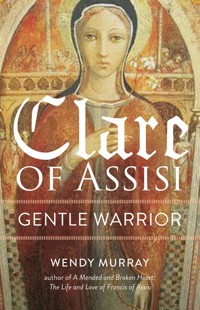
Cover image: “Santa Chiara” (Opera Unica) by Elvio Marchionni. 70 x 77.5 cm. Mixed media on plaster. Used by permission.
The Paraclete Press name and logo (dove on cross) and the San Damiano Books logo are trademarks of Paraclete Press, Inc.
Library of Congress Cataloging-in-Publication Data
Names: Murray, Wendy, 1956- author.
Title: Clare of Assisi : gentle warrior / Wendy Murray, author of A mended and broken heart: the life and love of Francis of Assisi.
Description: Brewster , Massachsetts : San Damiano Books, Paraclete Press, 2020. | Includes bibliographical references and index. | Summary: “Clare is shown as a figure of true heroism, tenacity, beatitude and grit who plotted her improbable course in the context of the raucous and explosive period of the Middle Ages”-- Provided by publisher.
Identifiers: LCCN 2020006805 | ISBN 9781640601833 (trade paperback) Subjects: LCSH: Clare, of Assisi, Saint, 1194-1253. | Poor Clares--History. | Poor Clares--Biography. | Franciscans--Biography. | Christian women saints--Italy--Assisi--Biography. | Christian saints--Italy--Assisi--Biography.
Classification: LCC BX4700.C6 M87 2020 | DDC 271/.97302 [B]--dc23
LC record available at https://lccn.loc.gov/2020006805
10 9 8 7 6 5 4 3 2 1
All rights reserved. No portion of this book may be reproduced, stored in an electronic retrieval system, or transmitted in any form or by any means—electronic, mechanical, photocopy, recording, or any other—except for brief quotations in printed reviews, without the prior permission of the publisher.
Published by Paraclete Press
Brewster, Massachusetts
www.paracletepress.com
Printed in the United States of America
CONTENTS
ABBREVIATIONS
PREFACE
INTRODUCTION : Why Care About Clare?
Part One
CHAPTER 1 NOBILITY
CHAPTER 2 PINING
CHAPTER 3 TRAUMA
CHAPTER 4 CONCESSIONS
CHAPTER 5 GRIEF
Part Two
CHAPTER 6 BATTLE LINES
CHAPTER 7 LETTERS
CHAPTER 8 INTERIOR LANDSCAPE
CHAPTER 9 “THE TENOR OF OUR LIFE”
CHAPTER 10 ASSAULTS AND VISITS
CHAPTER 11 CLARITY
CHAPTER 12 CONCLUSION
ACKNOWLEDGMENTS
APPENDICES
A MAPS
B SOURCE MATERIAL
GLOSSARY OF TERMS
ILLUSTRATIONS
RESOURCES (SELECTED)
INDEX
ABOUT THE AUTHOR
ABBREVIATIONS
All material taken from Francis of Assisi:
Early Documents and Clare of Assisi: Early Documents is denoted in the notes as FA:ED and CA:ED, respectively.
1LAg The First Letter to Blessed Agnes of Prague (1234)
2LAg The Second Letter to Blessed Agnes of Prague (1235)
3LAg The Third Letter to Blessed Agnes of Prague (1238)
4LAg The Fourth Letter to Blessed Agnes of Prague (1253)
FLCl The Form of Life (1253)
TestCl The Testament (1247-1253)
BlCl The Blessing
PrPov The Privilege of Poverty of Pope Gregory IX (1228)
FLInn The Form of Life provided by Pope Innocent IV (1247)
PC The Acts of the Process of Canonization (1253)
VL The Versified Legend (1254-1255)
BC The Bull of Canonization (1254)
LCl The Legend of Saint Clare (1254-1255)
Franciscan Biographical Writings
1C The First Witness of Thomas of Celano (1228)
2C The Second Witness of Thomas of Celano (1245-1247)
AP The Witness of the “Anonymous of Perugia” (1240-1241)
L3C The Legend of the Three Companions (1241-1247)
AC The Assisi Compilation (1244-1260)
LJS The Life of Saint Francis, Julian of Speyer
MP Mirror of Perfection
LegMaj Major Legend of Bonaventure
VL The Versified Life of Saint Francis by Henri d’Avranches
PREFACE
During a recent visit to Assisi, I chatted frequently with a British couple with whom I shared a breakfast table at the guest house where we were staying. After three breakfasts, they realized I had already written a book about Saint Francis and that the book happened to be available for purchase in the library of the guest house. On their last morning in Assisi, before this couple began the long trek hauling their bags to the train station, the gentleman asked if I would sign the copy of my book he had purchased from the library, which I was happy to do. And off they went. Then, as if in an afterthought, his wife quickly returned to tell me, with wetness in her eyes: “After speaking with you, I understand the feeling I had when I visited San Damiano.” (San Damiano is the small convent below town that Francis rebuilt and where Clare of Assisi lived out her days.) I asked her, “What feeling?” She said, “I felt sadness there, almost as if someone had died.”
I probed my memory trying to recall what I had said that had awakened such clarity on her part. I recalled, faintly, that I had shared with them how Saint Francis, near the end of his life, had been essentially kicked out of his own religious order,1 suggesting that the shifting tides of change were overtaking the idealism of his original vision.
The British woman’s words hung over me as I continued my research on Saint Clare. By the end of my trip, I felt a similar sadness. I felt it when I stood in the Basilica of Saint Clare, with its vaulted ceilings covered top-to-bottom in whitewash, with only a few partial glimpses of old frescoes underneath the white in random spots. The story of Clare must have certainly been told through fresco cycles, as was the case of the Basilica of Saint Francis on the other side of town—this was the function and purpose of basilicas. Yet, if there had been any frescoes depicting Clare’s life, they had been covered over. I overheard a tour guide explain it, saying that in the sixteenth and seventeenth centuries, during two separate outbreaks of the plague, the basilica had been turned into a hospital and the whitewash was installed for hygienic and cleaning purposes. He added that there was no intention to restore the artwork underneath. Clare’s story, he said, was hidden beneath the whitewash and there it would remain.2 This made me sad.
Where you are still able to find images of Clare in frescoes out and about in Assisi, most depict her as thick-jawed, sometimes dour, and wrapped heavily in black. Yet Clare was beautiful—she was the town beauty in Assisi during her youth—and many men, Francis among them, were enamored of her. She was light-filled and brave, kind and lively. Even before her commitment to a religious life, she gave food to the poor from her table in the palazzo in Assisi’s wealthy neighborhood of San Rufino. She dismissed out of hand, even as a young maiden, expectations and overtures of betrothal that befit a woman of rank in that town. But the Clare you see in the frescoes show her to be stern, maybe a little dowdy, and sometimes skulking, like a caricature of the nuns you hear about in stories of Catholic boarding schools. This, too, caused me sadness.
Yet, there is one fresco that is extravagantly displayed around town being marketed as the image of Clare. It is a portrait by the pre-Renaissance artist Simone Martini, who painted several portraits of members of the noble and regal class who followed Saint Francis. One portrait among these five depicts a stately woman whose visage is calm and lovely; she is draped in delicate linens and crowned with a corona of stars (see page 196). You see it everywhere in Assisi—on postcards, ceramics, in any number of diverse artistic reproductions. This image, of all images, captures the evanescent beauty and dignity of Clare. The problem is, the image is not Clare. Though it is marketed aggressively as Clare, the face belongs to another devoted female follower of Francis who, like Clare, was a woman of rank: Jacopa dei Settisoli, who hailed from Rome and was with Francis when he died. We know this because the corona surrounding the face, mentioned above, is not a crown of stars but of suns, and there are seven of them (“Settisoli” means “seven suns” in Italian). When I was researching my book on Saint Francis years ago, I had asked the friar who was the leading expert on the art of the Basilica about the anomaly. Why did they perpetuate, falsely, the image of Jacopa dei Settisoli as being that of Clare when they knew it not to be so? He answered with a shrug. “It is what the people want.”3
In that moment I understood that, in attempting to research and write honestly about the lives of both Francis and Clare, I would be up against an institutional willingness to embellish, exaggerate, and possibly misrepresent the lives of these personalities in service to “what the people want.”
I encountered a similar frustration during my research of Francis. Upon his death, his first official biographer, Thomas of Celano, wrote in 1228 a fairly honest account of Francis’s life, including his extravagant and misspent youth. Francis, “maliciously advancing beyond all of his peers in vanities, proved himself a more excessive inciter of evil and a zealous imitator of foolishness. He was an object of admiration to all, and he endeavored to surpass others in his flamboyant display of vain accomplishments: wit, curiosity, practical jokes and foolish talk, songs, and soft and flowing garments. Since he was very rich, he was not greedy but extravagant, not a hoarder of money but a squanderer of his property, a prudent dealer but a most unreliable steward.”4 Within a few years this version was eschewed and Thomas of Celano was instructed to write a second biography, which he composed in 1247. This later version, titled Remembrances (also called the Second Life) glossed over or eliminated altogether references to Francis’s rowdy and carnal youth, contrasting starkly to his earlier account. Describing Francis’s youth, he now says, “He completely rejected anything that could sound insulting to anyone. No one felt a young man of such noble manners could be born of the stock of those who were called his parents.”5
Then Bonaventure, who became the Order’s Minister General in 1257, ordered all previous versions of Francis’s life destroyed in deference to his own Major Life (1263), in which he wrote of Francis’s youth: “While living among humans, he was an imitator of angelic purity.”6 So it is a long and arduous exercise—tracking the distortions and deciphering the nub of the story beneath the distortions. That is the challenge and heartbreak of the researcher of Francis and Clare. Funny how a simple, devoted British woman, without any knowledge of these things, felt it anyway when she visited the place where Clare lived. Something had died, or, at the very least, gone missing.
I mean no disrespect to those upon whom it has fallen to manage these legacies, even as I attempt to peel away the layers of finessing that have changed and in parts obscured the story of Clare. As one historian put it when we spoke of these matters, “You have to respect the establishment.” And that is true. For, without “the establishment,” I and you would not have access to libraries and frescoes and friars and lovely vistas as we make our pilgrimages to learn something of Francis and Clare. Yet, ever since that moment when that gifted and helpful scholar-friar freely and unabashedly admitted to me that they perpetuated a falsehood to keep the people happy, I stopped accepting unequivocally the “received text” of the story of Clare.
Thankfully, there is enough that can be known from a few early sources to lend a little ground to stand upon. It is not a lot, but it is enough to begin to understand her on her own terms and not on those foisted upon her by the overseers, both during her life and after her death. These bits, measured against the backdrop of the times in which she lived both politically and ecclesiastically, begin to reveal the shape of her. We see a young, marriageable teenager who ran away from her noble household to follow a young upstart who had embarrassed his own family with a public display of renouncing them. Then, a lifetime later, we see a cloistered, hobbled “nun” (a term she eschewed) who, by that point, had lost every dream, whose life had been reduced to a shadow of her former self, that self who once flew fleet-footed across the plain in the middle of the night to the waiting Francis. Loss upon loss, that young girl died along the way. Time worked its ravages, and Clare had to adapt to sometimes jarringly contradictory circumstances. Yet, with her final breath, she uttered the final benediction of her life: “God, you are blessed for having created me.”
How she got from being the fleet-footed teen to the bed-ridden nun—culminating in the benediction that God himself was blessed in creating her—is the exploration of this book. I write it to honor her, the one in whom Francis’s soul found rest. The shifting sands of time and intention have changed and obscured her story. I cannot claim to have fully found it or reclaimed her. But I join the orchestra of searchers and scholars and lovers of Francis who have tried against other forces to shake loose the shards of light that remain untouched and which, viewed at the right angle, still shine.
1 See my book, A Mended and Broken Heart: The Life and Love of Francis of Assisi (New York: Basic Books, 2008), 123–33. Hereafter, Mended.
2 A Third Order female Franciscan I spoke with, who gave tours in the Basilica, questioned whether there were frescoes beneath the whitewash.
3 See Mended, 181.
4 1C 1:2; FA:ED, vol. 1, 183.
5 2C, 1:5, FA:ED vol. 2, 242.
6 LegMaj, FA:ED vol. 2, 527.
INTRODUCTION
WHY CARE ABOUT CLARE?
I have pondered why anyone should care to read a book about the life of Saint Clare. Was she not a derivative of Saint Francis, the truly important figure in this story? What more can she bring to the story that has not already been told in his? Further, she lived in the Middle Ages, an alien time to us; and she, as a woman of rank, willingly, purposefully exchanged a powerful identity for an inglorious one. In these modern times, why would such insouciance arouse curiosity? For others who (like myself) are Protestant, what about the fact that Clare is a “Catholic saint”? Doesn’t this mean her story belongs in the cavernous chambers of sacred imagination of Holy Rome, the accoutrements of which the Reformers threw out the Wittenberg door in 1517? By these standards, there is no compelling reason why a modern person, religious or otherwise, would have an interest in this oddly hewn character cut from the rock of medieval Umbria.
Yet, of course there are compelling reasons to study the life of Clare. First, while it could be said that she was derivative of Francis—she was called his “little plant”—Francis died young and Clare was left holding his legacy in her delicate hands while the winds of change and tumult battered the bulwark of his legacy. She fought those battles without him. Beyond that, as one Franciscan historian put it, “In some way we obtain from Saint Clare a clear and more undistracted view of the inner life of the pure Franciscan spirit, than from even Saint Francis himself, since even in him the external duties of the friar are apt somewhat to dim the vision of that interior life which was the innermost sanctuary and nursing ground of the Franciscan spirit.”7 Second, regarding the obscurity of the Middle Ages,8 I contend that the era is not as alien to our time as one might at first presume. “Barbarities laid bare” might describe either epoch in equitable measure. How does a person of religious conviction live out those ideals in a barbaric age? Clare helps answer that. Third, as for Clare being a woman who renounced power rather than striving to advance it, she offers an alternative picture of femininity that, in an upside-down way, rendered a different kind of power sufficient to shut the mouths of popes and turn advancing armies on their heels. This radical and totally original picture of womanhood will expand the soul of any twenty-first-century feminist. Finally, though Clare was Catholic, it is worth remembering that the Roman Church, in her day, was the only organizing apparatus for Christians, and unless one found protection and identity in that system, one was deemed a heretic. It is a tragedy of the Protestant movement that “the saints” are (at best) ignored and (at worst) dismissed from the faith tradition. One writer said it this way: “It is a cruel injustice and ingratitude to pass by in silence … generations of indomitable laborers who had cleared the thorns from the souls of our fathers, as they cleared the soil of Christian Europe.”9 Over the millennia, the “saints”—Clare among them—have risen to the top of global Christian witness, cultivating the landscape of Christian devotion, spawning movements that have changed their worlds.
Yet, I return to my original thought: In the end, there is no compelling rationale for any interest in Clare. Curiosity must ultimately arise from a place of mystery and the suspension of the standard categories and rationality. For this is the place where we will truly meet Clare—in the landscape of mystery—that is, if we are courageous enough to go there or desperate enough to end up there.
You Cannot Dream of Clare Without Francis
Years ago, a Franciscan friar in Assisi said to me, “You cannot dream of Clare without Francis, and you cannot dream of Francis without Clare.” If you have picked up this book as an introduction to the person of Clare of Assisi, to stay true to the sentiment of that friar, and since it is impossible to understand Clare without a cursory understanding of who he was, I include a brief synopsis of the life of Saint Francis.
Francis of Assisi was born in 1182 and died in 1226. He was a man of his place: Assisi, in the heart of Umbria, Italy, a land of rolling landscapes and a town cascading down the eastern slope of a mystical mountain, Mount Subasio. Assisi was a place that luminesced with magical light and the power of the land at every turn, and this magic animated Francis’s heart and imagination.
He lived in the lower part of town, called il sotto, the side of town where the merchants and other working people lived. (The nobility, including Clare’s family, lived in la sopra, the upper side of town.) Francis took great civic pride in his identity as part of the rising merchant class there. He was the son of a wealthy linen merchant and was being groomed to take over the family business, all while showcasing the latest flamboyant styles from France. He was exceedingly popular among Assisi’s younger crowd, who crowned him “king of the party.” He was a partier and womanizer and often kept the neighbors up at night and turned many heads.
He was also a warrior who aspired to knighthood. The only way a member of the merchant class could achieve that rank was in combat. To that end, he was an active participant in two wars that occurred during his lifetime. The first was a civil war between Assisi’s nobility and the merchant class when Francis was 16. During this siege Francis and his fellow merchant-class warriors tore down the walls of the city’s main fortress and drove the nobles from their homes into exile, including Clare’s family, raising the banner for the rising merchant class and decisively repulsing entrenched feudalism. The other war, when he was 20, was a melee with the town’s rival city, Perugia, and the exiled Assisiani nobles, who wanted to reclaim their homes. His friends and fellow warriors were slaughtered during this battle, but Francis survived. Because he was mounted and wearing armor, the enemy deemed him a good candidate for ransom and so took him a prisoner of war. He languished for a year in a dungeon prison with little light, no latrine, and rampant contagions being spread throughout. He became sick to the point of near death during this time until his father ransomed him. It took another year of his life to recover at home under the care of his mother. This changed him. His partying ways subsided and he turned his thoughts to God.
During this season, he became a man of stone, not for the destruction of a fortress, but for rebuilding ruined churches. His sufferings had awakened religious pining. As a result of a vision he had while praying in the ruins of a church outside Assisi, in which he heard the voice of God say to him, “Rebuild my church,” he went to work on three ruined churches in the valley below Assisi. The first, San Damiano (where he heard those words, “Rebuild my church”), he intended from the start to be a place to house women. The second is lost10 and the third, the Porziuncola, became his dwelling place and would eventually become the seat of his young Order.
Francis was very close to the land. He felt its power and perceived God’s beauty through every aspect of creation. He often retreated to secluded woods and caves when he needed spiritual centering and peace. He walked lonely mountain roads and had his most intense religious experiences when alone in nature and among the elements. At the end of his life, suffering from many illnesses, he wrote the first lyrical poem in vernacular Italian and put it to music, his famous Canticle of the Creatures (discussed in more detail in chapter 5). He died at the age of 44, within a year of the song’s creation. This is the basic outline of his life.
Even if, as it is said, “you cannot dream of Francis without Clare,” the person of Clare can still feel elusive. She felt elusive to me, even while I was writing my book about Saint Francis. I could not grasp the woman she became after the death of her beloved friend. She was writing excessively about eternal virginity and spiritual matrimony and beatific poverty, all of it on a level of imagination that felt to me like over-reach. Her spiritual vision of bejeweled breasts and perpetual virginity did not move or touch me. As a result, there always came a point in my research beyond which Clare seemed inaccessible and I abandoned hope of really understanding her. This was necessary at the time, for my mandate then was to focus on the life of Francis. Beyond how Clare’s life intersected his, I did not pursue further study of her. Yet now, ten years later—at a different stage of my life and vocation—my thoughts have returned to her.
Francis died when Clare was in her thirties. Prior to then, after she followed him in worldly renunciations as a teen, he tucked her safely away in the monastery of San Damiano—the first of three churches he had rebuilt—and there she would remain, protected by him and provided for by his friars. She sewed altar cloths and prayed for the sick; she performed works of mercy and tended her garden. Yet, despite the seeming tranquility of her new station, she experienced many trials as her life as a penitent religious evolved. (This will be discussed at length in due course.) During the early years of her new life, one of her greatest trials, according to one friar I consulted, was Clare’s always being “mad at” Francis because he rarely visited her at San Damiano. Before illness claimed his mobility, Francis was forever on the move throughout Italy and beyond, to Egypt and probably the Holy Land. This would be the first of many life-shattering adjustments she would navigate as the founding member of Francis’s female Order. Francis did return to San Damiano near the end of his life when he was very ill and near death. It was during this brief interlude of his life, in the company of Clare and in her garden, that Francis wrote his great Canticle of the Creatures. This was the last occasion they would see one another. Francis died the next year, becoming increasingly sick and infirm even as Clare was developing a crippling physical malady. By age 34, her approximate age when Francis died, she had become bedridden and was destined to live out her days within the confines of her convent dormitory unless otherwise moved by helpers in attendance.
Yet even from her bed, Clare bushwhacked her way into uncharted territory, both for women’s religious societies generally and Francis’s version of penitence specifically. She created new terms and differing themes for an existence that transcended the terms and themes of the Middle Ages and the rules of the Church. She broke through the social and religious apparatus that defined her times and she broke through her physical challenges. Clare is a breaker-through-er. She scaled high mountains from the confines of a little room in a modest convent that rested on a sloping hill outside the small town that had been her home. She could no longer walk, and she had renounced the securities of her noble rank. Yet she turned her world upside-down.
Clare is one for whom all earthly dreams evaporated and all imaginings for who she might become were consigned to some other place. That “other place” is where the real story of Clare begins. Real life kept Clare pinned to earth, but true life found her in that hidden place, the same place we all end up when there is no place left to go.
She has left an echo that reverberates to this day. It is a true echo, a clear echo. That is what makes her story meaningful now. If Clare could break through the terms dictated by her times and circumstances, surely we ought to be able to break through ours. Every spiritual seeker is a prisoner of time. Similarly, the attempt to believe enough to try and know God and to live for him must begin in time, in one’s own time, on a date on the calendar of one’s own history. We are all of us prisoners of the time in which we live. That is a place of commonality where she, in her time, and we in ours, can meet in friendship. And more than friendship, it is where we can reclaim life—our true life—amid a world gone amuck.
7 Cuthbert, Father, OSFC, Romanticism of St. Francis (New York: Longmans, Green & Co.,1915), 81.
8 The Middle Ages cover the period of approximately a thousand years between the fall of Rome in the fifth century and the dawn of the Renaissance in (approximately) the fifteenth century.
9 Charles de Montalembert, The Monks of the West from St. Benedict to St. Bernard, Vol. 1 (New York: P.J. Kennedy, 1912), 3.
10 The second church Francis rebuilt was located in the valley below Assisi not far from San Damiano. It was called at the time San Pietro della Spina. In the summer of 2007, an American Franciscan friar and I spent a day trying to locate the ruins of this lost church, which were said to still exist. After several hours of driving around and asking lots of questions to local farmers, we located it, though it was in ruins and overgrown with weeds and undergrowth.
Part One
CHAPTER 1
NOBILITY
It is impossible to grasp the significance of Clare and the power of her story without first understanding the rock from which she was hewn. And here, alas, the researcher runs into heartbreak.
What little historical knowledge we have of Saint Clare is derived largely from the early Franciscan documents, most of which interpreted her life through the life of Saint Francis. Even in these early writings, however, mention of Clare began to disappear over time. Franciscan scholar Paschal Robinson noted despairingly: “Not a few [records] were destroyed; others disappeared. As far as dates go, only one—the date of her canonization—is given. Save for a few fragments of pious legend not one of the early sources gives us the year of Saint Clare’s birth…. [W]e are without any exact knowledge of the life of Saint Clare down to 1212.”11
Within two years after Francis’s death at the age of 44 in 1226 (when Clare was approximately 34) the process of his canonization hastily took place and multiple narratives about the saint emerged, written by a diverse company of biographers for varying audiences.12 This period also marks the time when the role of Clare in his story began to be diminished and in some instances excised altogether. As Francis’s story evolved, the presence of Clare in his story diminished.13 For a variety of reasons, the creation of the saint meant the separation of her from his story. One historian in Assisi I spoke with told me, “Saint Clare was dangerous for the Church, so they tried to separate the two lives. She was too strong. Clare could be very problematic.”14
Despite critical gaps in the historical record about her, there remain elements of her life we do know incontrovertibly. We know, for example, that she was born into Assisi’s nobility and so enjoyed great advantages in her early life. We know she lived in a family of knights who were courageous, industrious, magnanimous, and cruel. We know she was born and grew up in Assisi (with an interlude, in exile, in neighboring Perugia), an intimate, feisty town hungry for war and where families and neighbors stood with one another in games and, at times, against one another in warfare. In either case, honor of the local saints wove the fabric of civic life together, whether San Rufino, San Giorgio, or Santo Stefano.15 She was surrounded by the women of Assisi who were resolute and impassioned and took pilgrim journeys overseas and who, when needed, joined in battle and went on Crusades. We know she was the firstborn daughter of a woman of noble lineage, Ortolana, devout, daring, and indomitable: as a young woman Ortolana traveled the pilgrim route from Assisi to Damietta (Egypt) to Mount Sinai and on to the Holy Land, where Saracen bandits continually harassed the traveling bands.
Clare lived in the Middle Ages when general barbarities of society and politics were laid bare. People knew the terms, knew what side they were on, and stood their ground ready to defend and die on that ground, which often was the case. There is something to be said for barbarities that are laid bare as opposed to barbarities that pulsate beneath the surface, under appearances, proclamation, and societal grievance, as is the case in our day. “Let’s just have it out” was the way of public discourse in the Middle Ages, which sometimes resulted in a call to arms but just as often left towns and their inhabitants to live and let live. War was intimate and endemic, both locally—town against town—and globally. Combat, carnage, and death were woven into the culture and were almost considered a rite of passage, especially for male members of the nobility who were born into knighthood or for those outside the noble class but who aspired to it. Knighthood was steeped in the culture of chivalry, a notion that loomed large in the imagination of the age. The nearness of death stripped away moral equivocation about it. It was a given that men would die (women too), and probably young. To die in principled combat conferred honor on their lives and glory upon their deaths. Thus, inherent in the culture of war and death was the disposition of courage. “Luxury” among the nobles was not a pillow to be sat upon. The members of the families of highest rank were knights, and sometimes women would engage in combat, too. Even Saint Francis had early aspirations of knighthood, engaged in brutal warfare, and inevitably took human life as a matter of course. In the time of Francis and Clare, “fighting the good fight” was not a theological abstraction. It involved arms, lances, shields, scabbards, and swords. There is a certain lucidity that arises from living a life in which the rules of engagement are so clearly and unapologetically importuned. Clare—in keeping with her name, which means “light”—possessed such lucidity.
Clare’s having been born into a family of great knights meant that warfare was woven into the fabric of her home life. “The sounds of war were ever about her house with the din of iron clad armor and longswords struck against floors.”16 Ancestors on her father’s side spawned a powerful family of feudal knights in central Italy and part of the Duchy of Spoleto. (Spoleto is a nearby hill town that served like the county seat.) The family names first appear in civic records in 1106, naming the sons of “Offredo” as Bernardo and Monaldo.17 Bernardo (sometimes referred to as Bernardino) had two sons—Offreduccio and Rinaldo—the first of whom was Clare’s paternal grandfather.18 He, in turn, had five sons, a cavalcade of knights: Monaldo (who appears later in Clare’s story), Paolo, Ugolino, Scipione, and Favorone—Clare’s father. She was known as Chiara di Favorone, daughter of Favorone, son of the well-known Count Offreducio di Bernardino. One of her relatives went on a crusade to fight the Saracens in Egypt, about whom it was recorded: “[O]ne after another he bowled them over; happy were they who showed him their heels because all others were sliced like turnips.”19
Lineage on her father’s side arose from German descent, part Frank and part Lombard. The Lombards were known to be taciturn, strong, decisive, and deeply rooted in a sense of social caste; the Franks were more open to contact and social interaction. Clare possessed positive qualities from both. She was known for her dignity and austerity as well as for her long blond hair (Lombard), but paid little mind to demarcations of social castes. She was also known to have been refined, meek in temperament, and in possession of a certain sweetness about her nobility (Frankish). One writer said: “She possessed that ancient prudence of her ancestors, which often turned into silence.”20
Favorone, it was said, was a knight “capable of fighting on horseback pursuing bands of the enemy with a drawn sword.”21 Beyond that, little is known about him. In the document tracing interviews made during the process of Clare’s canonization, called The Acts of the Process of Canonization,22 one witness, Pacifica di Guelfuccio—who was a blood relative of Clare’s—said that she “had never seen” him,23 while another witness, Pietro di Damiano, says he did know him when Clare was the age of 17—adding that both parents wanted her to marry. Otherwise, Favorone disappears from the narrative of Clare’s story. When Clare broke from the family to follow Francis, it was her paternal uncle, Monaldo, who pursued her in the effort to keep the family together. The same is true when her sister Catherine (later Agnes) followed suit. We know that Clare’s mother joined her daughter at San Damiano in 1226, the year Francis died, leading some to conclude that Favorone must have already died in order for her to take this step. Arnaldo Fortini makes the case, however, that Favorone may still have been living in the year 1229, since his name appears in archival records that highlight town fugitives. Naming three serfs “belonging to” Favorone, the record states: “Giles, a servant of Favorone, is condemned for his contumacy, because he … did not pay his fine of 25 soldi. Amicolus, a servant of Favorone, is condemned for the same reason. Bernardicius, a servant of Favorone, is condemned because he did not pay his fine.”24
One can’t help but wonder what kind of father he might have been to his three lovely, marriageable daughters and the kind of husband he was to his irrepressible, adventurous wife. Regardless, when it came to attempting to hold the family together after the intrusion and breakage caused by the one-time town playboy, Francesco, it was Monaldo who undertook it. But he failed.
An absentee father notwithstanding, no person informed Clare’s understanding of womanhood, chivalry, and Christian devotion more than her mother, Ortolana, a great adventurer and devoted pilgrim. Ortolana was born from the same familial line as the German Emperor Frederick II (who was born in Assisi December 26, 1195, near the same time of Clare’s birth25) and married her distant cousin, the accomplished knight, Favorone. Clare’s mother would have recounted to her three daughters stories of great knights who undertook glorious battles under the banner of the Cross. At the same time, she modeled a steeled devotion that would later define the spiritual constancy of Clare.
Ortolana came of age under the terms of privilege and responsibility that a noble lineage demanded, yet she was a woman of great faith and not in word only. She put action to her devotion and traveled tirelessly to Christian holy sites on more than one pilgrimage, including sites in Bethlehem and Jerusalem before they had been seized by the Saracens. Being married to an active and accomplished knight, she would have had occasion to accompany him on some of his campaigns and especially on a crusade—one writer notes, “the Crusading armies were habitually encumbered with crowds of non-combatants.” She rallied around the then-universal sentiment that the barbarity of the Saracen-usurped sacred Christian sites could not stand so long as there were believers willing to fight for their liberation.
Ortolana embraced the spiritual power of the pilgrimage, which took the believer outside the boundaries of a small world into the grand landscape of the heroes of early Christianity. More than that, the pilgrimage made tangible the human existence of their beloved Savior, which made pilgrimage in the Middle Ages the primary expression of Christian devotion, routinely forging the souls of great saints, privileged nobles, and average peasants alike. “The uprooting and the physical hardships entailed in going on pilgrimage gave the Christian a chance to atone for his sins and to travel in search of the heavenly homeland,” as one writer described it.26




