


1,99 €
Mehr erfahren.
- Herausgeber: Quickie Classics
- Kategorie: Religion und Spiritualität
- Sprache: Englisch
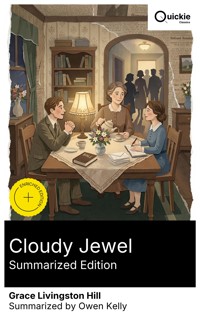
Cloudy Jewel (1920) follows Julia Cloud, a self-effacing, middle-aged woman who, released from years of dutiful caregiving, accepts her college-age niece Leslie and nephew Allison's invitation to keep house in a university town. There she crafts an open, orderly home whose warmth quietly reshapes student life: hospitality tames frivolity, tact answers cynicism, and faith anchors purpose. Hill's sentimental realism and brisk, episodic plotting serve a distinctly didactic aim, while witty dialogue and domestic detail enliven the scenes. The affectionate nickname "Cloudy Jewel" (Cloud by name, jewel by character) signals the novel's valuation of unshowy moral radiance. Grace Livingston Hill (1865–1947), a prolific architect of American inspirational romance, wrote from a devout Protestant milieu shaped by Sunday-school periodicals and Chautauqua reading culture. Supporting family through her pen, she cultivated fiction as gentle evangelism: familiar settings, clean courtship, and conversions embedded in everyday choices. Her sensitivity to women's constrained opportunities and to post–World War I anxieties about modern youth animate Julia Cloud's vocation, locating spiritual leadership in domestic stewardship and neighborly service rather than pulpit or platform. Recommended for readers of classic Christian fiction and scholars of domestic modernity, Cloudy Jewel offers a poised, humane defense of purposeful home-making amid social change. Quickie Classics summarizes timeless works with precision, preserving the author's voice and keeping the prose clear, fast, and readable—distilled, never diluted. Enriched Edition extras: Introduction · Synopsis · Historical Context · Brief Analysis · 4 Reflection Q&As · Editorial Footnotes.
Das E-Book können Sie in Legimi-Apps oder einer beliebigen App lesen, die das folgende Format unterstützen:
Veröffentlichungsjahr: 2026
Ähnliche















Cloudy Jewel (Summarized Edition)
Table of Contents
Introduction
At the heart of Cloudy Jewel lies the quiet revolution of a woman who learns that service, when freely chosen, becomes freedom. Grace Livingston Hill’s novel, set in early twentieth-century America, blends domestic fiction with Christian inspirational romance, unfolding among small-town parlors and a lively college community. First published in the early 1920s, it reflects Hill’s gift for locating spiritual stakes in ordinary routines and relationships. The narrative focuses less on grand events than on the formation of character through choices made at the breakfast table, on errands, and in the home. Within this intimate canvas, the book frames everyday life as a field for courage, loyalty, and love.
Grace Livingston Hill was one of the twentieth century’s most widely read authors of inspirational fiction, and Cloudy Jewel occupies a representative place in her body of work. Written for readers who valued clean romance, moral clarity, and practical faith, the novel meets its audience with steady warmth rather than melodrama. Its early twentieth-century context informs details of etiquette, transportation, and social expectation, yet the prose remains accessible. Hill’s scenes move quickly, her dialogue frank and earnest, her descriptions attentive to the comforts and frictions of shared living. The result is a period piece that still reads with surprising immediacy.
At the story’s outset, Julia Cloud emerges from years of unheralded caregiving into a season of uncertainty, only to be confronted with an unexpected invitation. Her college-age niece and nephew ask her to make a new life with them in a town near their studies, keeping house and guiding them as they step into adulthood. Accepting means leaving familiar routines, facing community scrutiny, and rediscovering herself beyond duty. From this simple beginning, the book builds a home-centered narrative in which meals, study hours, and small gatherings become the setting for growth, joy, and gentle adventure.
Cloudy Jewel treats homemaking not as drudgery but as a creative, ethical vocation, where order and beauty are expressions of care. Education matters, yet the novel prizes character as the true curriculum, measuring success by integrity rather than applause. Intergenerational friendship becomes a two-way street: the young learn steadiness; the older protagonist recovers courage, curiosity, and delight. Again and again, choices arise between convenience and conviction, popularity and kindness, hurry and presence. In charting those choices, Hill argues that a well-tended home can become a workshop of justice, hospitality, and hope.
Readers can expect an inviting mix of domestic detail, college-town bustle, and quietly romantic undercurrents. Hill’s third-person narration privileges interior resolve over spectacle, allowing tension to gather around social misunderstandings, financial pressures, and the testing of loyalties. Humor lightens conflicts, and sincere affection threads through conversations at the hearth and on campus walks. Without dwelling on darkness, the story acknowledges fatigue, loneliness, and the temptation to settle for less than the good. Its emotional register is steady and reassuring, making the novel ideal for readers who relish character-driven arcs and the comforts of everyday heroism.
While explicitly shaped by Christian conviction, the book emphasizes embodiment over abstraction: prayer, yes, but also punctuality, thrift, fairness, and welcome. Julia’s moral imagination is not strident; it is practical and contagious, inviting the people around her into rhythms that honor dignity. Hill’s style is clear and decorous, suited to family reading, with a cadence that invites unhurried reflection. The affectionate nickname suggested by the title gestures to a transformation the narrative explores with restraint, linking patience and brightness in a single life. As the pages turn, readers witness belief translated into habit, habit into culture, and culture into belonging.
For contemporary readers, Cloudy Jewel offers a template for reimagining purpose in midlife, for resisting burnout by transforming obligation into chosen care, and for building community in fractured times. Its emphasis on hospitality speaks to dorm rooms, apartments, and neighborhoods where welcome can still change a day. Its portrayal of mentorship and mutual respect resonates across generations, and its celebration of modest, sustainable rhythms counters pressure to hustle endlessly. As a landmark of inspirational romance and domestic fiction, the novel rewards both nostalgic comfort-seeking and serious ethical reading. Above all, it invites us to see home as a brave, generative act.
Synopsis
Cloudy Jewel, a novel by Grace Livingston Hill published in the early twentieth century, follows Julia Cloud, a middle-aged woman whose life has been shaped by years of quiet duty. After long service caring for an infirm parent, she faces bereavement and an uncertain future. Hill frames Julia not as a martyr but as a person of latent strength, poised between resignation and renewal. The story sets its stakes in the ordinary: livelihood, a roof to call her own, and the hope that everyday kindness can become purpose. From these modest beginnings, the narrative opens a path for transformation within a distinctly American, small-town milieu.
In the wake of loss, a domineering relative assumes Julia will again subsume her life to household drudgery. Instead, an unexpected invitation arrives from two young relatives newly in need of a home: they ask her to become their guardian and establish a residence near the college they plan to attend. The offer promises wages, respect, and companionship, along with a chance to shape a fresh start. Julia accepts, exchanging a pattern of unthanked toil for purposeful stewardship. The move to a college town sets the stage for encounters with youthful ambition, social expectations, and the practical demands of building a well-ordered home.
As the new household takes form, Hill emphasizes details of hospitality, thrift, and beauty that mirror Julia’s character. She crafts routines that support study without stifling joy, guiding her charges toward conduct that is principled rather than fashionable. Their home becomes a gathering place marked by warmth instead of extravagance, where music, conversation, and simple meals create community. The affectionate nickname Cloudy Jewel reflects how her steadiness and grace shine through an outwardly modest life. Within this sphere, the young people test independence, cultivating friendships and facing choices about leisure, loyalty, and reputation while Julia models a balanced, conscientious faith.
The college environment brings temptations and hierarchies that challenge the values of the new home. Parties, clubs, and rivalries invite conformity, while gossip and snobbery probe for weaknesses. Julia respects ambition yet questions the cost of belonging when it erodes character or excludes the vulnerable. Tensions with extended family intensify as those who once directed her choices resent her emerging autonomy. Through conversations and quiet decisions, she teaches discernment: how to decline invitations without bitterness, how to welcome outsiders without courting scandal, and how to hold fast to standards that protect scholarship, health, and mutual regard amid a competitive social scene.
Events inside and beyond the campus test these ideals. Illness, academic pressure, and moments of peril draw neighbors together and expose the difference between shallow amusement and self-giving friendship. The household responds with practical aid—meals, shelter, and steady presence—turning hospitality into a lifeline for classmates and townspeople alike. Hill uses these episodes to show character under strain and to trace how a well-governed home can ripple outward, influencing conduct more effectively than lectures. Challenges emerge that require courage and moral clarity, yet the narrative keeps attention on everyday faithfulness, suggesting that small acts of constancy can meet crises when they arrive.
Julia’s interior journey deepens as she weighs how much of herself to give and what future to claim. Work that begins as duty becomes vocation, restoring dignity after years of neglect. Visitors and colleagues recognize her gifts, and a guarded openness to companionship surfaces without overwhelming the central thread of family life. The young people under her care likewise grow beyond self-focus, grappling with vocation, stewardship of resources, and the cost of integrity in friendship and romance. Their choices, and Julia’s steady counsel, move the plot toward resolution while leaving room for providence to work in unexpected, quietly transformative ways.
Within Grace Livingston Hill’s body of inspirational fiction, Cloudy Jewel illustrates how the ordinary spaces of home and school can become arenas for moral imagination. The novel resists cynicism, proposing that an overlooked woman’s patience, competence, and faith can recalibrate a community more lastingly than prestige or wealth. Without relying on sensational turns, it sustains interest through character, setting, and the constant question of what makes a life well spent. Readers drawn to themes of caregiving, chosen family, and formation will find an enduring resonance in its closing pages, which affirm hope while preserving the privacy of the characters’ final steps.
Historical Context
Cloudy Jewel, published in the United States in 1920 by Grace Livingston Hill (1865-1947), is set in contemporary American small-town and college environments. Hill, a prolific author of evangelical Protestant fiction, wrote for a wide middle-class readership and favored plots in which domestic life and personal faith guide choices. The story centers on an unmarried woman who becomes caretaker for college-bound relatives, establishing a home that interacts closely with church and campus. Appearing just after World War I, the novel situates its characters amid institutions prominent in the period - household, congregation, and university - and expresses the era’s search for stability, moral clarity, and purposeful community.
Composed in the immediate aftermath of World War I, the book’s world reflects the United States’ turbulent shift from wartime mobilization to peace in 1919-1920. Demobilization disrupted families and local economies, and the 1918-1919 influenza pandemic left communities focused on health, duty, and mutual care. Churches and voluntary associations became centers of support, organizing relief and social programs. In this climate, narratives that rebuild household routines and emphasize dependable character resonated strongly. The novel’s stress on steadiness, thrift, and neighborly responsibility mirrors the broader cultural desire to restore order, while acknowledging that young adults faced new freedoms, temptations, and expectations in the postwar years.
Higher education expanded rapidly in the early twentieth century, and by 1920 coeducational colleges and state universities enrolled unprecedented numbers of students. Deans of women, student handbooks, honor systems, and residence rules formalized campus life, while fraternities, sororities, and athletic associations shaped student identity. The YMCA and YWCA maintained active chapters, and the Student Volunteer Movement linked faith with service and missions. Fraternity and dormitory 'house mothers' or chaperones became common in the 1910s, reflecting anxieties about propriety and guidance. Cloudy Jewel’s attention to a home established near a college, where an older guardian guides younger scholars, aligns closely with these institutional developments.
The 1920 ratification of the Nineteenth Amendment, granting women suffrage nationwide, crowned decades of Progressive Era activism that also expanded women’s roles in education, work, and civic reform. The period’s 'New Woman' pursued training and employment, yet a powerful maternalist ideal valorized caregiving labor in homes, churches, and schools. Single women frequently served as teachers, office workers, and supervisors of social programs. Hill’s portrayal of an unmarried woman exercising moral authority within a household and community reflects this environment: it affirms women’s public responsibility while grounding leadership in nurturing, service, and respectability, consistent with mainstream Protestant middle-class expectations in the late 1910s and early 1920s.
Religious life in the United States was marked by vigorous evangelical activity alongside debates over modern theology. The publication of The Fundamentals (1910-1915) and rising Bible institutes signaled a confident conservative Protestantism, while Social Gospel advocates emphasized reform and community service. Campus ministries, Sunday schools, and Christian Endeavor societies fostered youth piety and volunteerism. Grace Livingston Hill, raised in a devout Presbyterian milieu and related to popular Christian author Isabella Macdonald Alden ('Pansy'), wrote fiction that foregrounded prayer, scripture, and ethical discipline. Cloudy Jewel’s moral framework - favoring personal conversion, sober habits, and charitable outreach - echoes the emphases common in evangelical circles of its time.
Temperance shaped American culture for decades and culminated in national Prohibition: the Eighteenth Amendment was ratified in 1919, and the Volstead Act took effect in January 1920. Universities and civic groups worried about alcohol’s influence on youth, and many institutions enforced strict conduct codes. Advice literature warned against dances, late-night entertainments, and unsupervised parties thought to encourage drinking. Hill’s narrative reflects this milieu by underscoring sobriety, wholesome recreation, and accountable companionship. The characters’ choices unfold within a legal and social environment that officially banned liquor yet still confronted its temptations, giving the novel’s cautionary tone a concrete historical resonance for readers in 1920.
Daily life in 1920 America was transformed by technology and consumer goods that broadened mobility and leisure. Mass-produced automobiles, especially the Ford Model T, enabled trips between town and campus, church events, and charitable errands. Telephones, electric lighting, and department-store catalogues reshaped communication and domestic management, while the 1920 census recorded, for the first time, a majority urban population. Such changes intensified generational debates over speed, fashion, and propriety. Cloudy Jewel situates its household amid these conveniences and pressures, using practical hospitality, careful budgeting, and purposeful travel to model an orderly response to modernity without renouncing the period’s useful innovations.
The novel also belongs to a thriving publishing landscape that brought moral fiction to broad audiences through public libraries, church libraries, and commercial reprints. Hill’s books were widely circulated and marketed as clean, uplifting entertainment suitable for family reading. That reception context matters: readers in 1920 sought stories that could reconcile modern rhythms with inherited faith. Cloudy Jewel answers by presenting domestic stewardship as a stabilizing vocation and by critiquing status-seeking, waste, and peer pressure common in contemporary campus and social scenes. Without rejecting progress, it commends community service, study, and sober companionship, offering a distinctly early twentieth-century Protestant ideal of flourishing.




