


1,99 €
Mehr erfahren.
- Herausgeber: Quickie Classics
- Kategorie: Abenteuer, Thriller, Horror
- Sprache: Englisch
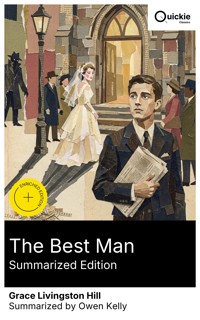
The Best Man fuses courtship with ethical suspense, using the title figure's steady integrity to refract the social expectations of early twentieth-century America. Hill stages parlors and quiet thresholds as sites where promises are tested, reputations threatened, and grace unexpectedly intervenes. Her style is brisk and scene-driven—lucid dialogue, decorous wit, and unembarrassed sentiment—with scriptural allusion folded into action rather than appended as homily. Within evangelical domestic fiction, the novel bridges nineteenth-century sentimentalism and the modern popular romance, registering tensions of class mobility and public piety. Grace Livingston Hill wrote from a devout upbringing and the conviction that narrative could model practical holiness. Mentored by family ties to earlier best-selling religious novelists and, at times, writing from economic necessity, she honed a craft that weds readability to moral clarity; this tale exemplifies her method of conversion by character, where patience, kindness, and courage quietly persuade. Recommended for readers of faith-suffused romance, students of American women's writing, and book clubs seeking clean yet textured storytelling, The Best Man offers gentle suspense, an upright hero, and a community reoriented by grace—an enduring study in conscience rendered with accessible charm. Quickie Classics summarizes timeless works with precision, preserving the author's voice and keeping the prose clear, fast, and readable—distilled, never diluted. Enriched Edition extras: Introduction · Synopsis · Historical Context · Brief Analysis · 4 Reflection Q&As · Editorial Footnotes.
Das E-Book können Sie in Legimi-Apps oder einer beliebigen App lesen, die das folgende Format unterstützen:
Veröffentlichungsjahr: 2026
Ähnliche




The Best Man (Summarized Edition)
Table of Contents
Introduction
When obligation collides with conscience, only character can decide the course of a heart. Grace Livingston Hill’s The Best Man is an inspirational romance set in the early twentieth-century United States. Hill, a prolific writer of uplifting fiction, uses this story to test ideals against public expectation and private duty. The title itself suggests both a ceremonial role and an ethical aspiration, prompting reflection on what it means to become one’s best self. The following pages offer a spoiler-safe orientation to the novel’s premise, voice, and themes, and explain why this gentle yet searching book continues to invite thoughtful readers.
It opens in a moment of ceremony and expectation, and swiftly brings into view a principled man and a young woman whose choices ripple through their families and community. Hill frames their intersecting paths with decorous manners, brisk scenes, and a clear moral center, so that tension arises from conscience and commitment rather than cynicism. The reading experience is warm, earnest, and gently suspenseful, with dialogue that carries much of the movement and observation that grounds each turn. Without spilling secrets, it is enough to say that a public occasion sets private tests, and that courage finds its proving in kindness.
At the heart of the novel lies the struggle to choose integrity over convenience, a contest staged against the subtleties of reputation and the claims of affection. Hill’s characters weigh duty, trust, and the stewardship of influence, discovering that compassion can be as exacting as bravery. Faith functions not as ornament but as a compass, orienting decisions in quiet, practical ways that shape the course of relationships. The story draws meaning from small acts—apologies, promises, and timely help—so that growth feels earned rather than contrived. The idea of the best man becomes an aspiration open to every person, not merely a role.
In craft, Hill favors clarity and momentum. Scenes move with economical description toward decisive conversations, while carefully chosen details of dress, rooms, and schedules fix the action in a recognizable social world. Secondary figures—friends, relatives, and authority figures—function as foils and mirrors, pressing the protagonists to articulate their values. The prose is decorous and sympathetic, avoiding sensationalism in favor of steady moral inquiry and tender humor. Suspense arises from ethical pressure points rather than danger for its own sake, keeping the focus on interior resolve. The result is a narrative that feels accessible yet searching, comfortingly traditional yet genuinely engaged.
The setting is the fabric of early-twentieth-century American life, where social rituals and expectations structure daily choices and public perception matters. Courtship customs, family responsibilities, and community networks form the backdrop against which moral action becomes visible. Hill acknowledges the constraints of the era even as she affirms personal agency, allowing characters to navigate convention without surrendering conviction. Domestic interiors and shared spaces—parlors and public places—anchor the drama in recognizable rhythms. The result is a portrait of a society in which civility is a language of care, and where the smallest courtesies can shelter real courage, compassion, and change.
For contemporary readers, the book offers both moral clarity and humane nuance, inviting reflection on integrity under pressure in an age that still prizes appearances. Its gentle romance models attentiveness, respect, and patience, pushing back against the speed and spectacle that often shape modern relationships. The emphasis on community—neighbors who notice, friends who intervene, mentors who counsel—suggests that character is cultivated together. Readers who value faith-informed storytelling will find a sincere spiritual thread; readers new to that tradition can appreciate its ethical questions and emotional intelligence. In either case, the novel becomes a quiet companion for thinking about courage, kindness, and responsibility.
Approach The Best Man as both a comfort read and a serious inquiry, expecting tenderness rather than shock, steady stakes rather than spectacle, and an undercurrent of spiritual purpose. Hill’s narrative rewards patient attention to small turns of thought and feeling, where a single decision or generous word can redirect a future. The book exemplifies early twentieth-century inspirational romance while also offering a compact study in how character is made. Without revealing outcomes, it is fair to say the journey favors honesty, humility, and hope. To read it now is to watch ordinary people reach, with grace, toward their best selves.
Synopsis
Grace Livingston Hill’s The Best Man opens within the stir of an early‑twentieth‑century social season, where a much‑watched wedding gathers families, friends, and the watchful public. Amid elegant trappings, Hill sketches a contrast between outward polish and inward principle, introducing a conscientious young man asked to stand as best man and a young woman whose circle prizes appearance. The occasion becomes a lens for Hill’s recurring question: what does it mean to choose well—in friendship, allegiance, and faith—when society pushes toward spectacle? The stage is set for a test of character that will ripple far beyond the festivity’s gilded surface.
On the wedding day, an unforeseen disturbance unsettles the carefully arranged ceremony, casting uncertainty over roles, loyalties, and reputations. In the confusion, the best man’s steady presence proves quietly decisive, a humane counterpoint to panic and gossip. The incident does not resolve neatly; rather, it initiates a reckoning. The heroine, caught between social expectations and conscience, must measure glitter against goodness. Hill keeps the narrative close to human reactions—small choices, quick judgments, and afterthoughts—using the aftermath to begin separating those who protect truth from those who exploit sensation. Subtly, respect grows where mere admiration once stood.
In the days that follow, Hill turns from spectacle to consequence. Drawing rooms hum with conjecture, while letters and visits thicken the web of half‑truths. The best man, unassuming yet purposeful, attends to practical matters others overlook: quiet inquiries, courtesy extended to the distressed, and a refusal to traffic in rumor. The heroine’s world, alert to status, struggles to metabolize uncertainty, and familial counsel runs along two lines—one urging swift retreat into appearances, the other urging patient integrity. Hill threads spiritual reflection through the social swirl, suggesting that the heart’s orientation will determine whose version of events endures.
Midway, the novel emphasizes discernment. Clues emerge not as thriller set pieces but as moral indicators: who keeps confidences, who tells partial stories, who bears inconvenience for the sake of right. A few friendships fray under strain; others deepen through shared restraint and service. The best man’s approach—practical, compassionate, and untheatrical—becomes a quietly radical witness against the era’s haste and display. Guidance arrives through Scripture read, prayers offered, and counsel from steady elders, and the heroine begins to identify the difference between admiration for charm and trust in character. The plot advances through decisions that reveal inward allegiances.
As trust takes root, Hill lets affection grow in ordinary settings—errands, conversations, and acts of neighborly help—rather than in grand declarations. The heroine weighs counsel given for her “good name” against the surer ground of truth lived consistently. Misunderstandings flare and subside, each testing the resolve to choose clarity over comfortable silence. The best man’s constancy becomes an interpretive key, demonstrating that love’s strength lies in reliability, not spectacle. Hill keeps outcomes withheld, yet she signals the direction of change: a shift from self‑protection toward mutual responsibility, and from borrowed opinions toward convictions the heart can carry into the open.
Approaching the climax, the narrative demands a visible stand. The cost is real: public acknowledgment, the possibility of lost favor, and the risk that patience will seem like weakness. Hill orchestrates a setting where motives must be named and half‑truths yield to daylight. Without revealing the novel’s final turns, the crucial movement rests on choosing to act with transparent integrity, even when it threatens comfort. Vindication, where it comes, is less triumphal than restorative, re‑threading relationships on sturdier lines. The resolution points away from spectacle toward service, suggesting that the best safeguard for reputation is the habit of truth.
The Best Man endures for its clear portrait of character under pressure and its gentle insistence that faith can guide modern dilemmas without withdrawal from the world. Hill reframes the title as more than a wedding role: it becomes a measure of manhood and, by extension, of partnership worthy of trust. By setting spiritual steadiness against social turbulence, the book offers readers a spoiler‑safe assurance—that the choices made in quiet, ordinary moments shape public outcomes. Its resonance lies in affirming that goodness is not a pose but a practice, and that the heart, trained to serve, becomes fit to love.
Historical Context
Grace Livingston Hill, a prolific American author of inspirational romances, wrote The Best Man during the Progressive Era, when U.S. society was grappling with rapid urban growth, reform politics, and shifting social norms. Her readership spanned Protestant, middle-class audiences who sought clean fiction that reaffirmed faith and propriety. Hill's family ties to evangelical publishing—most notably her aunt, the popular writer Isabella Macdonald Alden (known as Pansy)—and her own experience writing for religious periodicals shaped her emphasis on moral choice. The novel entered a booming mass-market book trade served by department stores and lending libraries, where affordable hardcovers and reprints circulated widely to household readers.
Set in early twentieth-century America, the story moves within recognizable middle-class institutions: Protestant churches, colleges, business offices, and well-ordered homes in cities and their suburbs. This was an era when professional careers in law, medicine, and commerce expanded, and respectable conduct in public and private life carried real social consequences. Rail depots, hotel parlors, and church corridors functioned as venues for introductions and negotiations, governed by etiquette manuals and community oversight. The narrative's emphasis on reputation, promise-keeping, and family expectation reflects a culture that prized reliability and discernment amid mobility, where a good name could advance opportunity as surely as money or schooling.
Weddings in this period were public rites of respectability, frequently held in churches and reported in local society pages with detail about attire, attendants, and guest lists. The best man role, inherited from Anglo-American custom, carried clear duties: safeguarding the ring, organizing logistics, and serving as the groom's trusted witness. Engagement rings, formal announcements, and published gift lists had become common among the urban middle class, reinforcing networks of kin and class. These conventions formed a shared social script for courtship and marriage that readers of the time instantly recognized, and the novel's title invokes that framework to examine loyalty and honor without resorting to sensationalism.




