


1,99 €
Mehr erfahren.
- Herausgeber: Quickie Classics
- Kategorie: Gesellschafts- und Liebesromane
- Sprache: Englisch
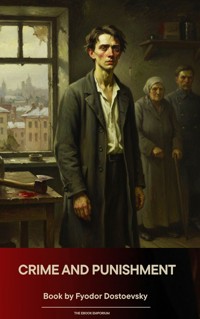
Crime and Punishment tracks the moral and psychological fallout of a murder by Rodion Raskolnikov, a destitute ex-student in squalid Petersburg. Combining fevered interior monologue with dialogic countervoices, Dostoevsky sets a detective frame around a philosophical drama of nihilism, the 'extraordinary man' theory, and redemption through suffering. Serialized urgency tightens the city's claustrophobic spaces—garrets, taverns, Porfiry's interrogations—while Sonya's Gospel reading reframes guilt as a summons to spiritual rebirth. Written in 1866 amid crushing debts and the pressures of magazine serialization, the book bears the imprint of Dostoevsky's biography. His arrest, mock execution, and years in a Siberian penal settlement furnished firsthand knowledge of crime, punishment, and faith, informing his skepticism toward Western rationalism and his probing of conscience, freedom, and moral law. This is indispensable for readers of psychological fiction and moral philosophy, as well as students of law and urban history. Approach it for its taut suspense and crystalline scenes; stay for its unsettling, clarifying vision of responsibility, compassion, and the possibility—hard-won—of redemption. Quickie Classics summarizes timeless works with precision, preserving the author's voice and keeping the prose clear, fast, and readable—distilled, never diluted. Enriched Edition extras: Introduction · Synopsis · Historical Context · Author Biography · Brief Analysis · 4 Reflection Q&As · Editorial Footnotes.
Das E-Book können Sie in Legimi-Apps oder einer beliebigen App lesen, die das folgende Format unterstützen:
Veröffentlichungsjahr: 2026
Ähnliche







Crime and Punishment (Summarized Edition)
Table of Contents
Introduction
At the heart of Fyodor Dostoevsky’s Crime and Punishment lies the collision between an abstract idea that seeks to justify transgression and the stubborn, embodied call of conscience, where cold calculations about human worth crash against the irreducible presence of another life, forcing the would-be thinker, the city that surrounds him, and the reader who follows his steps to reckon with whether any principle, however brilliant or benevolent it may claim to be, can ever erase the wounds it permits, the responsibilities it evades, or the inner voice that refuses to be argued out of its knowledge of right and wrong, and what it means to live in a society where suffering is visible, coins are scarce, rooms are airless, and excuses are plentiful.
Crime and Punishment is a psychological novel of moral inquiry set in St. Petersburg and first published in 1866, serialized in The Russian Messenger during a period of intense social and intellectual ferment in the Russian Empire. With its cramped apartments, crowded streets, and oppressive summer heat, the city forms a pressurized backdrop for a narrative that blends elements of crime fiction with philosophical drama. Dostoevsky’s focus is not the machinery of detection alone, but the inner weather of a mind wrestling with principles and consequences. The result is a work that bridges realism and psychological exploration while maintaining the propulsion of a tense urban story.
The premise follows a brilliant yet impoverished former student, Rodion Raskolnikov, who isolates himself as he develops a theory that tests the limits of moral law. In the novel’s early stages, he contemplates crossing a boundary that most consider inviolate, and an impulsive, violent act soon binds his ideas to the realities they ignore. What follows is not a whodunit but a how-to-live-with-it: feverish days, fractured nights, and a spiraling effort to outthink an ache that will not be quiet. The reading experience is suspenseful and intimate, an immersion in doubt, rationalization, and the search for solid ground.
Dostoevsky writes in a close third person that presses into Raskolnikov’s agitated mind, while surrounding him with voices that challenge, echo, or distort his thought. The prose moves from clipped, tense exchanges to hallucinatory interior scenes, making the city’s stairwells, marketplaces, and taverns feel like extensions of a mind under strain. Conversations are charged with subtext; seemingly casual encounters become probes into motive and character. The tonal range is striking: austere analysis yields to pity, irony to dread, tenderness to sudden panic. This shifting register sustains momentum while inviting readers to test each claim against lived experience.
Key themes include the tension between utilitarian reasoning and human empathy, the moral weight of conscience, and the question of whether punishment arises from courts, communities, or the self. The novel scrutinizes poverty and social fracture, showing how material desperation and loneliness can harden theory into action. It examines pride and self-justification, the lure of exceptionalism, and the fragile dignity of those trying to survive. It also considers the limits of legal judgment compared with the unrelenting pressure of remorse. Throughout, Dostoevsky asks what justice requires and whether redemption is imaginable within ordinary, compromised life.
For contemporary readers, the book remains urgent because its conflicts recur in new forms: arguments that ends justify means, the dehumanizing drift of ideological certainty, and life in cities where inequality and anonymity allow people to pass each other as abstractions. Its psychological portrait anticipates discussions of mental health, shame, and the narratives we create to excuse or confront harm. It probes how institutions uphold order and where they fail, and why empathy is not a luxury but a counterforce to cruelty. In a world of quick rationales and polarized debates, the novel invites slower, more demanding self-scrutiny.
Approaching Crime and Punishment today means entering a claustrophobic moral laboratory and letting its questions work on you. Expect a story at once propulsive and reflective, alternating urgency with deliberation as it follows a mind attempting to outargue its own humanity. The book’s power lies in its refusal to settle for easy answers, insisting instead on the complexity of motive and the cost of harm. In tracing the distance between what we can rationalize and what we can live with, Dostoevsky offers not a lesson but a reckoning, one that still illuminates the stakes of choice, responsibility, and fellow feeling.
Synopsis
Crime and Punishment, serialized in 1866 in The Russian Messenger, is Fyodor Dostoevsky’s intense study of crime, conscience, and moral responsibility set in St. Petersburg. The novel centers on Rodion Romanovich Raskolnikov, an impoverished former student whose ideas and circumstances press upon him in a cramped, oppressive city. He is bright and proud, yet withdrawn, nursing a theory about exceptional individuals and the boundaries of law and morality. The atmosphere of poverty, summer heat, and urban crowds amplifies his inner turmoil. Dostoevsky frames a narrative that moves from outward deprivation to inward crisis, tracing how an abstract idea collides with lived experience and human suffering.
Raskolnikov’s isolation hardens into a radical proposition: that some people may be justified in overstepping moral laws for a purported greater good. Fixating on a pawnbroker he deems harmful, he weighs a desperate act as both economic relief and philosophical test. Meanwhile he encounters Marmeladov, a civil servant broken by addiction, whose family’s destitution—especially that of his stepdaughter, Sofya (Sonya)—deepens the novel’s social canvas. Raskolnikov’s loyal friend Razumikhin offers warmth and practical help, while letters from his mother, Pulcheria Alexandrovna, announce the arrival of his sister, Avdotya Romanovna (Dunya), engaged to the calculating Peter Petrovich Luzhin.
Raskolnikov’s speculation turns into action. After rehearsing a plan and arming himself, he visits the pawnbroker under a pretext and kills her. The crime spirals when an unexpected witness enters, forcing another fatal blow and a frantic escape. The episode, depicted without sensationalism, inaugurates the novel’s central arc: the psychological aftermath rather than the mechanics of the deed. Shocked by what he has done, Raskolnikov stashes what he has taken and recoils from using it, as if material gain cannot touch the inner fracture now opened. From this point forward, the narrative tightens around fear, fever, and the search for moral footing.
Illness follows, and Raskolnikov lapses into delirium. Razumikhin nurses him with stubborn care, trying to rebuild ordinary routines. Raskolnikov’s mother and sister arrive, bringing family tensions and the looming figure of Luzhin, whose proposal to Dunya mixes ambition with condescension. Drawn to the police station by a trivial summons, Raskolnikov overhears talk of the murders and betrays agitation that he cannot fully hide. The city’s chatter, official inquiries, and his own erratic behavior weave a net both external and internal. Dostoevsky stages a conflict between surface normalcy and fraying composure, as chance encounters and small pressures steadily magnify suspense.
Porfiry Petrovich, the examining magistrate, emerges as a wry, probing intellect who prefers conversation to handcuffs. He has read an article Raskolnikov once published on crime and extraordinary individuals and uses it to draw out the younger man’s views. Their exchanges are layered with irony, sympathy, and hidden thrusts, turning the investigation into a battle of ideas and psychological endurance. Meanwhile, rumor and misdirection cloud the case: another man falls under suspicion, and the city supplies false leads and morbid fascination. The question becomes not merely who committed the crime, but what a guilty mind reveals through its evasions, rationalizations, and sudden flashes of anger.
The Marmeladov family’s plight intensifies the novel’s moral frame. After a fatal accident deepens their hardship, Raskolnikov brings help and meets Sonya more closely. She sustains her household through humiliating means yet preserves a quiet compassion and religious resolve. In her small room, conversations between them juxtapose his cold logic with her humility and endurance. She does not argue law; she embodies conscience. Through Sonya, Dostoevsky introduces a countercurrent to Raskolnikov’s theory—an ethic grounded in shared suffering and the possibility of redemption—without delivering answers, only sharper questions about responsibility, dignity, and the cost of separating principle from human life.
Around Dunya, new antagonisms gather. Luzhin seeks to bind her future to his advantage and resents Raskolnikov’s influence. In a sordid episode, he attempts to compromise Sonya’s reputation to elevate his own, revealing the social manipulations that accompany moral pretense. Another figure, Arkady Ivanovich Svidrigailov, Dunya’s former employer, reenters with troubling charisma and ambiguous aims. He operates in moral gray zones, neither simple villain nor reformer, and hints at knowledge that could unsettle multiple lives. With Luzhin’s self-interest and Svidrigailov’s unsettling freedom, the novel presents alternative paths for power, desire, and conscience, each reflecting Raskolnikov’s inner divide in distorted mirrors.
Pressure mounts as Porfiry’s interviews grow subtler and the city’s rumors louder. Raskolnikov wavers between defiance and an acute awareness of suffering—his own and others’. Razumikhin’s steadfast friendship offers a fragile tether to ordinary life, while Sonya’s presence points toward compassion and a difficult honesty. The intellectual duel with Porfiry becomes a moral one: is crime a matter of cleverness and nerve, or a wound that cannot be outreasoned? Dostoevsky amplifies the claustrophobia of rooms, streets, and stairwells as choices narrow. The narrative moves toward a reckoning that promises neither escape through brilliance nor comfort in denial.
Without disclosing final turns, the novel concludes its arc by confronting the limits of rational justification and the demands of conscience. Crime and Punishment endures for its fusion of suspense with psychological depth, its portrait of urban poverty, and its exploration of guilt, empathy, and responsibility. Raskolnikov’s ordeal reframes a philosophical thought experiment as a lived crisis, testing whether human beings can sever moral law from human connection. In its careful attention to suffering and the possibility of change, the book invites readers to weigh intellect against compassion and to consider what true accountability might require in both private and public life.
Historical Context
Crime and Punishment emerged in the Russian Empire during the 1860s, when St. Petersburg functioned as imperial capital and nerve center of bureaucracy, policing, and higher education. The city’s ministries, courts, and police districts answered to the autocracy of Tsar Alexander II, while the Russian Orthodox Church framed public morality and ritual. St. Petersburg University and other institutions trained a new generation of students drawn from diverse social origins. Thick literary journals mediated public debate under censorship that had eased somewhat since 1855. Within this milieu, urban neighborhoods of lodging houses, taverns, workshops, and pawnshops concentrated poverty, ambition, and surveillance.
After Russia’s defeat in the Crimean War, Alexander II launched the Great Reforms. The Emancipation of the Serfs in 1861 ended legal bondage for millions, prompting migration to towns and redefining obligations, property, and status. The judicial reform of 1864 introduced public trials, jury courts, independent judges, and examining magistrates, aiming to curb arbitrary police authority. Zemstvo councils, also in 1864, extended local self-government in many provinces. Although unevenly implemented, these changes altered daily encounters with law and authority. The novel’s attention to interrogation, legality, and moral responsibility reflects a culture adjusting to new procedures, sanctions, and ideas of justice.
St. Petersburg’s rapid growth filled subdivided apartments and attics with clerks, students, tradespeople, and the unemployed. Internal passport rules constrained movement, yet the city drew former serfs, provincial artisans, and migrants seeking wages. Low-paid piecework, casual labor, and small loans from pawnbrokers or moneylenders sustained precarious lives. The imperial state regulated taverns and alcohol revenues; drink remained a visible social reality. Since 1843, prostitution was legally regulated through the “yellow ticket,” marking registered women and shaping how police and society treated them. Crowded courtyards, stairwells, and night streets created intimate proximity between respectability and destitution, opportunity and crime.
Mid-century Russian intellectual life was polarized. Westernizers looked to European science and liberal institutions; Slavophiles emphasized Orthodoxy and communal traditions. After 1860, a radical current labeled “nihilism” rejected inherited authority, championing materialism and utility. Nikolai Chernyshevsky’s novel What Is to Be Done? (1863) imagined rational self-interest reorganizing society, while Dmitry Pisarev celebrated scientific clarity over romanticism. Utilitarian ethics from Bentham and Mill, filtered through Russian critics, infused debates about whether ends justify means. Turgenev’s Fathers and Sons (1862) popularized the generational conflict. Dostoevsky wrote within—and against—these polemics, questioning doctrines that measured human worth by calculation or social utility.
Fyodor Dostoevsky’s experiences gave him unusual authority on punishment and conscience. Arrested in 1849 for involvement with the Petrashevsky Circle, he endured a staged execution and four years of penal servitude in Omsk, followed by military exile in Semipalatinsk. The ordeal deepened his concern with suffering, faith, and the state. Returning to literary life, he traveled to Western Europe in 1862–1863, critiquing European rationalism and socialism in his essays. Personal losses in 1864 and chronic debts pressed him to write quickly. Crime and Punishment appeared in 1866 in the Russian Messenger, edited by Mikhail Katkov; Anna Snitkina assisted as stenographer.
University life in the early 1860s was turbulent. Student protests in 1861 over fees, dormitory rules, and police interference led to closures and arrests in St. Petersburg and Moscow. In 1862, suspicious city fires intensified official anxiety about radical networks, and the Third Section expanded surveillance. Censorship relaxed after 1855 but remained unpredictable, pushing writers to argue indirectly through character and plot. Many students from modest backgrounds, the raznochintsy, straddled classes, relying on stipends, tutoring, and lodgings on credit. Their precarious status, contact with polemical journals, and exposure to urban misery formed a recognizable social type in the novel’s milieu.
Public fascination with celebrated trials and European feuilletons about crime fed discussions of motive and responsibility. The new Russian courts popularized legal rhetoric accessible to ordinary readers, while newspapers reported investigations in vivid detail. Moral inquiry also drew on European biographies of conquerors and statesmen; Napoleon’s career remained a touchstone in Russia, often invoked to debate whether “great” individuals stand outside conventional morality. Dostoevsky scrutinized such arguments, contrasting legal guilt with inner judgment and redemption. His city’s stairwells, police offices, and courtrooms provided concrete arenas where ideology met institutional process, and where poverty sharpened ethical and psychological questions.
Crime and Punishment thus belongs to a moment of accelerated reform, migration, and ideological contest in imperial Russia. It situates a young intellectual amid St. Petersburg’s cramped rooms, regulated vices, and reconfigured legal order, testing doctrines that promised liberation through reason or social engineering. The novel’s preoccupation with debt, humiliation, and inner conflict mirrors the dislocations following emancipation and the uneven promise of equality before the law. By dramatizing conscience against calculation, and community against isolation, it critiques the era’s utilitarian optimism while acknowledging the pressing social realities that produced it, turning contemporary institutions and debates into a moral inquiry.
Author Biography
Fyodor Dostoevsky (1821–1881) was a central figure of nineteenth‑century Russian literature, renowned for probing the moral and psychological extremes of modern life. Writing amid the social ferment of imperial Russia, he explored questions of freedom, conscience, faith, and ideological fanaticism with an intensity that reshaped the novel’s possibilities. His narratives, often set in St. Petersburg’s tenements and courts, depict individuals under pressure—economic, spiritual, and political—while engaging the era’s debates between Westernizing reforms and Slavic traditions. Across novels, novellas, journalism, and notebooks, Dostoevsky forged a distinctive voice that combined philosophical inquiry with dramatic storytelling, leaving a durable imprint on world literature.
Raised in Moscow and educated in St. Petersburg, Dostoevsky trained at the capital’s military engineering school before turning decisively to letters. While studying mathematics and drafting, he read voraciously: Russian classics such as Pushkin and Gogol, European Romantics like Schiller, and French and English realists including Balzac and Dickens. Early translations from French helped him internalize European narrative technique. He moved in literary circles that discussed aesthetics and social questions, interacting with critics around Vissarion Belinsky’s milieu. These experiences, combined with exposure to urban poverty and bureaucratic life, shaped his sense of literature as a forum for ethical and philosophical confrontation.
Dostoevsky’s debut novel, Poor Folk (1846), was greeted as a significant new voice in the tradition of social prose, prompting early acclaim. Subsequent experiments, notably The Double (1846), met mixed reactions but revealed his fascination with divided consciousness. He wrote novellas and stories—among them White Nights (1848) and the unfinished Netochka Nezvanova (begun 1849)—that refined his interest in marginal lives and interior monologue. During this period he attended discussions with the Petrashevsky Circle, a group that debated reformist and utopian ideas. In 1849, he was arrested with other participants, an event that abruptly ended his early St. Petersburg career.
After a staged execution and last‑minute reprieve, Dostoevsky was sentenced to hard labor in Omsk and then to military service in Siberia during the 1850s. Prison life exposed him to convicts from across the empire and to the realities of punishment and redemption under an autocratic system. A copy of the New Testament, permitted in the camp, became central to his spiritual outlook. Living with epilepsy, he observed suffering with heightened empathy and detail. On partial rehabilitation, he returned to letters. Notes from a Dead House (1861–1862) drew on his incarceration, altering Russian views of the penal system and consolidating his reputation.
In the 1860s Dostoevsky co‑edited the journals Vremya and, after its closure by censors, Epoha, using them to publish fiction and commentary. Travel in Western Europe informed Winter Notes on Summer Impressions (1863), a reflective critique of contemporary societies. Notes from Underground (1864) advanced a new antihero, challenging rationalist utopias. Financial crises, compounded by gambling, pressed him into gruelling deadlines. He composed The Gambler (1867) at speed with the help of a stenographer who later became his spouse. Crime and Punishment (1866), serialized to great attention, and The Idiot (1869) deepened his exploration of guilt, compassion, and spiritual aspiration.
The 1870s brought a succession of major novels that engaged Russia’s ideological conflicts. Demons (1871–1872), inspired by revolutionary conspiracies, examines political fanaticism and moral vacuum. The Adolescent (1875) investigates generational uncertainty amid social flux. Alongside fiction, his Diary of a Writer (issued intermittently from 1873 to 1881) combined reportage, polemic, and sketches, turning him into a national interlocutor on law, faith, and public ethics. By the time The Brothers Karamazov (1880) appeared, his authority as a moral thinker and artist was widely recognized. His address at celebrations honoring Pushkin that same year cemented his public stature.
Dostoevsky died in early 1881 in St. Petersburg, having achieved broad readership at home and abroad. Though he struggled with illness and finances for much of his life, the late 1870s brought relative stability and sustained creative focus. His legacy rests on psychological depth, ethical intensity, and dialogic form—what later critics, notably Mikhail Bakhtin, described as novelistic polyphony. Generations of writers and thinkers, from Kafka to Camus and Sartre, and from Nietzsche to Freud, engaged with his work. Continually retranslated and debated, his books remain central to discussions of freedom, responsibility, and the search for meaning in modern society.
Crime and Punishment (Summarized Edition)
Translator’s Preface
Child of a poor, devout doctor, Dostoevsky grew up in cramped quarters with nightly sacred readings. Sickly yet brilliant, he ranked third at Petersburg Engineering and wrote Poor Folk, hailed by Nekrassov. In 1849 he and friends reading Fourier were seized; before rifles he recalled, "They snapped words over our heads… then his Majesty spared us." Siberian hard labour, a battalion, and epilepsy followed. Returning home, he launched Vremya and Epoch, both suppressed; debts forced feverish work, eased only by a devoted second wife. After his rapturous 1880 Pushkin speech, a kingly funeral confirmed the critic’s praise: "He was one of ourselves… he became great.
Part I
Chapter I
On a sweltering July evening a tall, gaunt student slipped from the tiny garret beneath the roof of S. Place and crept toward K. bridge. He had dodged his landlady on the stairs; every descent forced him past her open kitchen, and debt turned each chance meeting into an agony of shame. Poverty itself no longer frightened him—what sickened him was the small talk, the complaints, the required excuses. Better, he thought, to glide past like a cat than endure another interrogation. Wrapped in morbid isolation and near-hypochondria, he now felt dread of any human contact at all.
Once outside, the youth mocked himself. “I dream of daring deeds yet tremble at trifles,” he muttered. Fear, he decided, keeps mankind from taking a new step or uttering a new word. He accused himself of useless chatter, of lying for days in his “den” brooding over fairy-tale giants, of treating his fantasy as a toy. “Am I capable? Is it serious? No, a plaything,” he argued, yet the argument rang hollow. The suffocating street, piled with dust, scaffolding, bricks, and the sour Petersburg stench, gnawed at raw nerves already stretched by two starving, sleepless days.
Handsome in face but clothed in disgraceful tatters, he wandered unseeing through a district so coarse that even his rags drew little notice. Bitterness insulated him from embarrassment—until a drunken carter, jolting past atop a dray, bawled, “Hey, German hatter!” and pointed. He clutched the tall, battered Zimmerman hat, brimless and lopsided, and felt a stab of terror. “I knew it—this ridiculous thing could betray the whole plan,” he fretted. Invisibility required a cap, not this grotesque beacon. Trifles, he warned himself, destroy everything; the smallest remembered detail might furnish a clue, might wreck the scheme.
He had already tallied the distance—seven hundred thirty steps—from his gate to the pawnbroker’s. Today he covered them in mounting fever, telling himself this was only a rehearsal. The colossal building straddled canal and street, its two courtyards buzzing with tailors, cooks, clerks, and girls of chance; four doorkeepers watched the traffic. Dodging them, he slipped through the right entrance and up the narrow back stairs he favored for their obscurity. On the fourth floor porters shifted a German clerk’s furniture; soon that landing would be empty save for the crone, a circumstance he deemed fortunate. Heart racing, he rang.
The bell’s thin, tinny tinkle scraped his nerves. After a wary pause, an aged woman cracked the door and stared; only sharp, glittering eyes showed. Seeing other tenants on the landing, she opened wider, coughing. He entered the dark vestibule, partitioned from a kitchen reeking of rancid oil, and faced her scrutiny. She was minute, dried-up, sixty; a pointed nose, malicious eyes, grizzled hair plastered with grease, scrawny neck wrapped in flannel, and, despite the heat, a mangy yellow fur cape that flapped around bony shoulders. Clearing his throat, he bowed slightly, “Raskolnikov, the student—I visited a month ago.
She hesitated, then motioned him into the sitting room. Evening sun flooded yellow paper, geraniums, and muslin curtains, and he thought, “The sun will shine like this then too.” Furniture of cheap yellow wood—sofa, oval table, dressing stand between windows, chairs along walls, penny prints of German maidens—sparkled with ruthless cleanliness; even the floor gleamed. “Lizaveta’s work,” he judged, linking spotless order with spiteful widows. A lamp burned before a small ikon, and a cotton curtain concealed the tiny bedroom. The old woman planted herself before him and demanded coldly, “What do you want?” He drew the silver watch.
“Time’s up on your last pledge; the month expired,” she sniffed. He pleaded to renew it and asked four roubles for the watch that had been his father’s. “A rouble and a half, interest in advance,” she answered. Anger flared, yet he surrendered, ordering, “Hand it over.” Behind the curtain she rattled keys; he listened avidly. All hung on a single bunch in her right pocket, one massive key, deeply notched—surely a strongbox. “How degrading,” he mused. She returned, counted thirty-five copecks of interest, laid a rouble fifteen on the table, and he pocketed the coins without protest.
He lingered, stammering about a silver cigarette case he might soon pawn, then asked casually, “Are you always alone—does your sister stay here?” Her eyes flashed. “None of your business, sir.” Flushed, he muttered farewell and stumbled into the stairwell, stopping twice as if struck. In the street he burst out, “Loathsome! Can I possibly—no, nonsense!” Self-disgust choked him; words failed. The thought that such an atrocious act had occupied his mind for a month filled him with revulsion. Reeling like a drunkard, colliding with passers-by, he found himself before a basement tavern and descended the steps without thinking.




