


1,99 €
Mehr erfahren.
- Herausgeber: Quickie Classics
- Kategorie: Gesellschafts- und Liebesromane
- Sprache: Englisch
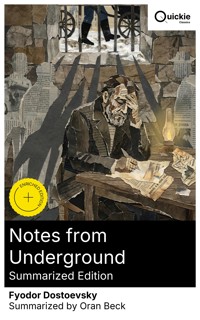
Published in 1864, Notes from Underground is a taut two-part novella that assaults the era's rational egoism and utilitarian optimism. In Part One, the unnamed Underground Man delivers a jagged, self-lacerating monologue, wielding paradox against deterministic science and social engineering. Part Two, Apropos of the Wet Snow, stages his ideas as lived humiliation: petty clashes with former schoolmates and a cruel exchange with Liza expose the costs of corrosive self-consciousness. The prose shifts from sardonic wit to feverish confession, perfecting an unreliable, dialectical form that anticipates modernist interiority and existential inquiry. Dostoevsky composed the book amid crisis and polemic: recently returned from Siberian imprisonment and exile, afflicted by epilepsy, and grieving his wife and brother, he confronted the prestige of positivism and the utopian schemes of Chernyshevsky. Experience among convicts supplied psychological depth, while fierce theological debate and Petersburg's bureaucratic labyrinth shaped its moral topography. For readers of philosophy and fiction alike, this brief yet inexhaustible work is indispensable. It rewards close study of freedom, rationality, and selfhood, and serves as a bracing antidote to facile systems as well as a prologue to the author's later masterpieces. Quickie Classics summarizes timeless works with precision, preserving the author's voice and keeping the prose clear, fast, and readable—distilled, never diluted. Enriched Edition extras: Introduction · Synopsis · Historical Context · Author Biography · Brief Analysis · 4 Reflection Q&As · Editorial Footnotes.
Das E-Book können Sie in Legimi-Apps oder einer beliebigen App lesen, die das folgende Format unterstützen:
Veröffentlichungsjahr: 2026
Ähnliche



















Notes from Underground (Summarized Edition)
Table of Contents
Introduction
This is a book about a man who defends his freedom even when it destroys him. Notes from Underground by Fyodor Dostoevsky is a short work of psychological and philosophical fiction set in nineteenth-century St. Petersburg, first published in 1864. Through an abrasive first-person confession, it examines the collision between rational systems and unruly human will at the dawn of modernity. The narrative advances not by plot spectacle but by argument, self-laceration, and sudden turns of insight. Often cited as a precursor to existentialist literature, the book compresses a profound inquiry into identity, agency, and humiliation into a compact, volatile form that still feels contemporary in its candor and daring.
The speaker, an unnamed former civil servant who has withdrawn from society, addresses us from his cramped isolation with a voice that is sardonic, hyperaware, and defiantly inconsistent. He quarrels with imaginary interlocutors, anticipates objections, and contradicts himself as a way to assert a stubborn autonomy. The sentences move with digressive energy—caustic, self-mocking, and abruptly tender—creating a rhythm that alternates between attack and confession. Rather than inviting sympathy, he tests the reader’s patience, asking us to sit with discomfort and ambiguity. The result is a reading experience that feels intimate and combative at once, like entering a mind under pressure.
The book is divided into two interlocking movements. The first presents a manifesto of sorts, in which the narrator challenges the era’s faith in enlightened calculation and the promise that human behavior can be optimized by reason alone. He advances a paradoxical defense of irrational desire as a form of selfhood. The second movement shifts to episodes from his earlier life, where petty encounters, wounded pride, and small choices reveal how his theories function under the strain of actual experience. Without relying on elaborate plot, the work deepens through echoes between idea and incident, inviting the reader to judge without final answers.
At its core, Notes from Underground interrogates the limits of reason, the seductions of determinism, and the stubborn residue of human freedom. Dostoevsky probes the belief, widespread in his time, that social engineering and utility can secure happiness, showing how individuals may cling to caprice precisely to resist being computed. The narrator’s insistence on choosing against his interests becomes both a protest and a pathology. Pain, pettiness, and self-sabotage are not glamorized; they are examined as symptoms of a deeper craving for dignity in a world of metrics, schedules, and impersonal authority. The book asks how autonomy survives within systems that explain us.
Psychologically, the portrait is exacting. Hyperconsciousness immobilizes the narrator: he scrutinizes every motive until action curdles into inertia, and inertia into resentment. Pride flips into self-loathing, then rebounds as aggression, tracing a cycle recognizable in modern accounts of alienation. The drab rooms and wintry streets of St. Petersburg reinforce this mood, yet the real landscape is interior—corridors of thought where small slights expand into obsessions. Dostoevsky renders this with unsentimental clarity, allowing the character’s contradictions to stand without authorial rescue. The book becomes a case study in how wounded vanity and moral awareness can coexist, each undermining the other.
For contemporary readers, the concerns feel unmistakably current. In an age that quantifies behavior and curates identities, the narrator’s resistance to being modeled reads as a warning against reducing persons to data or incentives. His isolation evokes forms of screen-mediated solitude; his dramatized self-consciousness resembles the feedback loops of public yet lonely life. The book presses questions about responsibility when one’s worst impulses are rationalized, about empathy when shame hardens into contempt, and about freedom when prediction claims to know us better than we know ourselves. Its challenge is ethical as much as intellectual: what kind of persons do systems make?
This unabridged Garnett translation, long a gateway for English-language readers, presents the work in a supple, unfussy prose that emphasizes clarity while preserving the narrator’s volatility. Without softening the abrasions, it keeps the arguments legible and the mood uncomfortably alive. The compactness of the book rewards slow reading: follow the pivots of thought, notice how a proud claim mutates into a plea, and let the repetitions accumulate force. Approached this way, Notes from Underground is not merely a document of its era but a living provocation, exposing the costs of freedom, the limits of explanation, and the fragile, stubborn dignity of the self.
Synopsis
Notes from Underground, first published in 1864, appears in English in Constance Garnett’s unabridged translation as a compact, two-part work by Fyodor Dostoevsky. Set in St. Petersburg and framed as a confession, it presents an unnamed former civil servant who writes from what he calls the underground, a state of social isolation and relentless self-scrutiny. The book proceeds from abstract argument to concrete recollection. In the opening part the narrator elaborates a polemic against rational social programs; in the second he recounts episodes from earlier years that illustrate his ideas in action. The result is both psychological portrait and critique of prevailing moral philosophies.
In Part One the narrator establishes himself as contradictory and combative, insisting he is both hyperconscious and incapable of decisive action. He writes from a cramped room, addressing an imagined audience he alternately taunts and implores. The underground, for him, is less a physical place than a mental posture: a retreat into wounded pride and analytic excess. He catalogues petty grievances, dramatizes his own meanness, and denies the comfort of consistent motives. This voice is deliberate, strategic, and self-exposing; the narrator anticipates objections, undercuts his claims, and then rebuilds them, offering a sustained performance of thought that challenges any straightforward reading of character.
His principal target is the optimism of rational egoism and utilitarian schemes that promise predictable human behavior and calculable happiness. Against such systems, he elevates individual will as stubbornly unprogrammable. He argues that people may deliberately choose pain or loss to assert freedom, preferring caprice over a life reduced to formulas. He invokes images of perfect organization and glassy certainty to warn that such completeness would humiliate the person who still craves choice. The underground man defends the right to be unreasonable, fearing that a mechanical account of motives would erase dignity and reduce humanity to docile arithmetic.
Closely linked to this defense of will is his unsettling meditation on the pleasures of suffering. He confesses a taste for self-laceration, suggesting that heightened consciousness breeds paralysis and a perverse enjoyment of humiliation. Where a man of action plunges ahead, he dissects his own motives until all initiative dissolves. He keeps score of insults, revisits slights, and nourishes fantasies of revenge that never quite become deeds. Part One thus sketches a mind at war with itself, fascinated by moral law yet determined to flout it, and prepares the reader for a shift from theoretical posturing to illustrative, lived episodes.
Part Two relocates the narrative to specific scenes from his earlier life as a minor official. The first concerns a long-festering grievance against a uniformed officer who once brushed him aside in a crowded street. He broods over the incident for years, conceiving a plan to reclaim dignity by a carefully staged collision. He calibrates distances, clothing, and courage, investing the trivial with the weight of justice. The episode unfolds quietly, without heroic release, revealing how his private theater of pride and resentment turns ordinary public space into a battleground where imagined recognition matters more than any tangible result.
Next he reenters the orbit of former school acquaintances, chiefly through a visit to Simonov that results in his self-invitation to a farewell dinner for Zverkov. The gathering exposes his social awkwardness and suspicious nature. He oscillates between ingratiation and provocation, alternately demanding respect and courting humiliation. Conversation curdles into barbs; debts and status hover in the background. The group eventually departs for further amusements, leaving the narrator to pursue them in a mixture of rage, loneliness, and theatrical self-importance. The evening, with its disappointments and posturing, crystallizes his belief that society runs on rituals he neither shares nor can stop resenting.
In a brothel that night he meets Liza, a young woman whose situation enables a different register. He delivers an impassioned monologue about degradation, domestic hope, and the future that awaits her if nothing changes. The speech mingles compassion with manipulation, inviting her to imagine dignity while also binding her to his moral staging. He provides his address, half-daring her to test whether his rhetoric conceals any genuine capacity for care. The scene suggests both a yearning to rescue and a need to dominate through words, leaving open the possibility of authentic connection amid the narrator’s habitual self-destruction.
Back at his lodgings, his ongoing feud with his servant Apollon resumes, exposing a household economy of petty power, debt, and defiance. Into this cramped theater Liza appears, and the narrator is forced to reconcile his eloquent ideals with the concrete demands of kindness. Their meeting peels away performance, revealing tenderness, pride, shame, and an uneasy calculus of money and obligation. He craves absolution and control at once, and the room becomes a stage for contested versions of dignity. What follows clarifies his pattern without closing it, emphasizing how fragile his freedom seems when measured against another person’s gaze.




