


Erhalten Sie Zugang zu diesem und mehr als 300000 Büchern ab EUR 5,99 monatlich.
- Herausgeber: Nick Hern Books
- Kategorie: Poesie und Drama
- Serie: NHB Modern Plays
- Sprache: Englisch
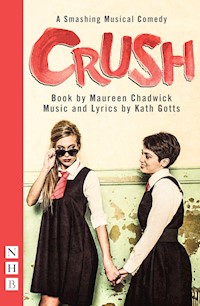
An outrageously fun musical set in an all-girls school in the 60s, from the team behind Bad Girls: The Musical. It's 1963 and the Dame Dorothea Dosserdale School for Girls has a proud tradition of fostering free spirits from all walks of life. So it's a crushing blow when the new headmistress turns out to be a tyrant with strict Victorian values – and top of her hit list are the two sixth-formers accused of 'Unnatural Behaviour' in the Art Room… Brimming with catchy tunes and witty lyrics, Crush is a hilarious pastiche of Girls' School stories – a blend of Malory Towers and St Trinian's – with added hockey sticks and 'lashings of jolly good fun' Coventry Telegraph. Crush was first performed on tour in the UK in 2015.
Sie lesen das E-Book in den Legimi-Apps auf:
Seitenzahl: 119
Veröffentlichungsjahr: 2016
Das E-Book (TTS) können Sie hören im Abo „Legimi Premium” in Legimi-Apps auf:
Ähnliche











Book by
Maureen Chadwick
Music and Lyrics by
Kath Gotts
NICK HERN BOOKS
London
www.nickhernbooks.co.uk
Contents
The Making of Crush: The Musical
Acknowledgements
Crush and the Girls’ School Story
Original Production
Characters
Authors’ Note
Musical Numbers
Note on Music
Crush: The Musical
The Making of Crush: The Musical
Kath Gotts
Crush: The Musical has had what is quite possibly a record-breakingly long gestation from conception to completion, one that’s as much to do with the changing social attitudes of the last quarter of a century as it is the detours of our own professional lives.
The show was first conceived when I was not that long out of school uniform myself, when the tragicomic emotional territory of first love and adolescent angst was sadly rather fresh in my memory. Maureen and I decided we wanted to write a musical together and with our shared delight in Fred and Ginger movies we had a mission to write our own version of a romantic comedy in classic book-musical form. Inspired by our love of the British tradition of schoolgirl fiction – from Malory Towers to St Trinian’s, and the old Girl’s Own Annuals – we thought it would be great fun to write a musical set in that world. In fact, we were amazed that nobody else had got there before us and that here was this whole rich genre as yet unpilfered by musical-theatre writers, with its own distinctive milieu and lingo, and the schoolgirl crush providing new love story material for musical-comedy treatment.
With some early encouragement from Wendy Toye and Julian Slade we entered the very embryonic Crush (then called Sugar and Spice) for the 1989 Vivian Ellis Prize for New Musicals – three songs and a synopsis. We were thrilled to find we’d made it into the televised final. When asked to describe the show I cheerfully explained that it was a traditional romantic musical – just a simple case of ‘girl meets girl, girl loses girl, one girl finds a boy and the other one finds another girl’. We’d heard that Cameron Mackintosh was rooting for us, but on the big day itself he unfortunately wasn’t there in person and the rest of the panel seemed altogether perplexed by a love song from one schoolgirl to another – one suggested that he could imagine the show appealing to the ‘old men in macs’ brigade. As for Vivian Ellis himself, he summed it up thus: ‘At my old school of St Hilda’s, it was, I always felt such talk was best confined to the locker room and that’s all I have to say about that!’
Despite this first ‘crushing blow’ to our enthusiasm we continued to develop the show on our own. Justin Greene – then at the Nuffield Theatre, Southampton – read an early draft and gave us some positive feedback to keep going. But not only were we trying to write light-hearted musical comedy in an era of sung-through blockbuster musicals, we were specifically trying to write a mainstream musical comedy with a nascent lesbian love story in the homophobic era of Section 28. (The evil headmistress Miss Bleacher was our version of Margaret Thatcher, slashing budgets for arts education and espousing conservative ‘family values’ – despite the antics of her cabinet ministers.)
Of course, most of the cast of our 2015 production of Crush weren’t even born in 1988 when Section 28 came into force, but this is why Crush isn’t so much a musical of its time as a musical that has had to wait its time. Back in the late eighties and nineties the very notion of celebrating romantic love between schoolgirls was seen as radically subversive. (Remember, this was pre-Anna Friel’s ‘Beth Jordache’ on Brookside back in 1994!)
Section 28 of the Local Government Act had stated that a local authority ‘shall not intentionally promote homosexuality or publish material with the intention of promoting homosexuality’ or ‘promote the teaching in any maintained school of the acceptability of homosexuality as a pretended family relationship’. Although there were never any criminal prosecutions under this law it did create a climate of fear and uncertainty – particularly for those working with young people. The 1987 British Social Attitudes Survey revealed that seventy-five per cent of the population said that homosexual activity was ‘always or mostly wrong’, with only eleven per cent believing it to be never wrong.
It wasn’t until 2003 that Section 28 was finally repealed – but how swiftly things have moved on since then, first with civil partnerships and then equal marriage. The relationship between public opinion and the law is, of course, a two-way street, with the law shaping public opinion as much as the other way around, and the world into which Crush has finally emerged all these years later would have been practically unimaginable when we started out. Indeed, our partnership with the charity Diversity Role Models to run anti-LGBT bullying workshops in schools shows just how far things have moved on.
Back in the dark days of the early nineties, however, we did pretty much consign Crush to Vivian Ellis’s ‘locker room’ and left it there for a couple of decades as we got on with the rest of our lives. We did do a little workshop presentation at the East Dulwich Tavern in 1997, but by then Maureen was already writing for Coronation Street, which led on to Bad Girls, and then off and away on a twelve-year roller-coaster ride with Shed Productions. Meanwhile I was finishing my music degree and working for a charity, before swerving off into TV music writing and being Shed’s first finance director! So, much though we would have hated to say so at the time, it was probably all for the best.
By 2004 we were workshopping Bad Girls: The Musical, another show for a predominantly female cast, which was first produced at West Yorkshire Playhouse in 2006, then transferred to the West End in 2007. And we’re delighted that it’s since become a hit with am-dram societies and drama colleges, both in the UK and around the world, and had its first professional revival at the Union Theatre in Southwark in March 2016.
But over the years we’d kept on singing ‘Navy Knicks’ and some of those early songs and thinking fondly of our abandoned musical in the bottom drawer. Finally, after she had left Shed Productions, Maureen decided it was time to take another look at it. Although fully expecting to have the usual cringe-making experience that goes with re-reading your juvenilia, she was delighted to discover how fresh it still seemed – as if all that youthful excitement and energy we’d first put into it was preserved intact, and the characters were just waiting to burst back into life. We knew we still loved its rebel spirit and felt it really captured something – an essence of schoolgirl passion, idealism and silliness. So we decided to start work in earnest to develop the original material into the musical we always wanted it to be. And, of course, we were much better equipped to take on that task than we would have been twenty years previously.
A ruthless process of rewriting ensued – songs cut, new ones added, existing songs reworked and the whole script and structure thoroughly nipped, tucked and polished. A workshop presentation of the new improved Crush at the Harold Pinter Theatre in October 2013 allowed us to get a good sense of seeing the show on its feet and in front of an audience – and from that we gathered a great deal of useful feedback for yet another round of revisions and additions…
Of course, when working on pre-existing material there’s always a risk that changing one small element will send the whole pack of cards tumbling down, so it’s been a delicate balance. But the final sessions of detailed scriptwork with the director prior to rehearsals allowed us to unearth the last few remaining ‘bodies under the patio’ and make sure everything locked together in the most lively fashion ready for its premiere in 2015.
It’s wonderful to have arrived at a time when the show can be widely enjoyed for what it is – a light but big-hearted and universal story about growing up, facing adversity and learning to be true to yourself. And we really hope that everyone who performs Crush or goes to see it will get as much fun out of it as we’ve tried to put into it.
Acknowledgements
In addition to all those who worked on the Belgrade Theatre production of Crush, the authors would like to thank the numerous colleagues and friends who have helped to take Crush on its long journey over the years – with particular acknowledgement to: Nikki Slade, James McConnell, Maggie Norris, Neil McArthur, Janet Prince, Sarah Travis, Gareth Valentine, Thom Southerland and Justin Greene – to name but a few.
Crush and the Girls’ School Story
Professor Rosemary Auchmuty FRSA
The popularity of girls’ school stories has always been an embarrassing enigma to mainstream critics. It is often claimed that Thomas Hughes’s Tom Brown’s School Days (1857) was the first British school story, with girls’ school stories following only after educational opportunities were extended to girls in the later nineteenth century. In fact, Sarah Fielding’s The Governess, or The Little Female Academy (1749) preceded Tom Brown by more than a century, and girls’ school stories have always been more significant than boys’ in terms of number of titles, popularity and sales.
There is a good reason for this. Prior to the mid-nineteenth century, middle-class girls were denied an academic education and were trained instead in the feminine virtues to be helpmates of men. The girls’ school story as we know and love it was a product of the early feminist movement to create educational opportunities for women in schools and universities and to fit them for paid employment and independent lives. Far from being the embodiment of respectability, restrictiveness and outmoded values that they later came to represent, the schools – the girls’ high schools and the public schools like Cheltenham Ladies’ College, Wycombe Abbey and Roedean – were radical and feminist in their recognition that knowledge is power and their insistence that girls be educated beyond married dependence. The books captured this spirit and so does Crush, where the founder’s suffragette vision is contrasted to the interloper headmistress’s invocation of regressive ‘Victorian values’.
The authors of girls’ school stories were themselves beneficiaries of this emancipation through education: jobbing writers in the main, they supplied an eager, growing market of school and working girls with a product at first viewed as harmless, if not morally sound and character-building. Their readers were generally girls who did not (and would not have been able to) attend the deliciously attractive boarding schools depicted, who received the books as school or Sunday-school prizes and later, drawn into the fantasy world, saved their pocket money to buy additions to their favourite series or requested them as birthday or Christmas presents. No one took much notice of their innocent pleasure until the subversive power of girls’ school stories began to be recognised just before the Second World War and the backlash began. Within a decade the genre had been practically wiped off the publishers’ lists, and those girls who had loved the books, and the women who went on loving them, had to fall back on nostalgia and the second-hand market.
Why have so many girls and women (and some men) loved the books, even up to the present day? And why did the books have to be denigrated and forcibly suppressed? The answer to both questions is the same. We loved them, and they had to go, because they depicted all-women worlds in which men were not the centre of women’s existence – were, indeed, largely decorative or superfluous – and where women could occupy any and every role requiring skill, courage and leadership. Naturally, in a patriarchy, this is quite wrong: women should be followers, not leaders; women should be dependent and in need of protection, not independent and brave; women should devote themselves to men, not to self-development or – God forbid – to other girls or women.
The destruction of girls’ school stories took many forms. One was the reinterpretation of the ‘crush’, the focus of this musical. In early school stories, such as those by Angela Brazil, girls’ hero-worship of other girls or mistresses is treated simply as a plot device typical of girls’ schools, quite neutrally, but in the 1920s, under the influence of the new ‘science’ of sexology, it came to be decried as immature and, later, unhealthy. It took the sophisticated parodies of male satirists like Lord Berners (The Girls of Radcliff Hall, 1936), Philip Larkin and Arthur Marshall to make an overt link with sexual deviance, but the critics quickly took this up, and by the 1970s everyone was sniggering at the ‘lesbian’ content of so many of these books. ‘One must assume that these authors… had not the faintest idea in this instance what they were writing about,’ observed Gillian Avery in Childhood’s Pattern (1975). In fact, I suggest, these authors knew very well that they were writing about love between women, but did not see it as pathological.
Many school-story enthusiasts have mixed feelings about the masculine camping-up of school life in Arthur Marshall and Co.’s work, which often seems to mock rather than celebrate women and their all-female world. When women write such parodies, however, the tone is more sympathetic: Nancy Spain’s Poison for Teacher (1949) (also set in ‘Radcliff Hall’, in this case based on her own school, Roedean) casts a critical but indulgent eye on both the institution and the genre; she was certainly writing consciously as an insider and a lesbian. Different again, because possible now, is the approach in Crush, where the lesbian content is neither satirised nor parodied: rather, it is central to the narrative and resolution of the school’s fight to defend its progressive values.




