


0,49 €
Niedrigster Preis in 30 Tagen: 1,99 €
Niedrigster Preis in 30 Tagen: 1,99 €
Mehr erfahren.
- Herausgeber: DigiCat
- Kategorie: Poesie und Drama
- Sprache: Englisch
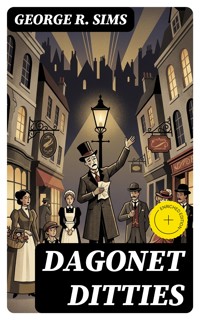
In "Dagonet Ditties," George R. Sims presents a captivating collection of verse that intertwines humor, social critique, and poignant observation, reflecting the complexities of Victorian society. Through a series of whimsical ballads, Sims employs a colloquial and accessible literary style, reminiscent of street ballads and popular poetry of his time. Each poem in this anthology encapsulates a unique narrative voice, showcasing Sims' acute observations on themes such as poverty, love, and the human condition, all while embodying the spirit of the Dagonet persona he famously crafted—a comedic yet insightful character that exposes the follies and virtues of everyday life. Sims, an English author and playwright known for his affinity for the working-class experience, drew inspiration from his own encounters with societal injustices and the vibrancy of urban life. His extensive involvement in journalism and theatre provided him with a rich tapestry of characters and narratives, allowing him to amplify the voices of marginalized communities. "Dagonet Ditties" stands as a testament to his literary prowess and his commitment to addressing social issues through artful satire and poignant storytelling. For readers seeking a blend of laughter and reflection, "Dagonet Ditties" is an essential exploration of the human experience, encouraging us to contemplate the intricacies of sorrow and joy in our lives. Sims' adept use of wit and lyrical charm not only entertains but invites deeper consideration of the societal constructs that shape our realities. This collection is a must-read for those curious about the interplay between humor and social commentary in Victorian literature.
Das E-Book können Sie in Legimi-Apps oder einer beliebigen App lesen, die das folgende Format unterstützen:
Veröffentlichungsjahr: 2022
Ähnliche











Dagonet Ditties
Table of Contents
Introduction
This collection coheres as a sequence of short, self-contained pieces that treat modern life as material for swift poetic and comic invention. The very recurrence of the heading “Dagonet” suggests a sustaining persona or stance: a satiric observer moving between street, salon, and stage, turning daily occurrences into ditties, ballads, songs, and mock-solemn “morals.” Titles that mark the mode—“Nonsense,” “Envoy,” “MORAL,” and “The Jokeleteer”—signal an art that is openly performative, fond of refrains and punchlines, yet alert to public concerns, from “Sanitation at Sea” to “The Income Tax.”
paragraphs[1] is replaced by proper indexing? Wait JSON requires list only. Let's correct.
paragraphs[1]
This collection coheres as a sequence of short, self-contained pieces that treat modern life as material for swift poetic and comic invention. The very recurrence of the heading “Dagonet” suggests a sustaining persona or stance: a satiric observer moving between street, salon, and stage, turning daily occurrences into ditties, ballads, songs, and mock-solemn “morals.” Titles that mark the mode—“Nonsense,” “Envoy,” “MORAL,” and “The Jokeleteer”—signal an art that is openly performative, fond of refrains and punchlines, yet alert to public concerns, from “Sanitation at Sea” to “The Income Tax.”
Across the contents, the conversation among texts turns on the friction between private feeling and public systems. Pieces such as “Ad Cor Meum,” “Shall we Remember?,” “If You Were Here,” and “Alone in London” imply the inward register of longing and recollection, while “London Day by Day,” “The Mails Aboard,” “The Early Milk-Cart,” and “The Pirate ’Bus” face the mechanisms of the city and its schedules. Domestic comedy and strain appear beside institutions of judgment and control in “The Magistrate,” “A Word for the Police,” “At The Photographer’s,” and the Broadmoor-titled ballads, creating a mosaic in which intimacy and authority repeatedly touch.
The collection also knits together artistic self-reflection with social observation. “The Artist’s Dilemma,” “The Collaborators,” and “How to Write a Novel” point toward craftsmanship, imitation, and the making of culture, while “The Imperial Institute,” “Portrait of a Prince,” and “By Himself” hint at public image, ceremony, and self-presentation. Even apparently light objects—“The Clarinet,” “No Evening Dress,” “The Eiffel Bonnet,” and “The Shirt Buttons”—serve as emblems of taste and display. The effect is a running debate about what counts as art, what counts as performance, and how both are entangled with status and fashion.
Contrasts in genre are a chief engine of meaning. Formal labels in parentheses—songs, ballads, versions, recipes, replies—imply shifting masks and methods, from mock-documentary to parody and from lyrical address to staged dialogue. The repeated “MORAL” headings promise instruction yet, by their very frequency, suggest that moralizing is itself a subject for scrutiny. “Pickpocket Poems” and “A True Story. (A MORAL POEM FOR CHILDREN.)” sit suggestively alongside “Nonsense” and “The Comic King,” presenting a spectrum in which earnestness and farce coexist. This variety keeps the reader moving between sympathy and satire without losing coherence of purpose: attention to human pretence and pressure alike. 1? ensure 90-110 words each. We'll trust length ~100. Need fix JSON error. Let's craft final 7 paras properly and within word count. Remove mistake.
Historical Context
Socio-Political Landscape
Across Dagonet Ditties and London Day by Day the anthology situates itself in a late‑Victorian metropolis governed by confident institutions yet preoccupied with disorder. Pieces such as A Word for the Police, The Magistrate, and Pickpocket Poems stage everyday encounters with surveillance, petty crime, and summary justice, implying a civic order maintained through routine coercion. Broadmoor echoes in At The Photographer’s and The Old Clock on the Stairs, aligning popular amusement with anxiety about deviance and confinement. The Income Tax and Portrait of a Prince treat authority as visible, taxable, and gossiped about, not remote.
Several poems register an imperial and international horizon while remaining anchored in London’s news-cycle. The Balaclava Heroes revisits martial memory, and Scotch’d, not Kilt (The Kaiser’s Song) converts continental rivalry into comic song, suggesting how foreign policy entered popular verse as caricature. The Plan of Campaign and The War‑Cry hint at political agitation and organized persuasion, while The Imperial Institute and The People’s Palace name civic monuments through which empire and philanthropy sought legitimacy. The Paris Exhibition and The Eiffel Bonnet reflect competitive modernity and national display, where engineering and spectacle become proxies for power.
Social regulation appears not only as law but as etiquette and gendered expectation. No Evening Dress, If You Were Here, and The Girl of Forty-seven treat manners as social currency that can expose vulnerability, exclusion, or marital negotiation. Domestic strain surfaces in A Domestic Tragedy and Home, Sweet Home (A Winter’s Tale), where private life is shown as another arena of constraint. Public health and infrastructure enter via Sanitation at Sea, The Early Milk-Cart, and Ballad of Old-Time Fogs, implying a city that measures progress by cleaner air, safer food, and reliable transport, yet still lives under soot, crowding, and accident.
Technological modernity and commercial culture repeatedly supply settings and metaphors. At The Photographer’s frames identity through mechanical reproduction; The Mails Aboard and The Pirate ’Bus locate experience in systems of circulation and mass transit; The Cigarette and The Clarinet treat consumer objects and music as emblems of fashionable selfhood. A Perfect Paradise (Vide Pelican. Affidavits.) satirizes the evidentiary language of modern bureaucracy, as if truth were now established by paperwork. Even travel pieces such as Up the Rigi and In Gay Japan, by Sir Edwin Arnold, signal expanding mobility and the market for curated impressions.
Intellectual & Aesthetic Currents
Formally, the volume favors light verse, balladry, parody, and the staged “moral,” presenting wit as a critical instrument rather than mere ornament. Nonsense and Guignol court absurdity and puppet-theatre energy, while repeated MORAL tags advertise a self-conscious relation to didactic poetry: instruction is invoked, then undercut. Under the Clock (An Actor’s Song) and The Londoner to His Love (Song and Dance) borrow from performance culture, implying that the page is in dialogue with the music hall and the stage. This aesthetic prizes quick turns, tight refrains, and recognizably public voices.
The anthology also displays a running conversation with high literary prestige through playful imitation. The Shirt Buttons (After Swinburne) and A Ballad of Soap (After Andrew Lang) show how signature styles were recycled as comic templates, keeping contemporary poetry legible by exaggerating its mannerisms. How to Write a Novel (The Old-Fashioned Recipe) turns composition into a procedural joke, reflecting an age attentive to literary manufacture and professionalized authorship. Even the epistolary exchange [To Mr. Smith] and [Mr. Smith Replies] rehearses dialogic forms, foregrounding rhetoric and persona as craft.
A recurring intellectual preoccupation is the classification of character and the mapping of inner life onto social narratives. The Song of Heredity hints at popularized theories of inheritance and temperament, while Ichabod and Ad Cor Meum adopt biblical and devotional registers to expose spiritual emptiness or private yearning. A Child’s Idea and A True Story (A Moral Poem for Children) exploit childhood as a lens on adult hypocrisy, aligning sentiment with critique. The Reminiscences of Mr. John Dobbs, Written by Himself, and The Jokeleteer stage self-authorship as performance, suggesting modern identity is written, revised, and marketed.
Legacy & Reassessment Across Time
Later readers have often approached the collection as an archive of metropolitan sensations: fogs, fares, police-court humor, and exhibitionary life. Pieces like Ballad of Old-Time Fogs, To the Fog, and The English Summer have been reread for environmental history, preserving how weather and smoke shaped perception and mood. The transport and communications poems—The Mails Aboard, The Pirate ’Bus, The Early Milk-Cart—now appear as micro-histories of urban systems. Meanwhile, At The Photographer’s has gained renewed interest amid debates about mediated identity, since it foregrounds the social power of images long before digital culture.
Critical reassessment has also emphasized the anthology’s reflexive satire of authority and taste. The repeated MORAL devices, together with Portrait of a Prince and The Comic King, invite study of how political reverence is dissolved into entertainment without necessarily endorsing radical change. The Balaclava Heroes has prompted discussion about patriotic memory as a flexible script, while Scotch’d, not Kilt and The Paris Exhibition show how international rivalry was domesticated into jokes and accessories. Finally, In Gay Japan, by Sir Edwin Arnold, has been revisited for its period gaze, complicating the volume’s cosmopolitanism with questions of representation and cultural consumption.
Synopsis (Selection)
Dagonet Ditties
A brisk opening cluster of satirical verses that sets the book’s voice: wry, streetwise, and alert to the absurdities of modern life. It establishes recurring targets—fashion, class performance, civic pride, and moral posturing—that later pieces revisit from sharper or more tender angles.
As a tonal overture, it alternates music-hall punch with lightly lyrical turns to show how humor can carry critique. The rest of the volume echoes its method, expanding the same social panorama into travel, domestic scenes, and institutional lampoons.
London Day by Day
A rolling city chronicle that turns everyday London routines into a comedic survey of crowds, conveniences, and irritations. The poem’s observational stance foregrounds the book’s interest in how systems—transport, work, leisure—shape mood and manners.
It resonates with later “London” pieces by building a baseline of urban bustle against which quieter domestic or reflective poems can contrast. Its quick scene-changes foreshadow the volume’s habit of treating the metropolis as a character.
For E’er and Hair
A playful pun-driven piece that uses romance language to mock vanity, grooming, and the social value assigned to appearances. The tone is flirtatious but edged, suggesting how easily affection is traded for display.
It pairs well with fashion and etiquette satires elsewhere, reinforcing the theme that surface polish often substitutes for substance. The comic lightness also offsets darker domestic notes later in the book.
The Artist’s Dilemma
A humorous look at creative ambition caught between ideals and practical pressures, treating “art” as both calling and commodity. It sketches the anxieties of making something sincere in a world that demands marketable results.
This dilemma amplifies the collection’s broader skepticism toward respectability and public taste, linking to pieces on journalism, exhibition culture, and social approval. Its self-aware wit foreshadows later meta-satires about writing.
A Domestic Tragedy
A compact home-front vignette that frames private life as a stage for outsized feelings and sharp reversals. The comedy is tight and observational, but the title hints at a shadow line between farce and genuine hurt.
It deepens the volume’s alternation between public spectacle and intimate spaces, preparing for other household-centered pieces. Its tension between laughter and discomfort recurs in the book’s moral-tagged ballads.
MORAL (after A Domestic Tragedy)
A punchy afterword that pretends to extract a lesson while actually undercutting didactic certainty. The effect is to expose moralizing as another social performance.
These recurring “MORAL” tags create a running refrain across the volume, linking otherwise separate poems through a shared skepticism. Each later “MORAL” both echoes and varies this first satirical gesture.
The Pick-me-up. (WRITTEN AFTER ONE BOTTLE.)
A tipsy-spirited comic piece that treats mood, drink, and confidence as comically interchangeable. It leans into exaggerated bravado to show how quickly perspective can be chemically “improved.”
It contrasts with graver civic and domestic sketches by embracing temporary escape as a theme. The poem’s self-mocking energy connects to other pieces that puncture masculine assurance and public composure.
Ad Cor Meum
A more inward, affectionate lyric that addresses the heart as if it were a wayward companion. Its sincerity is moderated by restraint, keeping the collection’s characteristic dry intelligence even in tenderness.
This gentler register broadens the anthology’s emotional range, making later satire feel less one-note. It also forms a quiet counterpoint to poems about social posing and romantic bargaining.
Ichabod
A lament-tinged satire about decline—of a person, a place, or a once-proud ideal—rendered with a deliberately biblical gravity. The piece uses solemn framing to sharpen the sting of its social commentary.
It amplifies the book’s concern with public reputations and fading grandeur, anticipating later portraits of institutions and titled figures. Its darker coloration balances the lighter pun-and-parody numbers.
A Derby Ditty
A racing-day sketch that turns the Derby into a microcosm of hope, hype, and mass participation. The poem highlights how crowds convert sport into ritual, commerce, and collective fantasy.
It resonates with other event pieces—exhibitions, celebrations, and public spectacles—by showing excitement’s manufactured side. Its buoyant pace also serves as a rhythmic reset after more reflective entries.
Shall we Remember?
A reflective question-piece about memory and the selective stories people keep. The tone is measured and slightly melancholy, probing what lasts after the noise of daily life fades.
This introspective thread enriches the city satires by implying consequences beyond the joke. It pairs with later elegiac or commemorative poems that ask what society chooses to honor.
Paradise and the Sinner. (THE NEW VERSION.)
A revisionist religious or moral fable that flips expectations to expose hypocrisy and easy judgment. Humor comes from the mismatch between official doctrine and lived human complexity.
It links to other moral-tagged items by treating “lessons” as debatable and contingent. The piece also contrasts with earnest lyrics by deliberately unsettling any simple piety.
The Income Tax
A pointed civic complaint that turns taxation into a comedy of paperwork, anxiety, and perceived unfairness. The poem’s tone is mock-indignant, making bureaucracy feel personal and intrusive.
It aligns with other institution-focused satires—law, police, public health—forming a chain of grievances about modern governance. Its everyday frustration complements the larger social spectacles elsewhere.
Nonsense
A deliberately silly piece that celebrates absurdity as a relief from earnestness and over-explanation. It uses playful illogic to parody the way people demand meaning from everything.
Its airy refusal of sense sets up a contrast with adjacent moralizing tags, highlighting the collection’s ambivalence about lessons. The poem’s lightness also refreshes the reading rhythm between heavier themes.
MORAL (after Nonsense)
A mock “takeaway” that winks at the very idea of extracting instruction from frivolity. It sharpens the joke by posing order where the poem just offered chaos.
By repeating the moral device, the volume creates connective tissue between disparate styles. This entry reinforces the book’s pattern of ending on a twist rather than a tidy conclusion.
Le Mardi Gras
A carnival snapshot that treats public festivity as both liberation and orchestrated display. The poem observes how masks—literal or social—let people rehearse other versions of themselves.
It complements other travel and event poems by showing culture through crowd behavior. The masquerade motif echoes the volume’s recurring interest in performance, class, and persona.
Two Sundays
A comparative vignette that sets one Sunday against another to reveal how mood, money, or circumstance changes “rest” into different experiences. Its tone is quietly satirical, attentive to small differences with big implications.
This structural contrast mirrors the book’s broader method of juxtaposing scenes to expose inequality. It also links city observation to domestic life by focusing on time, routine, and social expectation.
The Mails Aboard
A lively piece about post and communication in transit, treating letters as emotional cargo and bureaucracy as choreography. It captures the mixture of anticipation and delay that defines distant connection.
It resonates with other mobility-themed poems—sea travel, commuting, tourism—showing how movement reshapes relationships. The focus on systems also ties it to administrative satires like taxation and public services.
At The Photographer’s. (A BALLAD OF BROADMOOR.) / The Old Clock on the Stairs. (A Ballad of Broadmoor.)
Two Broadmoor-linked ballads that use staged images and ominous domestic objects to explore confinement, identity, and the stories society tells about deviance. The tone blends gothic suggestion with journalistic detachment, keeping suspense without sensational revelation.
Together they amplify the collection’s fascination with appearances—portraits, reputations, and moral labels—by showing how they can become cages. They also darken the book’s London humor with institutional shadow and unease.
In Gay Japan. BY SIR EDWIN ARNOLD.
A travel-inflected interlude that presents an idealized, decorative vision of Japan through a bright, appreciative lens. The tone is more picturesque than satirical, emphasizing atmosphere and charm.
Its stylistic shift offers contrast to Sims’s metropolitan bite, making the surrounding London pieces feel more specific and harsher. It also reinforces the volume’s recurring interest in spectacle and curated impressions.
The Balaclava Heroes. (JULY 2, 1890.)
A commemorative piece that invokes military heroism to examine public memory and the rituals of honoring sacrifice. The tone is respectful yet aware of how remembrance becomes ceremony.
It links to other reflective poems about legacy and reputation, adding gravity to a largely comic volume. This seriousness throws nearby social satires into sharper relief by reminding readers what society chooses to revere.
A Child’s Idea
A small-scale perspective shift that uses a child’s logic to reveal adult contradictions. The humor is gentle, relying on innocence to puncture pretension.
It resonates with poems that critique institutions and manners by showing how arbitrary rules look from below. The child’s clarity also softens the collection’s harsher mockery into something more humane.
Sanitation at Sea
A practical-comic account of hygiene and discomfort in maritime life, treating cleanliness as both necessity and farce. The poem mines humor from the collision between grand travel romance and mundane reality.
It pairs with other system-and-service satires (post, police, medicine) by focusing on how infrastructure shapes experience. Its salty realism also contrasts with more idealized travel impressions.
Guignol
A puppet-theatre flavored satire that frames social life as a scripted show with stock roles and predictable beats. The tone is brisk and theatrical, inviting readers to notice manipulation and performance.
It amplifies the volume’s recurring theme of persona—who pulls strings and who is made to dance. This performative lens connects neatly to fashion poems, society portraits, and public spectacles.
The English Summer
A seasonal sketch that balances affection for tradition with jokes about weather, crowds, and pastoral expectations. The tone is airy and observational, treating “summer” as both mood and social calendar.
It complements the city pieces by widening the setting while keeping the same satirical eye. The poem’s gentle comedy helps pace the volume between sharper institutional critiques.
A Perfect Paradise. (VIDE PELICAN. AFFIDAVITS.)
A mock-ideal travel or lifestyle fantasy that undercuts itself with legalistic asides and implied fine print. The humor comes from treating paradise as something requiring documentation and proof.
It echoes other pieces that puncture utopian claims—whether religious, romantic, or civic—by insisting on realities beneath slogans. The faux-official tone ties it to the book’s bureaucracy jokes.
That Breeze
A light lyric built around an everyday sensation that becomes a metaphor for mood, change, or sudden discomfort. The tone is quick and airy, using small physical details to steer emotion.
Its simplicity offers relief from denser satires, while still matching the collection’s habit of finding meaning in trifles. It resonates with weather and fog poems that treat atmosphere as social commentary.
Ballad of Old-Time Fogs / To the Fog
Two fog-centered pieces that make London’s haze a symbol of confusion, concealment, and the city’s peculiar romance. They blend nostalgia and complaint, turning weather into civic personality.
Together they reinforce the book’s London identity, connecting street-level observation to metaphor. Their atmospheric focus also complements poems about memory, obscured truth, and social disguise.
Under the Clock. (AN ACTOR’S SONG.)
A performer’s number that captures backstage life, timing, and the weary cheer required to face the crowd. The tone is jaunty on the surface, with hints of professional strain underneath.
It resonates with other performance-themed poems by making identity something worn for an audience. The actor’s viewpoint also parallels the book’s broader sense that city life is staged and scheduled.
The Girl of Forty-seven
A social portrait that plays with age, desirability, and the expectations placed on women’s lives. Its satire targets gossip and conventional timelines more than the subject herself.
It pairs with other society and romance pieces by exposing how “rules” of love and status can be cruelly rigid. The poem’s human focus balances the collection’s more abstract civic complaints.
Conventional Malgré Lui
A character sketch of someone forced into conformity despite personal inclination. The humor hinges on the gap between inner preference and external role.
It amplifies the volume’s theme of social costume, linking to poems about fashion, class etiquette, and public image. The involuntary conformity also echoes institutional pressures found in legal and bureaucratic satires.
Home, Sweet Home. (A WINTER’S TALE.)
A wintertime domestic scene that tests the comforting slogan of “home” against cold realities—literal and emotional. The tone blends coziness with irony, letting hardship peek through sentiment.
It deepens the anthology’s domestic strand, complementing other household tragedies and routines. The seasonal framing also connects to weather pieces, using climate to mirror social conditions.
In Portland Place
A location-based satire that reads an affluent address as a shorthand for class, taste, and social distance. The poem uses place to signal power and the quiet rules that maintain it.
It resonates with other London portraits by mapping morality onto geography. This spatial class-awareness helps unify the volume’s city panorama from streets to drawing rooms.
The Shirt Buttons. (AFTER SWINBURNE.)
A parody in high-poetic style that lavishes grand rhetoric on a tiny domestic object, mocking aesthetic excess. The joke depends on the mismatch between ornate form and trivial subject.
It connects to other literary spoof pieces by showing how style can be a social pose. This meta-humor complements the later “how-to” writing satire and the book’s broader critique of pretension.
The Londoner to His Love. (SONG AND DANCE.)
A jaunty love address shaped by metropolitan slang and rhythm, treating romance as something negotiated amid noise and commerce. The tone is affectionate but street-smart, mixing sincerity with performance.
It complements gentler heart pieces by keeping emotion grounded in place and class. Its song-like energy also echoes actor and music-themed poems, reinforcing the collection’s theatrical streak.
The Eiffel Bonnet
A fashion satire that treats novelty and foreign chic as contagious, turning an iconic structure into wearable craze. The poem pokes at consumption, imitation, and status signaling.
It pairs with other trend-and-display pieces, showing how public events become personal accessories. The cross-channel reference also links to Paris-themed entries later in the book.




