


9,99 €
Mehr erfahren.
- Herausgeber: BrightSummaries.com
- Kategorie: Bildung
- Serie: BrightSummaries.com
- Sprache: Englisch
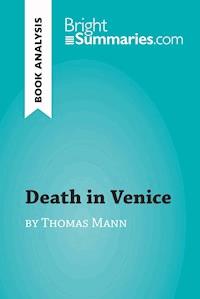
Unlock the more straightforward side of Death in Venice with this concise and insightful summary and analysis!
This engaging summary presents an analysis of
Death in Venice by Thomas Mann, which tells the story of an acclaimed author’s journey to Venice in an attempt to overcome his writer’s block. Once there, he is shaken out of his disciplined, morally upright existence by a strikingly beautiful boy, who captivates him to such an extent that he ignores the pestilence that is sweeping through the city and does everything in his power to remain close to the object of his affections. The novella is a fascinating meditation on obsession, the virtues of youth and the painful process of aging, and is widely considered to be one of Thomas Mann’s masterpieces. Mann is also known for his novels
Buddenbrooks,
The Magic Mountain and
Doctor Faustus, and was awarded the Nobel Prize in Literature in 1929.
Find out everything you need to know about
Death in Venice in a fraction of the time!
This in-depth and informative reading guide brings you:
• A complete plot summary
• Character studies
• Key themes and symbols
• Questions for further reflection
Why choose BrightSummaries.com?
Available in print and digital format, our publications are designed to accompany you on your reading journey. The clear and concise style makes for easy understanding, providing the perfect opportunity to improve your literary knowledge in no time.
See the very best of literature in a whole new light with BrightSummaries.com!
Das E-Book können Sie in Legimi-Apps oder einer beliebigen App lesen, die das folgende Format unterstützen:
Seitenzahl: 28
Veröffentlichungsjahr: 2018
Ähnliche








Thomas Mann
German novelist and essayist
Born in Lübeck (German Empire) in 1875.Died in Zürich in 1955.Literary awards:Nobel Prize in Literature, 1929Goethe Prize, 1949Notable honours:Member of the American Academy of Arts and Letters (elected in 1950)Member of the Academy of Arts, BerlinNotable works:Buddenbrooks (1901), novelThe Magic Mountain (1924), novelJoseph and his Brothers (1933-1943), four-part novelDoctor Faustus (1947), novelPaul Thomas Mann was born on 6 June 1875 in Lübeck, a city in the newly created German Empire. His father was a wealthy German merchant and his mother was Brazilian with German, Portuguese and Indian ancestry. Although he was never a particularly brilliant student, he was always drawn to writing and devoured the works of German philosophers, which had a major impact on his later work. During his teenage years, Mann realised that he was attracted to other boys, and his struggles with his homosexuality are reflected in his work. At university, he took classes on literature, mythology, economics, art and history, and in 1895 he travelled to Italy for the first time with his older brother Heinrich. During his time there, he wrote his first novel, Buddenbrooks, which earned him recognition in the European literary world. Before long, he achieved worldwide fame and rose to become one of the most significant figures of 20th-century literature.
In 1905, Mann married Katia Pringsheim, the daughter of a Jewish mathematician, with whom he went on to have six children. Although it is not evident in his writing, his personal life was marked by tragedy: two of his sisters and two of his children (the novelist Klaus and the musician Michael) committed suicide. Meanwhile, two of his children, Erika and Klaus, followed more closely in his footsteps than the others: in addition to embarking on literary careers like their father, they were also both gay. This was a source of personal heartache for them: Erika had an unhappy and short-lived marriage to the gay actor Gustaf Gründgens (1899-1963), while Klaus became engaged to his childhood friend Pamela Wedekind before breaking it off.
Mann published a series of successful novels in the early 20th century, and was awarded the Nobel Prize in Literature in 1929. However, with the rise of Nazism and Adolf Hitler (leader of the Nazi Party and German Chancellor, 1889-1945), whom Mann openly criticised, he was forced to emigrate to Switzerland and then the USA, where he taught at Princeton University. However, he found himself facing a different kind of persecution in the USA during the McCarthy era, which led him to return to Switzerland in the late 1940s. He died near Zürich in 1955.
Mann is widely recognised as one of the greatest German-language writers of all time, and his writing and thought had a major impact on 20th-century European literature. His vast body of work spans a range of genres, including theatre, short stories, novels and autobiographical writings. He was also an early supporter of gay rights, as he openly supported individuals’ right to make their own decisions about their private life.




