


5,99 €
Mehr erfahren.
- Herausgeber: resourceinternet
- Kategorie: Ratgeber
- Sprache: Englisch
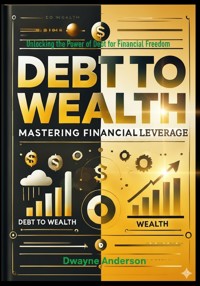
In today's financial landscape, traditional saving alone is no longer enough to create lasting security. Rising living costs, shifting interest rates, and evolving economic structures quietly reduce the real value of idle money, making it harder for even disciplined savers to feel stable over time. This reality calls for a shift, not toward speculation, but toward understanding how money actually works.
Debt to Wealth explores how financial progress is built through structure rather than speed. Instead of focusing on short-term gains, it shows how thoughtful use of debt, aligned with productive assets and long-term planning, can support stability and growth. When used responsibly, debt becomes a tool rather than a burden, allowing effort to compound instead of constantly being reset.
Building wealth is not a matter of chasing returns. It requires a change in perspective. Consistency, patience, and clarity matter more than complexity. As income is organized and obligations are structured, pressure begins to ease. Over time, money shifts from something that creates stress into something that supports choice, flexibility, and resilience.
The book emphasizes balance at every stage. Cash plays an essential role in providing relief and protection, but holding it without direction can quietly limit progress. Productive assets, when chosen carefully, tend to move with life rather than falling behind it. Understanding this balance helps align decisions with real-world conditions instead of outdated assumptions.
As the journey unfolds, readers are guided from financial strain toward stability, and from stability toward confidence. Later chapters introduce modern financial tools, including digital assets, tokenization, and decentralized systems, as extensions of the same principles rather than replacements. These tools are presented not as shortcuts, but as optional pathways that expand access and flexibility when used with discipline.
Das E-Book können Sie in Legimi-Apps oder einer beliebigen App lesen, die das folgende Format unterstützen:
Veröffentlichungsjahr: 2026
Ähnliche
















Debt to Wealth:
Mastering Financial Leverage
Table of Contents
Title Page
Disclaimer
Table of Contents
Foreword
Introduction
Chapter 1: The Reality of Modern Leverage
Chapter 2 | Financial Intelligence and the Relief Roadmap
Chapter 3 | Why Holding Cash Can Be a Risk
Chapter 4 | Understanding the Money Lever
Chapter 5 | Currency as a Strategy
Chapter 6 | The Tax Advantages of Strategic Debt
Chapter 7 | Real Estate as a Stability and Wealth Engine
Chapter 8: Scaling Through Business and Human Capital
Chapter 9 | The Path from Debt to Wealth
Chapter 10 | From Wealth to Continuity
Chapter 11 | Digital Assets as Financial Tools, Not Speculation
Chapter 12 | How Leverage Actually Works in the Crypto and DeFi World
Chapter 13 | Decentralized Finance and the New Leverage Frontier
Conclusion | From Understanding to Continuity
Resources for Continued Growth
Glossary of Terms
Disclaimer
The information contained in this book, Debt to Wealth: Mastering Financial Leverage, is provided for educational and informational purposes only. The author and publisher are not licensed financial advisors, investment advisors, accountants, or legal professionals, and nothing in this book should be construed as professional financial, investment, tax, or legal advice.
All strategies, concepts, and examples presented are based on general principles, personal research, and experiential understanding. Financial decisions involve risk, and individual circumstances vary widely.
What may be appropriate for one reader may not be appropriate for another. You are strongly encouraged to consult with a qualified financial advisor, accountant, tax professional, or legal professional before making any financial decisions or implementing any strategies discussed in this book.
The author and publisher make no representations or warranties, express or implied, regarding the accuracy, completeness, reliability, suitability, or availability of the information contained herein.
Any reliance you place on such information is strictly at your own risk.
To the fullest extent permitted by law, the author and publisher disclaim any liability for any loss, damage, or injury, including but not limited to indirect, incidental, consequential, or economic loss, arising out of or in connection with the use of this book or the application of any information contained within it.
This book may reference or direct readers to external websites or third-party resources that are not under the control of the author or publisher. The inclusion of such references does not constitute an endorsement, and the author and publisher are not responsible for the content, accuracy, or availability of external sources.
By reading this book, you agree to indemnify and hold harmless the author and publisher from and against any and all claims, liabilities, damages, costs, or expenses, including reasonable legal fees, arising from your use of the information provided.
Financial markets, economic conditions, and laws vary by jurisdiction and are subject to change. It is the reader’s responsibility to remain informed about applicable laws, regulations, and market conditions relevant to their individual circumstances.
Copyright © Dwayne Anderson 2024. All rights reserved.
Table of Contents
Foreword
From Burden to Bridge
Introduction
The New Rules of the Financial Game
Chapter 1
The Reality of Modern Leverage
Chapter 2
Financial Intelligence and the Relief Roadmap
Chapter 3
Why Holding Cash Can Be a Risk
Chapter 4
Understanding the Money Lever
Chapter 5
Currency as a Strategy
Chapter 6
The Tax Advantages of Strategic Debt
Chapter 7
Real Estate as a Stability and Wealth Engine
Chapter 8
Scaling Through Business and Human Capital
Chapter 9
The Path from Debt to Wealth
Chapter 10
From Wealth to Continuity
Chapter 11
Digital Assets as Financial Tools, Not Speculation
Chapter 12
How Leverage Actually Works in the Crypto and DeFi World
Chapter 13
Decentralized Finance and the New Leverage Frontier
Conclusion
Embracing the Journey
Glossary of Terms
Resources for Continued Growth
Foreword
If you are holding this book, you are likely feeling a specific kind of pressure that has become all too common in our modern world. You might feel as though you are running a race where the finish line keeps moving further away.
For many, the word debt carries a heavy, almost suffocating weight. It is often associated with late-night stress, phone calls from creditors, and the feeling of being trapped in a cycle that never ends. We have been taught from a young age that debt is a mistake, a burden to be avoided at all costs, and a sign of financial failure.
But there is a different side to this story, one that is rarely discussed in the classrooms or at the kitchen table. The secret to financial freedom is not just about getting out of debt; it is about changing your relationship with it.
In these pages, we are going to explore how debt, when understood and handled with precision, transforms from a weight that holds you back into a powerful lever that pulls you forward. This book is a guide to that transformation.
We are living through a period of massive economic change. The old rules of job security are fading. We see blue-collar roles being outsourced and white-collar professions being reshaped by new technologies.
In this environment, relying on a single paycheck and a traditional savings account is no longer enough to stay ahead. Inflation quietly eats away at the value of the money you have worked so hard to save, effectively punishing those who play by the old rules.
The wealthy have long understood a different set of rules. They do not view debt as a trap but as a tax-free source of capital. They use it to acquire assets that grow in value and produce income, allowing them to build wealth at a pace that savings alone could never match.
This practice, known as leveraging, is the engine behind real estate empires and successful business expansions. It is the reason why some people seem to get richer even when the economy is uncertain.
This book is designed to give you that same edge. We will move past the fear and the technical jargon to focus on practical, actionable strategies. You will learn how to distinguish between the debt that drains you and the debt that builds you.




