


0,00 €
Mehr erfahren.
- Herausgeber: Antique Editions
- Kategorie: Geisteswissenschaft
- Sprache: Englisch
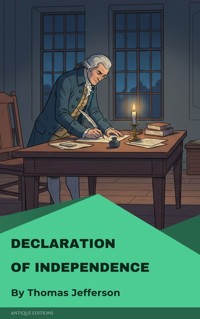
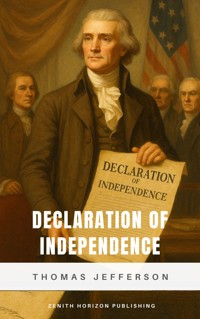
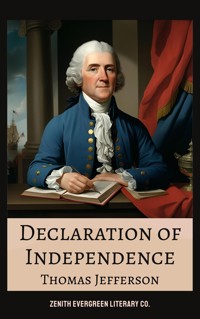
The words that changed the course of history. United States Declaration of Independence, primarily drafted by Thomas Jefferson, is one of the most influential political documents ever written. Adopted on July 4, 1776, it boldly proclaimed the American colonies' independence and introduced ideals that continue to shape democracy worldwide. With its unforgettable assertion that "all men are created equal," this historic text defines the principles of liberty, natural rights, and government by consent. Clear, powerful, and revolutionary, it laid the foundation for the birth of a nation. Inside this complete edition, you'll find: The full, unabridged original text A cornerstone of American political philosophy The enduring principles of freedom and human rights One of the most studied documents in world history For students, historians, and readers passionate about liberty and democracy, this foundational document remains essential reading. Add this historic masterpiece to your collection today and revisit the document that reshaped the world.
Das E-Book können Sie in Legimi-Apps oder einer beliebigen App lesen, die das folgende Format unterstützen:
Veröffentlichungsjahr: 2026
Ähnliche


Declaration of Independence
Thomas Jefferson
About Jefferson:
Thomas Jefferson (April 13, 1743 – July 4, 1826) was the third President of the United States (1801–1809), the principal author of the Declaration of Independence (1776), and one of the most influential Founding Fathers for his promotion of the ideals of republicanism in the United States. Major events during his presidency include the Louisiana Purchase (1803) and the Lewis and Clark Expedition (1804–1806). As a political philosopher, Jefferson was a man of the Enlightenment and knew many intellectual leaders in Britain and France. He idealized the independent yeoman farmer as exemplar of republican virtues, distrusted cities and financiers, and favored states' rights and a strictly limited federal government. Jefferson supported the separation of church and state and was the author of the Virginia Statute for Religious Freedom (1779, 1786). He was the eponym of Jeffersonian democracy and the co-founder and leader of the Democratic-Republican Party, which dominated American politics for a quarter-century. Jefferson served as the wartime Governor of Virginia (1779–1781), first United States Secretary of State (1789–1793) and second Vice President (1797–1801). A polymath, Jefferson achieved distinction as, among other things, a horticulturist, statesman, architect, archaeologist, paleontologist, author, inventor and founder of the University of Virginia. When President John F. Kennedy welcomed forty-nine Nobel Prize winners to the White House in 1962 he said, "I think this is the most extraordinary collection of talent and of human knowledge that has ever been gathered together at the White House — with the possible exception of when Thomas Jefferson dined alone." Source: Wikipedia
Declaration of Independence
WHEN in the course of human events, it becomes necessary for one people to dissolve the political bands which have connected them with another, and to assume among the powers of the earth, the separate and equal station to which the laws of nature and of nature's God entitle them, a decent respect to the opinions of mankind requires that they should declare the causes which impel them to the separation.
We hold these truths to be self-evident: That all men are created equal; that they are endowed by their Creator with certain unalienable rights; that among these are life, liberty, and the pursuit of happiness; that, to secure these rights, governments are instituted among men, deriving their just powers from the consent of the governed; that whenever any form of government becomes destructive of these ends, it is the right of the people to alter or to abolish it, and to institute new government, laying its foundation on such principles, and organizing its powers in such form, as to them shall seem most likely to effect their safety and happiness. Prudence, indeed, will dictate that governments long established should not be changed for light and transient causes; and accordingly all experience hath shown that mankind are more disposed to suffer, while evils are sufferable than to right themselves by abolishing the forms to which they are accustomed. But when a long train of abuses and usurpations, pursuing invariably the same object, evinces a design to reduce them under absolute despotism, it is their right, it is their duty, to throw off such government, and to provide new guards for their future security. Such has been the patient sufferance of these colonies; and such is now the necessity which constrains them to alter their former systems of government. The history of the present King of Great Britain is a history of repeated injuries and usurpations, all having in direct object the establishment of an absolute tyranny over these states. To prove this, let facts be submitted to a candid world.
He has refused his assent to laws, the most wholesome and necessary for the public good.
He has forbidden his governors to pass laws of immediate and pressing importance, unless suspended in their operation till his assent should be obtained; and, when so suspended, he has utterly neglected to attend to them.
He has refused to pass other laws for the accommodation of large districts of people, unless those people would relinquish the right of representation in the legislature, a right inestimable to them, and formidable to tyrants only.
He has called together legislative bodies at places unusual uncomfortable, and distant from the depository of their public records, for the sole purpose of fatiguing them into compliance with his measures.




