


0,99 €
Mehr erfahren.
- Herausgeber: ePembaBooks
- Kategorie: Religion und Spiritualität
- Sprache: Englisch
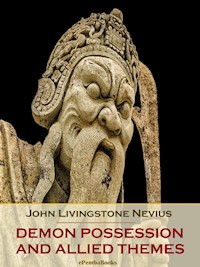
Originally published in 1894, “Demon Possession and Allied Themes” is a study of demon possession written by a veteran missionary to China, John Livingstone Nevius, who was initially sceptical of the phenomenon, until he began to study it himself.
Livingstone Nevius begins with a series of cases in China which he personally investigated, followed by the results of a survey sent out to other missionaries in China, and then gives examples from India, Japan, etc. He finds strong correlations with the New Testament accounts, and with other accounts from the ancient world. This is considered by many the classic treatment of the subject. The author also interacts with the various alternative explanations of the phenomena.
Das E-Book können Sie in Legimi-Apps oder einer beliebigen App lesen, die das folgende Format unterstützen:
Veröffentlichungsjahr: 2022
Ähnliche
















John Livingstone Nevius
Demon Possession and Allied Themes
Table of contents
DEMON POSSESSION AND ALLIED THEMES
Introductory Note
Preface
Note Of Explanation
Chapter 1. First Impressions And Experiences
Chapter 2. Experiences In Central Shantung
Chapter 3. Experiences In Shantung: Continued
Chapter 4. Circular Letter And Responses
Chapter . Responses To Circular: Continued
Chapter 6. More Responses To Circular
Chapter 7. Other Communications From Various Sources In China
Chapter 8. Demon-Possession In India, Japan And Other Lands
Chapter 9. Demon-Possession In Christian Countries
Chapter 10. Character Of The Evidence Presented, And The Facts Established By It
Chapter 11. Explanations: Evolution And Other Theories
Chapter 12. The Pathological Theory
Chapter 13. The Psychological Theory
Chapter 14. The Biblical Theory
Chapter 15. Teachings Of Scripture Continued
Chapter 16. Historical Sketch Of Demonism
Chapter 17. Spiritualism
Chapter 18. The Facts And Literature Of The Occult
Appendix I. More Chinese Instances. (A) Experience Of Chinese Christians In Pingto And Chu-Mao
Appendix. I. (B) Experience Of Mrs. Liu
Appendix I. (C) A Case Of Supposed Possession In Sa-Wo
Appendix I. (D) Case Of A Slave Girl
Appendix I. (E) Case In Eastern En-Chiu
Appendix I. (F). A Case In Southern Shiu Kwang
Appendix I. (G). Experiences Of Chiu Chino
Appendix I. (H) The Case Of A Family In En Chiu
Appendix I. (I) Extracts From A Letter From Mr. Shi Of Shan-Si
Appendix II. Other Testimonies
Notes
DEMON POSSESSION AND ALLIED THEMES
John Livingstone Nevius
Introductory Note
BY REV. F. F. ELLIN WOOD, D. D.
For several years I have been aware that Rev. Dr. John L. Nevius of Chefoo, China, was giving careful attention to certain strange psychical phenomena which were presented from time to time in the interior districts of the Shantung Province. I became more interested in the progress of his inquiries from the fact that upon an acquaintance continued for more than a quarter of a century I regarded him as a man peculiarly fitted to examine so intricate and difficult a subject.
His philosophic insight, his judicial fairness of mind, his caution and his conscientious thoroughness, appeared to me admirable qualifications for such a study. Moreover his thorough mastery of the Chinese language spoken and written, his intimate sympathy with the people, and his correspondingly truer interpretation of their innermost thought and life, have rendered him still more capable of ascertaining the real facts in the case, and of forming accurate judgments upon them.
Antecedently to any knowledge of the New Testament the people of North China believed fully in the possession of the minds and bodies of men by evil spirits. This belief is a part of that animism, or spirit worship, which has existed in China—as in many other countries—from the very beginning of history or tradition. It has always been understood that the personality of the evil spirit usurped, or for the time being supplanted that of the unwilling victim and acted through his organs and faculties. Physical suffering and sometimes violent paroxysms attended the presence and active influence of the spirit, and not only the particular demoniac but all his household were filled with more or less anxiety and distress.
When therefore Christianity was introduced into China, and the narratives of demoniacal possession given in the New Testament were read, the correspondence that was at once recognized by the native Christians seemed complete.
In relation to this particular form of New Testament miracles there has never been any difficulty on the part of Chinese Christians, if indeed among the heathen portion of the community. And what is very striking in the accounts given by Dr. Nevius, is their uniform confidence shown in the power of Jesus, or even of an appeal to His name to expel the spirits and set the victims free. According to the testimony of many witnesses no earnest Christian believer has ever continued to be afflicted. This seems to be a generally accepted fact, by the heathen who have known the circumstances, as well as by believers.
It will be observed that nearly all the incidents related are given on the testimony not of missionaries, but of native Christians—mostly native pastors. The cases have been carefully investigated, however, by several different missionaries, who have shared in the interest taken by Dr. Nevius, and no one of them appears to have any doubt of the veracity of the witnesses.
Some of the facts also have passed under their own immediate observation.
Missionaries in China have all proceeded with great caution in this matter. Dr. Nevius and others have avoided any measures which might lead the people to suppose that they claim the power to cast out devils even in Jesus’ name. Nor does it appear that any native minister has claimed any such power. The most that has been done has been to kneel down and pray to Jesus to relieve the sufferer, at the same time inviting all present to unite in the prayer; and it seems a well established fact that in nearly or quite every instance, the person afflicted, speaking apparently in a different personality and with a different voice has confessed the power of Jesus and has departed.
Whatever theory we may adopt by way of explaining these mysterious phenomena, the idea of intentional fraud on the part either of the afflicted, or of the Christian witnesses and sympathizers, is excluded.
The absence of all motive to deceive, the great number of instances, the well tried character of the witnesses, and all the circumstances connected with their minute and consistent narratives, establish beyond reasonable doubt their entire sincerity. Whatever the world at large may think the native Christians of Shantung are as fully convinced both of the reality of demoniacal possessions, and of the available power of Jesus to remedy them, as were the disciples in the apostolic church. And the number of coincidences which Dr. Nevius has pointed out between these cases and those described in the Gospels and the Acts of the Apostles is certainly remarkable. In regard to them each reader of the book must form his own conclusions. The author does not insist upon any particular interpretation, or any final conclusion. He is evidently impressed with the gravity of his subject and the possibility of erroneous speculations. But in his extended researches he has found such speculations already rife, and he has considered them briefly in some of the later chapters of his book.
A belief in demoniacal possession has existed in many lands and throughout the ages, and many and conflicting theories of explanation have been advanced by anthropologists and writers on psychology, hypnotism, etc. Some of these Dr. Nevius has answered, and, as I think, successfully; and on the whole his mind seems inclined to the view that as yet no theory has been advanced which so well accords with the facts as the simple and unquestioning conclusion so universally held by the Christians of Shantung, viz: that evil spirits do in many instances possess or control the mind and will of human beings.
Hypnotism, making due allowance for a thousand extravagances which have attended it, does seem to show that one strong and magnetic human will may so control the mind and will of its subject as by a mere silent volition to direct his words and acts. Who shall say then that a disembodied spirit may not do the same?
Professor Shaler of Harvard in his Interpretation of Nature has pointed out the fact of a strong reaction against the materialism which seemed confident of dominion a few years ago. Certain biological investigators, flushed with the success of their researches, were very confident that if they had not been able to discover the human soul with the microscope, they had at least identified it very closely with the substance of the brain and nerves. But now, as the professor shows, science is beginning to discover realms of spirit lying beyond the physical, and of which we have as yet but the barest glimpses of knowledge. Evidently human research has not yet finished its work and is not ready to rest its case upon any dogmatic verdict.
Over against materialistic speculation are the vagaries of spiritualists, theosophists and all apostles of Oriental or Occidental occultism. Their theories are on the opposite extreme, and it is one of their chief claims for recognition that they hope to save society from the deadening influence of materialism.
Dr. Nevius, after considering both of these extremes, finds no better account of man’s spiritual nature than that which is given in the Word of God:—No more rational view of his conflicts with evil, no more satisfactory and all sufficient remedy for that evil. While he does not dogmatize in regard to the mysterious maladies suffered in Shantung he deems it wise to state the facts, nor does he disguise the leanings of his own mind, in regard to them.
F. F. Ellinwood.
Preface
In this age of super abounding literature, an author in presenting a new book to the public, often feels called upon to give his reasons for so doing. Good and sufficient reasons will no doubt be thought especially called for in again raising the question: Is there such a thing as Demon-Possession in this latter part of the Nineteenth Century?
The author’s apology is, that in the prosecution of his missionary work in China this subject was repeatedly forced upon his attention, so that it became absolutely necessary to examine it, and to form an intelligent opinion respecting it.
In this investigation, in intervals of leisure during the past twelve years, facts have been elicited which seem to have more than a local and temporary interest, as they are nearly related to some of the most important questions of the day, viz.; the Authenticity and Inspiration of the Bible; Spiritualism; and Materialism. A somewhat exceptional opportunity for observation, and one which may prove transient, is an additional reason for making facts which have come to light the common possession of all who are interested in them.
As the matter contained in this volume is largely connected with the writer’s individual experiences, an effort to suppress his own personality, would be a useless affectation. It is hoped that this consideration will be regarded as a sufficient reason for using the first personal pronoun more frequently than would otherwise be necessary.
Some of the readers of these pages will in all probability be disappointed in finding the characters and doings of spirits much less interesting and creditable than they are as represented in the familiar writings of Milton and Dante. It must be borne in mind, however, that this is not a work of the imagination, and that the author is not responsible for the characters which he introduces. His object is to present a truthful statement of facts, confident that from such a course, nothing but good can come to the cause either of science or religion.
I wish here to express my thanks to my friend Henry W. Rankin, Esq., son of Rev. Henry V. Rankin, formerly my beloved colleague in Ningpo, for his kindly undertaking, on my leaving for China, to see this work through the Press, and also preparing the accompanying Index.
John L. Nevius.
August, 1892.
Note Of Explanation
In August, 1892, Dr. Nevius finished his work upon this book, placed it in the hands of the present writer to arrange for its publication, and returned to China. He had thought of adding another chapter, in which his principal argument, and its applications, should be stated more at large and concluded less abruptly; but time and health did not permit.
The unique foundations of his book lie in a collection of indisputable facts drawn from no libraries but from life.
Yet he spent much time searching in libraries, and towards the last he did this when he greatly needed rest. Still other features which would add to the completeness of the book he would gladly have supplied, but he felt that his own work must cease, and that this must be done, if done at all, by other hands. Accepting the offer of a friend to prepare an index, he subsequently expressed the desire that this friend, bound to him by life-long ties of love and reverence, and by sympathy with his convictions in this theme, should do more if he would, than read the proof and prepare the index.
He desired the correction of any obvious inaccuracy of language or quotation, and the addition of such bibliographical or other notes as might further elucidate the subject, or enhance the value of the book for students. With diffidence this editorial function was assumed, and with the hope of submitting results to his approval before the volume should take on its final form. The further examination of the related literature, and the verification of reference and quotations, insensibly grew to a larger task than was foreseen. It consumed much time, while still more delay was occasioned by illness and by other cares.
Then came the sad news of the author’s death, sad for the many hearts bereaved, though for him it meant a glad translation into the immediate presence of that Master whom he had served with devotion and delight. Ke had rounded out his forty years of missionary life, rich in manifold experience and priceless fruits. Dr. Nevius stood in the first rank of modern missionaries as an evangelist, pastor, educator, organizer, and founder of Christian literature in a pagan tongue. He was a man of rare versatility, and adaptability to untoward conditions, and there are many who knew him best as a successful promoter of the material interests of the great land of his labors and adoption. The number is also large of those who will look eagerly for the story of his life which his widow is eminently fitted to prepare. 1
He was one of those all-around men of whom no class has furnished so many or so illustrious examples as the missionaries of the Cross of Jesus Christ from St. Paul down. As a writer he was a prolific author of important works in the Chinese language. In matters pertaining to China no man was better informed than Dr. Nevius. A book written by him some years ago as a general account of the land and people is still as good an introduction to the subject as can be found. It was called China and the Chinese, and was published by Harper Bros, in New York in 1868.
It was no great pleasure in the subject that led him to prepare the present volume, but a deep sense of responsibility. Experiences unwelcome, as they were unsought, opened his mind to the significance of a much neglected class of facts; neglected by many who otherwise would be best qualified to interpret them, and who most need to understand them. But the facts, once known in their integrity, speak plainly for themselves, while the noble quality of this author’s mind, his evident fairness, thoroughness and soberness of argument, and his magnanimity towards all opponents of his views, are as unmistakable as they are rare and beautiful wherever found.
Some will think the missionary has beaten the professional scientist on his own ground, and exhibited a model of inductive study, tested premises, and conclusions covered by the premises, such as is seldom met. On the other hand, to many, so offensive are the views maintained in this volume that a response from such persons of apathy or contempt may be naturally expected. But from all the pain of incurring such a reception for his faithful work he has been spared.
As the bibliographical material accumulated, it seemed best to make a separate chapter of nearly all that part of it which had to do with books and writers not referred to by our author himself. And as these dealt with the entire class of those phenomena of which some varieties are more particularly treated in this volume, it was thought proper to introduce the description of books by some general remarks upon the class.
The term occult was preferred to other designations of this class as a whole for reasons which appear in the chapter, and for this eighteenth chapter on The Facts and Literature of the Occult the present writer is alone responsible; so also for the statements of the Bibliographical Index that succeeds it, for some scattered footnotes of a similar sort, and for that portion of the Appendix not concerned with Chinese instances.
In these additions the aim has been to fulfill, so far as might be, the desires of the author, to make the book more useful to every reader, and, in some degree, to furnish for the student the critical apparatus that would facilitate original researches in this field. But the editor’s work may be justly open to severer judgment than that done by the author.
Debarred from the latter’s counsel by long distance, then by his death, having to work alone, without the stimulus of companionship in dealing with a gloomy and oppressive theme, in much bodily weakness, and with insufficient access to books, it would not be surprising if at some points the bounds of prudence were exceeded, or errors committed unawares. He can but hope that such errors, should they exist, may be charged to their proper source, and that nothing which he may have said or omitted shall impair the due effect of the author’s words, or lessen the respectful attention which they receive.
Henry W. Rankin.
E. Northfield, Mass.
Chapter 1. First Impressions And Experiences
My first home in China was in the city of Nmgpo, in the province of Che-kiang, which place we reached in the spring of 1854. My first work was of course that of acquiring the language. A native scholar, Mr. Tu, was engaged to serve me as a teacher. He was a strong believer in the “supernatural,” and when we could understand each other through the medium of his vernacular, spiritual manifestations and possessions formed a frequent subject of conversation. I brought with me to China a strong conviction that a belief in demons, and communications with spiritual beings, belongs exclusively to a barbarous and superstitious age, and at present can consist only with mental weakness and want of culture. I indulged Mr. Tu, however, in talking on his favorite topics, because he did so with peculiar fluency and zest, and thus elements of variety and novelty were utilized on our severe and otherwise monotonous studies. But Mr. Tu’s marvelous stories soon lost the charm of novelty. I used my best endeavors, though with little success, to convince him that his views were the combined result of ignorance and imagination. I could not but notice, however, the striking resemblance between some of his statements of alleged facts and the demonology of Scripture. This resemblance I accounted for as only apparent or accidental, though it still left in my mind an unpleasant regret that it was so strong, and I should also add a feeling amounting almost to a regret that such detailed statements should have been recorded in the Bible.
In the summer of 1861, we removed from Ningpo to the province of Shantung in northern China. There again I met with many evidences of this same popular belief, which constantly confronted us in the prosecution of our missionary work.
The first event in connection with this subject in Shantung, which I recall to mind, occurred in a country station of one of my colleagues, about the year 1868. This colleague was desirous of renting a native house to be used as a chapel in the market town of Chang-kia chwang, about thirty miles from Chefoo. After many fruitless attempts to secure such a place, he was surprised by the unexpected offer of an excellent building in a very desirable location, and on very reasonable terms. Fearing that delay might give rise to difficulties and obstructions he concluded the bargain at once. The articles of agreement were drawn up, and native Christians in his employ were immediately assigned to occupy and take charge of the premises. The next morning the new occupants found a crowd of curious neighbors awaiting their first appearance on the street, and were asked with an air of mysterious interest how they had slept, and if they had passed a comfortable night. It soon transpired that the Christians had been sleeping in a “haunted house.” No one in the village had for some years dared to use the building for any purpose, which fact accounted for its having been so readily obtained.
So far there was nothing very remarkable in our having come into possession of a house supposed to be haunted, but the matter did not end here. Before night the occupants of a neighboring compound 2 came to see the Christians, informing them that the spirit had taken possession of one of the women in their family, and insisted upon taking up its abode with them, as it had been driven away from its former dwelling place by the presence of Christians, with whom it could not live. This family seemed to think they had a right to complain of this unwelcome visitor having been thus foisted upon them. The native Christians replied that they Would do what they could to rid the complainants of the spirit, and returned with them to their home taking with them a New Testament, and a Prayer printed in large characters as a. placard. After they had prayed and read the Scriptures the woman supposed to be possessed* was restored to her normal condition. The Prayer was posted on the walls, and the frightened inmates of the house were exhorted to withstand and drive out the spirit in the name of Jesus. They were not troubled afterward, though the spirit was heard of trying to gain an entrance into other families in the neighborhood.
In the above statements the villagers generally, and the native preacher, and the persons principally concerned (some of whom have since become Christians) all concur. The event excited some interest in our mission circle for a time. It was accounted for as due, like other cases of “haunted houses,” to fear and hallucination, and the subject was dismissed from our thoughts as unworthy of serious attention.
In the year 1871, or 1872, the following experiences were met with in the village of Chu-mao in the district of Ping-tu. There was a native school there in which was a boy named Liu, about twelve years of age, who was supposed to be at times possessed by an evil spirit. When the attacks occurred he would start and cry out with fear, as if conscious of some unseen presence, and then fall down insensible. On these occasions a woman in the village who was believed to be a spirit-medium, or exorcist, was immediately sent for. On the recurrence of one of these attacks another of the pupils ran to call the exorcist. On his way he met a man named Liu Chong-ho, who had recently been to Teng-chow fu, as an “enquirer,” and had, after studying the Scriptures there for a month or more, been baptized. On learning the boy’s errand he told him not to summon the exorcist, and at once returned with him to the school. Requiring all the pupils to kneel with him, he earnestly called on Jesus for help. Then turning to the prostrate boy he said in almost Scriptural words: “I command you in the name of Jesus Christ to come out of him!” The boy uttering a piercing cry, was at once restored to consciousness. I can say from personal knowledge that he never had another of those attacks from that day to this. Some years since he graduated from the high-school at Teng-chow fu; and is now a useful and efficient man. Both. his parents have become Christians. Liu Chong-ho died in the autumn of 1888 of cholera. He. had for more, than fifteen years sustained the character of a worthy, steadfast Christian, and at the time of his death was an elder in the Chu-mao church. The teacher of the school, Li Ching-pu, who afterward became a Christian, fully corroborated the story.
It may be well to state that no Protestant missionary, so far as I know, has ever given native converts instructions as to casting out spirits; and few, if any, have dreamed that their converts would have the disposition, the ability, or the opportunity to do so. When converts have undertaken to do it, it has always been from an unsuggested spontaneous impulse, the natural result of reading the Scriptures and applying its teachings to their actual circumstances.
When the boy above referred to was interrogated as to the reason for his crying out, he said it was because the spirit in leaving him hurt him; and he showed the place on his side where he was injured. Those present at the time still declare that they saw the spot, and believed that it originated as represented. This event, though somewhat startling, was not regarded as furnishing in itself any conclusive evidence of spirit-possession, and but little importance was attached to it. We supposed the boy to be suffering from epileptic fits, or something of that nature.
During the few years immediately following we were from time to time perplexed by similar occurrences, noticeably by one related to me by the native teacher Li Ching-pu above referred to, and confirmed by many independent witnesses. It will be found given at length in Appendix A. This and other eases brought the subject of demon-possessions into practical relation with our work as missionaries. The question to be considered was, do cases of possession actually exist in China? If they do not, how are the phenomena to be accounted for, and by what means shall we convince the native Christians of their delusion? What attitude shall we instruct them to take with reference to the whole matter?
I made enquiries of the more intelligent of our converts and found that the most of them believed in the reality of these manifestations, and could give more or less definite information of cases in their families, or among their neighbors, of which they had been eye-witnesses. I determined in my evangelistic tours in the interior to investigate the matter as opportunities offered. In the district of Ping-tu, 150 miles southwest from Chefoo, the Christians pointed out village after village which had either persons supposed to be “possessed,” or exorcists.
I had thought it would be easy to obtain the information I required. But unexpected difficulties presented themselves. On making enquiries in the different villages, every person applied to declined giving information, and most of them declared their absolute ignorance of what I was talking about. I soon learned the reason of this. To have a case of spirit-possession in a family is, as a rule, regarded as not only a great misfortune, but also a disgrace. A man would be almost as unwilling to give information of this kind about a neighbor, especially to a foreigner, as to accuse him of theft without any personal grudge leading him to do so. Moreover, in this case he would not only fear the resentment of his neighbors, but still more that of the avenging demon. So I found the object of my pursuit a very ignis-fatuus, ever eluding m3’ grasp as I approached it. I again, and not unwillingly, discontinued the investigation of the subject. It however often obtruded itself in the course of ensuing years; and in such a way as to make the reconsideration of it imperative.
Chapter 2. Experiences In Central Shantung
In the spring of 1877 I took part in the work of famine-relief in Central Shantung, after which my mission-tours were extended farther westward, over the district covered by this famine.
During the summer of 1878 I received a letter from a native assistant, Mr. Leng, relating some experiences which he had met with in the mountainous district of Ling-ku; his account of which, in his own words, is as follows:
“While visiting the enquirers at ‘Twin-Mountain Stream’ I was told of a young man, of the family name Kwo, living in the village of Hing-kia, who was suffering all sorts of inflictions from an evil spirit. I desired to see the man, and it was arranged that we should pay him a visit. We found Mr. Kwo at work in the fields,, where I had a conversation with him, which was as follows: ‘I have heard that you are troubled by an evil spirit.’ He replied: ‘It is true, and most humiliating. That I, a man in the full vigor of health, should be a slave to this demon, is the trial of my life; but there, is no help for it.’ I said: ‘I assure you there is help.’ ‘What do you mean?’ he asked. I replied: ‘I will tell you. I am associated with a foreign teacher of Christianity, who often visits the region east of you. His object is to urge all men to worship the one true God, and to believe in Jesus Christ, the only heaven-appointed Saviour. Jesus Christ is all-merciful and all powerful. It is His purpose to deliver us from the dominion of evil spirits; and they flee before Him.’ ‘But,’ said Kwo, ‘I have tried every thing, and in vain.’ I said: ‘You have not tried believing and trusting Jesus, and I assure you that if you will do this, and take Jesus to be your Saviour, the demon will leave you.’ He replied: ‘If what you say is true then I will believe in Jesus.’ Seeing that he was sincere, I further exhorted and encouraged him. In the meantime we had reached his house, and he pointed out to me the shrine where he worshiped the demon. I then told him that the first thing to do was to tear away this shrine. To this he readily consented. After this we all knelt down praying the Saviour to protect and save him. I then gave Mr. Kwo directions how to acquire further knowledge of Christianity; and leaving with him a few Christian books I took my leave. As we separated he thanked us warmly for our visit.”
After receiving this account from my native helper, I looked forward with no little interest to seeing this man.
In the month of March, 1879, on my way to the village of the “Twin-Mountain Stream,” Mr. Kwo, hearing of my approach, came out some distance on the road to meet me, and invited me to his house. Leaving my conveyance and luggage to go on to the inn by the main road, I accompanied him across the hills to his mountain home. On my way I learned further particulars of his previous life. He had never attended school, and until recently had been unable to read. Moreover, (and this is very unusual in China,) not a person in his village could read. He was a hardy mountaineer, thirty-eight years of age, bright and entertaining, with nothing in his appearance which could be regarded as unhealthy, or abnormal. It was late in the afternoon when I reached his home. I was at once introduced into the reception-room, which was the place where the evil spirit had formerly been worshiped.
I had scarcely seated myself when he called his little daughter, about ten years of age, to recite to me what she had learned. This bright child, who had never seen a foreigner, stood before me without the slightest appearance of shyness, and repeated page after page of a catechism specially prepared for Chinese enquirers, both question and answer, as fast as her tongue could go, evidently understanding what she said, «on, on, half through the book, including the Ten Commandments, and the Lord’s Prayer. Then she repeated selected passages of Scripture, and various forms of prayer, and also a number of hymns. When she could go no farther she stopped suddenly, saying: “That is as far as I have got!” When she had finished her recitation, her mother, a pleasant intelligent young woman with a child in her arms, came in, and she in turn went over the same lessons, and with the same correctness. On examining Mr. Kwo himself, I found that he had got on still further in these same studies.
This was only six months after Mr. Kwo had first heard of the religion of Jesus. Remembering his ignorance of the written language, and also that no one in his village could read, I enquired how it was possible for him to learn all this. The reply was: “On Sundays I go to worship with the Christians at the Shen-jen kwo (Home of the Genii) or at the ‘Twin-Mountain Stream,’ and sometimes one of the Christians comes to spend a day or two with me. Whenever I meet those who can teach me, I learn a little; and what I learn I teach my wife and daughter.” He then went on to say: “I told my wife and daughter that I intended to ask you for baptism on this visit. They said: ‘But you must not leave us behind.
We too wish to be baptized.’ Now we are all here before you, and we request baptism.” Having said this, he anxiously waited my decision. The answer immediately suggested to my mind was: “Can any man forbid water that these should not be baptized?” 3 And with no hesitation, though with some anxiety, I baptized the father, mother, little girl, and infant. The reception to the church of this family, under these novel circumstances, was an event of great interest to me. As the sun was setting I wended my way across the hills to the village of the “Twin-Mountain Stream,” Kwo accompanying me as my guide.
After the services of the next day, which was Sunday, I requested Mr. Kwo to accompany me to the next preaching place; and then drew from him a fuller history of his experiences from the time when he first came under the control, as he supposed, of the evil spirit. I afterward had long conversations with his wife, and also conversed on the same subject at length with his father. All the different accounts supplement and confirm his own, and agree in every important particular. I give these statements as I received them. I offer no opinion of my own respecting the phenomena presented. Of course Mr. Kwo’s statements respecting what he said and did when he was in a state of unconsciousness depend on the testimony of those about him. The story, in his own words, is as follows:
“Near the close of year before last (1877) I bought a number of pictures, including one of Wang Mu-niang, the wife of Yu-hwang, (the chief divinity of China). For the goddess Wang Mu-niang I selected the most honorable position in the house; the others I pasted on the walls here and there, as ornaments. On the second day of the first month I proposed worshiping the goddess; but my wife objected. The next night a spirit came, apparently in a dream, and said to me: ‘I am Wang Mu-niang, of Yuin-men san, (the name of a neighboring mountain). I have taken up my abode in your house.’ It said this repeatedly. I had awakened and was conscious of the presence of the spirit. I knew it was a shie-kwei, (evil spirit), and as such I resisted it, and cursed it, saying: ‘I will have nothing to do with you.’ This my wife heard, and begged to know what it meant, and I told her. After this all was quiet, and I was not disturbed for some days. About a week afterward a feeling of uneasiness and restlessness came over me, which I could not control. At night I went to bed as usual, but grew more and more restless. At last, seized by an irresistible impulse, I arose from my bed and went straight to a gambler’s den in Kao-kia, where I lost at once 16,000 cash, (sixteen dollars, a large sum for a peasant Chinaman). I started for home, and lost my way. But when it grew light I got back to my house. At that time I was conscious of what I was doing and saying, but I did things mechanically, and soon forgot what I had said. I did not care to eat, and only did so when urged to. After some days a gambler from Kao-kia came and asked me to go with him, which I did; and this time I lost 25,000 cash. On the fifteenth and sixteenth of the first month, I went to Pe-ta where there was a theatre. The same night I again lost 13,000 cash in gambling. The next morning I returned home, and just as I was entering my village I fell down frothing at the mouth and unconscious; and was carried to my house. Medicine was given me which partially restored me to consciousness. The next day I dressed myself and attempted to run away from home, but I soon found myself staggering; everything grew dark,-and I rushed back to my room. I soon became violent, attacking all who ventured near me. My father hearing the state of things came from his home to see me. As he entered I seized a fowling-piece, which I had secreted under my bed, and fired it at him. Fortunately the charge went over his head into the ceiling. With the help of the neighbors my father bound me with chains, and took me to his home in Chang-yiu. A doctor was called who, after giving me large doses of medicine without effect, left, refusing to have anything more to do with me. For five or six days I raved wildly, and my friends were in great distress. They proposed giving me more medicine, but the demon, speaking through me, replied: ‘Any amount of medicine will be of no use.’ My mother then asked: ‘If medicine is of no use, what shall we do?’ The demon replied: ‘Burn incense to me, and submit yourself to me, and all will be well.’ My parents promised to do this, and knelt down and worshiped the demon, begging it to torment me no longer. Thus the matter was arranged, I all the time remaining in a state of unconsciousness. About midnight I attempted to leave the house. The attendants followed me, brought me back, and bound me again. Then my parents a second time worshiped the demon, begging it to relieve me from my sufferings, and renewing their promise that I myself should hereafter worship and serve it. I then recovered consciousness, and my mother told me all that had happened, and of the promise they had made for me. On my refusing consent to this, I again lost all consciousness. My mother besought the favor of the demon, renewing her promise to insist upon my obedience, and I again recovered consciousness. In their great distress my father and mother implored me to fulfill their promise, and worship the evil spirit; and at last I reluctantly consented. The demon had directed that we should call a certain woman in Kao-chao who was a spirit-medium, to give us directions in putting in order our place for worship. So all was arranged, and on the first and fifteenth of each month we burnt incense, offered food, and made the required prostrations before the shrine on which the picture of the goddess was placed. The spirit came at intervals, sometimes every few days, and sometimes after a period of a month or more. At these times I felt a fluttering of the heart, and a sense of fear and inability to control myself, and was obliged to sit or lie down. I would tell my wife when these symptoms came on, and she would run for a neighboring woman less timid than herself, and they two burned incense to the demon in my stead, and received its directions, which they afterward communicated to me, for though spoken by my lips I had been entirely unconscious of them. The demon often bade us not to be afraid of it, saying it would not injure us, but that, on the contrary, it would help us in various ways; that it would instruct me in the healing art, so that people would flock to me to be cured of their diseases. This proved to be true; and soon from my own village the people came bringing their children to be healed by the aid of the demon. Sometimes it would cure the sick instantaneously, and without the use of medicine. Sometimes it would not respond when first summoned, and when it did appear would say it had been absent in such and such places; but it never said on what business. Many diseases were not under its control, and it seemed as if it could perfectly cure only such as were inflicted by spirits. My own child had long been ill, and I invoked the demon, but it did not come. The child died.
“The demon said he had many inferior spirits subject to him. He also frequently indicated his plan for my future life and employment. It was that through his assistance I should grow more and more skilled in healing diseases. The people would soon be willing to make a return for my services. In time of harvest I should go about from family to family getting contributions of grain, and these contributions as they accumulated should be applied to the support of the neighboring temple.”
I would remark that Mr. Kwo’s own account of Leng’s visit exactly corresponded with that given above. Mr. Kwo, however, added the following. Said he: “The death of our child occurred a few days after we had torn down the spirit’s shrine. My wife was much distressed, believing it was in consequence of my having offended the demon. She urged me to restore the shrine and resume the worship. I told her that whatever might happen I would not break my vow to worship and trust in Jesus. A few days after that the demon returned and, speaking through me, of course, a conversation ensued between it and my wife, which was as follows: ‘We understood that you were not to return. How is it that you have come back again?’ The demon replied: ‘I have returned but for one visit. If your husband is determined to be a Christian this is no place for me. But I wish to tell you I had nothing to do with the death of your child.’ ‘What do you know of Jesus Christ’? they asked. The answer was: ‘Jesus Christ is the great Lord over all; and now I am going away and you will not see me again.’ This, said Mr. Kwo, was actually the last visit; and we have not been troubled since.”
The above is a full account of Mr. Kwo’s case up to the spring of 1879. In October of that year I visited him again. Arriving at his house after a long and tiresome journey I requested him after our evening meal to conduct the usual family worship. He opened the Bible and read with fluency and accuracy the fourteenth chapter of St. John’s Gospel; and then followed a prayer, the simplicity, appropriateness, and earnestness of which surprised me greatly. On the next day, which was Sunday, I baptized nine adults in his house. They were from neighboring villages and had received their instruction in Christianity chiefly from him. His home had already become an independent centre of religious interest.
I have given this case particularly, because I am familiarly acquainted with the persons concerned in it; and to show its intimate connection with the progress of Christianity in that neighborhood.
It is now (1892) fourteen years since Mr. Kwo was baptized. Persecutions have tried the faith of the whole company of Christians in that neighborhood. Mr. Kwo’s father, after suffering severe losses in business, took to strong drink, and died, leaving his family in considerably reduced circumstances. Under the combined influence of old habits, evil and idolatrous associations, persecutions, and poverty, many of the Christians in that vicinity grew cold, and gave up the outward observance of Christian duties; though most of them still profess to be believers in Christianity. Mr. Kwo continued to be one of the most reliable and useful men in that region. He also grew more familiar with the Bible and Christian truth. He has his faults, as others have, but he is a decided and outspoken Christian, and his is a happy Christian home. Neither he nor his neighbors think of doubting that he was rescued from the dominion of an evil spirit through faith and trust in Christ.
During the last two years, interest in Christianity has greatly revived in Mr. Kvvo’s neighborhood, and there have been large accessions to the church, not a few of whom received their first religious impressions in the church in Mr. Kwo’s house.
In 1889, Mr. Kwo, in company with many other migrants from Central Shantung, removed with his family to the province of Shen-Si to take up cheap lands left vacant by the ravages of the famine of 1877. His leaving was a matter of much regret on the part of his foreign teachers, and the native Christians associated with him. For many months we could obtain no information concerning him, and fears were entertained that he had perished by the way as many of the emigrants did. We received letters from him in 1890 stating that he had found a new home, that he wanted for nothing; and that he had commenced a new work for Christ, and had a little company of neighbors, and newly formed acquaintances, worshiping with him in his house every Sunday.
Chapter 3. Experiences In Shantung: Continued
Early in the summer of 1879 I heard from the native assistant, Leng, of a case of supposed “possession,” in which he had failed to afford relief. This failure he attributed to want of faith. At my request, he gave me an account of the case, which, in his own words, is as follows:
“This spring when I was at Tse-kia chwang, in the district of Shiu-kwang, I was giving the Christians there an account of the case of Mr. Kwo at Hing-kia, when an enquirer present said: ‘We have a similar case here.’ It was that of a woman, also named Kwo. She was thirty-two years of age, and had suffered from this infliction eight years. It happened that at the time of my visit the woman was suffering more than usual. Her husband, in the hope that the demon would not disturb his wife in the house of a Christian, had brought her to the home of his brother-in-law, Mr. Sen, who had lately professed Christianity. On my arrival they said to me: ‘She is here, on the opposite side of the court,’ and they begged me to cast out the spirit; as they had tried every method they knew of without effect. Then without waiting for my assent, they brought the woman into the room where I was. I said: ‘I have no power to do anything of myself. We must ask God to help us.’ While we knelt in prayer the woman was lying on the 4k'ang apparently unconscious. When the prayer was finished she was sitting up, her eyes closed, with a fluttering motion of the eyelids, her countenance like one weeping, and the fingers of both hands tightly clenched. She would allow no one to straighten her closed fingers. I then, hardly expecting an answer, as the woman had hitherto been speechless, said to the demon: ‘Have you no fear of God? Why do you come here to afflict this woman?’ To this I received instantly the following reply:
‘Tien-fu Yia-su puh kwan an,
Wo tsa 1 che-li tsih pa nian,
Ni iao nien wo, nan shang nan,
Pi iao keh wo pa-shin ngan.’
[Translation]:
‘God and Christ will not interfere. I have been here seven or eight years; and I claim this as my resting-place. You cannot get rid of me.’
She continued for some time uttering a succession of rhymes similar to the above, without the slightest pause; the purport of them all being: ‘I want a resting-place, and I’ll not leave this one.’ The utterances were so rapid that the verse given above was the only one I could remember perfectly. I can recall another line: ‘You are men, but I am shien,’ (i.e. one of the genii). After repeating these verses, evidently extemporized for the occasion, a person present dragged her back to her apartments—the demon not having been exorcised.
Mr. Leng revisited this region in the month of August. His further, and more satisfactory experiences in connection with this case, I also give in his own words:
“I was attending service one Sunday at a village called Wu-kia-miao-ts, two miles from Tse-kia chwang, and Mr. Sen from the latter village was present. Noticing in Mr. Sen’s hand a paper parcel I enquired what it contained, and was told that it contained cinnabar. This is a medicine which is much used for the purpose of expelling evil spirits. Mr. Sen said he had procured it to administer to the possessed woman, Mrs. Kwo, who was suffering from her malady very severely. I then spoke to the Christians present as follows: ‘We are worshipers of the true God. We ought not to use the world’s methods for exorcising demons, but rather appeal to God only. The reason why we did not succeed before was our want of faith. This is our sin.’ I went on to tell them how willing God is to answer prayer, referring to my own experience in the famine region, when, reduced almost to starvation, I prayed to God for help, and was heard and rescued. I asked those present if they would join me in prayer for Mrs. Kwo, and they all did so. After this I set out for Tse-kia chwang in company with two other Christians.
“While this was transpiring at Wu-kia-miao-ts the Christians at Tse-kia chwang were attempting to hold their customary Sunday service; but Mrs. Kwo (or the demon possessing her) was determined to prevent it. She raved wildly, and springing upon the table threw the Bibles and hymn-books on the floor. The wife of a younger Mr. Sen, who was a Christian, then became similarly affected; and the two women were raving together. They were heard saying to each other: ‘Those three men are coming here, and have got as far as the stream.’ Some one asked: ‘Who are coming?’ The woman replied with great emphasis: ‘One of them is that man Leng.’ As I was not expected to visit that place until a few days later, a daughter of the family said: ‘He will not be here to-day.’ To which the demon replied: ‘If he does not come here to-day, then I am no shien. They are now crossing the stream, and will reach here when the sun is about so high,’ and she pointed to the west. No one could have known, in the ordinary way, that we were coming, as our visit was not thought of until just before starting. Moreover the two men who went with me were from different villages, at a considerable distance in opposite directions, and had had no previous intention of accompanying me. When we arrived at the village a large company were assembled at Mr. Sen’s house, attracted by the disturbance, and curious to see the result of it. After a time I went into the north building where the two raving women were sitting together on the k'ang. I addressed the demon possessing them as follows: ‘Do you not know that the members of this family are believers in the true God, and that this is a place used for his worship? You are not only disturbing the peace of this house, but you are fighting against God. If you do not leave, we will immediately call upon God to drive you out.’ The younger of the two women then said to the other: ‘Let us go—let us go!’ The other drew back on the k'ang angrily saying: ‘I’ll not go! I’ll stay and be the death of this woman!’ I then said with great vehemence: ‘You evil, malignant spirit! You have not the power of life and death; and you cannot intimidate us by your vain threats. We will now call upon God to drive you out.’ So the Christians all knelt to pray. The bystanders say that during the prayer the two possessed persons, awakening as if from sleep, looked about, and seeing us kneeling, quietly got down from the k'ang and knelt beside us. When we rose from prayer we saw the women still kneeling; and soon after Mrs. Kwo arose and came forward greeting us naturally and politely, evidently quite restored.” Here ends Mr. Long’s narrative.
I myself visited the place in the month of October in company with Rev. J. A. Leyenberger, at which time Mrs. Kwo asked for baptism. As she gave evidence of sincerity and faith in Christ, she was baptized, together with thirteen others. As far as I know she has had no return of her malady.
The statements of Mr. Leng, as given above, were confirmed by minute examinations of all the parties concerned, and their testimony was clear and consistent. No one in the village or neighborhood doubts the truth of the story; nor do they regard it as anything specially strange or remarkable.
Mrs. Kwo is highly esteemed in her neighborhood, and has, since her baptism, been regarded by all who know her as an intelligent and consistent Christian. She is a woman of pleasing manners, and a retiring disposition, apparently in good health, and there is nothing unnatural or peculiar in her appearance. For nearly two years after her baptism, threatened returns of her old malady gave her and her friends no little anxiety. She says that she was frequently conscious of the presence of the evil spirit seeking to gain his former control over her, and was almost powerless to resist the unseen influence which she felt threatening her. At such times she at once fell on her knees and appealed to Christ for help, which she never failed to receive. She says that these returns of the demon became less and less frequent and persistent, and after a time ceased altogether. Mrs. Kwo has never in her normal condition shown any aptitude for improvising verses, and I presume could not now compose a single stanza.
The morning following the baptism of Mrs. Kwo, one of the Christians in the village informed my traveling companion, Mr. Leyenberger, and myself, that a woman living in a neighboring house, who was a spirit-medium, was then under the influence of a demon, and was improvising verses referring to us. We enquired the character and history of the woman, and received the following reply: “She was in your audience yesterday morning. She has frequently come to our services, and was for a time much interested in hearing about Christianity. But she said that she always felt distressed after being at our meetings, and on that account she had ceased attending them. There had been a struggle in her mind between a desire to be a Christian, and the influence of the demon which controlled her; between a sense of right and duty, and her unwillingness to give up the gains of her business as a spirit-medium. She spends her time going about among the villages in the neighborhood telling fortunes, and healing diseases, and in this way makes a good deal of money for the support of herself and family.”
We were desirous of seeing this woman, especially as her case resembled Mrs. Kwo’s in the particular of extemporising verses. After some hesitation and delay we were allowed to enter. As we approached we heard the measured cadences of the woman’s monotonous chant, which, we were told, had already continued for more than an hour. Entering the house we saw her lying on the k’ang. Her appearance was that of a corpse; the face expressionless, and no part of the body stirred except the lips and tongue; which were giving forth utterances with the rapidity and uniformity of clockwork. Everything she said was in measured verse, and was chanted to an unvarying tune. The first half of each verse seemed like the meaningless chants heard in Buddhist temples; but the latter half was evidently impromptu, and referred to us, and the Christian religion, and our work as missionaries. Her voice never faltered, and she never hesitated an instant for a word. The rapid, perfectly uniform, and long continued utterances, seemed to us such as could not possibly be counterfeited, or premeditated. Her daughter-in-law, at our suggestion, tried to arouse her, calling her loudly by name. But it seemed like talking to the dead. Her respiration was natural, and her pulse full and regular, the skin neither dry nor moist; and there was not the slightest evidence of fever or excitement. Her arm when lifted fell down again entirely limp. After watching her for some minutes we went to attend morning prayers with the Christians. On our return she presented exactly the same appearance, but her utterances had ceased, and she was speechless, motionless, and apparently unconscious. Her daughter-in-law told us that it was useless trying to awaken her; but that sooner or later she would come back to consciousness herself. We were told that later in the day she roused and went about her work. Not many months after this she died.




