



1,99 €
Niedrigster Preis in 30 Tagen: 0,00 €
Niedrigster Preis in 30 Tagen: 0,00 €
Mehr erfahren.
- Herausgeber: Musaicum Books
- Kategorie: Geisteswissenschaft
- Sprache: Englisch
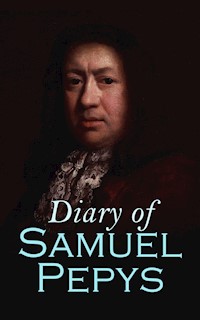
Samuel Pepys' 'Diary of Samuel Pepys' is a firsthand account of life in 17th century England, providing readers with a unique insight into the political and social landscapes of the time. Pepys' diary is known for its detailed descriptions of major events such as the Great Plague and the Great Fire of London, as well as his personal experiences and daily life. Written in a candid and informal style, Pepys' diary is considered a valuable historical document and a masterpiece of English literature, showcasing his keen observations and lively storytelling. The diary offers a window into the past, shedding light on the challenges and triumphs of the period. Samuel Pepys, a naval administrator and Member of Parliament, utilized his position to record contemporary events and personal reflections in his diary. His firsthand experiences and intimate observations provide readers with a vivid and engaging narrative that brings history to life. I highly recommend 'Diary of Samuel Pepys' to readers interested in history, literature, and the human experience, as it offers a captivating glimpse into the past through the eyes of a curious and insightful observer. In this enriched edition, we have carefully created added value for your reading experience: - A succinct Introduction situates the work's timeless appeal and themes. - The Synopsis outlines the central plot, highlighting key developments without spoiling critical twists. - A detailed Historical Context immerses you in the era's events and influences that shaped the writing. - An Author Biography reveals milestones in the author's life, illuminating the personal insights behind the text. - A thorough Analysis dissects symbols, motifs, and character arcs to unearth underlying meanings. - Reflection questions prompt you to engage personally with the work's messages, connecting them to modern life. - Hand‐picked Memorable Quotes shine a spotlight on moments of literary brilliance. - Interactive footnotes clarify unusual references, historical allusions, and archaic phrases for an effortless, more informed read.
Das E-Book können Sie in Legimi-Apps oder einer beliebigen App lesen, die das folgende Format unterstützen:
Veröffentlichungsjahr: 2020
Ähnliche
















Diary of Samuel Pepys
Published by
Books
Table of Contents
Introduction
At the hinge of a restored monarchy, a meticulous clerk learns that the most unruly empire he must govern is his own daily life, where ambition, pleasure, conscience, and duty collide hour by hour in rooms, streets, offices, and theaters, and where the world’s upheavals are measured not only in proclamations and battles but in the price of a meal, the ache of a pair of eyes, the flicker of candlelight over an account book, and the intimate reckonings that turn a single day into a ledger of the soul.
Samuel Pepys, a rising civil servant in Restoration London, kept the diary commonly known as The Diary of Samuel Pepys between 1660 and 1669, charting the intersection of his work at the heart of England’s naval administration with the private routines of a household, friendships, and entertainment. Written close to the events it records, it follows the rhythm of ordinary days rather than a preconceived plot, building a picture of a city and a career in motion. The premise is disarmingly simple: to note what happened, and what it felt like, as life unfolded.
Pepys wrote in a form of shorthand adapted from Thomas Shelton’s system, a private hand that let him write quickly and candidly. He frequently sprinkled the entries with foreign words and abbreviations, further veiling sensitive matters from casual readers. The diary’s continuity is remarkable: he sustained near-daily entries for nine years, often including lists, accounts, and resolutions that show a mind attuned to record-keeping. In May 1669 he brought the project to a close, citing concern for his eyesight, and stored the volumes among the books that would later constitute his carefully curated library.
After Pepys’s death, the original manuscript volumes were preserved in the Pepys Library at Magdalene College, Cambridge, where they remain. Their nineteenth-century decipherment transformed a private record into a public classic. The diary first appeared in print in 1825 in an expurgated edition issued by Lord Braybrooke, based on the painstaking transcription of the Rev. John Smith. Subsequent editors expanded and corrected the text, culminating in the comprehensive, fully annotated edition prepared by Robert Latham and William Matthews between 1970 and 1983, which restored the work’s scale, texture, and linguistic precision for modern readers.
From the moment substantial portions became available, readers recognized the diary’s singular power. It is both documentary and literary: a source of first order for historians of the Restoration, and a masterpiece of English life-writing whose candor, detail, and narrative vitality rival many novels. Its classic status rests on the breadth of its canvas and the intimacy of its focus, the way it can sweep across institutions and then settle on an object on a table. The book also exemplifies a distinctly modern sensibility, attentive to time, money, self-improvement, and the management of competing claims.
Pepys’s gift as a narrator lies in the concreteness of attention. He registers texture, sound, smell, and temperament; he notices the difference between a plan and its messy execution. The entries move with the pace of a day, stitched by errands, appointments, letters, and sudden encounters. Repetition becomes structure, and small variations turn habitual loops into stories. Without contrivance, he shapes scenes, captures idiosyncrasies, and allows irony to emerge from juxtaposition. The language, plain yet lively, is rhythmic with lists and clauses, and the cumulative effect is an intimacy that feels earned rather than confessional.
The diary is animated by recurring themes that remain recognizably human: ambition tempered by anxiety; appetite checked by conscience; public responsibility balanced against private satisfaction. It is a record of work, with its calculations, delays, and negotiations; a record of domesticity, with its budgets, purchases, and moods; and a record of sociability, charting loyalty, rivalry, and influence. Pepys treats memory as a tool of self-governance, returning to resolutions, updating accounts, and gauging progress. The result is a sustained meditation on self-fashioning under pressure, where character is tested as much by routine as by extraordinary circumstances.
Because Pepys writes from within networks of office, household, and city, the diary offers a panorama of Restoration urban life. One moves through chambers of administration, parlors, taverns, and playhouses, witnessing how news and rumor travel, how patronage operates, and how taste is formed. The entries document the technologies of writing and record-keeping, the etiquette of visits and gifts, and the energizing pull of music and performance. At every turn, the material culture of the age—clothes, books, instruments, furnishings—becomes evidence of aspiration and identity, set against the constant negotiation of rank, obligation, and opportunity.
For historians, the diary’s value lies in its proximity to decision-making and its fidelity to dailiness. It traces the ways policies are discussed, offices staffed, and ships supplied, while also noting prices, weather, and work rhythms that rarely surface in formal state papers. The administrative reforms of the decade, the shifting balance of authority among councils and boards, and the practical limits of communication all leave their imprint here. Yet the book never reads like a treatise. Its testimony is embodied in a life, and that embodiment keeps the larger patterns anchored to particular rooms, voices, and tasks.
Across two centuries of readership, the diary has shaped expectations for what a personal record can achieve. It provided a model for intimate prose that nonetheless regards institutions unsentimentally, influencing diarists, biographers, and novelists who prize the texture of lived time. Writers such as Virginia Woolf and Robert Louis Stevenson studied and praised Pepys for precisely this quality, finding in him a companionable witness who enlarges the possibilities of English prose. Editors, too, have taken cues from the diary, building apparatus that respects the grain of daily entries while clarifying names, dates, and procedures.
Modern readers encounter the diary in many forms, from selective abridgements that present a brisk narrative arc to comprehensive editions that preserve every repetition and ledger line. Either path reveals a work that rewards lingering. To read Pepys is to feel how accumulation creates meaning, how habits shape horizons, and how a city prints itself on the mind that measures it. The book’s accessibility is part of its charm: the concerns are practical, the scenes concrete, the voice energetic. Yet its intellectual reach is wide, asking how a life should be organized, remembered, and judged.
That question keeps the diary vividly contemporary. In an age of calendars, metrics, and continuous self-documentation, Pepys’s pages illuminate both the use and the cost of keeping score. They probe the boundary between exposure and privacy, the ethics of ambition, and the consolations of art in crowded times. The book endures because it turns chronology into character and administration into narrative, making the maintenance of a life as absorbing as any plot. Its methods—attention, revision, accountability—remain instructive; its pleasures—curiosity, humor, appetite—remain human. To enter it is to meet a mind learning, day by day, how to live.
Synopsis
Diary of Samuel Pepys is a first-person record kept daily from 1660 to 1669, charting the author’s professional ascent and private life against the turbulent backdrop of Restoration London. Written in shorthand and later published after his death, it combines observations of high politics with minute accounts of work, money, marriage, and leisure. Pepys writes as a practical civil servant learning his trade, attentive to detail and the social rhythms of the city. The entries move chronologically, creating an incremental narrative where minor incidents accumulate into a panorama of government, commerce, and community at a moment when England was redefining its institutions and habits.
Beginning with the return of the monarchy in 1660, Pepys records his duties under his patron Edward Montagu, whose fortunes rise with the new regime. He witnesses the cautious unravelling of the Commonwealth’s arrangements and the re-establishment of court ceremonial and offices. At sea and in London, he notes procedures, favors, and the reshaping of authority. He navigates patronage carefully, capitalizing on opportunity while keeping exact accounts of expenses and gifts. This period culminates in his move into a central administrative post in the Navy Office, setting the stage for the diary’s core subject: the daily labor of sustaining a great maritime power.
Installed at Seething Lane among fellow commissioners and clerks, Pepys lays out a steady portrait of paperwork, audits, contracts, and shipyard visits. He traces the procurement of timber, masts, victuals, and the payment of wages, balancing parsimony with necessity. The diary attends to bottlenecks and abuses—late payments, poor materials, overlapping jurisdictions—and to his own efforts to regularize accounts and assert discipline. He cultivates relationships with merchants and officers, while wary of conflicts of interest. Through meetings, memoranda, and inspections, he learns to translate royal directives into practical outcomes. These entries reveal how policy is implemented, not by decree alone, but through negotiation, oversight, and persistent attention.
Alongside official duties, Pepys chronicles the life of his household with his wife Elizabeth, detailing servants, rents, furnishings, and the steady calibration of status through dress, dining, and decor. The reopening of the theatres after years of closure becomes a recurring pleasure, as he tracks new plays, performers, and fashions. Music lessons and instruments occupy his evenings, and book-buying marks his intellectual appetites. Domestic frictions, reconciliations, and social calls punctuate the rhythm of work, illuminating expectations of marriage and friendship among the middling and court-adjacent classes. Health worries—especially sore eyes from reading and writing—appear intermittently, foreshadowing the strain that diary-keeping itself imposes.
In proximity to Whitehall, Pepys observes the workings of the restored court and its influence on the navy he serves. He notes audiences with superiors, including the Duke of York in his role overseeing maritime affairs, and reports from councils where policy and supply intersect. The diary registers shifts in ministerial favor and the consequences for contracts, appointments, and inquiries. It also records the city’s religious and civic complexion in the Restoration settlement, as parishes, livery companies, and the law adjust to new authorities. Through this vantage, the reader sees how personal access, reputation, and timely information shape outcomes as decisively as formal rank.
As war with the Dutch unfolds, Pepys narrates the mounting logistical demands that accompany fleets sent to sea. He documents the pressure to provision quickly, find seamen, secure credit, and move materials through congested yards. Reports of engagements arrive with rumors and corrections, while victories and setbacks reverberate through the office in urgent orders and recriminations. He records the mood of the city—cheer when news is favorable, anger when pay is delayed or losses are feared—and the scrutiny of Parliament over expenditures. The diary highlights the strain on systems designed for peacetime, revealing the vulnerabilities of finance, transport, and administration under sustained conflict.
Public calamities test both household and state. During the plague, Pepys notes measures to limit contact, closures, and the thinning of streets as mortality rises. Business does not fully stop, and he describes how offices adapt, with letters, couriers, and meetings arranged to continue essential work. The Great Fire brings a different kind of emergency: rapid movement of records and goods, appeals for demolition to halt the flames, and the spectacle of neighborhoods consumed. He chronicles evacuations, temporary lodgings, and the first signs of rebuilding. Through these crises, his entries emphasize prudence, improvisation, and the dependence of order on countless practical decisions.
In the war’s aftermath, Pepys confronts committees and audits examining naval performance, defending procedures while acknowledging deficiencies. Rivalries within the office and shifts in patronage test his position, even as his competence becomes more widely recognized. He records attempts at reform—new contracts, tighter controls, clearer lines of responsibility—and the recurring obstacle of inadequate funds. Socially, he continues his rounds of theatre, music, and visits, yet worries about overwork and the deterioration of his eyesight. The diary moves toward closure as he resolves to rest his eyes and reduce writing, leaving a continuous record that ends not with an event, but with a decision for health.
Taken together, the diary offers an unparalleled cross-section of Restoration England, where statecraft, commerce, and private aspiration intersect. Pepys’s candor and methodical attention render the texture of a city recovering from revolution and adapting to new norms. The work’s enduring significance lies in its fusion of public history with the intimate scale of habit and choice, showing how institutions function through individuals grappling with limits and opportunities. Without relying on grand pronouncements, it illuminates governance, urban resilience, and the ethics of professional life. As a sustained act of observation, it invites readers to consider how daily practice shapes an age.
Historical Context
Samuel Pepys’s Diary is set chiefly in London between 1660 and 1669, the first decade of England’s Restoration. The dominant institutions shaping its world are the reestablished monarchy under Charles II, the restored Church of England, and a bicameral Parliament negotiating its power with the Crown. Administratively, the Navy Board anchors much of Pepys’s daily life, while courts, parishes, and livery companies order urban routines. London, one of Europe’s largest cities, is crowded, commercially vibrant, and vulnerable to disease and fire. Pepys writes as a rising civil servant, observing both courtly spectacle and office minutiae, and his pages track how these institutions recover, adapt, and occasionally falter.
The Diary presumes a background of upheaval. The 1640s–1650s saw civil wars, regicide, and the republican Interregnum under the Commonwealth and the Protectorate. These decades disrupted church governance, curtailed royal prerogatives, and reconfigured the army and navy. Puritan moral regulation reshaped public culture, closing theaters and redirecting civic rituals. Pepys, born in 1633 and educated at Cambridge, matured amid this instability. By 1660, many English elites sought political settlement after military rule and fiscal stress. The Diary’s sharp attention to procedure, office-holding, and legitimacy reflects the generation’s preoccupation with restoring authority without returning to the perceived abuses of the early Stuart monarchy.
The Restoration of 1660 brought Charles II back from exile, framed by the Declaration of Breda’s promises of pardon, property security, and religious moderation. Parliament’s Act of Indemnity and Oblivion (1660) pardoned most who served the regime since 1642, while several regicides were executed. A jubilant civic and court culture reemerged, culminating in the 1661 coronation. Pepys records pageantry, oaths, and the reconstruction of royal households. Yet Restoration also revived questions about royal finance and military control. The Diary’s daily scenes—patronage petitions, ceremonial loyalty, and tensions over revenue—mirror the delicate balance between continuity and change that underwrote the new regime’s legitimacy.
Religious settlement was central. The Church of England regained legal primacy through measures later known as the Clarendon Code: the Corporation Act (1661), Act of Uniformity (1662), Conventicle Act (1664), and Five Mile Act (1665). These statutes enforced episcopal worship and restricted nonconformist public life. Ministers who refused the 1662 Book of Common Prayer were ejected from livings, and lay dissent faced fines or imprisonment. Pepys, no ideologue, observes sermons, churchgoing, and the policing of religious assemblies. The Diary thus tracks how uniformity was reimposed in parish spaces, even as private sympathies and practical toleration complicated enforcement within London’s dense neighborhoods.
Pepys’s career illuminates the Restoration state’s administrative growth. Appointed Clerk of the Acts to the Navy Board in 1660 through the patronage of his kinsman Edward Montagu (later Earl of Sandwich), he worked with the Comptroller, Surveyor, and Treasurer to manage shipbuilding, victualling, dockyards, and pay. The Board coordinated with yards at Deptford, Woolwich, Chatham, and elsewhere, relying on contractors, warrants, and exact paperwork. The Diary details audits, contracts, and the pressures of supply in wartime. Pepys’s diligence and curiosity—visits to ropeyards, experiments with account reforms—expose both the promise and the strain of a modernizing bureaucracy under political scrutiny.
Anglo-Dutch rivalry defined foreign and naval policy. The Second Anglo-Dutch War (1665–1667) arose from commercial competition, colonial friction, and the Navigation Acts (1651, 1660, 1663), which sought to channel trade through English ships and ports. Major engagements included Lowestoft (1665), the Four Days’ Battle (1666), and the St. James’s Day Fight (1666). In 1667, the Dutch raid on the Medway shocked England and hastened peace at Breda (1667), which reshaped colonial holdings. Pepys documents the administrative burdens of mobilization, shortages, and dockyard vulnerabilities, offering a ground-level view of strategic ambitions constrained by finance, logistics, and political will.
Fiscal capacity conditioned policy. Crown revenues after 1660—customs, excise, and the hearth tax (from 1662)—rarely matched wartime needs. Arrears accumulated in the navy, provoking supply crises and public criticism. Parliament established the Commission of Public Accounts (1667), which met at Brooke House to examine spending, including naval contracts. The inquiry coincided with the political fall of Edward Hyde, Earl of Clarendon, amid blame for war failures. Pepys appears frequently in this world of audits and accountability, defending procedures and advocating reform. His entries chart the emerging expectation that executive power submit to financial oversight, a hallmark of later constitutional practice.
The Diary is also a ledger of London’s mercantile dynamism. The Navigation Acts privileged English shipping; the East India Company expanded Asian trade and, in 1668, assumed possession of Bombay from the Crown; and the Company of Royal Adventurers Trading to Africa (chartered 1660, renewed 1663) pursued West African commerce, including the transatlantic slave trade, with royal backing. Coffeehouses multiplied as hubs of information and credit. The official Oxford Gazette began in 1665, becoming the London Gazette when the court returned. Pepys frequents merchants, insurers, and goldsmith-bankers, revealing a city where news, finance, and maritime enterprise intersected with state policy.
Public health catastrophe struck in 1665 with the Great Plague of London. Likely spread by fleas on rats, the epidemic led authorities to enforce quarantine, house shuttings, and movement restrictions. Parish clerks’ Bills of Mortality recorded weekly burials, and many residents, including parts of the court, fled the city. Trade slowed; civic services faltered; and fear reshaped everyday routines. Pepys’s notes on mortality figures, empty streets, and the administration’s responses align with contemporary records. The Diary captures both the fragility of urban life under microbial threat and the continuities—office work, provisioning—that persisted even as death counts spiked.
In September 1666, the Great Fire devastated central London, beginning in a baker’s shop on Pudding Lane and spreading rapidly through timbered buildings and narrow streets. Firefighting relied on buckets, firehooks, and—controversially but effectively—gunpowder to create firebreaks. Old St. Paul’s Cathedral and many parishes were lost; warehouses and guildhalls burned. Immediate relief, property disputes, and plans for rebuilding followed. The Rebuilding of London Act (1667) mandated brick and stone construction and wider streets, while special Fire Courts expedited claims. Pepys’s eyewitness urgency matches civic records, and his entries illuminate how disaster provoked regulatory change and urban redesign.
The Restoration decade coincided with the institutionalization of scientific inquiry. The Royal Society, founded in 1660 and chartered in 1662 and 1663, gathered experimenters such as Robert Boyle, Robert Hooke, and Christopher Wren under the motto “Nullius in verba.” Pepys was elected a Fellow in 1665. The Society promoted observation, measurement, and the publication of natural-philosophical work. The Diary shows curiosity about instruments and demonstrations within a London attuned to novelty. Simultaneously, print culture remained regulated under the Licensing of the Press Act (1662), revealing a tension between controlled information and a widening appetite for news, science, and debate.
Technological and infrastructural changes shaped daily rhythms. The Post Office Act (1660) confirmed a national postal monopoly, improving correspondence flows that Pepys exploited for business and news. Mechanical coinage resumed in 1662, introducing more uniform milled coins and signaling attempts to stabilize currency and deter clipping. Timekeeping improved with better watches and pendulum clocks, aiding navigation and administration. Urban consumption expanded: imported sugar, tobacco, tea, and spices filtered through London’s markets. The Diary’s entries on purchases, repairs, and household provisioning document how technological standardization and global commodities entered ordinary routines, even as costs and shortages constrained behavior.
Restoration leisure revived after decades of austerity. Theaters reopened under royal patents to Thomas Killigrew and William Davenant, and, for the first time in England, women acted on the public stage. Comedies and heroic drama thrived, reflecting and satirizing courtly fashions and urban manners. Music flourished in court and city, with consorts, singing, and new instruments recorded across social levels. Pepys was an avid theatergoer and amateur musician, and his Diary helps date performances, companies, and repertory. His responses mirror broader debates about taste, morality, and expense, situating the arts within a patronage network that also depended on ticket sales and novelty.
Urban society in the 1660s rested on households, parishes, and occupational hierarchies. Livery companies regulated trades; apprenticeships structured training; and servants were integral to domestic economies. Policing relied on parish constables and ward watch. Marriage alliances and dowries shaped property transmission, while women’s legal options were constrained, though widows and traders could exercise economic agency. The Diary’s meticulous record of wages, suits, and disputes illustrates employer–servant relations, neighborly obligations, and social mobility. Pepys’s own advancement through education and patronage typifies a middling official navigating deference and ambition in a city where access to office could transform fortunes.
Imperial and diplomatic contexts inflect Pepys’s pages. The 1662 marriage of Charles II to Catherine of Braganza brought Tangier and Bombay as part of her dowry, requiring English garrisons and maritime support. Tangier became a costly North African outpost, exposed to local warfare and dependent on naval supply—matters that reached the Navy Board. Relations with Spain, the Dutch Republic, and Portugal shifted through treaties and commercial competition, while North African corsair activity challenged shipping. The Diary registers these pressures in contracts, convoy planning, and court discussion, showing how overseas commitments and global trade ambitions strained England’s still-developing fiscal–military apparatus.
Pepys’s writing practice itself belongs to the period’s culture of record-keeping. He wrote the Diary in Thomas Shelton’s tachygraphic shorthand, sometimes mixing languages to guard privacy. The habit of keeping account books, memoranda, and correspondence was shared across offices and merchants. Pepys stopped the Diary in 1669, citing fears for his eyesight. The manuscript remained private until the 19th century, when John Smith deciphered it and Lord Braybrooke published selections in 1825; later, more complete scholarly editions appeared. This transmission history underscores the Diary’s dual identity: an immediate record of the 1660s and a modern source reshaping how that decade is understood.
Gender, sexuality, and court culture form part of the Diary’s social backdrop. Charles II’s court projected splendor and informality, with patronage networks linking mistresses, courtiers, and officeholders. Londoners debated decorum while participating in a looser public sphere of coffeehouses, clubs, and playhouses. Publishing controls and libel prosecutions coexisted with satirical pamphlets and rumor. Pepys’s observations—of fashion, flirtation, and scandal—reflect a society negotiating public and private boundaries in new ways. Although intensely personal in places, his record aligns with broader evidence of shifting norms, suggesting how Restoration civility, commerce, and spectacle complicated older models of piety and restraint. The transitions were uneven and contested, not simply libertine or puritanical in character, but deeply pragmatic and adaptive across city and court.
Author Biography
Samuel Pepys (1633–1703) was an English naval administrator, parliamentarian, and diarist whose writings have become indispensable to understanding Restoration England. Living through the return of the monarchy, the Anglo-Dutch wars, the Great Plague, and the Great Fire of London, he observed public affairs and everyday life with exceptional immediacy. Professionally, he helped modernize administration of the Royal Navy; literarily, he left a private diary unparalleled for its range and candor. Though not published in his lifetime, the diary has shaped historical and cultural narratives of the seventeenth century, offering scholars and general readers alike a vivid window onto governance, urban experience, and emerging modern sensibilities.
Educated at St Paul’s School in London and at Magdalene College, Cambridge, Pepys absorbed a classical curriculum that emphasized languages, rhetoric, and the careful keeping of records—skills that later underpinned his administrative career. As a young man he learned Thomas Shelton’s shorthand, the system he used to write his diary. He also cultivated a life-long interest in music, theatre, and books, participating enthusiastically in the urban culture of his age. The intellectual atmosphere of the Restoration—curious, experimental, and sociable—shaped his habits of observation. He belonged to a milieu that valued practical knowledge, accounting, and systematic note-taking, all of which became hallmarks of his method.
Pepys’s public service rose with the Restoration in 1660, when he joined the Navy Board as a principal administrator. He kept his diary from 1660 to 1669, recording work routines, London streets, playhouses and taverns, as well as national crises. His entries are among the most detailed eyewitness accounts of the Great Plague and the Great Fire, and they track the pressures of war on finance, supply, and shipyards. The diary also reveals how a growing bureaucracy managed complex tasks: audits, contracts, victualling, and dockyard oversight. Its mix of close detail and wide perspective has made it a primary source for naval and urban historians.
Literarily, the diary stands out for its immediacy, self-scrutiny, and descriptive precision. Pepys wrote privately, often switching between English, shorthand, and occasional foreign phrases, creating a record not meant for public view. After remaining in manuscript for generations, his writings appeared in abridged nineteenth-century editions and later in comprehensive twentieth-century scholarship that restored passages and annotations. Readers have praised the diary for its vivid narrative of ordinary time—work, weather, prices, entertainments—as much as for its chronicles of catastrophe. It has influenced biographers, historians, and novelists, who draw on Pepys’s granular observation and narrative pacing to reconstruct social worlds and administrative realities.
Beyond the diary, Pepys’s career advanced through senior posts connected with the Royal Navy and Parliament. He became a prominent voice for professional standards in shipbuilding, victualling, and personnel management, and he pressed for better record-keeping and accountability in contracts and stores. His Memoires of the Royal Navy, published in 1690, distilled administrative experience into a succinct historical overview and rationale for reform. He also authored reports and correspondence that clarified procedures and the chain of command within the naval establishment. These efforts earned him a durable reputation among historians of maritime administration as a practical reformer who combined method with political acumen.
Pepys’s public life intersected with the broader intellectual currents of his day. He was active in the Royal Society and served as its president in the mid-1680s, reflecting his interest in experiment, measurement, and the circulation of knowledge. Political turbulence touched him during the late 1670s, when he was briefly imprisoned amid unfounded suspicions, after which he eventually returned to high office. Throughout, he articulated a governing ethos that valued system over patronage, careful audit over improvisation, and institutional memory over charisma. His papers show a steady attention to training, logistics, and documentation—principles that would shape modern conceptions of civil and naval service.
In later years he withdrew from office, tending to study, correspondence, and the organization of his extensive library. He died in 1703, and his carefully preserved books, manuscripts, and papers—including the diary—were maintained as a coherent collection that is now housed at Magdalene College, Cambridge. That library has made sustained scholarly engagement with his manuscripts possible, anchoring editions and research across disciplines. Pepys’s legacy is twofold: as an administrator who helped rationalize naval governance, and as a writer whose private pages became a public monument. Today his work remains a touchstone for understanding how institutions, cities, and individuals navigated the uncertainties of a transformative century.
Diary of Samuel Pepys
PREFACE
Although the Diary of Samuel Pepys has been in the hands of the public for nearly seventy years, it has not hitherto appeared in its entirety. In the original edition of 1825 scarcely half of the manuscript was printed. Lord Braybrooke added some passages as the various editions were published, but in the preface to his last edition he wrote: “there appeared indeed no necessity to amplify or in any way to alter the text of the Diary beyond the correction of a few verbal errors and corrupt passages hitherto overlooked.”
The public knew nothing as to what was left unprinted, and there was therefore a general feeling of gratification when it was announced some eighteen years ago that a new edition was to be published by the Rev. Mynors Bright, with the addition of new matter equal to a third of the whole. It was understood that at last the Diary was to appear in its entirety, but there was a passage in Mr. Bright’s preface which suggested a doubt respecting the necessary completeness. He wrote: “It would have been tedious to the reader if I had copied from the Diary the account of his daily work at the office.”
As a matter of fact, Mr. Bright left roughly speaking about one-fifth of the whole Diary still unprinted, although he transcribed the whole, and bequeathed his transcript to Magdalene College.
It has now been decided that the whole of the Diary shall be made public, with the exception of a few passages which cannot possibly be printed. It may be thought by some that these omissions are due to an unnecessary squeamishness, but it is not really so, and readers are therefore asked to have faith in the judgment of the editor. Where any passages have been omitted marks of omission are added, so that in all cases readers will know where anything has been left out.
Lord Braybrooke made the remark in his “Life of Pepys,” that “the cipher employed by him greatly resembles that known by the name of ‘Rich’s system[1].’ ” When Mr. Bright came to decipher the MS., he discovered that the shorthand system used by Pepys was an earlier one than Rich’s, viz., that of Thomas Shelton, who made his system public in 1620.
In his various editions Lord Braybrooke gave a large number of valuable notes, in the collection and arrangement of which he was assisted by the late Mr. John Holmes of the British Museum, and the late Mr. James Yeowell, sometime sub-editor of “Notes and Queries.” Where these notes are left unaltered in the present edition the letter “B.” has been affixed to them, but in many instances the notes have been altered and added to from later information, and in these cases no mark is affixed. A large number of additional notes are now supplied, but still much has had to be left unexplained. Many persons are mentioned in the Diary who were little known in the outer world, and in some instances it has been impossible to identify them. In other cases, however, it has been possible to throw light upon these persons by reference to different portions of the Diary itself. I would here ask the kind assistance of any reader who is able to illustrate passages that have been left unnoted. I have received much assistance from the various books in which the Diary is quoted. Every writer on the period covered by the Diary has been pleased to illustrate his subject by quotations from Pepys, and from these books it has often been possible to find information which helps to explain difficult passages in the Diary.
Much illustrative matter of value was obtained by Lord Braybrooke from the “Diurnall” of Thomas Rugge, which is preserved in the British Museum (Add. MSS. 10,116, 10,117). The following is the description of this interesting work as given by Lord Braybrooke
Another work I have found of the greatest value is the late Mr. J. E. Doyle’s “Official Baronage of England” (1886), which contains a mass of valuable information not easily to be obtained elsewhere. By reference to its pages I have been enabled to correct several erroneous dates in previous notes caused by a very natural confusion of years in the case of the months of January, February, and March, before it was finally fixed that the year should commence in January instead of March. More confusion has probably been introduced into history from this than from any other cause of a like nature. The reference to two years, as in the case of, say, Jan. 5, 1661–62, may appear clumsy, but it is the only safe plan of notation. If one year only is mentioned, the reader is never sure whether or not the correction has been made. It is a matter for sincere regret that the popular support was withheld from Mr. Doyle’s important undertaking, so that the author’s intention of publishing further volumes, containing the Baronies not dealt with in those already published, was frustrated.
JANUARY 1659–1660
Blessed be God, at the end of the last year I was in very good health, without any sense of my old pain, but upon taking of cold.
I lived in Axe Yard,
having my wife, and servant Jane, and no more in family than us three. My wife … gave me hopes of her being with child, but on the last day of the year. … [the hope was belied.]
[Ed. note: … are used to denote censored passages]
The condition of the State was thus; viz. the Rump, after being disturbed by my Lord Lambert,
was lately returned to sit again. The officers of the Army all forced to yield. Lawson
lies still in the river, and Monk—[George Monk, born 1608, created Duke of Albemarle, 1660, married Ann Clarges, March, 1654, died January 3rd, 1676.]—is with his army in Scotland. Only my Lord Lambert is not yet come into the Parliament, nor is it expected that he will without being forced to it. The new Common Council of the City do speak very high; and had sent to Monk their sword-bearer, to acquaint him with their desires for a free and full Parliament, which is at present the desires, and the hopes, and expectation of all. Twenty-two of the old secluded members
having been at the House-door the last week to demand entrance, but it was denied them; and it is believed that [neither] they nor the people will be satisfied till the House be filled. My own private condition very handsome, and esteemed rich, but indeed very poor; besides my goods of my house, and my office, which at present is somewhat uncertain. Mr. Downing master of my office.
Jan. 1st (Lord’s day). This morning (we living lately in the garret,) I rose, put on my suit with great skirts, having not lately worn any other, clothes but them. Went to Mr. Gunning’s
chapel at Exeter House, where he made a very good sermon upon these words:—“That in the fulness of time God sent his Son, made of a woman,” &c.; showing, that, by “made under the law,” is meant his circumcision, which is solemnized this day. Dined at home in the garret, where my wife dressed the remains of a turkey, and in the doing of it she burned her hand. I staid at home all the afternoon, looking over my accounts; then went with my wife to my father’s, and in going observed the great posts which the City have set up at the Conduit in Fleet-street. Supt at my father’s, where in came Mrs. The. Turner—[Theophila Turner, daughter of Sergeant John and Jane Turner, who married Sir Arthur Harris, Bart. She died 1686.]—and Madam Morrice, and supt with us. After that my wife and I went home with them, and so to our own home.
2nd. In the morning before I went forth old East brought me a dozen of bottles of sack, and I gave him a shilling for his pains. Then I went to Mr. Sheply—[Shepley was a servant of Admiral Sir Edward Montagu[4]]—who was drawing of sack in the wine cellar to send to other places as a gift from my Lord, and told me that my Lord had given him order to give me the dozen of bottles. Thence I went to the Temple to speak with Mr. Calthropp about the £60 due to my Lord,
but missed of him, he being abroad. Then I went to Mr. Crew’s
and borrowed £10 of Mr. Andrewes for my own use, and so went to my office, where there was nothing to do. Then I walked a great while in Westminster Hall, where I heard that Lambert was coming up to London; that my Lord Fairfax
was in the head of the Irish brigade, but it was not certain what he would declare for. The House was to-day upon finishing the act for the Council of State, which they did; and for the indemnity to the soldiers; and were to sit again thereupon in the afternoon. Great talk that many places have declared for a free Parliament; and it is believed that they will be forced to fill up the House with the old members. From the Hall I called at home, and so went to Mr. Crew’s (my wife she was to go to her father’s), thinking to have dined, but I came too late, so Mr. Moore and I and another gentleman went out and drank a cup of ale together in the new market, and there I eat some bread and cheese for my dinner. After that Mr. Moore and I went as far as Fleet-street together and parted, he going into the City, I to find Mr. Calthrop, but failed again of finding him, so returned to Mr. Crew’s again, and from thence went along with Mrs. Jemimah
home, and there she taught me how to play at cribbage. Then I went home, and finding my wife gone to see Mrs. Hunt, I went to Will’s,
and there sat with Mr. Ashwell talking and singing till nine o’clock, and so home, there, having not eaten anything but bread and cheese, my wife cut me a slice of brawn which. I received from my Lady;—[Jemima, wife of Sir Edward Montagu, daughter of John Crew of Stene, afterwards Lord Crew.]—which proves as good as ever I had any. So to bed, and my wife had a very bad night of it through wind and cold.
3rd. I went out in the morning, it being a great frost, and walked to Mrs. Turner’s
to stop her from coming to see me to-day, because of Mrs. Jem’s corning, thence I went to the Temple to speak with Mr. Calthrop, and walked in his chamber an hour, but could not see him, so went to Westminster, where I found soldiers in my office to receive money, and paid it them. At noon went home, where Mrs. Jem, her maid, Mr. Sheply, Hawly, and Moore dined with me on a piece of beef and cabbage, and a collar of brawn. We then fell to cards till dark, and then I went home with Mrs. Jem, and meeting Mr. Hawly got him to bear me company to Chancery Lane, where I spoke with Mr. Calthrop, he told me that Sir James Calthrop was lately dead, but that he would write to his Lady, that the money may be speedily paid. Thence back to White Hall, where I understood that the Parliament had passed the act for indemnity to the soldiers and officers that would come in, in so many days, and that my Lord Lambert should have benefit of the said act. They had also voted that all vacancies in the House, by the death of any of the old members, shall be filled up; but those that are living shall not be called in. Thence I went home, and there found Mr. Hunt and his wife, and Mr. Hawly, who sat with me till ten at night at cards, and so broke up and to bed.
4th. Early came Mr. Vanly—[Mr. Vanley appears to have been Pepys’s landlord; he is mentioned again in the Diary on September 20th, 1660.]—to me for his half-year’s rent, which I had not in the house, but took his man to the office and there paid him. Then I went down into the Hall and to Will’s, where Hawly brought a piece of his Cheshire cheese, and we were merry with it. Then into the Hall again, where I met with the Clerk and Quarter Master of my Lord’s troop, and took them to the Swan’ and gave them their morning’s draft,
they being just come to town. Mr. Jenkins shewed me two bills of exchange for money to receive upon my Lord’s and my pay. It snowed hard all this morning, and was very cold, and my nose was much swelled with cold. Strange the difference of men’s talk! Some say that Lambert must of necessity yield up; others, that he is very strong, and that the Fifth-monarchy-men[6] [will] stick to him, if he declares for a free Parliament. Chillington was sent yesterday to him with the vote of pardon and indemnity from the Parliament. From the Hall I came home, where I found letters from Hinchinbroke
and news of Mr. Sheply’s going thither the next week. I dined at home, and from thence went to Will’s to Shaw, who promised me to go along with me to Atkinson’s about some money, but I found him at cards with Spicer and D. Vines, and could not get him along with me. I was vext at this, and went and walked in the Hall, where I heard that the Parliament spent this day in fasting and prayer; and in the afternoon came letters from the North, that brought certain news that my Lord Lambent his forces were all forsaking him, and that he was left with only fifty horse, and that he did now declare for the Parliament himself; and that my Lord Fairfax did also rest satisfied, and had laid down his arms, and that what he had done was only to secure the country against my Lord Lambert his raising of money, and free quarter. I went to Will’s again, where I found them still at cards, and Spicer had won 14s. of Shaw and Vines. Then I spent a little time with G. Vines and Maylard at Vines’s at our viols.
So home, and from thence to Mr. Hunt’s, and sat with them and Mr. Hawly at cards till ten at night, and was much made of by them. Home and so to bed, but much troubled with my nose, which was much swelled.
5th. I went to my office, where the money was again expected from the Excise office, but none brought, but was promised to be sent this afternoon. I dined with Mr. Sheply, at my Lord’s lodgings, upon his turkey-pie. And so to my office again; where the Excise money was brought, and some of it told to soldiers till it was dark. Then I went home, and after writing a letter to my Lord and told him the news that the Parliament hath this night voted that the members that were discharged from sitting in the years 1648 and 49, were duly discharged; and that there should be writs issued presently for the calling of others in their places, and that Monk and Fairfax were commanded up to town, and that the Prince’s lodgings were to be provided for Monk at Whitehall. Then my wife and I, it being a great frost, went to Mrs. Jem’s, in expectation to eat a sack-posset[7], but Mr. Edward—[Edward Montage, son of Sir Edward, and afterwards Lord Hinchinbroke.]—not coming it was put off; and so I left my wife playing at cards with her, and went myself with my lanthorn to Mr. Fage, to consult concerning my nose, who told me it was nothing but cold, and after that we did discourse concerning public business; and he told me it is true the City had not time enough to do much, but they are resolved to shake off the soldiers; and that unless there be a free Parliament chosen, he did believe there are half the Common Council will not levy any money by order of this Parliament. From thence I went to my father’s, where I found Mrs. Ramsey and her grandchild, a pretty girl, and staid a while and talked with them and my mother, and then took my leave, only heard of an invitation to go to dinner to-morrow to my cosen Thomas Pepys.—[Thomas Pepys, probably the son of Thomas Pepys of London (born, 1595), brother of Samuel’s father, John Pepys.]—I went back to Mrs. Jem, and took my wife and Mrs. Sheply, and went home.
6th. This morning Mr. Sheply and I did eat our breakfast at Mrs. Harper’s, (my brother John’ being with me,)




