


1,99 €
Mehr erfahren.
- Herausgeber: Quickie Classics
- Kategorie: Gesellschafts- und Liebesromane
- Sprache: Englisch
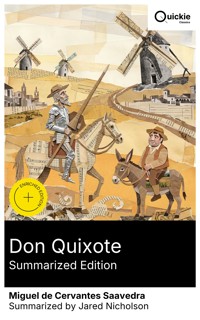
Don Quixote, issued in two parts (1605, 1615), dismantles the waning chivalric romance while helping invent the modern novel. The deluded hidalgo and his canny squire, Sancho Panza, wander early modern Spain in episodes that braid farce with ethical reflection. Cervantes multiplies narrators—chiefly the feigned Arab historian Cide Hamete Benengeli—mixes inserted tales with the main plot, and exploits self-referential play to probe authorship, truth, and perception. The prose toggles between elevated parody and scrupulous realism, portraying a society moving from knightly fictions to pragmatic modernity. Cervantes fought at Lepanto, lost the use of his left hand, and endured years of captivity in Algiers; later, as a tax official and frustrated dramatist under Lope de Vega's shadow, he met Spain's bureaucratic tangles and social margins firsthand. Such ordeals fueled his skepticism toward heroic postures and his compassion for failure, shaping a book obsessed with how reading, desire, and circumstance remake one another. Read this novel for its laughter and lucidity: a study of imagination's dignity and risk, a primer in narrative invention, and a humane portrait of a culture in flux. Whether newcomer or scholar, you will find a companion that still teaches how to read—and how to live. Quickie Classics summarizes timeless works with precision, preserving the author's voice and keeping the prose clear, fast, and readable—distilled, never diluted. Enriched Edition extras: Introduction · Synopsis · Historical Context · Author Biography · Brief Analysis · 4 Reflection Q&As · Editorial Footnotes.
Das E-Book können Sie in Legimi-Apps oder einer beliebigen App lesen, die das folgende Format unterstützen:
Veröffentlichungsjahr: 2026
Ähnliche




Don Quixote (Summarized Edition)
Table of Contents
Introduction
Between the stubborn clarity of dreams and the uneasy blur of reality, Don Quixote unfolds as a grand comedy of misrecognition that asks how far a person can ride an idea before the world, or the heart, reins it in, and it balances parody and pathos, celebrates the stubborn dignity of yearning, tracks the way stories colonize experience, and measures the cost and consolation of living by a code that no longer commands belief, even as it grants courage, comedy, companionship, and a disquieting mirror for readers who still test themselves against the fictions they choose to follow.
Composed by Miguel de Cervantes Saavedra and published in two parts in the early seventeenth century, Don Quixote is a Spanish novel set largely in La Mancha and across the roads and villages of early modern Spain. It builds on and burlesques chivalric romance while drawing energy from picaresque travel narratives, festival comedy, and moral reflection. Emerging from the vibrant literary milieu of Spain’s Golden Age, its pages move between inns, estates, and open countryside, where a self-styled knight and his squire meet commoners, clergy, soldiers, and entertainers. The result is a capacious narrative that accommodates slapstick, meditation, and social observation.
The premise is simple and elastic: an aging landowner, scoured by voracious reading, resolves to live as a knight-errant, renames himself Don Quixote, enlists a practical neighbor as squire, and rides out to enact the virtues he has admired in books. The narrator’s voice is playful and layered, framing episodes through a purported source text and editorial asides that invite readers to consider who controls a story. The style mingles high rhetoric with earthy detail, and the tone shifts from exuberant farce to tender melancholy, producing a reading experience that is vigorous, surprising, and surprisingly humane without disclosing its larger turns.
At its heart lies a meditation on how imagination shapes perception and conduct, testing the borders between what is seen and what is believed. Don Quixote’s ideals rub against the stubborn textures of labor, law, and necessity, yet the novel refuses to treat conviction as mere error, instead probing how identity is enacted through language, costume, and ritual. Friendship, hospitality, justice, and dignity are weighed in shifting circumstances, as stories within stories model how communities negotiate reputation and desire. Cervantes balances sympathetic scrutiny with sharp satire, revealing the entanglement of aspiration and harm without collapsing either into simple praise or scorn.
The book is also an inquiry into how texts circulate and claim authority. Its mock-scholarly apparatus, with a named chronicler and playful disputes over sources, turns reading into an ethical act: to follow a narrative is to accept responsibilities toward characters, authors, and one’s own judgment. Cervantes shows how reputations are built, borrowed, and bruised in a culture saturated with stories, from ballads to gossip to professional performers. As satire, the novel exposes credulity and opportunism; as comedy, it delights in improvisation and linguistic spark; as humane reflection, it honors the stubborn hope that meaning can be made together.
For contemporary readers, its questions feel freshly urgent: how do we tell truth from persuasion, how do ideals endure amid markets and institutions, and what obligations do we owe to those whose visions unsettle our own? The book’s exploration of media influence, performative identity, and the politics of reputation prefigures debates about virality, branding, and public truth. Just as crucial, its portrait of companionship across difference models an ethics of listening without surrendering judgment. In an age crowded with competing narratives, Cervantes offers not certainty but stamina, urging attention, humility, and a comic resilience that makes stamina feel like care.
Approach this novel expecting adventure and laughter, but also intervals of digression, embedded tales, and reflective pauses that enlarge the journey rather than delay it. The pacing is episodic, the scenes vividly staged, and the language—whether in Spanish or in translation—capable of sudden shifts from courtly flourish to rustic bite. Reading with patience lets the central partnership grow in complexity, as the world answers their aspirations with rebuff, surprise, and occasional grace. The reward is both narrative pleasure and a deepening conversation about how people make meaning together, even when they disagree about what stands before their eyes.
Synopsis
Don Quixote, by Miguel de Cervantes Saavedra, unfolds in two parts published in 1605 and 1615 during Spain’s Golden Age. It begins with Alonso Quixano, an aging rural hidalgo from La Mancha, who becomes so absorbed in chivalric romances that he resolves to revive knighthood under the name Don Quixote de la Mancha. Armed with refurbished gear, mounted on the nag Rocinante, and guided by an idealized lady, Dulcinea del Toboso, he sets out to right wrongs. Cervantes establishes a comic yet probing tension between literary fantasy and everyday reality, while introducing narrative frames that question how stories are made and told.
His first foray is solitary and tentative. Mistaking an inn for a castle, he begs to be dubbed a knight, and an amused innkeeper indulges the ceremony. Misreadings multiply: muleteers, merchants, and villagers become, in his eyes, characters from romances. Injuries and confusion follow, and concerned neighbors convey him home. There, a priest and a barber—friends alarmed by his obsession—review his library and debate the value of the books he cherishes. Their intervention underscores the work’s satire of literary excess and sets boundaries between imagination and communal norms, without extinguishing the protagonist’s newly forged purpose.
Undeterred, Don Quixote recruits a neighbor, Sancho Panza, a practical farmer lured by hopes of reward and advancement. Their partnership—one propelled by exalted ideals, the other grounded in earthy proverbs—becomes the book’s central counterpoint. On this second sally, their conversations shape the journey as much as events. Iconic misadventures follow, including the charge against windmills he takes for giants, exemplifying his persistent reinterpretation of the world. Yet his failures rarely diminish his resolve. Sancho, alternately credulous and skeptical, negotiates between loyalty and common sense, learning to translate his master’s visionary language into terms the road can bear.
The pair encounter travelers, tradesmen, and shepherds, mistaking flocks for armies and a barber’s basin for a legendary helmet. These episodes broaden the canvas of early modern Spain, with inns, highways, and village squares serving as stages for argument and storytelling. A rescue of convicts backfires, reminding them—and readers—how zeal can collide with law and consequence. Along the way, embedded tales and confessions from people they meet enrich the narrative, creating a mosaic of voices about love, honor, and fortune. The movement between action and tale-telling deepens Cervantes’s interrogation of truth, perspective, and the uses of fiction.
Driven by setbacks and ideals, Don Quixote withdraws to the wilds of the Sierra Morena to perform stylized penance, echoing the romances he cherishes. Sancho acts as messenger, negotiating delicate errands related to Dulcinea and testing his own ingenuity. Friends from the village devise stratagems that adopt his chivalric vocabulary to guide him safely home, showing how community, benevolence, and gentle deception can check the risks of fanatical reading. This closing of the first phase leaves the knight’s spirit unbroken and the squire’s loyalty complicated, preparing the ground for a renewed departure under altered circumstances.
The second part, published a decade later, acknowledges the fame of their earlier exploits within the story world. Cervantes foregrounds his fictional historian, Cide Hamete Benengeli, to emphasize questions of authorship and reliability. News of an unauthorized sequel circulates, and characters they meet have read about them, shaping expectations and choices. Don Quixote and Sancho set out again with heightened self-awareness, confronting a society now primed to watch, test, and sometimes manipulate them. Recognition turns the road into a theater, where performance and identity intertwine, and where the boundary between lived experience and literary script becomes even more permeable.
A noble household, ruled by a Duke and Duchess, becomes a locus for elaborate entertainments that play on the knight’s ideals and the squire’s ambitions. Apparent enchantments and staged challenges multiply, especially around the figure of Dulcinea, whose status becomes a recurring riddle. Sancho is invited to exercise authority in a mock governorship, providing a lens on justice, policy, and the pressures of office. Meanwhile, Don Quixote’s trials probe the resilience of his code, alternately flattering and undermining his vision. The episodes extend the satire from books of chivalry to courtly manners, social spectacle, and the performance of power.
The journey continues through towns and coasts, into printing houses and public squares, where the pair confronts imposture, celebrity, and the consequences of their own story’s circulation. Challenges from rivals and orchestrators of pageants test the limits of endurance and belief. Sancho’s pragmatism grows alongside his devotion, while Don Quixote wrestles with the fit between moral aspiration and tangible reality. Cervantes threads realistic detail—regional speech, professions, customs—into scenes that are also meditations on truth and invention. The novel’s multiple mirrors reflect readers back to themselves, asking how perception, reputation, and narrative shape the world people inhabit.
Without disclosing later turns, the work culminates in reflections on friendship, dignity, and the responsibilities of imagination. Don Quixote remains a satire of chivalric excess and, at the same time, a sympathetic portrait of idealism confronting a pragmatic age. Its layered narration, self-referential play, and psychological nuance helped define the modern novel’s possibilities. The book endures for its questions: how stories guide action, how communities manage dreams, and how individuals pursue meaning amid ordinary constraints. Across both parts, Cervantes offers a humane, often comic exploration of error and aspiration, inviting readers to measure reality without relinquishing wonder.
Historical Context
Don Quixote appeared in two parts (Madrid, 1605; Madrid, 1615) during the Habsburg rule of Spain. Miguel de Cervantes Saavedra (1547–1616) wrote under the reigns of Philip II and Philip III, as court and administration shifted between Madrid and Valladolid (the royal court moved to Valladolid, 1601–1606, then returned to Madrid). Castile provided the main setting, especially La Mancha, a dry, cereal-growing region dotted with small towns and estates. The monarchy presided over a corporate society structured by orders, privileges, and municipal councils, while royal councils, notably the Council of Castile, oversaw justice and administration. This framework anchors the novel’s roads, villages, and authorities.
Sixteenth-century Spain was shaped by the Catholic Counter-Reformation. The Council of Trent’s decrees were enforced through episcopal visitations, religious orders, and, in Spain, close collaboration between crown and church. The Spanish Inquisition monitored orthodoxy and book circulation, and printing required licenses, privilege, and a price approval (tasa) recorded in front matter. Seville, Madrid, and Salamanca were major printing centers. Don Quixote’s first part was printed by Juan de la Cuesta for the bookseller Francisco de Robles with royal and ecclesiastical licenses. The regulatory regime, together with vigorous urban book trade and public readings, frames the novel’s engagement with books, credibility, and authorized texts.
Spain’s imperial revenues from American silver intensified a long price revolution across Europe in the sixteenth century. Castile, the fiscal heart of the monarchy, endured heavy taxation, rising prices, and repeated royal suspensions of payments (1557, 1575, 1596, 1607). Rural communities in La Mancha and nearby regions depended on grain, vineyards, and some saffron, while the powerful Mesta sheep guild enjoyed crown protection for transhumant grazing. Economic pressures, periodic poor harvests, and indebted municipalities produced itinerant labor, veteran soldiers seeking work, and a visibility of poverty documented by contemporaries. This environment informs the novel’s roads, inns, and encounters with officials, traders, and marginalized people.
Cervantes’s life intersected closely with Spain’s military and administrative world. He fought as a soldier in the Holy League fleet at the Battle of Lepanto (1571), where he was wounded in the left hand. Captured by corsairs in 1575, he spent five years in Algiers until ransomed by Trinitarian friars in 1580. Back in Spain, he worked as a royal commissary requisitioning grain and oil and later as a tax collector, positions that entailed travel, audits, and disputes. A documented imprisonment in Seville in 1597 followed accounting irregularities. Such experiences supplied practical knowledge of officials, contracts, and Mediterranean frontiers that the novel repeatedly references.
The book emerged within Spain’s literary Golden Age, when diverse prose forms flourished. Romances of chivalry such as Amadís de Gaula (popularized in 1508) and Palmerín remained widely read, alongside pastoral fiction, Byzantine adventure, and the Moorish novel. The picaresque, launched by Lazarillo de Tormes (1554) and developed by Mateo Alemán’s Guzmán de Alfarache (1599), offered social critique through low-born narrators. Public and private reading overlapped; episodes were read aloud in homes, inns, and workshops. Cervantes, also an active playwright and poet, shaped Don Quixote as a learned, comic response to these currents, scrutinizing reading habits, narrative authority, and the uses of fiction.
Early modern Castile organized society by estate and privilege. Hidalgos, a lower nobility exempt from certain taxes, often lived modestly while guarding honor and lineage; merchants, artisans, and peasants worked within guilds and municipal regulations. Statutes of limpieza de sangre, adopted by many institutions, restricted access for those of Jewish or Muslim ancestry. Universities at Salamanca and Alcalá trained jurists and clerics who staffed the bureaucracy and parishes. The Santa Hermandad, a crown-backed constabulary, patrolled roads and rural districts. These social and legal structures, together with everyday parish life and guild economies, shape the novel’s attention to status, reputation, and public order.
Spain’s regional variety forms part of the backdrop. Castile’s interior plains contrasted with the irrigated huertas of Aragon and the Mediterranean commerce of Catalonia and Valencia. Travel relied on royal roads, river crossings, and a network of ventas and posadas offering basic lodging to muleteers, merchants, officials, and travelers. The expulsion of the Moriscos (1609–1614), ordered under Philip III, reshaped communities especially in the Crown of Aragon and Valencia. Coastal life remained tied to Mediterranean trade and corsair conflict. Such geography and movement, including journeys toward Aragon and Catalonia, inform the novel’s scenes of transit, regional speech, and encounters across social boundaries.
Part I of Don Quixote went through multiple editions within its first year and soon circulated in Lisbon and Valencia; early translations followed, including Thomas Shelton’s English version (1612) and César Oudin’s French (1614). In 1614 an anonymous writer using the name Avellaneda published a spurious sequel, prompting Cervantes to issue his authorized Part II in 1615. The episode illustrates a competitive, regulated print marketplace and readers’ appetite for satire and adventure. By ridiculing archaic chivalric conventions while depicting magistrates, clergy, soldiers, and tradespeople, the work mirrors Spain’s institutions and strains. Its humor and formal play double as a critique of idealized honor and unexamined authority.
Author Biography
Miguel de Cervantes Saavedra (1547–1616) stands as a central figure of the Spanish Golden Age and a foundational voice in world literature. Best known for Don Quixote, he navigated the turbulent currents of a Europe marked by empire, reform, and artistic innovation. His life encompassed soldiering, captivity, and civil service, experiences that fed a varied oeuvre of prose, poetry, and drama. Cervantes fused humanist learning with acute observation of everyday life, shaping characters whose inner conflicts resonate beyond their historical moment. His narrative experiments—multiple perspectives, authorship games, and tonal shifts—pushed prose fiction toward the modern novel, while retaining a deep engagement with classical and popular genres.
Born in Alcalá de Henares and raised in various Castilian towns, Cervantes likely received a modest education but absorbed humanist currents in Madrid. His earliest known verses appeared in a memorial volume edited by the schoolmaster Juan López de Hoyos, who praised him as a pupil. In the late 1560s he spent time in Italy, including Rome, where he encountered Renaissance art, pastoral poetry, and the Italianate narrative tradition. These encounters deepened his knowledge of classical models and contemporary forms—chivalric romance, pastoral, picaresque, and comic theater—resources he would later recombine with a distinctly observational eye for speech, social codes, and everyday irony.
Cervantes became a soldier in the Spanish forces and fought in the Battle of Lepanto in 1571, where he was wounded in the left hand, a lasting injury he referenced with proud irony. Continuing military service in the Mediterranean, he was captured by corsairs in 1575 and taken to Algiers, remaining in captivity for about five years until ransomed. The hardships, attempted escapes, and the multicultural society of the regency left indelible marks on his imagination. He transformed this experience into drama, notably in El trato de Argel and later in Los baños de Argel, works that examine captivity, conscience, and negotiation across faiths and languages.
After his return to Spain in 1580, Cervantes sought literary standing while earning a living through royal service. He published the pastoral romance La Galatea in 1585 and composed tragedies and comedies, including La Numancia and El trato de Argel, though the changing theater soon favored the innovations of Lope de Vega. As a government commissary he collected grain and oil for the fleet, traveling widely in Andalusia. Accounting disputes and administrative pressures led to legal entanglements, including a brief imprisonment in Seville in 1597. These years broadened his view of Spain’s regions and social strata, enriching the settings, voices, and moral complexity of his later prose.
The first part of Don Quixote appeared in Madrid in 1605 and quickly achieved remarkable popularity. While engaging the conventions of chivalric romance, it subjects them to comic scrutiny and ethical testing, pairing an aging would-be knight with a shrewd squire and drawing on a chorus of storytellers and documents. Readers praised its lively dialogue, experiments with authorship, and the vitality of its characters, who move between illusion and practical reason. The book circulated widely across the Iberian world and beyond, securing Cervantes’s reputation. Its success, however, did not spare him ongoing financial concerns, and he continued to pursue opportunities in poetry and theater.
A fertile closing phase followed. Cervantes published Novelas ejemplares in 1613, a collection of varied prose tales that blend moral reflection with sharp social observation. His mock-epic poem Viaje del Parnaso appeared in 1614, surveying contemporary poets with humor and critique. That same year a spurious sequel to his masterpiece, signed by “Avellaneda,” prompted a swift, authoritative response. The authentic Second Part of Don Quixote (1615) deepened the metafictional play and ethical resonance of the first. He also issued Ocho comedias y ocho entremeses nuevos nunca representados in 1615, demonstrating particular brilliance in the short interludes, where precise types and quick-witted dialogue shine.
Cervantes spent his final years in Madrid, completing Los trabajos de Persiles y Sigismunda, a Byzantine-style romance that was published posthumously in 1617. He died in April 1616, closing a life that mirrored the contradictions of his age: imperial reach and local hardship, lofty ideals and sharp realism. His legacy grew steadily across Europe and the Americas, informing the development of the novel and modern narrative irony. Writers from Fielding and Sterne to Flaubert, Dostoevsky, and Borges have acknowledged debts to his example, while his characters entered global parlance and imagery. Cervantes remains central to debates about fiction, freedom, and the ethics of imagination.
Don Quixote (Summarized Edition)
CONTENTS VOLUME I
An eccentric gentleman of La Mancha makes himself a knight, leaves home on a first sally, convinces an innkeeper to dub him, suffers beatings while friends burn his chivalry books. Renewed, he rides with Sancho Panza, tilts at windmills, duels a Biscayan, hears shepherdess Marcela’s tragedy among goatherds, fights Yanguesans, mistakes an inn for a castle, escorts a corpse, seizes Mambrino’s helmet, frees shackled prisoners, raves in Sierra Morena, enacts wild penance, is duped by Dorothea and his friends, bursts wine skins, listens to a captive’s tale, quarrels over pack-saddles, smites penitents, and, declared enchanted, ends the journey caged and carried home.
CONTENTS VOLUME II
The curate and barber visit Don Quixote, diagnosing madness; Sancho trades barbs with niece and housekeeper; Samson Carrasco debates them; Sancho answers his doubts. Teresa Panza and Sancho jest about ambitions. Niece and housekeeper plead with Don Quixote; he and Sancho set out anew, vowing fealty to Dulcinea. On the road he meets the Cortes of Death cart, the Knight of the Mirrors and Grove, discovering them unmasked. A discreet gentleman, the Green Gaban host, and lions fail to curb his courage. The enamoured shepherd, Camacho's lavish wedding, Basilio's daring ploy, and the wondrous cave of Montesinos follow.
Don Quixote recounts impossible visions, boards an enchanted bark, meets a huntress. A duke and duchess amuse themselves: Dulcinea’s disenchantment, the distressed duenna Trifaldi, wooden steed Clavileño, and Sancho’s island governorship unfold. Cats and bells torment the knight; Sancho judges wisely yet resigns after chaos. Tosilos duels him over a maiden; Altisidora's pursuit, enchanted head, galleys, and fair Morisco cascade. The Knight of the White Moon defeats him, imposing a year’s retreat; he dreams of pastoral life, endures bristly and bizarre trials, returns home, reads omens, falls ill, renounces chivalry, drafts his will, blesses friends, and peacefully dies.
TRANSLATOR’S PREFACE
I: ABOUT THIS TRANSLATION
I reluctantly set aside my cherished plan for a new edition of Shelton’s Don Quixote, now scarce, to begin this task. For some, myself included, his racy English carries a charm no modern version matches. Born in Cervantes’s own era, Shelton heard the tale with a vitality only a contemporary enjoys; he poured Spanish into the English of Shakespeare, who may have ridden home with the book and, beneath the New Place mulberry, greeted a kindred spirit. Yet wide favour is hopeless: his crusted prose pleases only a minority, and his hasty, unrevised first part brims with literal blunders and loose renderings.
Some declare no satisfactory English Don Quixote exists, and the verdict is inevitable: Spanish humour’s sententious terseness seldom survives exile. Idioms bend, words resist, and the flavour can only be distantly imitated. Shelton’s 1608 manuscript, printed 1612, opened the parade. The second part, issued 1620, seems tamer, sparking claims of another hand; yet its closeness, identical mistakes, and unchanged style show the same pen, now older and writing for a bookseller rather than currente calamo. He remains barbarously literal one moment, recklessly loose the next, never suspecting that one Spanish word may need several English faces.
John Phillips, Milton’s nephew, stepped in 1687 with a version, he boasted, “made English… according to the humour of our modern language.” It proved less translation than bawdy travesty, unmatched for vulgar buffoonery. Ned Ward followed in 1700 with a Hudibrastic verse frolic unworthy of the name. In 1712 tea-dealer Peter Motteux offered a concoction “by several hands,” really Shelton filtered through French Saint Martin and larded with Phillips, every Spanish savour replaced by Franco-cockney sauce. Trying to improve Cervantes with street-corner flippancy is as foolish as stuffing lard into prize beef, yet this misrepresentation won extensive favour.
Outrage spurred Charles Jervas, portrait painter and friend to Pope and Swift, to attempt the task in a different spirit. Published posthumously, printers spelled his name Jarvis, and so the error clings. His version has appeared more often than any other, is unquestionably the most faithful, yet few praise it. He offended by asserting Shelton worked from Franciosini’s Italian, ten years too late to be possible, and suspicion deepened when Pope quipped he “translated ‘Don Quixote’ without understanding Spanish.” Critics say he borrowed from Shelton; still, for fifty lines he corrects where Shelton errs once. Accused of stiffness, he chose unsmiling gravity over flippant smiles.
Smollett’s 1755 edition, largely built from Jervas without fresh Spanish, continued the chain. Impostor George Kelly, 1769, merely shuffled Motteux’s words; Wilmot’s 1774 abridgment and Miss Smirke’s 1818 patchwork repeated old fabric; Duffield’s recent set I have only glanced at. Across these efforts two camps emerge: many are content if the adventures arrive in lively garb, however alien; others insist on hearing the tale as Cervantes spoke it, within the limits of another tongue. In truth they need not clash; a translator who respects the classic can still entertain the casual, but his first duty is fidelity.
Therefore my guiding rule is to shun every whiff of affectation. The book itself mocks pretence, and Cervantes abhorred it. Archaising English for colour is mere theatre; Spanish has changed little since the seventeenth century, and most pages of Don Quixote still echo common speech. Simple, direct, everyday words will ride closest to the original, except in the inserted tales and the knight’s florid orations. Household names and phrases long rooted in English should remain unless a clear reason forces change. Above all I accept the Morisco’s charge “not to omit or add anything,” striving for fidelity in letter and spirit.
II: ABOUT CERVANTES AND DON QUIXOTE
For four generations Spain laughed over Don Quixote before anyone wondered aloud, “Who was Miguel de Cervantes Saavedra?” When London printers planned a sumptuous edition in 1738 biographers hunted vainly; all living memory had vanished. Sixteenth- and seventeenth-century Spain cared little for recording “the men of the time,” leaving only hints in Cervantes’ prefaces. Mayans y Siscar pieced scraps together, then Ríos, Pellicer, and finally Navarrete sifted archives. Navarrete truly left no stone unturned, yet confessed, “No letter of his writing survives.” Thus the life of Spain’s greatest humorist must still be rebuilt from fragments and conjecture.
Like Lope de Vega, Quevedo, and Calderón, Cervantes sprang from ancient mountain blood. Chroniclers often call the stock Galician, yet evidence points northwest of Old Castile, at rugged Cervatos where Castile, León, and Asturias meet. Rodrigo Méndez Silva’s vast 1648 genealogy, Illustrious Ancestry, traces the line from the tenth century to Cervantes’ grandchildren. It begins with warrior Nuño Alfonso, almost as famed under Alfonso VII as the Cid under Alfonso VI. Rewarded with lands near Toledo, he built a keep he named Cervatos in memory of his distant “solar.” There the surname first hardened and ancestral pride took root.
At Nuño’s death in 1143 the fortress passed to his son Alfonso Muño, who, when territorial surnames grew fashionable, styled himself Alfonso Muño de Cervatos. His elder son Pedro kept the title, vexing the younger, Gonzalo. Above the Alcántara bridge at Toledo the ruins of San Servando—once San Servan, San Servantes, finally San Cervantes—still crown the ravine. Alfonso VI restored that castle after conquering Toledo in 1085, and family lore claimed the founder’s great-grandfather helped raise its walls. Gonzalo, angered by Pedro’s monopoly of “Cervatos,” adopted the Tagus citadel’s name as his own to “differentiate” himself.
Both surnames flourished. The Cervantes branch proved the hardier, sending shoots into Andalusia, Extremadura, Galicia, and Portugal, producing soldiers, prelates, magistrates, even two cardinal-archbishops. From the Andalusian line came Diego de Cervantes, commander of Santiago; he wed Juana Avellaneda, granddaughter of Juan Arias de Saavedra. Their son Rodrigo married Doña Leonor de Cortinas and had Rodrigo, Andrea, Luisa, and Miguel—the future author. Gazing back upon nine centuries of real warriors, Miguel saw sham knights crowding the printed page, and the contrast sharpened the satire that later toppled chivalry. He also knew families once mighty can “taper like a pyramid.
Miguel was born at Alcalá de Henares and baptized in Santa María Mayor on 9 October 1547. A self-drawn glimpse shows a tawny-haired lad dazzled as Lope de Rueda’s troupe built a plank stage in the plaza and acted rustic farces shaping his future interludes. Drama captured him early. He read voraciously; the first part of Don Quixote proves vast youthful reading—ballads, chronicles, countless romances—half remembered, often misquoted, yet indelibly colouring his mind. Quiet hours poured into pages devoured behind shop counters and under arcades.
Old chivalrous Spain ended with Granada; a new, absolute monarchy harnessed nobles, cities, Cortes, even Inquisition. Abroad the empire glittered, unpaid bills still hidden. Literature, too, was in flux: Garcilaso and Mendoza imported Italian forms; shepherds and nymphs overran verses, scholars collected true ballads, presses flooded streets with romances of chivalry since Montalvo revived Amadís. Printing multiplied treasure and trash alike, and a keen youth could drink from every stream.
Alcalá, then a bustling university town, was paradise for such a reader. Picture the bright-eyed boy pondering a fresh Vida de Lazarillo de Tormes or chuckling at a woodcut of some absurd knight bristling with plumes. His sense of the incongruous, lively at ten, may have sprouted Don Quixote’s first seed. Meanwhile Alcalá’s presses rivalled Burgos and Seville; theology thrived, yet the streets favoured light letters, tempting any child with a few maravedís[1] to barter for dog-eared folios. From such stalls he learned to weigh printed grandeur against common reality.
Biographers once packed him off to Salamanca, but evidence collapses. Rodrigo de Cervantes was poor; why send a son 150 miles when a university stood nearby? A single lost matriculation note glimpsed by Professor Tomás González proves nothing. Miguel’s silence is louder: no campus prank or lecture jest colours his books. All that survives is Professor Juan López de Hoyos calling him “my dear and beloved pupil” in a 1569 memorial volume for Queen Isabel de Valois. Cervantes contributed sonnets and an elegy. None guessed those flickers would ignite Spain’s greatest bonfire.
When Giulio Acquaviva concluded a papal mission in 1568 he whisked Miguel to Rome as chamberlain. Promotion beckoned, yet in 1570 Cervantes enlisted as a common soldier under Captain Diego Urbina in Moncada’s regiment, then serving Marc-Antonio Colonna. Europe braced for Ottoman clash. Though fever-stricken below decks on 7 October 1571, he rose, declaring, “I choose death in the service of God and the King over health.” Aboard the galley Marquesa he fought through Lepanto[2], receiving two shots in the chest and one that crippled his left hand.
Seven months in Messina’s hospital could not restore the limb, though Mercury later assured him it was “for greater glory of the right.” Fit enough, he joined Manuel Ponce de León’s company in 1572, served at Tunis and La Goletta, then secured leave to sail home. On 26 September 1575 the Sun galley met Algerine corsairs. After stout resistance Miguel, his brother Rodrigo, and other officers were overpowered and carried to Algiers, chains clanking on the crowded deck.
Dali Mami, captor of the brothers, found letters from Don John of Austria and Sicily’s Viceroy recommending Miguel for command, and valued the prize exorbitantly. Rodrigo de Cervantes sold all he owned, sisters surrendered dowries, yet the offer was spurned. Rodrigo the brother was ransomed, returning to Spain to hire a vessel. Miguel attempted escape toward Oran with several comrades, but their Moorish guide deserted after a day, forcing the band to crawl back unbroken.
Undaunted, he hatched a bolder plot. In a seaside garden he and a Spanish gardener hollowed a hideout, ferrying fourteen captives, feeding them for months, awaiting Rodrigo’s ship. Lanterns glimmered offshore, but a fishing boat scared the crew. Renewed attempts led to arrests; soon Turkish troops ringed the garden. Cervantes ordered companions to accuse no one. Before Dey Hassan he declared, “I alone contrived everything.” The gardener was hanged; Cervantes was bought for 500 crowns.
Hassan imprisoned his dangerous purchase, yet Cervantes smuggled a letter to Oran seeking rescue. The courier was seized; Hassan impaled him and ordered two thousand blows for Cervantes. Intercession spared his life, but irons grew heavier, guard stricter. Months crawled; still he fed fellow captives hope, whispering bold counsel through the bars.
At last he arranged, through a renegade and two Valencian merchants, to buy an armed vessel and spirit sixty captives away. Dominican Juan Blanco de Paz, jealous of his influence, betrayed the plan. Merchants urged Miguel to flee secretly; he responded, “None shall suffer through me,” and surrendered. Hassan tied a halter round his neck, ready to hang him unless he named accomplices. Cervantes insisted four gentlemen, now gone, helped; the sixty knew nothing. Hassan flung him back in chains.
Meanwhile family and Trinitarian friar Juan Gil scraped 300 ducats. Hassan, sailing for Constantinople, meant to take his slaves; Miguel already lay chained on board when the Dey relented, halving the demand. Gil borrowed the rest; on 19 September 1580 Cervantes stepped ashore free after five years minus one week. Learning Blanco de Paz forged charges for the Inquisition, he drafted twenty-five questions and gathered eleven depositions praising his conduct.
Each witness, in solemn prose, described the man who comforted faint-hearts, shared his purse, devised escapes, acting as “father and mother” to the destitute. Admiration trembled beneath legal formulas, painting a hero no torture could bend. His old regiment marched to Portugal to uphold Philip’s claim, and poverty drove him to rejoin. He served in the Azores in 1582 and 1583, dreaming of literature while powder smoked.
Peace returned; he reached Spain late in 1583 bearing two manuscripts: the pastoral Galatea and the opening of Persiles y Sigismunda. Some say he also returned with infant daughter Isabel de Saavedra, a claim resting on a 1605 document naming her his natural child. Promotion seemed hopeless for a one-handed soldier; at thirty-seven he chose letters over barracks, trusting the muses rather than uncertain pay.
Galatea appeared at Alcalá in 1585, pleasing readers without enriching its author. While it passed through the press he married Doña Catalina de Palacios Salazar y Vozmediano of Esquivias, whose small dowry stilled hunger. Inflamed anew by boyhood memories, he plunged into drama. Within three years he wrote perhaps thirty plays. “They were never pelted with cucumbers, and no one hissed,” he later boasted. Yet they failed to hold the stage; only Numancia and Trato de Argel survive—noble in feeling, incurably clumsy. Disappointed, he soon sought other bread beyond the footlights.
A 1592 contract shows resilience: with manager Rodrigo Osorio he promised six comedies at fifty ducats each, fee payable only if deemed “among the best ever played in Spain.” None qualified. Better fortune came at Saragossa, where his elegy for Saint Jacinto won three silver spoons in 1595. The crown then appointed him collector of Granada revenues, an itinerant post paying little but offering mileage and human scenery. He tramped dusty roads, slept in ventas, scribbled receipts, storing faces and voices that later filled Don Quixote’s highways.
Trusting a bankrupt merchant to remit funds, he found accounts short, was jailed in Seville in September 1597, and freed by year’s end on security. Behind bars, or on collecting tours, he watched Benedictine monks on tall mules, strolling actors in gaudy garb, barbers with basins, recruits singing beside bundles, reapers listening to Fierabrás near a gateway, ventas where Helen and Paris or weeping Dido decorated smoky walls. Those Hogarthian touches brightened later pages. Perhaps, too, he glimpsed a gaunt hidalgo with lean hack and greyhound, dreaming away the vanished Reconquista.
Triana’s rogues tempted his pen; there he drafted the sparkling Rinconete y Cortadillo, embryo of later humour. After 1598 his trail blurs until 1603, yet tradition whispers he began Don Quixote in prison, reading chapters at the Duke of Béjar’s. Publishers balked until Francisco Robles bought the manuscript, claiming copyright only for Castile. Hopeful at last, Cervantes saw printing finished in December 1604 in bustling Cuesta’s shop.
New Year 1605 burst with Don Quixote’s arrival. Readers roared; pirates rushed Lisbon and Valencia editions; Robles hurried a second issue, securing Aragon and Portugal rights by February. Some grandees scowled at a book mocking cherished romances, dramatists near Lope bristled, culto poets sneered, yet wits applauded. Cervantes, living in Valladolid, earned little coin, supporting himself drafting petitions and sharing lodgings with wife Catalina, daughter Isabel, sister Andrea, niece Constanza, and enigmatic Magdalena de Sotomayor together.
The book marched beyond Spain. Brussels printed it in 1607; Madrid needed a third home edition in 1608; Milan followed 1610; Brussels again 1611. Still Cervantes delayed the sequel. Instead he shaped a dozen Novelas ejemplares, issued in summer 1613, dedicating them to Conde de Lemos. In the preface he teased, “You shall soon see further exploits of Don Quixote and humours of Sancho Panza.” Readers rejoiced, but Cervantes’ heart still burned for dramatic glory; the stage, not the saddle, beckoned again.
He believed Spain’s theatre needed reform. Managers, he complained, pandered to childish tastes; Lope spun plays by the ream while true art starved. Cervantes meant to found a national drama on Greek principles—Numancia his model—yet managers rejected new scripts. In the Novelas preface he calls Don Quixote his step-child, caring less for that “mere book of entertainment” than for unperformed comedies. At sixty-eight he boasted Engaño a los ojos, still in draft, would silence cavillers and raise him beside Aeschylus upon Spain’s stage to universal applause and wonder.
October 1614 dealt a blow: a small octavo printed at Tarragona proclaimed Second Volume of Don Quixote by “the Licentiate Alonso Fernández de Avellaneda.” Its preface jeered—Cervantes was old, one-handed, poor, envious, petulant, a jailbird. Avellaneda, clearly a playwright of Lope’s clique, usurped his characters and fouled his name. Cervantes bristled; fearing other interlopers, he vowed to finish his own sequel and “leave no corner for poachers,” resolving, if need be, to kill his knight forever.
From that moment he wrote like a man pursued. By early 1615 the manuscript lay complete: Don Quixote must die, Dulcinea remain enchanted, Sancho shine brighter. Presses delayed, yet in December 1615 the authorised Second Part appeared—richer, easier, expanding Sancho’s reign in Barataria, chastising Avellaneda, closing with the Knight’s calm testament against future sallies. Meanwhile Cervantes published eight comedies and interludes with a sparkling prologue recounting Spain’s early stage and promising Engaño still to come.
Dropsy betrayed him. From bed he dated Persiles’ dedication to Lemos, 19 April 1616, saying he signed “with my foot already in the stirrup.” Four days later, 23 April, he died—the same date England marks for Shakespeare. He faced death cheerfully and was buried in the Trinitarian convent where daughter Isabel likely professed. Later the nuns moved, carrying their dead; whether Cervantes’ bones travelled or lie lost Madrid has searched in vain for.
Some biographers call his life unhappy—poverty, toil, disappointment—but he sighed only once: “Happy the man whose bread comes from Heaven alone.” Fortitude, humour, and sanguine spirit armed him. He laughed over penury, plotted amid chains, dreamed after failure. His struggles matched thousands of hard-pressed Spaniards; what marked him was the alchemy turning misery into golden pages, swords and basins into windmills, prison rust into laughter. He accepted his portion bravely and, by accepting, conquered it for all future hungry dreamers.
Spain is chided for neglect: no grand tomb, no early monument. Yet what could bronze add to a name stamped on every stall? Cervantes held no posts worthier than other strugglers; playgoers were not bound to applaud clumsy tragedies because he would later write Don Quixote. The public did its part: it read, laughed, bought, giving thirty thousand sales before his death. Many editions sufficed awhile, but by 1634 demand revived, and since then presses have scarcely rested, each language claiming the Knight and his squire as their own treasure.
Except the Bible, no book has flown farther. Within seven years Don Quixote spoke French, English, Italian, German; now he greets every tongue. The most cosmopolitan tale is also the most Spanish: as Manon embodies France and Tom Jones England, so Don Quixote breathes Castile’s dust, yet stands on Eskimo shelves and Indian bazaars. What secret draws all minds? Partly universal humour, partly wisdom, but chiefly irresistible farce—sheep battles, wineskins spurting, windmills whirling, Sancho tossed skyward again and again.
England first clothed the Knight properly. The sumptuous 1738 London edition, urged by Lord Carteret, provided fine paper, plates, and a carefully collated text. Scholars shifted from laughing to dissecting; critics soon claimed the humour secondary, an allegory of Ideal versus Real, and printers heaped commentaries. Though many emendations proved fanciful, the movement rescued the novel from chap-book squalor and made accuracy fashionable, so Ibarra’s splendid 1771 Spanish edition followed the English lead and raised standards for ever.
While allegorists dreamed, simple fact remained: Cervantes meant to bury the romances of chivalry, not chivalry itself. For two centuries presses had spewed Amadises and Palmerins; preachers and magistrates denounced the craze; he chose ridicule for broom. His book laughed away sham chivalry, not the spirit that died with Granada. Don Félix Pacheco later said Cervantes’ single laugh checked street swaggerers and hushed Spanish councils for a century. He wielded no philosophy but common sense sharpened to a gleaming Castilian rapier of wit alone.
Cervantes began with no elaborate scheme—only a crazed gentleman acting out printed fantasies. The earliest manuscript lacked divisions or Cid Hamete; these he inserted later, parodying chivalric authors’ mysterious sources. Sancho Panza was absent at first; the landlord’s remark that every knight travels with a squire inspired the incomparable peasant. When Sancho asked to bring his donkey, violating all romance decorum, Cervantes struck the keynote of incongruity. Sancho’s blunt realism forever punctures his master’s bubbles, drawing laughter and revealing deeper truths of delusion and humanity.
By the Second Part, Don Quixote and Sancho lived independently. The prose flows easier; reflection mingles with farce; Cervantes reminds us the Knight’s madness is limited to chivalry. Don Quixote shows flashes of individuality—irascible yet placable, patient with Sancho’s chatter. Sancho, no longer merely greedy, becomes master liar: first over Dulcinea’s enchantment, later atop wooden Clavileño. His homely, plausible lies win readers. By them the sequel surpasses the opening in vital charm today.
Cervantes’ stage is La Mancha, Spain’s driest plateau—a deliberate joke lost on some. Nothing there suggests romance; even the windmills are shabby. Setting a knight-errant amid this barrenness, lodging him in ventas mistaken for castles, creates the absurd contrast on which much humour rests. Illustrators who place him by ornate fountains miss the point: he should watch arms beside a rough stone trough. Prosaic surroundings magnify ideal dreams, and the reader laughs at the collision between Manchegan dust and pages of Amadís until wind clear vision.
Spanish humour thrives on dead-pan gravity; Cervantes relates marvels as plain fact, never winking. Castilian cadence doubles the jest, making Sancho’s blunders resonate. Translators struggle; flippant tones flatten jokes, and even grave English cannot mimic that sonorous simplicity. Phillips’ crudeness fares worse. The secret is the author’s serious air: we are left alone with knight and squire, while later humourists, from Sterne onward, peep over the page. Cervantes remains invisible, the straight-faced conjurer who lets absurdity expose and exhaust itself before our eyes.
Beyond the pair stands a teeming gallery: bachelor Carrasco, earnest curate, sharp Teresa Panza, coquettish Altisidora, even nameless students on the road. None are lay figures; each breathes life, and none are hateful—Maritornes, for all dubious virtue, owns a kind heart. Sancho, dissected, shows little lovable save loyalty, yet the world loves him. Such inexhaustible humanity keeps the novel fresh. Cervantes planted them once; readers water them anew each century, finding faces of neighbours and echoes of themselves among the pages of Don Quixote’s Spain.




