


0,49 €
Mehr erfahren.
- Herausgeber: Quickie Classics
- Kategorie: Abenteuer, Thriller, Horror
- Sprache: Englisch
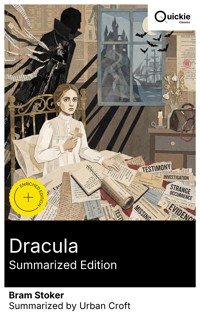
Dracula unfolds through diaries, letters, telegrams, a ship's log, and phonograph transcripts, assembling a mosaic of testimony that drives its relentless suspense from Transylvania to Whitby and London. Stoker fuses high Gothic atmosphere with the apparatus of modernity—typewriters, rail timetables, and experimental blood transfusions—stage-managing a polyphonic hunt for an elusive predator. The novel channels late‑Victorian anxieties about degeneration, sexuality, and "reverse colonization," balancing scientific rationalism with folklore as Van Helsing, Mina, and their cohort confront a foreign, mobile aristocrat who weaponizes secrecy and contagion. Bram Stoker, Dublin‑born and educated at Trinity College, combined a disciplined civil‑service mind with decades as Henry Irving's manager at London's Lyceum Theatre, honing a dramatist's sense of pacing and spectacle. His Whitby sojourn and meticulous notebooks—fed by travel guides, medical journals, and Emily Gerard's account of Transylvanian superstitions—supplied the novel's geography and lore. The result, published in 1897, synthesizes theatrical set pieces with contemporary debates on criminology, psychology, and technology, reflecting an author fascinated by how modern record‑keeping might battle the uncanny. Recommended for readers of Gothic fiction, cultural historians, and thriller enthusiasts alike, Dracula remains a brisk, unsettling study of modernity besieged—at once page‑turning entertainment and a touchstone for interpreting our archival age. Quickie Classics summarizes timeless works with precision, preserving the author's voice and keeping the prose clear, fast, and readable—distilled, never diluted. Enriched Edition extras: Introduction · Synopsis · Historical Context · Author Biography · Brief Analysis · 4 Reflection Q&As · Editorial Footnotes.
Das E-Book können Sie in Legimi-Apps oder einer beliebigen App lesen, die das folgende Format unterstützen:
Veröffentlichungsjahr: 2026
Ähnliche




![DRACULA by Bram Stoker [2025 Kindle Edition] - The #1 Classic Vampire Horror Novel that Inspired Nosferatu | FREE with Kindle Unlimited - Bram Stoker - E-Book](https://legimifiles.blob.core.windows.net/images/1519075e598819811bf5aaf3b61c7775/w200_u90.jpg)





Dracula (Summarized Edition)
Table of Contents
Introduction
Between the bright confidence of modern reason and the shadow of an ancient hunger, Dracula stages a contest for the soul of a rapidly changing world, setting doctors, solicitors, and diligent companions armed with diaries, timetables, shorthand, and new machines against a patient, predatory force older than borders or science, tracing how fear travels by ship and whisper and how courage gathers in copied pages and midnight councils, so that the very tools meant to measure and master reality become both the record of encroaching dread and the means by which disciplined friendship, careful inquiry, and steadfast hope seek to resist it.
Bram Stoker’s Dracula, first published in 1897, is a landmark of Gothic horror that merges supernatural terror with the textures of late nineteenth‑century life. An Irish author writing for a British audience, Stoker locates his tale between the stark landscapes of Transylvania and the busy streets and harbors of England, including coastal and urban settings that channel the era’s mobility and unease. The novel’s epistolary form—diaries, letters, telegrams, newspaper clippings, and institutional reports—situates it amid rapid technological change. It stands at the hinge of the Victorian age, where scientific optimism meets the persistence of folklore and the uncanny.
The premise begins in professional routine: a young solicitor, Jonathan Harker, travels to the Carpathian Mountains to finalize a real‑estate transaction for an enigmatic nobleman. The castle he enters is full of hospitality and strangeness, where ordinary habits are subtly disturbed until ordinary certainty no longer holds. Back in England, odd events ripple outward, drawing friends, fiancés, and physicians into a web of observation and response. Stoker’s mosaic of documents creates a shifting chorus of voices. The reading experience moves from meticulous travel notes to confidential confessions, from clinical case entries to urgent telegrams, building suspense through accumulation rather than spectacle.
One of the novel’s central themes is the contest between modern knowledge and ancient threat. Stoker populates the story with typewriters, shorthand notebooks, phonograph cylinders, train schedules, and medical procedures, setting them against superstition, local lore, and forms of predation that ignore borders. The characters’ effort to compile, compare, and interpret data becomes a defense against confusion and fear. Yet the book acknowledges that facts alone cannot calm the dark; courage, trust, and moral clarity must organize the evidence into action. The result is at once procedural and uncanny, a thriller of paperwork whose margins glow with primal dread.
Dracula also examines intimacy, consent, and the vulnerability of bodies and minds. The diaries are acts of self‑exposure as much as record‑keeping, revealing how love, friendship, and conscience turn private experience into shared resolve. Mina’s coordination of documents exemplifies practical intelligence and ethical steadiness; Dr. Seward’s recordings show science striving to understand what it does not yet have language for; Van Helsing, trained in medicine yet attentive to folk wisdom, bridges disciplines and generations. Their collaboration turns a scattered company into a purposeful community, suggesting that solidarity and careful listening can face what isolated brilliance cannot.
The book’s influence can be measured not only in the vast afterlife of adaptations but in the way it codified a modern image of the vampire while keeping mystery intact. Stoker’s settings—storm‑lashed seas, abbey ruins, fog‑bound streets—lend the supernatural a palpable geography, rooting myth in ports, parlors, and hospitals. The narrative’s methodical pace and documentary form distinguish it from later retellings that emphasize spectacle. Stoker’s original remains a study in atmosphere and method, carefully layering rumor, evidence, and intuition until the invisible gains weight and the ordinary world seems porous to a will that travels by night.
For contemporary readers, Dracula endures because it speaks to perennial anxieties: contagion, coercion, manipulation, and the ethics of gathering and sharing information. Its epistolary collage anticipates a world of feeds and files, where truth must be assembled from partial, sometimes contradictory accounts. The novel’s attention to borders, ships, and railways resonates with ongoing questions about movement and safety; its concern with autonomy and trust feels urgent in any era of charismatic exploitation. Read today, Stoker’s work invites vigilance without despair, reminding us that knowledge joined to compassion—and organized with care—can turn fear into concerted, resilient action.
Synopsis
Published in 1897, Bram Stoker’s Dracula is a Gothic novel presented through an assemblage of diaries, letters, telegrams, newspaper reports, and official memoranda. This epistolary design invites readers to piece together a case file, balancing testimony, dates, and observable facts. The narrative opens with Jonathan Harker, a young English solicitor, traveling to the Carpathian Mountains to assist a Transylvanian nobleman, Count Dracula, with a London property purchase. Rustic warnings and unnerving incidents accompany his journey, yet professional duty keeps him on course. At the castle, courteous ritual mixes with an odd emptiness, and Harker’s practical notes acquire an undercurrent of fear as hospitality turns claustrophobic.
In the castle’s isolated halls, Harker notices irregularities that chip away at his confidence: the absence of servants, strange nocturnal habits, and a growing sense that his movements are watched. The Count questions him closely about English customs and geography, showing an intense interest in urban life and anonymity. Wolves, mists, and sudden changes in weather heighten the impression of a hostile landscape governed by an unseen will. Letters are controlled, mirrors on experience distort, and doors that should open do not. Gradually Harker recognizes he is not a guest but a captive, and what began as routine legal work threatens to become a struggle for survival.
From this remote terror, the narrative shifts to England, where Mina Murray and her friend Lucy Westenra write from the seaside town of Whitby. Their entries capture small social rhythms—strolls, reading, proposals of marriage—set against unusual atmospheric phenomena. Lucy receives several proposals, accepts one, and remains close with the others, binding a circle of men who will later cooperate. A storm-driven ship arrives under disturbing circumstances, and provincial curiosity turns to unease. Newspaper clippings and official notes record the event with procedural calm, yet the timing coincides with nocturnal disturbances and a growing sense that something alien has slipped quietly into the country.
Lucy begins to suffer from a mysterious illness marked by fatigue and episodes of sleepwalking, troubling those around her. Dr. John Seward, who directs a nearby asylum and once sought Lucy’s hand, consults his mentor, Professor Abraham Van Helsing, a Dutch physician and scholar with wide learning. Their examinations blend the latest medical techniques with unorthodox precautions, revealing a puzzle that resists purely rational mapping. Watchfulness is arranged, remedies are attempted, and records of symptoms are meticulously kept. The doctors are torn between clinical certainty and a dawning recognition that older, folkloric explanations might illuminate patterns modern medicine cannot yet fully explain.
At the asylum, Seward studies a patient named Renfield, whose compulsions revolve around appetite, hierarchy, and the intake of living things as a way to accumulate vitality. His case notes, cool in tone yet unsettled in implication, develop a thematic counterpoint to the larger mystery: predation, dependency, and the exchange of life. Renfield’s moods and declarations appear to rise and fall with events outside his cell, suggesting a link between private delusion and public menace. Through him, the narrative tests the limits of diagnosis, asking how far scientific categories can go when confronted with behavior that seems to coordinate with unseen forces.
Converging evidence leads Van Helsing and his allies to entertain an extraordinary hypothesis: a predatory being from distant lands has established a foothold in modern London. The group tests their theory by correlating symptoms, sightings, shipping records, and the geography of recent events. Protective symbols, surgical procedures, and careful vigilance are deployed alongside skepticism, for the investigators must justify each step to themselves and to their companions. London’s streets, churches, and houses become a contested map where tradition and technology meet. The novel thus stages a debate between superstition and empiricism, with both summoned into service against a threat that exploits doubt.
Mina’s diligence becomes central as she assembles diaries, clippings, and transcripts into a coherent archive, using shorthand, typewriting, and indexing to transform scattered testimonies into intelligence. Patterns emerge: consignments, timetables, and unusual real-estate holdings point to networks of refuges maintained under an assumed respectability. The team traces shipments associated with earth-filled boxes, noting how ordinary commerce can shelter extraordinary designs. Clues are verified with public records and private recollections, turning bureaucracy into a tool of pursuit. As the circle of knowledge widens, danger presses inward, and the investigators realize that information confers both power and exposure in a contest fought largely at night.
The allies—Mina, Jonathan Harker, Arthur Holmwood, Dr. Seward, Quincey Morris, and Van Helsing—formalize their purpose and divide labors, balancing personal affection with grim responsibility. Their work demands persistence, secrecy, and moral clarity in the face of suffering that touches those they love. Scenes of quiet domestic care alternate with tense vigils and strategic searches, while the cost of action is measured in fatigue and risk. The narrative widens beyond London as the adversary’s movements necessitate travel and coordination across borders. Ethical questions recur: how to show mercy to the afflicted, how to protect the innocent, and how to confront an enemy who thrives on invitation.
Without disclosing the final turns, the novel builds toward an organized confrontation grounded in shared records, faith, and disciplined reasoning. Dracula endures as a touchstone of modern Gothic because it fuses folklore with the instruments of a bureaucratic, technological age, translating ancient dread into ledgers, maps, and sworn statements. Its epistolary method anticipates procedural and detective storytelling, while its emphasis on cooperation gives moral shape to the pursuit. The book’s influence on later vampire fiction is extensive, fixing motifs of migration, secrecy, and seductive power, and its central question remains resonant: how a modern society can recognize and counter a hidden, predatory threat.
Historical Context
Published in 1897, Dracula emerged in late Victorian Britain, a period marked by industrial maturity, imperial reach, and confidence tempered by unease. London functioned as an imperial hub linked by railways, steamships, and the telegraph, while the General Post Office, the Metropolitan Police, and expanding hospitals embodied modern bureaucratic life. New consumer technologies—the typewriter, camera, and phonograph—entered offices and homes, and mass-circulation newspapers shaped public opinion. Higher literacy created a large market for popular fiction. Against this setting of organized, measurable progress, Bram Stoker situated a tale that confronts modern institutions with archaic beliefs and tests whether contemporary tools can master ancient threats.
Dracula stands within a long Gothic lineage that stretched from Horace Walpole and Ann Radcliffe to nineteenth‑century reinventions. The vampire had earlier entered English literature through John Polidori’s The Vampyre (1819), the serial Varney the Vampire (1845–1847), and Sheridan Le Fanu’s Carmilla (1872). By the 1890s Gothic motifs circulated through sensation fiction, stage melodrama, and penny papers, overlapping with the era’s fascination with crime. The 1888 Whitechapel murders exposed fears about urban anonymity, policing limits, and a voracious press. Stoker’s novel uses epistolary fragments, clippings, and official reports in a manner recognizable to readers saturated with sensational journalism and documentary realism.
In the 1890s Transylvania formed part of the Kingdom of Hungary within the Austro‑Hungarian Empire, a region Western travelers described as mountainous, multiethnic, and remote from London’s modern rhythms. Stoker researched Eastern European folklore through published sources. His notes cite William Wilkinson’s 1820 Account of the Principalities of Wallachia and Moldavia, which mentions a historical figure called “Dracula,” and Emily Gerard’s 1885 essay “Transylvanian Superstitions,” which summarized local beliefs and introduced terms like “nosferatu” to English readers. Such materials equipped him to juxtapose British administrative order with the era’s ethnographic curiosity about the Carpathians, staging encounters between mapped modernity and perceived borderland traditions.
Victorian science shaped both professional practice and popular imagination. Germ theory and antiseptic surgery gained ground from the 1860s; laboratory bacteriology advanced under Robert Koch. Psychiatry developed within asylums overseen by “alienists,” while hypnotism and mesmerism were debated at medical societies. Blood transfusion was attempted but remained perilous before Karl Landsteiner identified blood groups in 1901. Organizations like the Society for Psychical Research (1882) examined claims of the supernatural, and public interest in spiritualism endured. Stoker incorporates this scientific and para‑scientific milieu through doctors, case notes, hypnosis, and cutting‑edge devices such as the phonograph and typewriter, testing the reach of empirical method.
The 1890s hosted vigorous debate about the “New Woman,” a term popularized by Sarah Grand in 1894 to describe educated, self‑reliant women demanding broader roles. Legal reforms like the Married Women’s Property Acts (1870, 1882) altered domestic economics, and women increasingly entered clerical and service occupations associated with the typewriter and shorthand. Campaigns for higher education and suffrage gained visibility; the National Union of Women’s Suffrage Societies formed in 1897. Victorian conduct literature emphasized chastity and respectability even as urban life complicated supervision. Dracula reflects these tensions by featuring female characters with professional skills alongside anxieties about vulnerability, autonomy, and social reputation.
Britain’s global empire fostered pride and a sense of exposure. Steamship routes and undersea cables bound distant ports to the metropole, accelerating the movement of people, goods, and ideas. Cultural debates about national vitality flourished: Francis Galton named eugenics in 1883; Cesare Lombroso advanced criminal anthropology; and Max Nordau’s Degeneration (1892) diagnosed cultural fatigue. In this climate the notion that external or atavistic forces might infiltrate civil society had public resonance. Dracula channels such anxieties by imagining a predatory foreign presence entering modern networks and testing urban resilience, while also portraying coordinated expertise as a counterforce to perceived decline.
Late‑Victorian Britain professionalized investigation but faced limits. The Metropolitan Police (founded 1829) and Scotland Yard symbolized modern order, yet high‑profile cases exposed investigative gaps. Forensic science was evolving, with the systematic use of fingerprints in Britain arriving only in 1901. Simultaneously, daily newspapers expanded rapidly—The Daily Mail launched in 1896—turning crime and scandal into national spectacles via the telegraph. Detective fiction, notably Arthur Conan Doyle’s Sherlock Holmes stories, had trained readers to value logical inference and compiled evidence. Dracula adapts these expectations through diaries, letters, telegrams, and reports assembled into a case history, probing bureaucracy’s strengths and blind spots.
Bram Stoker (1847–1912), an Irish author and civil servant turned theatre manager, spent decades running London’s Lyceum Theatre for actor Henry Irving. His theatrical logistics, touring in Britain and the United States, and work with scripts and promptbooks informed his sense of pacing and spectacle. A visit to Whitby in 1890, a port with dramatic cliffs and recorded shipwrecks, supplied locales; his research notes preserved material from the town’s library. Dracula was published by Archibald Constable in 1897 to mixed but attentive reviews. The novel’s collision of folklore with modern offices, instruments, and travel routes both critiques complacency and affirms coordinated modern response.




