


1,99 €
Mehr erfahren.
- Herausgeber: e-artnow Collections
- Kategorie: Gesellschafts- und Liebesromane
- Sprache: Englisch
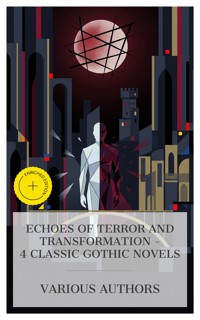
Echoes of Terror and Transformation: 4 Classic Gothic Novels invites readers into haunting worlds where fear and change intertwine, presenting a spectrum of narratives that delve into the human psyche and societal norms. This anthology captures the essence of Gothic literature through tales that challenge perceptions while evoking an atmosphere of suspense and introspection. Each novel within this collection stands out for its intricate weaving of horror and romanticism, where supernatural elements and moral dilemmas create a landscape of both terror and beauty. From existential angst to moral questioning, each work exemplifies the core of Gothic fiction, illustrating the timeless struggle between dark passions and transformative hope. The anthology gathers four seminal authors, Mary Wollstonecraft Shelley, Victor Hugo, Robert Louis Stevenson, and Oscar Wilde, each renowned for their contributions to literature's Gothic tradition. Shelley's groundbreaking narrative reshaped the horror genre, while Hugo's immersive settings examined human depravity. Stevenson's duality themes explored internal conflict, and Wilde's exquisite prose combined macabre allure with social critique. Originating from diverse cultural and historical milieus, these authors collectively epitomize the transformative power of Gothic storytelling, enhancing the reader's appreciation of this multifaceted genre. Readers are encouraged to explore this anthology as it offers a rare convergence of classic Gothic narratives that continue to resonate. Echoes of Terror and Transformation is more than a collection; it is an academic pursuit, a window into the dark recesses and transformative epochs of literary history. Engaging with this compilation enriches one's understanding of the Gothic tradition and its evolution, making it an essential experience for exploring the profound depths and allegorical intricacies these masterpieces hold.
Das E-Book können Sie in Legimi-Apps oder einer beliebigen App lesen, die das folgende Format unterstützen:
Veröffentlichungsjahr: 2025
Ähnliche




Echoes of Terror and Transformation – 4 Classic Gothic Novels
Table of Contents
Introduction
Curatorial Vision
Echoes of Terror and Transformation gathers four landmark Gothic narratives to explore how fear remakes the self and society. Mary Wollstonecraft Shelley’s Frankenstein; Or, The Modern Prometheus interrogates responsibility and invention; Robert Louis Stevenson’s The Strange Case of Dr. Jekyll and Mr. Hyde probes inner division; Oscar Wilde’s The Picture of Dorian Gray examines beauty under moral pressure; Victor Hugo’s The Man Who Laughs confronts spectacle and social cruelty. Brought together, they trace a continuous line from the body’s vulnerability to the psyche’s fractures and the seductions of image, asking how terror catalyzes change and what kind of transformation follows.
The through-line uniting these works is an ethical inquiry conducted through Gothic devices: masks, laboratories, portraits, and scars. Each author stages encounters between outward appearance and inward motive, where identity is refashioned by gazes, experiments, impulses, and wounds. The collection follows figures tested by isolation and exposure: the shunned, the divided, the celebrated, the displayed. It foregrounds how terror can be intimate, residing in a private room, and public, amplified by crowds. The philosophical concerns are shared: personhood, autonomy, desire, and accountability. Aesthetic strategies differ, yet each narrative insists that transformation is never merely physical; it alters judgment, memory, and fate.
This assembly aims to chart an arc from social violence to self-inflicted metamorphosis. The Man Who Laughs exposes a world that weaponizes visibility; Frankenstein; Or, The Modern Prometheus presents a maker confronted by consequences; The Strange Case of Dr. Jekyll and Mr. Hyde distills the struggle into a compact moral crucible; The Picture of Dorian Gray turns the gaze inward, where beauty’s privilege breeds entropy. The grouping emphasizes continuities across different narrative scales, showing how terror migrates from public arenas to private consciences, and how transformation is alternately imposed, engineered, embraced, or denied, yet never free of ethical cost.
Read in concert rather than isolation, these novels illuminate each other’s questions and methods. Counterpoints emerge: an arena versus a salon, a laboratory versus a mirror. The juxtaposition encourages readers to track recurring imagery and divergent solutions to moral stress, noting how a scar, a chemical, a rumor, or a canvas can reshape destiny. Instead of treating each narrative as an enclosed chamber, the collection invites movement across thresholds, allowing echoes to accumulate. The result is a composite portrait of Gothic imagination that privileges conversation over solitude, revealing patterns and tensions that only become visible through sustained comparison.
Thematic & Aesthetic Interplay
Across these pages, emblems recur and evolve. A face branded into perpetual mirth, a private study filled with instruments, a portrait guarding a secret, and a life assembled from fragments all stage the contest between surface and depth. Terror is not only a scream in the night; it is also the recognition that identity can be constructed, traded, or watched. The texts interrogate who bears guilt when creation exceeds intention, and how spectatorship binds the crowd to the individual’s fate. Their imagery—mirrors, doors, stairways, streets—frames passage from innocence to knowledge, and from safety to perilous self-discovery.
Victor Hugo offers breadth and indignation, a sweeping view of injustice that situates bodily difference within public ritual. Mary Wollstonecraft Shelley turns inquiry into a speculative pursuit, where isolation sharpens ethical perplexity. Robert Louis Stevenson compresses dread into a taut psychological experiment, stripping away ornament to expose divided intention. Oscar Wilde, with urbane poise, filters horror through wit and elegance, letting charm unsettle conscience. These tonal contrasts produce a rich counterpoint. Each work pivots between confession and performance, secrecy and display, rendering the Gothic not a single register but a flexible instrument capable of moral argument.
Without direct citation, affinities suggest a genealogy of concerns. Shelley’s meditation on making and answerability establishes a template for later crises of divided agency that Stevenson crystallizes and Wilde refracts through aesthetics. Hugo’s preoccupation with spectacle and the crowd anticipates the others’ interest in how the gaze manufactures fate, whether in a gentleman’s reputation, a scientist’s isolation, or an adored youth’s immunity. The novels mutually sharpen terms—creation, mask, temptation, responsibility—so that a figure in one book seems to complete a sentence begun in another. Their dialogue lies less in overt reference than in converging problems.
Motifs traverse the volume like refrains: doors locked and opened; letters of reputation written not on paper but on flesh and rumor; instruments that promise mastery yet disclose vulnerability. The city’s twilight is a common stage, where fog, salons, theatres, and laboratories blur boundaries between experiment and exhibition. Even sound binds them—laughter that terrifies, silence that accuses, whispers that multiply a secret. Portraits, scars, vials, and manuscripts serve as moral technologies, recording choices while concealing origins. Through such shared devices, the novels collaborate and argue, testing whether transformation redeems, damns, or merely reveals what was already there.
Enduring Impact & Critical Reception
These novels remain urgent because they dramatize tensions that continue to structure modern life: innovation without consensus, desire without limit, fame without privacy, judgment without mercy. They ask how societies treat difference, how individuals negotiate temptation, and how images govern behavior. The Gothic here is not an escape from the present but a precision instrument for examining it. Their enduring power lies in the fusion of atmosphere with thought, where a chilling setting is inseparable from an ethical dilemma. Each book proposes that terror clarifies, stripping away consoling fictions so that responsibility, however painful, can be faced.
Critical engagement has long recognized these works as touchstones of Gothic imagination and modern moral inquiry. They have anchored debates about the ethics of scientific ambition, the psychology of duplicity, the social construction of monstrosity, and the seductions of aesthetic autonomy. Scholars have returned repeatedly to their images and arguments, finding new stresses for each era. Their language, structure, and symbolism have become common reference points in classrooms and public discourse alike. That breadth of attention reflects not consensus but productive disagreement, since each narrative refuses easy verdicts, sustaining inquiry rather than resolving it once and for all.
In cultural afterlives, these titles circulate far beyond the page. Their figures and phrases recur on stage and screen, in visual art and popular idiom. Frankenstein; Or, The Modern Prometheus has become shorthand for creation outrunning control. The Strange Case of Dr. Jekyll and Mr. Hyde names a split that institutions and individuals still recognize. The Picture of Dorian Gray endures as a parable of youth and image. The Man Who Laughs contributes an unforgettable visage to discussions of spectacle and pity. Such longevity testifies to narratives that condense complex anxieties into enduring, adaptable forms.
To encounter these four together is to witness a conversation about the human face, the divided heart, and the consequences of looking away. They dramatize the costs of self-fashioning, the allure of power, and the frailty of judgment under pressure. Their terror is clarifying rather than sensational, and their transformations expose the terms by which a life is measured. This collection does not close debate; it opens a space where competing values confront one another. In that space, these novels continue to unsettle complacency and to tutor imagination, courage, and caution in equal measure.
Historical Context
Socio-Political Landscape
Between the aftermath of the French Revolution and the high Victorian decades, Europe and Britain grappled with industrial capitalism, urban overcrowding, and the consolidation of nation-states. The period saw expanding empires abroad and anxieties about contagion, poverty, and crime at home. In this atmosphere, Gothic fiction became a flexible instrument for probing power: the courtroom and laboratory, the aristocratic salon and the slum, the parliament and the stage. The four novels collected here arise from contested terrains where respectability polices desire, philanthropy shadows exploitation, and technological prowess collides with fragile social bonds. Their terrors magnify public debates about order, authority, and the human costs of progress.
Mary Wollstonecraft Shelley published Frankenstein in a Europe emerging from the Napoleonic wars, when demobilized soldiers returned to strained economies and factories accelerated mechanized labor. Universities and scientific societies promoted experimental inquiry, while religious authorities and politicians warned against hubris and social unmooring. The novel’s itinerant geographies traverse republican Geneva, German states invested in technical education, and remote northern frontiers that symbolize both imperial reach and existential isolation. Questions of responsibility—toward dependents, toward knowledge, toward the body politic—echo contemporary quarrels over poor relief and civic duty. Its narrative arrives as political culture reimagines citizenship, yet struggles to manage the human fallout of modernization.
Robert Louis Stevenson’s London in The Strange Case of Dr. Jekyll and Mr. Hyde is the metropolis of professional guilds, charitable committees, and a vigilant press. Respectability functions as soft law, enforcing conduct beyond formal statutes. Urban reforms attempt street lighting, sanitation, and slum clearance, while booming commerce funnels wealth through discreet front doors and down shadowed alleys. The case-like narrative reflects legalistic habits of mind: testimony, sealed documents, and medical authority regulate truth. The novella’s unease with reputational economy mirrors a society where careers could be unmade by scandal, and where policing—both literal and social—claimed to cleanse the city while displacing its troubles.
The Picture of Dorian Gray unfolds within late Victorian culture wars over morality legislation, obscenity, and the boundaries of private life. Campaigners sought to regulate print culture and nightlife, and periodical editors navigated heightened scrutiny. Art patronage, clubland sociability, and elite education intertwined with surveillance by gossip columns and courts. The decade also sharpened debate over individual liberty versus public virtue. Oscar Wilde’s own courtroom ordeals soon made the novel emblematic of the risks artists faced when aesthetic rebellion met legal authority. In its salons and studios, the book probes how class privilege masks transgression, and how law and rumor collaborate to fix or destroy reputations.
Victor Hugo’s The Man Who Laughs, though published in 1869, looks back to a monarchical past to indict present injustices. The novel’s panorama of aristocratic privilege, state violence, and theatrical politics resonates with nineteenth-century France’s oscillation between empire and republic. Censorship, plebiscitary spectacle, and the exploitation of the poor haunted public life, even as universalist rhetoric promised dignity. By staging a body literally marked by power, the book exposes hereditary entitlement and bureaucratic cruelty as two faces of the same order. Its searing compassion for outsiders addresses a society negotiating the meaning of citizenship and the perils of rule by image.
Transnational exchanges shape all four works. French and British readers shared a marketplace of serialized fiction, illustrated editions, and theatrical adaptations that converted novels into public controversies. Expanding literacy, railway distribution, and circulating libraries broadened audiences while also tightening gatekeeping, as editors trimmed or moralized material to suit subscribers. Reform Acts enlarged the electorate in Britain, intensifying debates about the moral fitness of voters and the didactic duty of art. Meanwhile, charity organizations professionalized compassion, and hospitals and courts asserted expert jurisdiction over bodies and behavior. The result is a shared stage where literature contends with institutions that claim to define the normal and the permissible.
Intellectual & Aesthetic Currents
The Gothic supplied a toolkit for dramatizing modern contradictions: sublime landscapes alongside urban underworlds, haunted castles replaced by haunted consciences, the monstrous shifting from external threats to internal fractures. Across this anthology, the grotesque is not merely shock but a lens for recognizing how beauty and horror intermingle in civil life. Narrative experiments—confessions, embedded documents, portraits, and performative tableaux—test the credibility of witnesses and the stability of perception. The works also negotiate realism’s demand for social detail with romance’s taste for wonder, inventing hybrid forms that stage inquiry itself as risky, alluring, and morally consequential.
Frankenstein emerges from a moment when natural philosophy chased life’s animating spark through laboratories and lecture halls. Electrical demonstrations, anatomical theaters, and speculative debates about vitality heralded a culture that prized experiment yet feared its ethical overflow. The novel’s shifting frames and Arctic horizon dramatize knowledge as exploration, with discovery tethered to loss. Sublime nature alternately consoles and judges, countering mechanical mastery with awe. Intertextual echoes of classical myth and Enlightenment ambition situate the act of making as a philosophical wager on what humanity is for. The book converts technical curiosity into a meditation on obligation, recognition, and the price of innovation.
The Strange Case of Dr. Jekyll and Mr. Hyde absorbs late-century discourses of mind and body: laboratory testing, new pharmacologies, and emerging theories of divided consciousness and habitual vice. Its case-file structure mirrors scientific and legal rhetoric, using testimonies, sealed narratives, and professional language to police uncertainty. The city becomes an experimental apparatus, with doors, streets, and chemist’s shops delimiting controlled environments. Ambiguous symptoms and respectable veneers reflect contemporary worries about degeneration, addiction, and the fragility of willpower. Stevenson fuses sensation narrative with clinical detachment, crafting a parable of experiment gone awry that nevertheless refuses to reduce character to a single diagnostic formula.
The Picture of Dorian Gray stands at the intersection of Aestheticism and Decadence, movements that elevated style, sensation, and cultivated pose over didactic purpose. The novel’s epigrams perform an ethics of beauty that treats art as sovereign, while its portrait literalizes the inscription of experience onto a secret self. Decorative interiors, rare objects, and musical and pictorial allusions create a sensorium that rivals religion and civic duty. Yet the book also registers the modern technologies of self-fashioning—photography, mass magazines, department stores—that turn desire into display. Wilde stages a philosophical duel between art’s autonomy and the moral claims asserted by society and the reader.
The Man Who Laughs crystallizes a romantic theory of the grotesque in which disfigurement reveals political truth and laughter both liberates and wounds. Hugo’s dramaturgy blends melodrama, social panorama, and lyrical invective, mobilizing fairground spectacle and parliamentary rhetoric alike. Characters move through spaces of stage and court, church and tavern, underscoring how institutions script bodies. The novel’s fascination with performance anticipates the modern politics of image: applause, jeers, and rumor organize public will. By wedding compassion to satire, Hugo discovers an aesthetic where excess—of feeling, of event, of symbol—becomes a democratic critique aimed at exposing cruelty disguised as nobility.
Competing schools and gatekeepers frame these books. Moralists demanded edification; avant-gardists pursued experimentation; editors balanced sensation with propriety to retain subscribers and avoid prosecution. Critical quarrels over science’s reach, the authority of expertise, and the legitimacy of pleasure inflect every page. Architectural Gothic revivals reshaped cityscapes, just as gaslight, railways, and telegraphy altered tempo and perception, inviting literature to test new rhythms of fear and wonder. The anthology’s shared terrain is a battlefield over who gets to define truth: the scientist, the critic, the magistrate, or the artist. Each text responds by constructing alternative tribunals—of conscience, spectatorship, and memory.
Legacy & Reassessment Across Time
Frankenstein quickly escaped its pages through stage versions and popular iconography, but critical fortunes shifted as new sciences and technologies emerged. Readers reinterpreted its laboratory scenes through lenses of industrial accidents, medical experimentation, nuclear power, and digital life. Bioethics seized on its questions of consent and responsibility, while debates on artificial intelligence found in its creator–creature bond a grammar for accountability and care. Feminist, labor, and postcolonial critics reframed the narrative as a study of reproduction, abandonment, and social unseeing. The novel endures because it binds technical audacity to fragile duty, a pairing that every innovation reactivates and tests anew.
The Strange Case of Dr. Jekyll and Mr. Hyde became a cultural shorthand for divided selves, its vocabulary migrating into psychiatry, criminology, and popular slang. Twentieth-century wars, shell shock, and later substance crises gave the story renewed diagnostic potency, while urban noir inherited its chiaroscuro of streets and secrets. Scholars have debated whether the text pathologizes desire or critiques the regimes that force duplicity. Adaptations oscillate between moral fable and social satire, staging the pressures of surveillance and the instability of professional authority. The work’s compactness ensures continual reinvention; its case remains open because its evidence indicts both subject and system.
The Picture of Dorian Gray traveled a long arc from scandal to syllabus. Early censure yielded to readings that foreground performance, intimacy, and the politics of taste. As legal and social reforms transformed attitudes toward privacy and sexuality, the novel became a touchstone for queer self-fashioning and a critique of respectability. Visual culture—film, fashion, photography—appropriated its emblem of youth without consequence, while consumer capitalism turned its parable into advertising’s dream and nightmare. Contemporary audiences see in its mirror the curated self of social media and the wellness industry’s denial of decay, yet the text keeps insisting on cost and witness.
The Man Who Laughs influenced theater and cinema with its unforgettable iconography, but critical reassessment has emphasized its political acuity. Read against modern populisms and media spectacles, the novel’s fusion of sympathy and satire illuminates how crowds are moved and how elites script consent. Disability studies have explored its representation of marked bodies, while human rights discourses recognize its indictment of institutional cruelty. Each period of French crisis, from republic to republic, has returned to Hugo’s vision of compassion as civic force. The narrative’s survival in popular imagery testifies to a durable intuition: entertainment can reveal the architecture of power.
Across the twentieth and twenty-first centuries, these four works have served as laboratories for reading modernity’s extremes: mechanized war, bureaucratic surveillance, biomedical revolutions, mass propaganda, and commodified desire. New media mutate their motifs—experiment, confession, portrait, spectacle—into code, data, and platform. Environmental anxieties hear in them a warning about creation without care; economic critiques see allegories of extraction and waste. In classrooms and adaptations, the books provoke arguments about agency, stigma, and the ethics of looking. That they continue to unsettle is not accidental: each converts historical turmoil into a durable form capable of diagnosing our next transformation.
Echoes of Terror and Transformation – 4 Classic Gothic Novels
Duality and the Fragmented Self
Creation, Hubris, and Societal Consequences
Victor Hugo
The Man Who Laughs
Another Preliminary Chapter.—The Comprachicos
PART I.
BOOK THE FIRST.—NIGHT NOT SO BLACK AS MAN.
I.—Portland Bill
II.—Left Alone
III.—Alone
IV.—Questions
V.—The Tree of Human Invention
VI.—Struggle between Death and Night
VII.—The North Point of Portland
BOOK THE SECOND.—THE HOOKER AT SEA.
I.—Superhuman Laws
II.—Our First Rough Sketches Filled in
III.—Troubled Men on the Troubled Sea
IV.—A Cloud Different from the Others enters on the Scene
V.—Hardquanonne
VI.—They Think that Help is at Hand
VII.—Superhuman Horrors
VIII.—Nix et Nox
IX.—The Charge Confided to a Raging Sea
X.—The Colossal Savage, the Storm
XI.—The Caskets
XII.—Face to Face with the Rock
XIII.—Face to Face with Night
XIV.—Ortach
XV.—Portentosum Mare
XVI.—The Problem Suddenly Works in Silence
XVII.—The Last Resource
XVIII.—The Highest Resource
BOOK THE THIRD.—THE CHILD IN THE SHADOW.
I.—Chesil
II.—The Effect of Snow
III.—A Burden Makes a Rough Road Rougher
IV.—Another Form of Desert
V.—Misanthropy Plays Its Pranks
VI.—The Awaking
PART II.
BOOK THE FIRST.—THE EVERLASTING PRESENCE OF THE PAST. MAN REFLECTS MAN.
I.—Lord Clancharlie
II.—Lord David Dirry-Moir
III.—The Duchess Josiana
IV.—The Leader of Fashion
V.—Queen Anne
VI.—Barkilphedro
VII.—Barkilphedro Gnaws His Way
VIII.—Inferi
IX.—Hate is as Strong as Love
X.—The Flame which would be Seen if Man were Transparent
XI.—Barkilphedro in Ambuscade
XII.—Scotland, Ireland, and England
BOOK THE SECOND.—GWYNPLAINE AND DEA.
I.—Wherein we see the Face of Him of whom we have hitherto seen only the Acts
II.—Dea
III.—"Oculos non Habet, et Videt"
IV.—Well-matched Lovers
V.—The Blue Sky through the Black Cloud
VI.—Ursus as Tutor, and Ursus as Guardian
VII.—Blindness Gives Lessons in Clairvoyance
VIII.—Not only Happiness, but Prosperity
IX.—Absurdities which Folks without Taste call Poetry
X.—An Outsider's View of Men and Things
XI.—Gwynplaine Thinks Justice, and Ursus Talks Truth
XII.—Ursus the Poet Drags on Ursus the Philosopher
BOOK THE THIRD.—THE BEGINNING OF THE FISSURE.
I.—The Tadcaster Inn
II.—Open-Air Eloquence
III.—Where the Passer-by Reappears
IV.—Contraries Fraternize in Hate
V.—The Wapentake
VI.—The Mouse Examined by the Cats
VII.—Why Should a Gold Piece Lower Itself by Mixing with a Heap of Pennies?
VIII.—Symptoms of Poisoning
IX.—Abyssus Abyssum Vocat
BOOK THE FOURTH.—THE CELL OF TORTURE.
I.—The Temptation of St. Gwynplaine
II.—From Gay to Grave
III.—Lex, Rex, Fex
IV.—Ursus Spies the Police
V.—A Fearful Place
VI.—The Kind of Magistracy under the Wigs of Former Days
VII.—Shuddering
VIII.—Lamentation
BOOK THE FIFTH.—THE SEA AND FATE ARE MOVED BY THE SAME BREATH.
I.—The Durability of Fragile Things
II.—The Waif Knows Its Own Course
III.—An Awakening
IV.—Fascination
V.—We Think We Remember; We Forget
BOOK THE SIXTH.—URSUS UNDER DIFFERENT ASPECTS.
I.—What the Misanthrope said
II.—What He did
III.—Complications
IV.—Moenibus Surdis Campana Muta
V.—State Policy Deals with Little Matters as Well as with Great
BOOK THE SEVENTH.—THE TITANESS.
I.—The Awakening
II.—The Resemblance of a Palace to a Wood
III.—Eve
IV.—Satan
V.—They Recognize, but do not Know, Each Other
BOOK THE EIGHTH.—THE CAPITOL AND THINGS AROUND IT.
I.—Analysis of Majestic Matters
II.—Impartiality
III.—The Old Hall
IV.—The Old Chamber
V.—Aristocratic Gossip
VI.—The High and the Low
VII.—Storms of Men are Worse than Storms of Oceans
VIII.—He would be a Good Brother, were he not a Good Son
BOOK THE NINTH.—IN RUINS.
I.—It is through Excess of Greatness that Man reaches Excess of Misery
II.—The Dregs
CONCLUSION.—THE NIGHT AND THE SEA.
I.—A Watch-dog may be a Guardian Angel
II.—Barkilphedro, having aimed at the Eagle, brings down the Dove
III.—Paradise Regained Below
IV.—Nay; on High!
THE LAUGHING MAN.
A ROMANCE OF ENGLISH HISTORY.
PRELIMINARY CHAPTER.
URSUS.
I.
Ursus and Homo were fast friends. Ursus was a man, Homo a wolf. Their dispositions tallied. It was the man who had christened the wolf: probably he had also chosen his own name. Having found Ursus fit for himself, he had found Homo fit for the beast. Man and wolf turned their partnership to account at fairs, at village fêtes, at the corners of streets where passers-by throng, and out of the need which people seem to feel everywhere to listen to idle gossip and to buy quack medicine. The wolf, gentle and courteously subordinate, diverted the crowd. It is a pleasant thing to behold the tameness of animals. Our greatest delight is to see all the varieties of domestication parade before us. This it is which collects so many folks on the road of royal processions.
Ursus and Homo went about from cross-road to cross-road, from the High Street of Aberystwith to the High Street of Jedburgh, from country-side to country-side, from shire to shire, from town to town. One market exhausted, they went on to another. Ursus lived in a small van upon wheels, which Homo was civilized enough to draw by day and guard by night. On bad roads, up hills, and where there were too many ruts, or there was too much mud, the man buckled the trace round his neck and pulled fraternally, side by side with the wolf. They had thus grown old together. They encamped at haphazard on a common, in the glade of a wood, on the waste patch of grass where roads intersect, at the outskirts of villages, at the gates of towns, in market-places, in public walks, on the borders of parks, before the entrances of churches. When the cart drew up on a fair green, when the gossips ran up open-mouthed and the curious made a circle round the pair, Ursus harangued and Homo approved. Homo, with a bowl in his mouth, politely made a collection among the audience. They gained their livelihood. The wolf was lettered, likewise the man. The wolf had been trained by the man, or had trained himself unassisted, to divers wolfish arts, which swelled the receipts. "Above all things, do not degenerate into a man," his friend would say to him.
Never did the wolf bite: the man did now and then. At least, to bite was the intent of Ursus. He was a misanthrope, and to italicize his misanthropy he had made himself a juggler. To live, also; for the stomach has to be consulted. Moreover, this juggler-misanthrope, whether to add to the complexity of his being or to perfect it, was a doctor. To be a doctor is little: Ursus was a ventriloquist. You heard him speak without his moving his lips. He counterfeited, so as to deceive you, any one's accent or pronunciation. He imitated voices so exactly that you believed you heard the people themselves. All alone he simulated the murmur of a crowd, and this gave him a right to the title of Engastrimythos, which he took. He reproduced all sorts of cries of birds, as of the thrush, the wren, the pipit lark, otherwise called the gray cheeper, and the ring ousel, all travellers like himself: so that at times when the fancy struck him, he made you aware either of a public thoroughfare filled with the uproar of men, or of a meadow loud with the voices of beasts—at one time stormy as a multitude, at another fresh and serene as the dawn. Such gifts, although rare, exist. In the last century a man called Touzel, who imitated the mingled utterances of men and animals, and who counterfeited all the cries of beasts, was attached to the person of Buffon—to serve as a menagerie.
Ursus was sagacious, contradictory, odd, and inclined to the singular expositions which we term fables. He had the appearance of believing in them, and this impudence was a part of his humour. He read people's hands, opened books at random and drew conclusions, told fortunes, taught that it is perilous to meet a black mare, still more perilous, as you start for a journey, to hear yourself accosted by one who knows not whither you are going; and he called himself a dealer in superstitions. He used to say: "There is one difference between me and the Archbishop of Canterbury: I avow what I am." Hence it was that the archbishop, justly indignant, had him one day before him; but Ursus cleverly disarmed his grace by reciting a sermon he had composed upon Christmas Day, which the delighted archbishop learnt by heart, and delivered from the pulpit as his own. In consideration thereof the archbishop pardoned Ursus.
As a doctor, Ursus wrought cures by some means or other. He made use of aromatics; he was versed in simples; he made the most of the immense power which lies in a heap of neglected plants, such as the hazel, the catkin, the white alder, the white bryony, the mealy-tree, the traveller's joy, the buckthorn. He treated phthisis with the sundew; at opportune moments he would use the leaves of the spurge, which plucked at the bottom are a purgative and plucked at the top, an emetic. He cured sore throat by means of the vegetable excrescence called Jew's ear. He knew the rush which cures the ox and the mint which cures the horse. He was well acquainted with the beauties and virtues of the herb mandragora, which, as every one knows, is of both sexes. He had many recipes. He cured burns with the salamander wool, of which, according to Pliny, Nero had a napkin. Ursus possessed a retort and a flask; he effected transmutations; he sold panaceas. It was said of him that he had once been for a short time in Bedlam; they had done him the honour to take him for a madman, but had set him free on discovering that he was only a poet. This story was probably not true; we have all to submit to some such legend about us.
The fact is, Ursus was a bit of a savant, a man of taste, and an old Latin poet. He was learned in two forms; he Hippocratized and he Pindarized. He could have vied in bombast with Rapin and Vida. He could have composed Jesuit tragedies in a style not less triumphant than that of Father Bouhours. It followed from his familiarity with the venerable rhythms and metres of the ancients, that he had peculiar figures of speech, and a whole family of classical metaphors. He would say of a mother followed by her two daughters, There is a dactyl; of a father preceded by his two sons, There is an anapæst; and of a little child walking between its grandmother and grandfather, There is an amphimacer. So much knowledge could only end in starvation. The school of Salerno says, "Eat little and often." Ursus ate little and seldom, thus obeying one half the precept and disobeying the other; but this was the fault of the public, who did not always flock to him, and who did not often buy.
Ursus was wont to say: "The expectoration of a sentence is a relief. The wolf is comforted by its howl, the sheep by its wool, the forest by its finch, woman by her love, and the philosopher by his epiphonema." Ursus at a pinch composed comedies, which, in recital, he all but acted; this helped to sell the drugs. Among other works, he had composed an heroic pastoral in honour of Sir Hugh Middleton, who in 1608 brought a river to London. The river was lying peacefully in Hertfordshire, twenty miles from London: the knight came and took possession of it. He brought a brigade of six hundred men, armed with shovels and pickaxes; set to breaking up the ground, scooping it out in one place, raising it in another—now thirty feet high, now twenty feet deep; made wooden aqueducts high in air; and at different points constructed eight hundred bridges of stone, bricks, and timber. One fine morning the river entered London, which was short of water. Ursus transformed all these vulgar details into a fine Eclogue between the Thames and the New River, in which the former invited the latter to come to him, and offered her his bed, saying, "I am too old to please women, but I am rich enough to pay them"—an ingenious and gallant conceit to indicate how Sir Hugh Middleton had completed the work at his own expense.
Ursus was great in soliloquy. Of a disposition at once unsociable and talkative, desiring to see no one, yet wishing to converse with some one, he got out of the difficulty by talking to himself. Any one who has lived a solitary life knows how deeply seated monologue is in one's nature. Speech imprisoned frets to find a vent. To harangue space is an outlet. To speak out aloud when alone is as it were to have a dialogue with the divinity which is within. It was, as is well known, a custom of Socrates; he declaimed to himself. Luther did the same. Ursus took after those great men. He had the hermaphrodite faculty of being his own audience. He questioned himself, answered himself, praised himself, blamed himself. You heard him in the street soliloquizing in his van. The passers-by, who have their own way of appreciating clever people, used to say: He is an idiot. As we have just observed, he abused himself at times; but there were times also when he rendered himself justice. One day, in one of these allocutions addressed to himself, he was heard to cry out, "I have studied vegetation in all its mysteries—in the stalk, in the bud, in the sepal, in the stamen, in the carpel, in the ovule, in the spore, in the theca, and in the apothecium. I have thoroughly sifted chromatics, osmosy, and chymosy—that is to say, the formation of colours, of smell, and of taste." There was something fatuous, doubtless, in this certificate which Ursus gave to Ursus; but let those who have not thoroughly sifted chromatics, osmosy, and chymosy cast the first stone at him.
Fortunately Ursus had never gone into the Low Countries; there they would certainly have weighed him, to ascertain whether he was of the normal weight, above or below which a man is a sorcerer. In Holland this weight was sagely fixed by law. Nothing was simpler or more ingenious. It was a clear test. They put you in a scale, and the evidence was conclusive if you broke the equilibrium. Too heavy, you were hanged; too light, you were burned. To this day the scales in which sorcerers were weighed may be seen at Oudewater, but they are now used for weighing cheeses; how religion has degenerated! Ursus would certainly have had a crow to pluck with those scales. In his travels he kept away from Holland, and he did well. Indeed, we believe that he used never to leave the United Kingdom.
However this may have been, he was very poor and morose, and having made the acquaintance of Homo in a wood, a taste for a wandering life had come over him. He had taken the wolf into partnership, and with him had gone forth on the highways, living in the open air the great life of chance. He had a great deal of industry and of reserve, and great skill in everything connected with healing operations, restoring the sick to health, and in working wonders peculiar to himself. He was considered a clever mountebank and a good doctor. As may be imagined, he passed for a wizard as well—not much indeed; only a little, for it was unwholesome in those days to be considered a friend of the devil. To tell the truth, Ursus, by his passion for pharmacy and his love of plants, laid himself open to suspicion, seeing that he often went to gather herbs in rough thickets where grew Lucifer's salads, and where, as has been proved by the Counsellor De l'Ancre, there is a risk of meeting in the evening mist a man who comes out of the earth, "blind of the right eye, barefooted, without a cloak, and a sword by his side." But for the matter of that, Ursus, although eccentric in manner and disposition, was too good a fellow to invoke or disperse hail, to make faces appear, to kill a man with the torment of excessive dancing, to suggest dreams fair or foul and full of terror, and to cause the birth of cocks with four wings. He had no such mischievous tricks. He was incapable of certain abominations, such as, for instance, speaking German, Hebrew, or Greek, without having learned them, which is a sign of unpardonable wickedness, or of a natural infirmity proceeding from a morbid humour. If Ursus spoke Latin, it was because he knew it. He would never have allowed himself to speak Syriac, which he did not know. Besides, it is asserted that Syriac is the language spoken in the midnight meetings at which uncanny people worship the devil. In medicine he justly preferred Galen to Cardan; Cardan, although a learned man, being but an earthworm to Galen.
To sum up, Ursus was not one of those persons who live in fear of the police. His van was long enough and wide enough to allow of his lying down in it on a box containing his not very sumptuous apparel. He owned a lantern, several wigs, and some utensils suspended from nails, among which were musical instruments. He possessed, besides, a bearskin with which he covered himself on his days of grand performance. He called this putting on full dress. He used to say, "I have two skins; this is the real one," pointing to the bearskin.
The little house on wheels belonged to himself and to the wolf. Besides his house, his retort, and his wolf, he had a flute and a violoncello on which he played prettily. He concocted his own elixirs. His wits yielded him enough to sup on sometimes. In the top of his van was a hole, through which passed the pipe of a cast-iron stove; so close to his box as to scorch the wood of it. The stove had two compartments; in one of them Ursus cooked his chemicals, and in the other his potatoes. At night the wolf slept under the van, amicably secured by a chain. Homo's hair was black, that of Ursus, gray; Ursus was fifty, unless, indeed, he was sixty. He accepted his destiny, to such an extent that, as we have just seen, he ate potatoes, the trash on which at that time they fed pigs and convicts. He ate them indignant, but resigned. He was not tall—he was long. He was bent and melancholy. The bowed frame of an old man is the settlement in the architecture of life. Nature had formed him for sadness. He found it difficult to smile, and he had never been able to weep, so that he was deprived of the consolation of tears as well as of the palliative of joy. An old man is a thinking ruin; and such a ruin was Ursus. He had the loquacity of a charlatan, the leanness of a prophet, the irascibility of a charged mine: such was Ursus. In his youth he had been a philosopher in the house of a lord.
This was 180 years ago, when men were more like wolves than they are now.
Not so very much though.
II.
Homo was no ordinary wolf. From his appetite for medlars and potatoes he might have been taken for a prairie wolf; from his dark hide, for a lycaon; and from his howl prolonged into a bark, for a dog of Chili. But no one has as yet observed the eyeball of a dog of Chili sufficiently to enable us to determine whether he be not a fox, and Homo was a real wolf. He was five feet long, which is a fine length for a wolf, even in Lithuania; he was very strong; he looked at you askance, which was not his fault; he had a soft tongue, with which he occasionally licked Ursus; he had a narrow brush of short bristles on his backbone, and he was lean with the wholesome leanness of a forest life. Before he knew Ursus and had a carriage to draw, he thought nothing of doing his fifty miles a night. Ursus meeting him in a thicket near a stream of running water, had conceived a high opinion of him from seeing the skill and sagacity with which he fished out crayfish, and welcomed him as an honest and genuine Koupara wolf of the kind called crab-eater.
As a beast of burden, Ursus preferred Homo to a donkey. He would have felt repugnance to having his hut drawn by an ass; he thought too highly of the ass for that. Moreover he had observed that the ass, a four-legged thinker little understood by men, has a habit of cocking his ears uneasily when philosophers talk nonsense. In life the ass is a third person between our thoughts and ourselves, and acts as a restraint. As a friend, Ursus preferred Homo to a dog, considering that the love of a wolf is more rare.
Hence it was that Homo sufficed for Ursus. Homo was for Ursus more than a companion, he was an analogue. Ursus used to pat the wolf's empty ribs, saying: "I have found the second volume of myself!" Again he said, "When I am dead, any one wishing to know me need only study Homo. I shall leave a true copy behind me."
The English law, not very lenient to beasts of the forest, might have picked a quarrel with the wolf, and have put him to trouble for his assurance in going freely about the towns: but Homo took advantage of the immunity granted by a statute of Edward IV. to servants: "Every servant in attendance on his master is free to come and go." Besides, a certain relaxation of the law had resulted with regard to wolves, in consequence of its being the fashion of the ladies of the Court, under the later Stuarts, to have, instead of dogs, little wolves, called adives, about the size of cats, which were brought from Asia at great cost.
Ursus had communicated to Homo a portion of his talents: such as to stand upright, to restrain his rage into sulkiness, to growl instead of howling, etc.; and on his part, the wolf had taught the man what he knew—to do without a roof, without bread and fire, to prefer hunger in the woods to slavery in a palace.
The van, hut, and vehicle in one, which traversed so many different roads, without, however, leaving Great Britain, had four wheels, with shafts for the wolf and a splinter-bar for the man. The splinter-bar came into use when the roads were bad. The van was strong, although it was built of light boards like a dove-cot. In front there was a glass door with a little balcony used for orations, which had something of the character of the platform tempered by an air of the pulpit. At the back there was a door with a practicable panel. By lowering the three steps which turned on a hinge below the door, access was gained to the hut, which at night was securely fastened with bolt and lock. Rain and snow had fallen plentifully on it; it had been painted, but of what colour it was difficult to say, change of season being to vans what changes of reign are to courtiers. In front, outside, was a board, a kind of frontispiece, on which the following inscription might once have been deciphered; it was in black letters on a white ground, but by degrees the characters had become confused and blurred:—
"By friction gold loses every year a fourteen hundredth part of its bulk. This is what is called the Wear. Hence it follows that on fourteen hundred millions of gold in circulation throughout the world, one million is lost annually. This million dissolves into dust, flies away, floats about, is reduced to atoms, charges, drugs, weighs down consciences, amalgamates with the souls of the rich whom it renders proud, and with those of the poor whom it renders brutish."
The inscription, rubbed and blotted by the rain and by the kindness of nature, was fortunately illegible, for it is possible that its philosophy concerning the inhalation of gold, at the same time both enigmatical and lucid, might not have been to the taste of the sheriffs, the provost-marshals, and other big-wigs of the law. English legislation did not trifle in those days. It did not take much to make a man a felon. The magistrates were ferocious by tradition, and cruelty was a matter of routine. The judges of assize increased and multiplied. Jeffreys had become a breed.
III.
In the interior of the van there were two other inscriptions. Above the box, on a whitewashed plank, a hand had written in ink as follows:—
"The Baron, peer of England, wears a cap with six pearls. The coronet begins with the rank of Viscount. The Viscount wears a coronet of which the pearls are without number. The Earl a coronet with the pearls upon points, mingled with strawberry leaves placed low between. The Marquis, one with pearls and leaves on the same level. The Duke, one with strawberry leaves alone—no pearls. The Royal Duke, a circlet of crosses and fleurs de lys. The Prince of Wales, crown like that of the King, but unclosed.
"The Duke is a most high and most puissant prince, the Marquis and Earl most noble and puissant lord, the Viscount noble and puissant lord, the Baron a trusty lord. The Duke is his Grace; the other Peers their Lordships. Most honourable is higher than right honourable.
"Lords who are peers are lords in their own right. Lords who are not peers are lords by courtesy:—there are no real lords, excepting such as are peers.
"The House of Lords is a chamber and a court, Concilium et Curia, legislature and court of justice. The Commons, who are the people, when ordered to the bar of the Lords, humbly present themselves bareheaded before the peers, who remain covered. The Commons send up their bills by forty members, who present the bill with three low bows. The Lords send their bills to the Commons by a mere clerk. In case of disagreement, the two Houses confer in the Painted Chamber, the Peers seated and covered, the Commons standing and bareheaded.
"Peers go to parliament in their coaches in file; the Commons do not. Some peers go to Westminster in open four-wheeled chariots. The use of these and of coaches emblazoned with coats of arms and coronets is allowed only to peers, and forms a portion of their dignity.
"Barons have the same rank as bishops. To be a baron peer of England, it is necessary to be in possession of a tenure from the king per Baroniam integram, by full barony. The full barony consists of thirteen knights' fees and one third part, each knight's fee being of the value of £20 sterling, which makes in all 400 marks. The head of a barony (Caput baroniæ) is a castle disposed by inheritance, as England herself, that is to say, descending to daughters if there be no sons, and in that case going to the eldest daughter, cæteris filiabus aliundè satisfactis.[1]
"Barons have the degree of lord: in Saxon, laford;dominus in high Latin; Lordus in low Latin. The eldest and younger sons of viscounts and barons are the first esquires in the kingdom. The eldest sons of peers take precedence of knights of the garter. The younger sons do not. The eldest son of a viscount comes after all barons, and precedes all baronets. Every daughter of a peer is a Lady. Other English girls are plain Mistress.
"All judges rank below peers. The serjeant wears a lambskin tippet; the judge one of patchwork, de minuto vario, made up of a variety of little white furs, always excepting ermine. Ermine is reserved for peers and the king.
"A lord never takes an oath, either to the crown or the law. His word suffices; he says, Upon my honour.
"By a law of Edward the Sixth, peers have the privilege of committing manslaughter. A peer who kills a man without premeditation is not prosecuted.
"The persons of peers are inviolable.
"A peer cannot be held in durance, save in the Tower of London.
"A writ of supplicavit cannot be granted against a peer.
"A peer sent for by the king has the right to kill one or two deer in the royal park.
"A peer holds in his castle a baron's court of justice.
"It is unworthy of a peer to walk the street in a cloak, followed by two footmen. He should only show himself attended by a great train of gentlemen of his household.
"A peer can be amerced only by his peers, and never to any greater amount than five pounds, excepting in the case of a duke, who can be amerced ten.
"A peer may retain six aliens born, any other Englishman but four.
"A peer can have wine custom-free; an earl eight tuns.
"A peer is alone exempt from presenting himself before the sheriff of the circuit.
"A peer cannot be assessed towards the militia.
"When it pleases a peer he raises a regiment and gives it to the king; thus have done their graces the Dukes of Athol, Hamilton, and Northumberland.
"A peer can hold only of a peer.
"In a civil cause he can demand the adjournment of the case, if there be not at least one knight on the jury.
"A peer nominates his own chaplains. A baron appoints three chaplains; a viscount four; an earl and a marquis five; a duke six.
"A peer cannot be put to the rack, even for high treason. A peer cannot be branded on the hand. A peer is a clerk, though he knows not how to read. In law he knows.
"A duke has a right to a canopy, or cloth of state, in all places where the king is not present; a viscount may have one in his house; a baron has a cover of assay, which may be held under his cup while he drinks. A baroness has the right to have her train borne by a man in the presence of a viscountess.
"Eighty-six tables, with five hundred dishes, are served every day in the royal palace at each meal.
"If a plebeian strike a lord, his hand is cut off.
"A lord is very nearly a king.
"The king is very nearly a god.
"The earth is a lordship.
"The English address God as my lord!"
Opposite this writing was written a second one, in the same fashion, which ran thus:—
"Henry Auverquerque, Earl of Grantham, who sits in the House of Lords between the Earl of Jersey and the Earl of Greenwich, has a hundred thousand a year. To his lordship belongs the palace of Grantham Terrace, built all of marble and famous for what is called the labyrinth of passages—a curiosity which contains the scarlet corridor in marble of Sarancolin, the brown corridor in lumachel of Astracan, the white corridor in marble of Lani, the black corridor in marble of Alabanda, the gray corridor in marble of Staremma, the yellow corridor in marble of Hesse, the green corridor in marble of the Tyrol, the red corridor, half cherry-spotted marble of Bohemia, half lumachel of Cordova, the blue corridor in turquin of Genoa, the violet in granite of Catalonia, the mourning-hued corridor veined black and white in slate of Murviedro, the pink corridor in cipolin of the Alps, the pearl corridor in lumachel of Nonetta, and the corridor of all colours, called the courtiers' corridor, in motley.
"Richard Lowther, Viscount Lonsdale, owns Lowther in Westmorland, which has a magnificent approach, and a flight of entrance steps which seem to invite the ingress of kings.
"Richard, Earl of Scarborough, Viscount and Baron Lumley of Lumley Castle, Viscount Lumley of Waterford in Ireland, and Lord Lieutenant and Vice-Admiral of the county of Northumberland and of Durham, both city and county, owns the double castleward of old and new Sandbeck, where you admire a superb railing, in the form of a semicircle, surrounding the basin of a matchless fountain. He has, besides, his castle of Lumley.
"Robert Darcy, Earl of Holderness, has his domain of Holderness, with baronial towers, and large gardens laid out in French fashion, where he drives in his coach-and-six, preceded by two outriders, as becomes a peer of England.
"Charles Beauclerc, Duke of St. Albans, Earl of Burford, Baron Hedington, Grand Falconer of England, has an abode at Windsor, regal even by the side of the king's.
"Charles Bodville Robartes, Baron Robartes of Truro, Viscount Bodmin and Earl of Radnor, owns Wimpole in Cambridgeshire, which is as three palaces in one, having three façades, one bowed and two triangular. The approach is by an avenue of trees four deep.
"The most noble and most puissant Lord Philip, Baron Herbert of Cardiff, Earl of Montgomery and of Pembroke, Ross of Kendall, Parr, Fitzhugh, Marmion, St. Quentin, and Herbert of Shurland, Warden of the Stannaries in the counties of Cornwall and Devon, hereditary visitor of Jesus College, possesses the wonderful gardens at Wilton, where there are two sheaf-like fountains, finer than those of his most Christian Majesty King Louis XIV. at Versailles.
"Charles Somerset, Duke of Somerset, owns Somerset House on the Thames, which is equal to the Villa Pamphili at Rome. On the chimney-piece are seen two porcelain vases of the dynasty of the Yuens, which are worth half a million in French money.
"In Yorkshire, Arthur, Lord Ingram, Viscount Irwin, has Temple Newsain, which is entered under a triumphal arch and which has large wide roofs resembling Moorish terraces.
"Robert, Lord Ferrers of Chartly, Bourchier, and Lonvaine, has Staunton Harold in Leicestershire, of which the park is geometrically planned in the shape of a temple with a façade, and in front of the piece of water is the great church with the square belfry, which belongs to his lordship.
"In the county of Northampton, Charles Spencer, Earl of Sunderland, member of his Majesty's Privy Council, possesses Althorp, at the entrance of which is a railing with four columns surmounted by groups in marble.
"Laurence Hyde, Earl of Rochester, has, in Surrey, New Park, rendered magnificent by its sculptured pinnacles, its circular lawn belted by trees, and its woodland, at the extremity of which is a little mountain, artistically rounded, and surmounted by a large oak, which can be seen from afar.
"Philip Stanhope, Earl of Chesterfield, possesses Bretby Hall in Derbyshire, with a splendid clock tower, falconries, warrens, and very fine sheets of water, long, square, and oval, one of which is shaped like a mirror, and has two jets, which throw the water to a great height.
"Charles Cornwallis, Baron Cornwallis of Eye, owns Broome Hall, a palace of the fourteenth century.
"The most noble Algernon Capel, Viscount Maiden, Earl of Essex, has Cashiobury in Hertfordshire, a seat which has the shape of a capital H, and which rejoices sportsmen with its abundance of game.
"Charles, Lord Ossulston, owns Darnley in Middlesex, approached by Italian gardens.




