


8,49 €
Mehr erfahren.
- Herausgeber: Nick Hern Books
- Kategorie: Poesie und Drama
- Sprache: Englisch
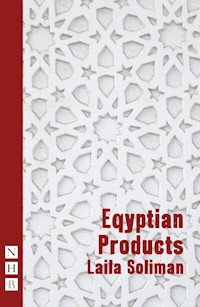
Hadia is an independent woman in Cairo. Gasir is a painfully awkward lab assistant with attachment issues over his dead mother. Is he really her knight in shining armour? Egyptian Products by Egyptian writer Laila Soliman was first performed in this English translation by Khalid Laith as a rehearsed reading at the Royal Court Theatre, London, in 2008. It was developed as part of an ambitious project by the Royal Court Theatre's International Department and the British Council, working with twenty-one writers from across the Near East and North Africa.
Das E-Book können Sie in Legimi-Apps oder einer beliebigen App lesen, die das folgende Format unterstützen:
Veröffentlichungsjahr: 2017
Ähnliche






PLAYS FROMTHE ARAB WORLD
LAILA SOLIMAN EGYPTIAN PRODUCTSTranslated by Khalid Laith
Edited and with a Foreword by Elyse Dodgson
Introduced by Laila Hourani
BRITISHCOUNCIL
NICK HERNBOOKS
ROYAL COURTTHEATRE
www.britishcouncil.org
www.nickhernbooks.co.uk
www.royalcourttheatre.com
Contents
Foreword
Introduction:Young Arab Playwrights and the Half-open Door
EGYPTIAN PRODUCTS
Copyright and Performing Rights Information
Foreword
In April 2007 the British Council and the Royal Court Theatre in London embarked on a unique project working with young Arab writers across seven countries from the Near East to North Africa. Twenty-one emerging playwrights from Egypt, Jordan, Lebanon, Morocco, Palestine, Syria and Tunisia travelled to Damascus to work with the playwrights April De Angelis, David Greig and myself. There, we started a journey that spanned two years, with different phases of the work continuing in Tunis, Cairo, Amman and Beirut. I have been coordinating and leading workshops with international playwrights for the Royal Court for over fifteen years, but never has an international new-writing project been more ambitious or far-reaching.
Our first work with writers in the region began in Palestine in 1998 with a workshop for local playwrights in collaboration with Al Kasaba Theatre. Throughout the last ten years this work has continued with British writers and directors working in the West Bank, and Palestinian writers taking part in projects at the Royal Court. All of this work has been supported by the Genesis Foundation and the British Council. In 2005 the playwright David Greig began working in Syria, leading a group of playwrights there in a project initiated by the British Council. By 2006 they asked the Royal Court to become involved, too, and that culminated in a week of play-development work with Syrian writers at the Royal Court, presented in January 2007, and the participation of three Syrian writers on the Royal Court International Residency.
The next step seemed even more extraordinary. We were approached by Carole McFadden, the Drama and Dance Adviser of the British Council in London, and Laila Hourani, Regional Arts Manager for the Near East and North Africa, to participate in a new-writing project that would involve young playwrights across the whole region. This seemed to be a great opportunity that no one at the Royal Court could resist. We really had to start at the beginning as we had never worked on a regional project before. The associate directors Ramin Gray, Sacha Wares and I travelled to all of the countries and came back with different experiences and different recommendations. It was clear that some countries had much stronger theatre cultures than others and different degrees of new writing. We also had to consider the different dialects of Arabic when we were looking to translate the work. We decided, in the end, to open applications to all writers in the seven countries under the age of thirty-five and asked them to send samples of their work as well as proposals for new plays. We chose twenty-one writers and by a small miracle managed to get them all to Damascus for the first workshop. We discovered that we would be working in a beautiful ancient Damascene house in the Old City. It is difficult to describe how moving it was, after these months of travelling and planning, to come face to face with such a group of inspiring young writers in the open courtyard of this wonderful house.
It was challenging from the beginning, and some of the writers were both tentative and doubtful as they began to explore the possibilities of writing a new contemporary play for us. The only way we could change that was by concentrating on the work itself. David Greig told the writers: ‘This work at its best is a dance between the side of you that dreams and the side engaged in the world.’
Three months after the first meeting, twenty out of twenty-one writers submitted drafts of new plays. In Tunis in November 2007 we helped to move the plays forward to another draft. In Cairo in March 2008 we were joined by Royal Court Artistic Director, Dominic Cooke, and invited actors from the region to take the plays to a more finished draft, which was presented to a local audience. It was difficult to make a selection of the plays to present at the Royal Court in London in November 2008, but we finally chose seven plays and presented them in a season called I Come From There: New Plays from the Arab World. Houses were full and there was no doubt that the very idea of this work was inspiring our British audiences too.
After further workshops with a group of regional directors, the plays began to take off in the countries of origin. Readings took place in Beirut, Amman and Tunis in 2009. In May 2009 two different plays opened on the same day in Ramallah and Damascus. I believe this is just the beginning of some extraordinary work that will be produced by new writers in the Arab world.
Elyse DodgsonAssociate Director/Head of International DepartmentRoyal Court Theatre
This is the foreword to Plays from the Arab World; the collection in which this play first appears.
Young Arab Playwrights and the Half-open Door
The idea of working with Arab playwrights to develop their playwriting skills emerged when I attended the British Council showcase at the 2003 Edinburgh Festival Fringe. It was my first close experience of new British theatre. The festival that year featured hit plays like by Henry Adams, by David Harrower and by David Greig. I was struck by the new Scottish playwrights and their experience, and felt a commonality with the Arab world that I couldn’t quite articulate at the time. Was it the ‘dark earth’ in David Harrower’s play that reminded me of the volcanic black earth that is so characteristic of my husband’s village in Sweida, south of Syria? Or was it the subtle poetry of David Greig’s language that made me see the potential of the Arabic stage using an Arabic language rooted in the street, while maintaining the magic of its mother tongue? Was it the hidden feel of history and its heavy shadow on the present? Or was it the dilemma of neighbouring a strong enemy of the past?
Lesen Sie weiter in der vollständigen Ausgabe!
Lesen Sie weiter in der vollständigen Ausgabe!




