


0,99 €
Mehr erfahren.
- Herausgeber: DigiCat
- Kategorie: Für Kinder und Jugendliche
- Sprache: Englisch
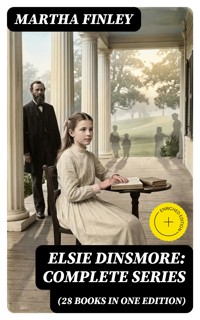
Martha Finley's "Elsie Dinsmore: Complete Series" is a seminal collection of 28 interlinked narratives that chronicle the life journey of a virtuous young girl navigating the challenges of 19th-century America. Written in an accessible yet lyrical style, Finley combines elements of sentimentality and didacticism, providing readers with thought-provoking explorations of faith, morality, and the trials of adolescence. The series is notable for its rich character development and vivid depictions of familial relationships, reflecting the broader societal values and expectations of women during this period. Martha Finley, born in 1828, was a prolific author and a member of the Holiness movement, which undoubtedly influenced her writings. The moral fortitude and religious principles displayed in "Elsie Dinsmore" echo Finley's own beliefs and the pedagogical methods of her era, aiming to instill ethical values within her young audience. Her experiences as a teacher and her reformist leanings serve as a backdrop to the character of Elsie, making this series not only a tale of personal growth but also a commentary on societal norms. This complete series is highly recommended for readers interested in historical fiction, children's literature, and moral tales. Finley's enduring themes of resilience, compassion, and faith resonate beyond their time, offering vital lessons for contemporary readers. Whether for academic study or leisurely reading, this comprehensive edition is an indispensable treasure trove for those drawn to classic literature. In this enriched edition, we have carefully created added value for your reading experience: - A comprehensive Introduction outlines these selected works' unifying features, themes, or stylistic evolutions. - A Historical Context section situates the works in their broader era—social currents, cultural trends, and key events that underpin their creation. - A concise Synopsis (Selection) offers an accessible overview of the included texts, helping readers navigate plotlines and main ideas without revealing critical twists. - A unified Analysis examines recurring motifs and stylistic hallmarks across the collection, tying the stories together while spotlighting the different work's strengths. - Reflection questions inspire deeper contemplation of the author's overarching message, inviting readers to draw connections among different texts and relate them to modern contexts. - Lastly, our hand‐picked Memorable Quotes distill pivotal lines and turning points, serving as touchstones for the collection's central themes.
Das E-Book können Sie in Legimi-Apps oder einer beliebigen App lesen, die das folgende Format unterstützen:
Veröffentlichungsjahr: 2023
Ähnliche

















Elsie Dinsmore: Complete Series (28 Books in One Edition)
Table of Contents
Introduction
Elsie Dinsmore: Complete Series (28 Books in One Edition) brings together the entire cycle of Martha Finley’s Elsie novels, from the first appearance of the heroine in Elsie Dinsmore through the multigenerational close in Elsie and Her Namesakes. Conceived and published as a continuous series across the late nineteenth and early twentieth centuries, these twenty-eight works are presented here as a single reading experience, allowing the arc of family, faith, and domestic life to unfold without interruption. The collection’s scope is intentionally comprehensive: it gathers complete novels only, providing the full narrative succession implied by titles such as Womanhood, Motherhood, Children, Widowhood, and beyond.
The series belongs to the tradition of juvenile and domestic fiction, long associated with family and Sunday school reading, and it is composed entirely of novels rather than short pieces or ancillary writings. Its premise begins with a devout, sensitive child learning to reconcile conscience, Scripture, and parental authority within a Southern household. As Elsie matures, the narrative broadens to include education, courtship, household management, and matriarchal responsibilities, while maintaining a focus on private life and moral formation. Episodes of travel, holidays, and visits—signaled in titles set at Roselands, Ion, Viamede, Nantucket, and elsewhere—provide variety of scene and occasion for ethical testing and communal solidarity.
Across all volumes, Finley foregrounds themes that unify the long sequence: the primacy of faith in everyday conduct; the duties of children and parents; the restorative work of forgiveness; the shaping power of study, worship, and hospitality; and the endurance of family ties across generations. The novels continually return to questions of obedience, truthfulness, stewardship, and the wise use of wealth and leisure. Domestic spaces—drawing rooms, schoolrooms, nurseries, porches, and gardens—become the settings where small decisions carry lasting consequence. The story world is knit together by shared prayer, table talk, and visits that reinforce kinship, mentorship, and responsibility to neighbors and guests.
Finley’s stylistic signature is unmistakable: clear, earnest narration; dialogue charged with moral reasoning; scenes shaped by sentiment yet disciplined by didactic purpose. Characters frequently weigh competing duties, consult Scripture, and measure desires against conscience, producing conversations and family councils that structure much of the action. The pacing favors steady accumulation over sudden reversal, allowing patterns of habit and growth to register across books. Moments of danger, illness, or travel lend dramatic contour, but the center of gravity remains the household. Readers encounter a consistent vocabulary of affection, propriety, and self-control, rendered in a prose that seeks lucidity rather than ornament for its persuasive ends.
While anchored in domesticity, the series ranges widely in setting and circumstance, using movement to refresh perspective. The titles chart excursions to coastal resorts, riverways, and mountain retreats; civic spectacles such as a notable world’s fair; and regional circuits along the Hudson and through the American South. Voyages by yacht and journeys on inland waters expand the cast and introduce new friendships and relations, while reunions at Roselands, Ion, and Viamede stabilize the family center. This alternation between home and travel allows Finley to juxtapose private devotion with public encounter, renewing the moral conversation as places, generations, and seasons change.
Historically, the Elsie books were among the most familiar American series of their kind, circulating widely in homes, lending libraries, and church contexts. Their continuing significance lies in the window they provide onto nineteenth-century evangelical domestic ideals and the reading cultures that sustained them. The novels also serve as documents of their moment, preserving language, manners, and assumptions that invite attentive historical reading. Contemporary audiences may approach them for spiritual reflection, for family-centered storytelling, or as artifacts of literary and social history, recognizing both the sincerity of their purpose and the period conventions that shape their portrayals of duty, piety, and affection.
This complete edition is designed to be read sequentially, though individual volumes retain self-contained episodes that make partial reading feasible. Beginning with Elsie’s childhood and extending to her namesakes, the series rewards patience, as character, kinship, and place deepen through repetition and return. Readers will find in these pages a sustained meditation on conscience formed in community, and on the consolations of faith amid ordinary cares. By assembling all twenty-eight novels in one place, the collection offers an uninterrupted view of Martha Finley’s long-form craftsmanship, inviting renewed engagement with a saga that helped define a major current of American domestic fiction.
Historical Context
The Elsie Dinsmore series unfolded between 1867 and 1905, stretching from the first years of Reconstruction into the cusp of the Progressive Era. It emerged within a booming juvenile market shaped by the American Sunday-School movement and New York commercial houses that circulated didactic fiction to middle-class families. Drawing on antebellum sentimental and domestic novels, Martha Finley fashioned an ideal of Christian girlhood whose development could be tracked across decades and locales. The long arc allowed her to mirror national transitions—postwar healing, industrial expansion, and new leisure—while retaining a framework of evangelical piety, filial duty, and domestic order that readers and Sunday-school teachers widely endorsed.
Set largely in the American South, the series reflects the tensions of the Civil War (1861–1865) and Reconstruction (1865–1877) as they reshaped plantation households like Roselands and Viamede. Finley evokes a hierarchical, paternalist domestic world disrupted by emancipation and new labor arrangements overseen, in part, by the Freedmen’s Bureau after 1865. As late-nineteenth-century “Lost Cause” memory hardened—promoted by organizations such as the United Daughters of the Confederacy (founded 1894)—nostalgic depictions of genteel planters and faithful servants gained cultural traction. Contemporary readers often embraced this conciliatory sentiment, even as later critics have identified romanticization of slaveholding society and racial stereotyping within the books’ recurring social tableaux.
Finley’s moral universe was thoroughly evangelical. The series grew alongside postbellum revivalism led by figures such as Dwight L. Moody, whose campaigns in the 1870s–1890s, from Chicago to Northfield, promoted conversion, Bible study, and family worship. The American Sunday-School Union and tract societies supplied curricula, memory verses, and lesson helps that echo in Elsie’s catechetical dialogues and scrupulous Sabbath-keeping. Conflicts between divine authority and parental command—central in the earliest volumes—reflect Protestant debates about conscience, obedience, and discipline. Readers steeped in weekly Sunday-school routines found the narratives both aspirational and practicable, reinforcing a wider culture that equated domestic order with personal regeneration and civic stability.
Elsie’s maturation across girlhood, motherhood, and widowhood unfolded amid evolving debates on womanhood. The mid-century “cult of true womanhood” prized piety, purity, submissiveness, and domesticity, yet postwar decades saw women’s education expand—Vassar opened in 1865, Wellesley in 1875—and Married Women’s Property Acts gradually tempered coverture. Finley affirmed maternal moral authority and domestic management rather than political agitation, aligning with mainstream Protestant respectability. High mortality rates and the prevalence of widows after the war and recurrent epidemics lent plausibility to plotlines of bereavement and remarriage. The series thus negotiated change by celebrating capable, philanthropic household leadership while retaining deference to patriarchal structures and clerical guidance.
Advances in transportation and tourism shape many settings. Expanding railroad and steamship networks after the 1860s made seasonal travel to resorts—Nantucket, the Hudson River Valley, the Gulf Coast—feasible for prosperous families. Finley’s itineraries double as moralized guidebooks, mapping an emergent leisure culture of hotels, promenades, and restorative sea air. Elsie at the World’s Fair corresponds to the 1893 Columbian Exposition in Chicago, where electric illumination, neoclassical “White City” architecture, and the Ferris wheel showcased urban modernity. By placing devout households amid these spectacles, the series rehearsed a common Gilded Age negotiation: how to enjoy mobility and consumption without compromising Sabbath observance, sobriety, and domestic restraint.
Finley wrote when American child-rearing ideals were shifting from punitive models toward moral suasion and affectionate discipline. Home instruction, Bible lessons, and recitation—the world of McGuffey Readers and parlor schooling—pervade the series, even as public common schools spread. Debates over corporal punishment and filial autonomy animate early conflicts between Elsie and her stern father, then soften into intergenerational mentorship. The broader child-saving movement, from the Children’s Aid Society’s outreach to proliferating orphan asylums, supplied plots of guardianship, rescue, and adoption. Through orderly routines of reading, prayer, and polite conversation, the books present domestic pedagogy as the surest hedge against urban vice and modern distractions.
Recurring holiday chapters trace the domestication of festivity in postwar America. Christmas gained new prominence through parlors trimmed with evergreens, gift books, and images popularized by Thomas Nast’s Santa in Harper’s Weekly during the 1860s–1880s. Finley anchors such scenes in charity—baskets for the poor, missionary boxes—echoing the period’s voluntary societies and the Woman’s Christian Temperance Union (founded 1874) with its maternalist reform ethos. Health crises, from repeated yellow fever outbreaks to tuberculosis, made convalescent travel southward or seaside winters plausible narrative solutions. The books weave these practices into a Christianized consumer culture, where hospitality, careful spending, and benevolence are presented as mutually reinforcing seasonal virtues.
Commercially, the books enjoyed long print runs, frequent reissues, and transatlantic circulation, fitting comfortably beside other domestic fictions in parlors and Sunday-school libraries. Admirers praised their clarity of moral instruction; detractors in the late nineteenth century increasingly mocked “goody-goody” juvenile fare amid a broader realist turn in American letters. Twentieth-century readers reevaluated the series for its racial paternalism and rigid gender hierarchies, while religious audiences continued to prize its devotional tone. Read from 1867 to 1905, the cycle documents a culture moving from Civil War rupture toward national reconciliation and consumer modernity, even as it insists that Protestant domestic discipline could stabilize that restless transformation.
Synopsis (Selection)
Early Elsie: Childhood and Girlhood (Elsie Dinsmore; Elsie's Holidays at Roselands; Elsie's Girlhood)
These volumes introduce devout young Elsie as she learns to balance conscience, obedience, and affection within a demanding Southern family.
With a tender, didactic tone, they establish the series’ hallmarks—Scripture-centered counsel, moral tests, and domestic scenes—while guiding Elsie from childhood toward poised adolescence.
Elsie's Transition to Adult Life (Elsie's Womanhood; Elsie's Motherhood)
Elsie enters courtship, marriage, and early parenthood, modeling propriety and steady faith amid new social responsibilities.
The focus shifts from personal scruples to household leadership, showing gentle authority, hospitality, and education in a pious home.
Midlife and Matriarch: Family Expansion (Elsie's Children; Elsie's Widowhood; Grandmother Elsie)
The saga broadens to multiple generations, with Elsie as moral center guiding children and grandchildren through joys and trials.
Tones of consolation and legacy come forward, emphasizing perseverance, memory, and the sustaining rhythms of prayer and family ritual.
New Relations and Nantucket (Elsie's New Relations; Elsie at Nantucket)
New kinships and alliances test manners and loyalty as the family circle widens.
Seaside travel brings light adventure and natural description, paired with lessons on tact, charity, and self-command.
The Two Elsies and Kinship Web (The Two Elsies; Elsie's Kith and Kin)
Mirrored names and lineages invite comparisons of character, reputation, and the claims of inheritance across the clan.
Themes of reconciliation and mutual forgiveness underscore the binding power of shared beliefs and family duty.
Woodburn and Holiday Volumes (Elsie's Friends at Woodburn; Christmas with Grandma Elsie)
Country-house episodes celebrate friendship, games, and instructive entertainments under considerate supervision.
Holiday narratives spotlight generosity, devotional music, and community care as seasonal ideals.
The Raymonds Adventures (Elsie and the Raymonds; Elsie Yachting with the Raymonds)
Allied families undertake joint projects and excursions, with Elsie offering calm guidance and tact.
A yachting tour adds mild peril and scenic variety while reaffirming prudence, gratitude, and teamwork.
Southern Homes and Vacations (Elsie's Vacation; Elsie at Viamede; Elsie at Ion)
Visits to southern estates provide restorative change and opportunities for household management and mentorship.
Regional contrasts highlight hospitality and thrift, using travel as a framework for practical morality after social change.
Public Spectacle and Inland Journeys (Elsie at the World's Fair; Elsie's Journey on Inland Waters)
The family encounters national exhibitions and new technologies through a gently conservative lens.
River and lake travel offer nature lore and cautionary interludes, filtered through reflective, prayerful narration.
Homeward and Regional Visits (Elsie at Home; Elsie on the Hudson; Elsie in the South)
Domestic routines and reunion scenes anchor the middle-to-late series, emphasizing order, etiquette, and affectionate oversight.
Trips north and south extend themes of reconciliation and landscape appreciation while strengthening interfamily ties.
Youth in Peace and War (Elsie's Young Folks in Peace and War)
The younger set faces civic duty and home-front pressures as the wider world intrudes.
Courage, self-control, and unity are praised, with difficult events treated discreetly to preserve the series’ protective tone.
Winter Travels and Late-Family Portraits (Elsie's Winter Trip; Elsie and Her Loved Ones; Elsie and Her Namesakes)
Later installments gather far-flung relatives, emphasizing continuity through namesakes, memory, and shared practices.
Seasonal journeys provide reflective summations of influence and stewardship, closing on serenity and intergenerational faith.
Elsie Dinsmore: Complete Series (28 Books in One Edition)
Elsie Dinsmore
Table of Contents
Chapter First
"I never saw an eye so bright, And yet so soft as hers; It sometimes swam in liquid light, And sometimes swam in tears; It seemed a beauty set apart For softness and for sighs." —MRS. WELBY.
The school-room at Roselands was a very pleasant apartment; the ceiling, it is true, was somewhat lower than in the more modern portion of the building, for the wing in which it was situated dated back to the old-fashioned days prior to the Revolution, while the larger part of the mansion had not stood more than twenty or thirty years; but the effect was relieved by windows reaching from floor to ceiling, and opening on a veranda which overlooked a lovely flower-garden, beyond which were fields and woods and hills. The view from the veranda was very beautiful, and the room itself looked most inviting, with its neat matting, its windows draped with snow-white muslin, its comfortable chairs, and pretty rosewood desks.
Within this pleasant apartment sat Miss Day with her pupils, six in number. She was giving a lesson to Enna, the youngest, the spoiled darling of the family, the pet and plaything of both father and mother. It was always a trying task to both teacher and scholar, for Enna was very wilful, and her teacher's patience by no means inexhaustible.
"There!" exclaimed Miss Day, shutting the book and giving it an impatient toss on to the desk; "go, for I might as well try to teach old Bruno. I presume he would learn about as fast."
And Enna walked away with a pout on her pretty face, muttering that she would "tell mamma."
"Young ladies and gentlemen," said Miss Day, looking at her watch, "I shall leave you to your studies for an hour; at the end of which time I shall return to hear your recitations, when those who have attended properly to their duties will be permitted to ride out with me to visit the fair."
"Oh! that will be jolly!" exclaimed Arthur, a bright-eyed, mischief-loving boy of ten.
"Hush!" said Miss Day sternly; "let me hear no more such exclamations; and remember that you will not go unless your lessons are thoroughly learned. Louise and Lora," addressing two young girls of the respective ages of twelve and fourteen, "that French exercise must be perfect, and your English lessons as well. Elsie," to a little girl of eight, sitting alone at a desk near one of the windows, and bending over a slate with an appearance of great industry, "every figure of that example must be correct, your geography lesson recited perfectly, and a page in your copybook written without a blot."
"Yes, ma'am," said the child meekly, raising a pair of large soft eyes of the darkest hazel for an instant to her teacher's face, and then dropping them again upon her slate.
"And see that none of you leave the room until I return," continued the governess. "Walter, if you miss one word of that spelling, you will have to stay at home and learn it over."
"Unless mamma interferes, as she will be pretty sure to do," muttered Arthur, as the door closed on Miss Day, and her retreating footsteps were heard passing down the hall.
For about ten minutes after her departure, all was quiet in the school-room, each seemingly completely absorbed in study. But at the end of that time Arthur sprang up, and flinging his book across the room, exclaimed, "There! I know my lesson; and if I didn't, I shouldn't study another bit for old Day, or Night either."
"Do be quiet, Arthur," said his sister Louise; "I can't study in such a racket."
Arthur stole on tiptoe across the room, and coming up behind Elsie, tickled the back of her neck with a feather.
She started, saying in a pleading tone, "Please, Arthur, don't."
"It pleases me to do," he said, repeating the experiment.
Elsie changed her position, saying in the same gentle, persuasive tone, "O Arthur! please let me alone, or I never shall be able to do this example."
"What! all this time on one example! you ought to be ashamed. Why, I could have done it half a dozen times over."
"I have been over and over it," replied the little girl in a tone of despondency, "and still there are two figures that will not come right."
"How do you know they are not right, little puss?" shaking her curls as he spoke.
"Oh! please, Arthur, don't pull my hair. I have the answer—that's the way I know."
"Well, then, why don't you just set the figures down. I would."
"Oh! no, indeed; that would not be honest."
"Pooh! nonsense! nobody would be the wiser, nor the poorer."
"No, but it would be just like telling a lie. But I can never get it right while you are bothering me so," said Elsie, laying her slate aside in despair. Then taking out her geography, she began studying most diligently. But Arthur continued his persecutions—tickling her, pulling her hair, twitching the book out of her hand, and talking almost incessantly, making remarks, and asking questions; till at last Elsie said, as if just ready to cry, "Indeed, Arthur, if you don't let me alone, I shall never be able to get my lessons."
"Go away then; take your book out on the veranda, and learn your lessons there," said Louise. "I'll call you when Miss Day comes."
"Oh! no, Louise, I cannot do that, because it would be disobedience," replied Elsie, taking out her writing materials.
Arthur stood over her criticising every letter she made, and finally jogged her elbow in such a way as to cause her to drop all the ink in her pen upon the paper, making quite a large blot.
"Oh!" cried the little girl, bursting into tears, "now I shall lose my ride, for Miss Day will not let me go; and I was so anxious to see all those beautiful flowers."
Arthur, who was really not very vicious, felt some compunction when he saw the mischief he had done. "Never mind, Elsie," said he. "I can fix it yet. Just let me tear out this page, and you can begin again on the next, and I'll not bother you. I'll make these two figures come right too," he added, taking up her slate.
"Thank you, Arthur," said the little girl, smiling through her tears; "you are very kind, but it would not be honest to do either, and I had rather stay at home than be deceitful."
"Very well, miss," said he, tossing his head, and walking away, "since you won't let me help you, it is all your own fault if you have to stay at home."
"Elsie," exclaimed Louise, "I have no patience with you! such ridiculous scruples as you are always raising. I shall not pity you one bit, if you are obliged to stay at home."
Elsie made no reply, but, brushing away a tear, bent over her writing, taking great pains with every letter, though saying sadly to herself all the time, "It's of no use, for that great ugly blot will spoil it all."
She finished her page, and, excepting the unfortunate blot, it all looked very neat indeed, showing plainly that it had been written with great care. She then took up her slate and patiently went over and over every figure of the troublesome example, trying to discover where her mistake had been. But much time had been lost through Arthur's teasing, and her mind was so disturbed by the accident to her writing that she tried in vain to fix it upon the business in hand; and before the two troublesome figures had been made right, the hour was past and Miss Day returned.
"Oh!" thought Elsie, "if she will only hear the others first, I may be able to get this and the geography ready yet; and perhaps, if Arthur will be generous enough to tell her about the blot, she may excuse me for it."
But it was a vain hope. Miss Day had no sooner seated herself at her desk, than she called, "Elsie, come here and say that lesson; and bring your copybook and slate, that I may examine your work."
Elsie tremblingly obeyed.
The lesson, though a difficult one, was very tolerably recited; for Elsie, knowing Arthur's propensity for teasing, had studied it in her own room before school hours. But Miss Day handed back the book with a frown, saying, "I told you the recitation must be perfect, and it was not."
She was always more severe with Elsie than with any other of her pupils. The reason the reader will probably be able to divine ere long.
"There are two incorrect figures in this example," said she, laying down the slate, after glancing over its contents. Then taking up the copy-book, she exclaimed, "Careless, disobedient child! did I not caution you to be careful not to blot your book! There will be no ride for you this morning. You have failed in everything. Go to your seat. Make that example right, and do the next; learn your geography lesson over, and write another page in your copy-book; and, mind, if there is a blot on it, you will get no dinner."
Weeping and sobbing, Elsie took up her books and obeyed.
During this scene Arthur stood at his desk pretending to study, but glancing every now and then at Elsie, with a conscience evidently ill at ease. She cast an imploring glance at him, as she returned to her seat; but he turned away his head, muttering, "It's all her own fault, for she wouldn't let me help her."
As he looked up again, he caught his sister Lora's eyes fixed on him with an expression of scorn and contempt. He colored violently, and dropped his eyes upon his book.
"Miss Day," said Lora, indignantly, "I see Arthur does not mean to speak, and as I cannot bear to see such injustice, I must tell you that it is all his fault that Elsie has failed in her lessons; for she tried her very best, but he teased her incessantly, and also jogged her elbow and made her spill the ink on her book; and to her credit she was too honorable to tear out the leaf from her copy-book, or to let him make her example right; both which he very generously proposed doing after causing all the mischief."
"Is this so, Arthur?" asked Miss Day, angrily.
The boy hung his head, but made no reply.
"Very well, then," said Miss Day, "you too must stay at home."
"Surely," said Lora, in surprise, "you will not keep Elsie, since I have shown you that she was not to blame."
"Miss Lora," replied her teacher, haughtily, "I wish you to understand that I am not to be dictated to by my pupils."
Lora bit her lip, but said nothing, and Miss Day went on hearing the lessons without further remark.
In the meantime the little Elsie sat at her desk, striving to conquer the feelings of anger and indignation that were swelling in her breast; for Elsie, though she possessed much of "the ornament of a meek and quiet spirit," was not yet perfect, and often had a fierce contest with her naturally quick temper. Yet it was seldom, very seldom that word or tone or look betrayed the existence of such feelings; and it was a common remark in the family that Elsie had no spirit.
The recitations were scarcely finished when the door opened and a lady entered dressed for a ride.
"Not through yet, Miss Day?" she asked.
"Yes, madam, we are just done," replied the teacher, closing the French grammar and handing it to Louise.
"Well, I hope your pupils have all done their duty this morning, and are ready to accompany us to the fair," said Mrs. Dinsmore. "But what is the matter with Elsie?"
"She has failed in all her exercises, and therefore has been told that she must remain at home," replied Miss Day with heightened color and in a tone of anger; "and as Miss Lora tells me that Master Arthur was partly the cause, I have forbidden him also to accompany us."
"Excuse me, Miss Day, for correcting you," said Lora, a little indignantly; "but I did not say partly, for I am sure it was entirely his fault."
"Hush, hush, Lora," said her mother, a little impatiently; "how can you be sure of any such thing; Miss Day, I must beg of you to excuse Arthur this once, for I have quite set my heart on taking him along. He is fond of mischief, I know, but he is only a child, and you must not be too hard upon him."
"Very well, madam," replied the governess stiffly, "you have of course the best right to control your own children."
Mrs. Dinsmore turned to leave the room.
"Mamma," asked Lora, "is not Elsie to be allowed to go too?"
"Elsie is not my child, and I have nothing to say about it. Miss Day, who knows all the circumstances, is much better able than I to judge whether or no she is deserving of punishment," replied Mrs. Dinsmore, sailing out of the room.
"You will let her go, Miss Day?" said Lora, inquiringly.
"Miss Lora," replied Miss Day, angrily, "I have already told you I was not to be dictated to. I have said Elsie must remain at home, and I shall not break my word."
"Such injustice!" muttered Lora, turning away.
"Lora," said Louise, impatiently, "why need you concern yourself with Elsie's affairs? for my part, I have no pity for her, so full as she is of nonsensical scruples."
Miss Day crossed the room to where Elsie was sitting leaning her head upon the desk, struggling hard to keep down the feelings of anger and indignation aroused by the unjust treatment she had received.
"Did I not order you to learn that lesson over?" said the governess, "and why are you sitting here idling?"
Elsie dared not speak lest her anger should show itself in words; so merely raised her head, and hastily brushing away her tears, opened the book. But Miss Day, who was irritated by Mrs. Dinsmore's interference, and also by the consciousness that she was acting unjustly, seemed determined to vent her displeasure upon her innocent victim.
"Why do you not speak?" she exclaimed, seizing Elsie by the arm and shaking her violently. "Answer me this instant. Why have you been idling all the morning?"
"I have not," replied the child hastily, stung to the quick by her unjust violence. "I have tried hard to do my duty, and you are punishing me when I don't deserve it at all."
"How dare you? there! take that for your impertinence," said Miss Day, giving her a box on the ear.
Elsie was about to make a still more angry reply; but she restrained herself, and turning to her book, tried to study, though the hot, blinding tears came so thick and fast that she could not see a letter.
"De carriage am waiting, ladies, an' missus in a hurry," said a servant, opening the door; and Miss Day hastily quitted the room, followed by Louise and Lora; and Elsie was left alone.
She laid down the geography, and opening her desk, took out a small pocket Bible, which bore the marks of frequent use. She turned over the leaves as though seeking for some particular passage; at length she found it, and wiping away the blinding tears, she read these words in a low, murmuring tone:
"For this is thankworthy, if a man for conscience toward God endure grief, suffering wrongfully. For what glory is it if, when ye be buffeted for your faults, ye shall take it patiently? but if when ye do well, and suffer for it, ye take it patiently, this is acceptable with God. For even hereunto were ye called; because Christ also suffered for us, leaving us an example that ye should follow His steps."
"Oh! I have not done it. I did not take it patiently. I am afraid I am not following in His steps," she cried, bursting into an agony of tears and sobs.
"My dear little girl, what is the matter?" asked a kind voice, and a soft hand was gently laid on her shoulder.
The child looked up hastily. "O Miss Allison!" she said, "is it you? I thought I was quite alone."
"And so you were, my dear, until this moment" replied the lady, drawing up a chair, and sitting down close beside her. "I was on the veranda, and hearing sobs, came in to see if I could be of any assistance. You look very much distressed; will you not tell me the cause of your sorrow?"
Elsie answered only by a fresh burst of tears.
"They have all gone to the fair and left you at home alone; perhaps to learn a lesson you have failed in reciting?" said the lady, inquiringly.
"Yes, ma'am," said the child; "but that is not the worst;" and her tears fell faster, as she laid the little Bible on the desk, and pointed with her finger to the words she had been reading. "Oh!" she sobbed, "I—I did not do it; I did not bear it patiently. I was treated unjustly, and punished when I was not to blame, and I grew angry. Oh! I'm afraid I shall never be like Jesus! never, never."
The child's distress seemed very great, and Miss Allison was extremely surprised. She was a visitor who had been in the house only a few days, and, herself a devoted Christian, had been greatly pained by the utter disregard of the family in which she was sojourning for the teachings of God's word. Rose Allison was from the North, and Mr. Dinsmore, the proprietor of Roselands, was an old friend of her father, to whom he had been paying a visit, and finding Rose in delicate health, he had prevailed upon her parents to allow her to spend the winter months with his family in the more congenial clime of their Southern home.
"My poor child," she said, passing her arm around the little one's waist, "my poor little Elsie! that is your name, is it not?"
"Yes, ma'am; Elsie Dinsmore," replied the little girl.
"Well, Elsie, let me read you another verse from this blessed book. Here it is: 'The blood of Jesus Christ his Son, cleanseth us from all sin.' And here again: 'If any man sin, we have an advocate with the Father Jesus Christ the righteous.' Dear Elsie, 'if we confess our sins, He is faithful and just to forgive us our sins.'"
"Yes, ma'am," said the child; "I have asked Him to forgive me, and I know He has; but I am so sorry, oh! so sorry that I have grieved and displeased Him; for, O Miss Allison! I do love Jesus, and want to be like Him always."
"Yes, dear child, we must grieve for our sins when we remember that they helped to slay the Lord. But I am very, very glad to learn that you love Jesus, and are striving to do His will. I love Him too, and we will love one another; for you know He says, 'By this shall men know that ye are my disciples, if ye have love one to another,'" said Miss Allison, stroking the little girl's hair, and kissing her tenderly.
"Will you love me? Oh! how glad I am," exclaimed the child joyfully; "I have nobody to love me but poor old mammy."
"And who is mammy?" asked the lady.
"My dear old nurse, who has always taken care of me. Have you not seen her, ma'am?"
"Perhaps I may. I have seen a number of nice old colored women about here since I came. But, Elsie, will you tell me who taught you about Jesus, and how long you have loved Him?"
"Ever since I can remember," replied the little girl earnestly; "and it was dear old mammy who first told me how He suffered and died on the cross for us." Her eyes filled with tears and her voice quivered with emotion. "She used to talk to me about it just as soon as I could understand anything," she continued; "and then she would tell me that my own dear mamma loved Jesus, and had gone to be with Him in heaven; and how, when she was dying, she put me—a little, wee baby, I was then not quite a week old—into her arms, and said, 'Mammy, take my dear little baby and love her, and take care of her just as you did of me; and O mammy! be sure that you teach her to love God.' Would you like to see my mamma, Miss Allison?"
And as she spoke she drew from her bosom a miniature set in gold and diamonds, which she wore suspended by a gold chain around her neck, and put it in Rose's hand.
It was the likeness of a young and blooming girl, not more than fifteen or sixteen years of age. She was very beautiful, with a sweet, gentle, winning countenance, the same soft hazel eyes and golden brown curls that the little Elsie possessed; the same regular features, pure complexion, and sweet smile.
Miss Allison gazed at it a moment in silent admiration; then turning from it to the child with a puzzled expression, she said, "But, Elsie, I do not understand; are you not sister to Enna and the rest, and is not Mrs. Dinsmore own mother to them all?"
"Yes, ma'am, to all of them, but not to me nor my papa. Their brother Horace is my papa, and so they are all my aunts and uncles."
"Indeed," said the lady, musingly; "I thought you looked very unlike the rest. And your papa is away, is he not, Elsie?"
"Yes, ma'am; he is in Europe. He has been away almost ever since I was born, and I have never seen him. Oh! how I do wish he would come home! how I long to see him! Do you think he would love me, Miss Allison? Do you think he would take me on his knee and pet me, as grandpa does Enna?"
"I should think he would, dear; I don't know how he could help loving his own dear little girl," said the lady, again kissing the little rosy cheek. "But now," she added, rising, "I must go away and let you learn your lesson."
Then taking up the little Bible, and turning over the leaves, she asked, "Would you like to come to my room sometimes in the mornings and evenings, and read this book with me, Elsie?"
"Oh! yes, ma'am, dearly!" exclaimed the child, her eyes sparkling with pleasure.
"Come then this evening, if you like; and now goodbye for the present." And pressing another kiss on the child's cheek, she left her and went back to her own room, where she found her friend Adelaide Dinsmore, a young lady near her own age, and the eldest daughter of the family. Adelaide was seated on a sofa, busily employed with some fancy work.
"You see I am making myself quite at home," she said, looking up as Rose entered. "I cannot imagine where you have been all this time."
"Can you not? In the school-room, talking with little Elsie. Do you know, Adelaide, I thought she was your sister; but she tells me not."
"No, she is Horace's child. I supposed you knew; but if you do not, I may just as well tell you the whole story. Horace was a very wild boy, petted and spoiled, and always used to having his own way; and when he was about seventeen—quite a forward youth he was too—he must needs go to New Orleans to spend some months with a schoolmate; and there he met, and fell desperately in love with, a very beautiful girl a year or two younger than himself, an orphan and very wealthy. Fearing that objections would be made on the score of their youth, etc., etc., he persuaded her to consent to a private marriage, and they had been man and wife for some months before either her friends or his suspected it.
"Well, when it came at last to papa's ears, he was very angry, both on account of their extreme youth, and because, as Elsie Grayson's father had made all his money by trade, he did not consider her quite my brother's equal; so he called Horace home and sent him North to college. Then he studied law, and since that he has been traveling in foreign lands. But to return to his wife; it seems that her guardian was quite as much opposed to the match as papa; and the poor girl was made to believe that she should never see her husband again. All their letters were intercepted, and finally she was told that he was dead; so, as Aunt Chloe says, 'she grew thin and pale, and weak and melancholy,' and while the little Elsie was yet not quite a week old, she died. We never saw her; she died in her guardian's house, and there the little Elsie stayed in charge of Aunt Chloe, who was an old servant in the family, and had nursed her mother before her, and of the housekeeper, Mrs. Murray, a pious old Scotch woman, until about four years ago, when her guardian's death broke up the family, and then they came to us. Horace never comes home, and does not seem to care for his child, for he never mentions her in his letters, except when it is necessary in the way of business."
"She is a dear little thing," said Rose. "I am sure he could not help loving her, if he could only see her."
"Oh! yes, she is well enough, and I often feel sorry for the lonely little thing, but the truth is, I believe we are a little jealous of her; she is so extremely beautiful, and heiress to such an immense fortune. Mamma often frets, and says that one of these days she will quite eclipse her younger daughters."
"But then," said Rose, "she is almost as near; her own grand-daughter."
"No, she is not so very near," replied Adelaide, "for Horace is not mamma's son. He was seven or eight years old when she married papa, and I think she was never particularly fond of him."
"Ah! yes," thought Rose, "that explains it. Poor little Elsie! No wonder you pine for your father's love, and grieve over the loss of the mother you never knew!"
"She is an odd child," said Adelaide; "I don't understand her; she is so meek and patient she will fairly let you trample upon her. It provokes papa. He says she is no Dinsmore, or she would know how to stand up for her own rights; and yet she has a temper, I know, for once in a great while it shows itself for an instant—only an instant, though, and at very long intervals—and then she grieves over it for days, as though she had committed some great crime; while the rest of us think nothing of getting angry half a dozen times in a day. And then she is forever poring over that little Bible of hers; what she sees so attractive in it I'm sure I cannot tell, for I must say I find it the dullest of dull books."
"Do you," said Rose; "how strange! I had rather give up all other books than that one. 'Thy testimonies have I taken as a heritage forever, for they are the rejoicing of my heart,' 'How sweet are thy words unto my taste! Yea, sweeter than honey to my mouth.'"
"Do you really love it so, Rose?" asked Adelaide, lifting her eyes to her friend's face with an expression of astonishment; "do tell me why?"
"For its exceeding great and precious promises Adelaide; for its holy teachings; for its offers of peace and pardon and eternal life. I am a sinner, Adelaide, lost, ruined, helpless, hopeless, and the Bible brings me the glad news of salvation offered as a free, unmerited gift; it tells me that Jesus died to save sinners—just such sinners as I. I find that I have a heart deceitful above all things and desperately wicked, and the blessed Bible tells me how that heart can be renewed, and where I can obtain that holiness without which no man shall see the Lord. I find myself utterly unable to keep God's holy law, and it tells me of One who has kept it for me. I find that I deserve the wrath and curse of a justly offended God, and it tells me of Him who was made a curse for me. I find that all my righteousnesses are as filthy rags, and it offers me the beautiful, spotless robe of Christ's perfect righteousness. Yes, it tells me that God can be just, and the justifier of him who believes in Jesus."
Rose spoke these words with deep emotion, then suddenly clasping her hands and raising her eyes, she exclaimed, "'Thanks be unto God for His unspeakable gift!'"
For a moment there was silence. Then Adelaide spoke:
"Rose," said she, "you talk as if you were a great sinner; but I don't believe it; it is only your humility that makes you think so. Why, what have you ever done? Had you been a thief, a murderer, or guilty of any other great crime, I could see the propriety of your using such language with regard to yourself; but for a refined, intelligent, amiable young lady, excuse me for saying it, dear Rose, but such language seems to me simply absurd."
"Man looketh upon the outward appearance, but the Lord pondereth the heart," said Rose, gently. "No, dear Adelaide, you are mistaken; for I can truly say 'mine iniquities have gone over my head as a cloud, and my transgressions as a thick cloud.' Every duty has been stained with sin, every motive impure, every thought unholy. From my earliest existence, God has required the undivided love of my whole heart, soul, strength, and mind; and so far from yielding it, I live at enmity with Him, and rebellion against His government, until within the last two years. For seventeen years He has showered blessings upon me, giving me life, health, strength, friends, and all that was necessary for happiness; and for fifteen of those years I returned Him nothing but ingratitude and rebellion. For fifteen years I rejected His offers of pardon and reconciliation, turned my back upon the Saviour of sinners, and resisted all the strivings of God's Holy Spirit, and will you say that I am not a great sinner?" Her voice quivered, and her eyes were full of tears.
"Dear Rose," said Adelaide, putting her arm around her friend and kissing her cheek affectionately, "don't think of these things; religion is too gloomy for one so young as you."
"Gloomy, dear Adelaide!" replied Rose, returning the embrace; "I never knew what true happiness was until I found Jesus. My sins often make me sad, but religion, never.
"'Oft I walk beneath the cloud, Dark as midnight's gloomy shroud; But when fear is at the height, Jesus comes, and all is light.'"
Chapter Second
"Thy injuries would teach patience to blaspheme, Yet still thou art a dove." —BEAUMONT'S Double Marriage.
"When forced to part from those we love, Though sure to meet to-morrow; We yet a kind of anguish prove And feel a touch of sorrow. But oh! what words can paint the fears When from these friends we sever, Perhaps to part for months—for years— Perhaps to part forever." —ANON.
When Miss Allison had gone, and Elsie found herself once more quite alone, she rose from her chair, and kneeling down with the open Bible before her, she poured out her story of sins and sorrows, in simple, child-like words, into the ears of the dear Saviour whom she loved so well; confessing that when she had done well and suffered for it, she had not taken it patiently, and earnestly pleading that she might be made like unto the meek and lowly Jesus. Low sobs burst from her burdened heart, and the tears of penitence fell upon the pages of the holy book. But when she rose from her knees, her load of sin and sorrow was all gone, and her heart made light and happy with a sweet sense of peace and pardon. Once again, as often before, the little Elsie was made to experience the blessedness of "the man whose transgression is forgiven, whose sin is covered."
She now set to work diligently at her studies, and ere the party returned was quite prepared to meet Miss Day, having attended faithfully to all she had required of her. The lesson was recited without the smallest mistake, every figure of the examples worked out correctly, and the page of the copy-book neatly and carefully written.
Miss Day had been in a very captious mood all day, and seemed really provoked that Elsie had not given her the smallest excuse for fault-finding. Handing the book back to her, she said, very coldly, "I see you can do your duties well enough when you choose."
Elsie felt keenly the injustice of the remark, and longed to say that she had tried quite as earnestly in the morning; but she resolutely crushed down the indignant feeling, and calling to mind the rash words that had cost her so many repentant tears, she replied meekly, "I am sorry I did not succeed better this morning, Miss Day, though I did really try; and I am still more sorry for the saucy answer I gave you; and I ask your pardon for it."
"You ought to be sorry," replied Miss Day, severely, "and I hope you are; for it was a very impertinent speech indeed, and deserving of a much more severe punishment than you received. Now go, and never let me hear anything of the kind from you again."
Poor little Elsie's eyes filled with tears at these ungracious words, accompanied by a still more ungracious manner; but she turned away without a word, and placing her books and slate carefully in her desk, left the room.
Rose Allison was sitting alone in her room that evening, thinking of her far-distant home, when hearing a gentle rap at her door, she rose and opened it to find Elsie standing there with her little Bible in her hand.
"Come in, darling," she said, stooping to give the little one a kiss; "I am very glad to see you."
"I may stay with you for half an hour, Miss Allison, if you like," said the child, seating herself on the low ottoman pointed out by Rose, "and then mammy is coming to put me to bed."
"It will be a very pleasant half-hour to both of us, I hope," replied Rose, opening her Bible.
They read a chapter together—Rose now and then pausing to make a few explanations—and then kneeling down, she offered up a prayer for the teachings of the Spirit, and for God's blessing on themselves and all their dear ones.
"Dear little Elsie," she said, folding the child in her arms, when they had risen from their knees, "how I love you already, and how very glad I am to find that there is one in this house beside myself who loves Jesus, and loves to study His word, and to call upon His name."
"Yes, dear Miss Allison; and there is more than one, for mammy loves Him, too, very dearly," replied the little girl, earnestly.
"Does she, darling? Then I must love her, too, for I cannot help loving all who love my Saviour."
Then Rose sat down, and drawing the little girl to a seat on her knee, they talked sweetly together of the race they were running, and the prize they hoped to obtain at the end of it; of the battle they were fighting, and the invisible foes with whom they were called to struggle—the armor that had been provided, and of Him who had promised to be the Captain of their salvation, and to bring them off more than conquerors. They were pilgrims in the same straight and narrow way[1q], and it was very pleasant thus to walk a little while together. "Then they that feared the Lord spake often one to another; and the Lord hearkened and heard it; and a book of remembrance was written before Him for them that feared the Lord, and that thought upon His name. And they shall be mine, saith the Lord of hosts, in that day when I make up my jewels; and I will spare them, as a man spareth his own son that serveth him."
"That is mammy coming for me," said Elsie, as a low knock was heard at the door.
"Come in," said Rose, and the door opened, and a very nice colored woman of middle age, looking beautifully neat in her snow-white apron and turban, entered with a low courtesy, asking, "Is my little missus ready for bed now?"
"Yes," said Elsie, jumping off Rose's lap; "but come here, mammy; I want to introduce you to Miss Allison."
"How do you do, Aunt Chloe? I am very glad to know you, since Elsie tells me you are a servant of the same blessed Master whom I love and try to serve," said Rose, putting her small white hand cordially into Chloe's dusky one.
"'Deed I hope I is, missus," replied Chloe, pressing it fervently in both of hers. "I's only a poor old black sinner, but de good Lord Jesus, He loves me jes de same as if I was white, an' I love Him an' all His chillen with all my heart."
"Yes, Aunt Chloe," said Rose, "He is our peace, and hath made both one, and hath broken down the middle wall of partition between us; so that we are no more strangers and foreigners, but fellow-citizens with the saints and of the household of God; and are built upon the foundation of the apostles and prophets, Jesus Christ himself being the chief corner-stone."
"Yes, missus, dat's it for sure; ole Chloe knows dat's in de Bible; an' if we be built on dat bressed corner-stone, we's safe ebery one; I'se heard it many's de time, an' it fills dis ole heart with joy an' peace in believing," she exclaimed, raising her tearful eyes and clasping her hands. "But good night, missus; I must put my chile to bed," she added, taking Elsie's hand.
"Good-night, Aunt Chloe; come in again," said Rose. "And good-night to you, too, dear little Elsie," folding the little girl again in her arms.
"Ain't dat a bressed young lady, darlin'!" exclaimed Chloe, earnestly, as she began the business of preparing her young charge for bed.
"O mammy, I love her so much! she's so good and kind," replied the child, "and she loves Jesus, and loves to talk about Him."
"She reminds me of your dear mamma, Miss Elsie, but she's not so handsome," replied the nurse, with a tear in her eye; "ole Chloe tinks dere's nebber any lady so beautiful as her dear young missus was."
Elsie drew out the miniature and kissed it, murmuring, "Dear, darling mamma," then put it back in her bosom again, for she always wore it day and night. She was standing in her white night-dress, the tiny white feet just peeping from under it, while Chloe brushed back her curls and put on her night-cap.
"Dere now, darlin', you's ready for bed," she exclaimed, giving the child a hug and a kiss.
"No, mammy, not quite," replied the little girl, and gliding away to the side of the bed, she knelt down and offered up her evening prayer. Then, coming back to the toilet table, she opened her little Bible, saying, "Now, mammy, I will read you a chapter while you are getting ready for bed."
The room was large and airy, and Aunt Chloe, who was never willing to leave her nursling, but watched over her night and day with the most devoted affection, slept in a cot bed in one corner.
"Tank you, my dear young missus, you's berry good," she said, beginning the preparations for the night by taking off her turban and replacing it by a thick night-cap.
When the chapter was finished Elsie got into bed, saying, "Now, mammy, you may put out the light as soon as you please; and be sure to call me early in the morning, for I have a lesson to learn before breakfast."
"That I will, darlin'," replied the old woman, spreading the cover carefully over her. "Good-night, my pet, your ole mammy hopes her chile will have pleasant dreams."
Rose Allison was an early riser, and as the breakfast hour at Roselands was eight o'clock, she always had an hour or two for reading before it was time to join the family circle. She had asked Elsie to come to her at half-past seven, and punctually at the hour the little girl's gentle rap was heard at her door.
"Come in," said Rose, and Elsie entered, looking as bright and fresh and rosy as the morning. She had her little Bible under her arm, and a bouquet of fresh flowers in her hand. "Good-morning, dear Miss Allison," she said, dropping a graceful courtesy as she presented it. "I have come to read, and I have just been out to gather these for you, because I know you love flowers."
"Thank you, darling, they are very lovely," said Rose, accepting the gift and bestowing a caress upon the giver. "You are quite punctual," she added, "and now we can have our half-hour together before breakfast."
The time was spent profitably and pleasantly, and passed so quickly that both were surprised when the breakfast bell rang.
Miss Allison spent the whole fall and winter at Roselands; and it was very seldom during all that time that she and Elsie failed to have their morning and evening reading and prayer together. Rose was often made to wonder at the depth of the little girl's piety and the knowledge of divine things she possessed. But Elsie had had the best of teaching. Chloe, though entirely uneducated, was a simple-minded, earnest Christian, and with a heart full of love to Jesus, had, as we have seen, early endeavored to lead the little one to Him, and Mrs. Murray—the housekeeper whom Adelaide had mentioned, and who had assisted Chloe in the care of the child from the time of her birth until a few months before Rose's coming, when she had suddenly been summoned home to Scotland—had proved a very faithful friend. She was an intelligent woman and devotedly pious, and had carefully instructed this lonely little one, for whom she felt almost a parent's affection, and her efforts to bring her to a saving knowledge of Christ had been signally owned and blessed of God; and in answer to her earnest prayers, the Holy Spirit had vouchsafed His teachings, without which all human instruction must ever be in vain. And young as Elsie was, she had already a very lovely and well-developed Christian character. Though not a remarkably precocious child in other respects, she seemed to have very clear and correct views on almost every subject connected with her duty to God and her neighbor; was very truthful both in word and deed, very strict in her observance of the Sabbath—though the rest of the family were by no means particular in that respect—very diligent in her studies, respectful to superiors, and kind to inferiors and equals; and she was gentle, sweet-tempered, patient, and forgiving to a remarkable degree. Rose became strongly attached to her, and the little girl fully returned her affection.
Elsie was very sensitive and affectionate, and felt keenly the want of sympathy and love, for which, at the time of Rose's coming, she had no one to look to but poor old Chloe, who loved her with all her heart.
It is true, Adelaide sometimes treated her almost affectionately, and Lora, who had a very strong sense of justice, occasionally interfered and took her part when she was very unjustly accused, but no one seemed really to care for her, and she often felt sad and lonely. Mr. Dinsmore, though her own grandfather, treated her with entire neglect, seemed to have not the slightest affection for her, and usually spoke of her as "old Crayson's grandchild." Mrs. Dinsmore really disliked her, because she looked upon her as the child of a stepson for whom she had never felt any affection, and also as the future rival of her own children; while the governess and the younger members of the family, following the example of their elders, treated her with neglect, and occasionally even with abuse. Miss Day, knowing that she was in no danger of incurring the displeasure of her superiors by so doing, vented upon her all the spite she dared not show to her other pupils; and continually she was made to give up her toys and pleasures to Enna, and even sometimes to Arthur and Walter. It often cost her a struggle, and had she possessed less of the ornament of a meek and quiet spirit, her life had been wretched indeed.
But in spite of all her trials and vexations, little Elsie was the happiest person in the family; for she had in her heart that peace which the world can neither give nor take away; that joy which the Saviour gives to His own, and no man taketh from them. She constantly carried all her sorrows and troubles to Him, and the coldness and neglect of others seemed but to drive her nearer to that Heavenly Friend, until she felt that while possessed of His love, she could not be unhappy, though treated with scorn and abuse by all the world.
"The good are better made by ill,




