


5,49 €
Mehr erfahren.
- Herausgeber: Rana Books
- Kategorie: Fremdsprachen
- Sprache: Englisch
Stepping into an immigration interview room can feel like stepping into the unknown. For many, it’s not just an interview — it’s a life-changing moment.
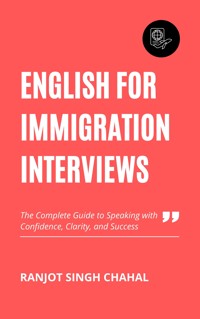
English for Immigration Interviews by Ranjot Chahal is the ultimate guide to mastering that moment with confidence, clarity, and calm communication.
Whether you’re applying for a student visa, work permit, or permanent residency, this book helps you transform nervousness into self-assurance.
Through real examples, emotional insights, and practical English guidance, Ranjot Chahal teaches you how to speak naturally, think clearly, and connect respectfully with your interviewer.
Inside this complete guide, you’ll discover:
Proven strategies to speak confidently under pressure
Tips to understand questions accurately and answer with clarity
Techniques for managing anxiety, stress, and body language
Real-world sample dialogues and 150 common visa interview Q&As
Lessons in emotional intelligence and cultural sensitivity that go beyond grammar
This isn’t just a book about English — it’s a book about you: how you carry yourself, how you think under stress, and how you represent your story with honesty and grace.
Whether you’re a first-time applicant or preparing for your final interview, English for Immigration Interviews will help you walk into that room not as a nervous applicant, but as a confident global communicator ready to succeed anywhere.
Das E-Book können Sie in Legimi-Apps oder einer beliebigen App lesen, die das folgende Format unterstützen:
Seitenzahl: 250
Veröffentlichungsjahr: 2025
Ähnliche


















Ranjot Singh Chahal
English for Immigration Interviews
The Complete Guide to Speaking with Confidence, Clarity, and Success
First published by Rana Books 2025
Copyright © 2025 by Ranjot Singh Chahal
All rights reserved. No part of this publication may be reproduced, stored or transmitted in any form or by any means, electronic, mechanical, photocopying, recording, scanning, or otherwise without written permission from the publisher. It is illegal to copy this book, post it to a website, or distribute it by any other means without permission.
First edition
Contents
Chapter 1: Understanding Immigration Interviews
Chapter 2: Essential English Skills for Immigration Success
Chapter 3: Introducing Yourself Professionally
Chapter 4: Talking About Your Country and Background
Chapter 5: Explaining Your Purpose of Immigration
Chapter 6: Discussing Work and Education Background
Chapter 7: Family and Relationship Questions
Chapter 8: Describing Financial Situation
Chapter 9: Talking About Travel History and Previous Visas
Chapter 10: Understanding and Explaining Visa Intentions Clearly
Chapter 11: Dealing with Difficult or Unexpected Questions
Chapter 12: Communicating Confidence Through Body Language and Voice
Chapter 13: Handling Cultural Questions and Adapting to a New Environment
Chapter 14: Explaining Career Goals and Future Plans
Chapter 15: Understanding Immigration Laws and Responsibilities
Chapter 16: Managing Stress and Building Confidence Before the Interview
Chapter 17: Mastering Listening and Speaking Skills for Clear Communication
Chapter 18: Handling Unexpected or Difficult Questions
Chapter 19: Building Emotional Intelligence and Cultural Sensitivity
Ending Chapter: The Journey Beyond the Interview
150 Common Visa Interview Questions and Answers
Chapter 1: Understanding Immigration Interviews
Immigration interviews are among the most important moments in many people’s lives. They can determine whether you will be allowed to enter, live, or work in a new country. For many, it is not just a formal meeting — it’s a dream, a chance to begin again, to reunite with family, or to find safety and stability. But interviews are often stressful, especially when English is not your first language. This chapter will help you understand what immigration interviews are really about, what officers expect, and how you can prepare yourself mentally and linguistically to succeed.
1.1 The Real Purpose of an Immigration Interview
Many people believe that immigration interviews are only about documents or checking your background. That is partly true, but the deeper purpose of the interview is communication and verification. The immigration officer wants to confirm three main things:
That your information is true and consistent with your application.That you are trustworthy and genuine in your reasons for moving.That you understand and can adapt to the country’s language, culture, and legal expectations.Your answers show not only your honesty but also your personality. Even a short sentence can show a lot about your confidence, preparation, and language ability. For example, when asked:
Officer: Why do you want to move to the United Kingdom?
Applicant: Because I believe I can build a good future here, continue my studies, and contribute to society.
This kind of answer sounds confident, clear, and polite. It shows your motivation without exaggeration. The interview is never just a test of English — it is a test of how well you can express yourself clearly and truthfully.
1.2 Types of Immigration Interviews
There are several kinds of immigration interviews depending on your purpose. Understanding each type helps you prepare specific vocabulary and ideas.
Visa Interviews: Usually for students, workers, or visitors. The officer checks your reason for travel, your plans, and your financial stability.Residency or Permanent Stay Interviews: For those applying to stay longer or permanently. Officers look for evidence of genuine relationships, financial support, and future plans.Citizenship Interviews: Focuses on your integration — your knowledge of the country, language, laws, and responsibilities.Asylum or Refugee Interviews: These are more emotional and serious. Officers ask about personal experiences, safety issues, and reasons for seeking protection.Each type requires a slightly different approach, but all share one rule: clarity and consistency. You must be honest and prepared with your story, documents, and vocabulary.
1.3 What Immigration Officers Really Look For
Officers are trained not just to listen to your words but to observe your attitude. They pay attention to tone, body language, and how naturally you speak. A nervous person is understandable — everyone gets nervous — but officers can tell the difference between nervousness and dishonesty.
They often evaluate:
Confidence: Are you answering directly or hesitating too much?Language ability: Do you understand questions clearly and respond appropriately?Truthfulness: Are your answers consistent with your application documents?Attitude: Are you polite, respectful, and cooperative?Example:
Officer: Can you tell me how you will support yourself while studying in the UK?
Applicant A: My uncle will pay for everything.
Officer: What does your uncle do?
Applicant A: Umm… he is… working in something… maybe restaurant.
This kind of hesitation can make the officer doubt your preparation.
Now see this version:
Applicant B: My uncle works as a chef in a restaurant in Birmingham. He has been living there for 8 years and will support my study expenses.
Same idea, but clearer, more confident, and believable.
1.4 The Structure of an Immigration Interview
While interviews vary, most follow a common pattern:
Greeting and verification: You are greeted, your ID and documents are checked.Basic information: Name, date of birth, purpose of visit.Detailed questions: About education, work, family, travel history, and plans.Clarification or follow-up: If any detail seems unclear.Closing: Officer may explain the next step or decision timeline.Usually, the interview lasts 10–30 minutes, though some asylum or citizenship interviews can last much longer.
1.5 Common Fears and How to Overcome Them
It’s completely normal to feel nervous. However, fear often comes from misunderstanding or lack of preparation. Many people worry they will make grammar mistakes or forget words, but officers are not expecting perfect English — they just need to understand you.
Here are practical steps to overcome fear:
Practice speaking daily. Even 10 minutes a day builds fluency.Record yourself answering common questions. Listen and improve.Prepare key vocabulary for your specific case — e.g., “student visa,” “sponsorship,” “family reunion.”Visualize success. Imagine yourself speaking confidently.Stay calm and polite, even if you don’t understand something.If you don’t understand a question, you can say:
“I’m sorry, could you please repeat the question?”
or
“Could you please explain that in another way?”
Officers appreciate honesty more than guessing incorrectly.
1.6 Cultural Awareness and Communication Style
English communication in immigration settings is polite and formal. Officers expect calm, direct answers without unnecessary detail. Avoid jokes, sarcasm, or long personal stories unless they are relevant.
For example:
Officer: What will you do after finishing your studies?
Wrong: I’m not sure, maybe I’ll find some job, maybe go back, maybe stay.
Better: After completing my studies, I plan to return home and use my knowledge to develop my career in business management.
Notice how the second answer sounds more structured and confident. Even if you hope to stay longer later, keep your answers realistic and aligned with your visa type.
Also, remember cultural politeness:
Always say “Good morning” or “Good afternoon.”Use “please” and “thank you.”Maintain light eye contact.Don’t interrupt the officer.These small gestures create a respectful impression.
1.7 Language Focus: Polite and Formal English
During immigration interviews, you need formal expressions. Instead of direct phrases like “I want to come,” use polite structures such as:
“I would like to come to study.”“I am planning to move for better job opportunities.”“I wish to live with my family.”Common polite expressions:
“Yes, of course.”“That’s correct.”“I understand.”“Thank you for the question.”“I appreciate your time.”Even small improvements like using “would like” instead of “want” make your English sound more professional and respectful.
1.8 Body Language and Tone
Non-verbal communication matters just as much as spoken words.
Keep your posture straight, shoulders relaxed, and maintain a friendly tone. Avoid crossing your arms, fidgeting, or looking away too often. Smile gently when appropriate.
If you feel nervous, take slow breaths before answering. Officers are trained to notice body language. Calm, natural gestures show honesty and confidence.
1.9 The Role of Honesty and Consistency
Honesty is the foundation of every successful immigration interview. Even small lies can cause big problems later because officers check every detail. For example, if your visa application says you will study computer science, but in the interview, you say business administration, that inconsistency can lead to rejection.
Always review your documents before the interview. Know what you wrote in your application. If you made an error, admit it politely instead of pretending.
Example:
Officer: I see here you mentioned your brother lives in London, but in your application, you didn’t include that. Why?
Applicant: I’m sorry. That was a mistake on my part. I misunderstood the question on the form. My brother has recently moved there, and I should have updated it.
This kind of honesty earns respect. Officers appreciate people who take responsibility.
1.10 Listening Skills
Listening is one of the most underrated skills in immigration interviews. Sometimes people prepare long answers but forget to actually listen to what is being asked. The officer may ask, “Where will you live during your studies?” and the applicant starts talking about their university instead of the accommodation.
To improve listening:
Focus completely on the officer’s words.Listen for keywords like “why,” “how long,” “where.”Repeat part of the question in your answer.For example:Officer: Why did you choose this university?
Applicant: I chose this university because it offers strong research programs in data science.
Repeating part of the question keeps your answer clear and directly relevant.
1.11 Managing Emotions During the Interview
Immigration interviews can be emotional, especially for family reunions or asylum cases. It’s okay to feel emotional, but try to express your feelings calmly in English.
For example:
“It has been very difficult to live away from my family, and I’m really hoping we can be together again.”
Avoid crying or raising your voice. Officers understand emotional cases, but professionalism helps them take your answers seriously.
1.12 Common Mistakes to Avoid
Memorizing answers word-for-word.It sounds robotic. Instead, prepare ideas and speak naturally.Using slang or overly casual language.Words like “yeah,” “gonna,” “wanna” are too informal.Over-explaining.Keep your answers focused. Two to three sentences are usually enough.Showing frustration.If you feel misunderstood, stay calm and ask politely for repetition.Contradicting your application form.Always check your documents before the interview.1.13 Building Confidence with Practice
Here’s a simple three-step method you can follow daily before your interview:
Prepare 10 common questions (e.g., “Why did you choose this country?” “What will you do after graduation?”).Answer them aloud in front of a mirror or camera.Watch your recording, correct your mistakes, and try again.Example mini practice:
Officer: Why did you choose Canada for your studies?
Applicant: I chose Canada because it offers high-quality education and a multicultural environment. I believe studying there will help me grow both academically and personally.
Notice how the answer is short, structured, and confident.
1.14 Example of a Short Mock Interview
Let’s look at a simple sample dialogue to understand tone and structure.
Officer: Good morning. How are you today?
Applicant: Good morning, sir. I’m doing well, thank you. How are you?
Officer: I’m fine. Please tell me why you want to go to Australia.
Applicant: I would like to study information technology at the University of Sydney because it offers a strong program and international learning environment.
Officer: Who will pay for your studies?
Applicant: My father will support me financially. He owns a business in our hometown.
Officer: Do you plan to return after your studies?
Applicant: Yes, after completing my degree, I plan to return home and work in the IT sector to support my family business.
This dialogue shows politeness, clarity, and focus. Each answer is specific and honest.
1.15 Preparing Mentally and Emotionally
Immigration interviews are not only about language; they’re about mindset. Confidence comes from preparation. Before your interview:
Sleep well the night before.Dress neatly — formal clothes create a good impression.Bring your documents organized in a folder.Arrive early.Take deep breaths before speaking.Remind yourself: the officer is not your enemy. They are simply doing their job. If you approach the interview as a conversation rather than a test, your nervousness will reduce.
1.16 Self-Practice Exercises
You can try these exercises to strengthen your English:
Write your own answers for the top 20 immigration questions.Record a full mock interview with a friend or even using your phone.Review your tone: Do you sound polite and calm?Check your grammar: Are your sentences clear?Work on timing: Keep each answer within 15–25 seconds.The more you practice, the more natural you’ll become.
1.17 The Importance of Simplicity
Simple English often communicates more powerfully than complicated words. Officers are not impressed by big vocabulary; they want clarity.
For example:
Instead of: “I am endeavoring to enhance my professional competence through international exposure.”Say: “I want to improve my skills by studying in another country.”Your goal is communication, not performance.
1.18 Real-Life Example: Two Applicants
Let’s imagine two applicants for a student visa.
Applicant 1:
“I want to go to Canada because I like the country and it’s beautiful. I think it’s good for me.”
Applicant 2:
“I chose Canada because it has excellent universities and practical learning methods. I also appreciate that it’s a safe and multicultural country.”
Which one sounds more professional?
Applicant 2 — because it’s specific, formal, and meaningful. The more detailed and genuine your reason, the better your impression.
1.19 When Things Go Wrong
Sometimes, interviews don’t go as expected. Maybe you forget a document, or the officer seems strict. Don’t panic. Staying calm in such moments shows maturity.
If you forgot something:
“I apologize, I don’t have that document with me right now, but I can provide it later if required.”
If you make a mistake:
“I’m sorry, let me correct that. I meant to say 2018, not 2019.”
Correcting yourself politely is better than pretending nothing happened.
1.20 Final Thoughts: Confidence Comes from Clarity
Success in an immigration interview does not depend on perfect English. It depends on understanding the process, speaking clearly, and showing sincerity. Officers appreciate honest, organized applicants who can express their thoughts in a calm and respectful way.
To summarize the essence of this chapter:
Learn to express your ideas simply and clearly.Be honest and consistent.Practice listening and responding politely.Stay calm and respectful, no matter what.Remember: the interview is a conversation, not a courtroom.With the right mindset and preparation, your English can become your strongest ally in achieving your immigration goals.
Chapter 2: Essential English Skills for Immigration Success
Language is not just a tool — it is your bridge to opportunity. In an immigration interview, your English ability does much more than convey information; it reveals confidence, personality, and cultural readiness. Even if your documents are perfect, unclear communication can create doubt in the officer’s mind. That’s why mastering a few key English skills is essential for interview success.
This chapter will guide you through the fundamental skills you need — speaking, listening, grammar, pronunciation, vocabulary, and the art of polite expression — all adapted to real immigration contexts.
2.1 Why English Proficiency Matters
Immigration officers are not language teachers; they are observers of communication. They don’t expect you to speak like a native English speaker, but they expect you to communicate clearly, naturally, and confidently.
Strong English skills show:
You can integrate easily into the country.You are serious about your application.You have the ability to follow laws, study, or work effectively.When officers ask questions, they are not only checking your facts — they are testing your understanding, listening, and fluency.
Let’s take an example:
Officer: Why did you choose this particular college?
Applicant A: I chose because it’s good.
Applicant B: I chose this college because it offers a specialized course in marketing, and I believe it matches my career goals.
The second answer is longer but also more structured, showing comprehension and thought. That’s what makes officers confident about your ability.
2.2 The Four Core English Skills
Every interview depends on four key communication skills: Listening, Speaking, Reading, and Writing.
For an immigration interview, listening and speaking are the most critical — but let’s understand how each contributes to success.
1. Listening
This is your foundation. You must understand the question before answering. Many applicants fail not because of poor speaking, but because they answer the wrong question.
Tip: Listen for question words like why, when, how long, who, where, and what.
Example:
Officer: How long will your course last?
Wrong: I will study Business Management.
Right: My course will last for two years.
Listening carefully prevents miscommunication and builds trust.
2. Speaking
This is the heart of your interview. Clear pronunciation, proper grammar, and confidence create a strong impression. Avoid rushing or using filler words like “uh,” “you know,” or “like.”
Speak slowly, organize your thoughts, and maintain a calm tone. Remember: short, clear sentences are better than long, confusing ones.
3. Reading
While you won’t read much during the interview, you may need to read forms, notices, or signs at the office. Understanding written English also helps you interpret the officer’s questions correctly if they refer to something from your documents.
4. Writing
For most visa categories, you write essays or statements of purpose before the interview. Knowing how to write clearly also improves how you think and speak. Writing practice builds better sentence structures for speaking.
2.3 Mastering Pronunciation
Pronunciation is often the biggest barrier for non-native English speakers. You don’t need a perfect accent — you just need clarity. Officers can understand a foreign accent as long as the words are pronounced clearly.
Common pronunciation challenges
Skipping word endings:Many learners forget to pronounce -ed or -s endings.Say: worked (not “work”)Say: studies (not “study”)Confusing long and short vowels:“ship” vs. “sheep”“bit” vs. “beat”Stress and intonation:English rhythm is based on stress patterns. Practice emphasizing key words.Example:I chose this university because it’s well-ranked.(Stress on chose, university, well-ranked.)Practice Tip
Read your answers aloud and record them. Listen for unclear words. Repeat until your speech feels smooth and natural.
2.4 Grammar That Matters Most
You don’t need advanced grammar to impress an officer — just accuracy and consistency. Focus on these simple structures:
Present Simple Tense – for facts and habitsI work as a teacher.
My father owns a shop.
Past Tense – for past experiencesI graduated in 2020.
I worked in Delhi for two years.
Future Forms – for plans and intentionsI will study computer science.
I’m planning to return to my country after graduation.
Modals for politeness and possibilityI would like to apply for this visa.
I might work part-time during my studies.
Articles and prepositionsI live in the capital city.
I’m applying for a student visa.
Correct grammar builds professionalism. Even simple errors like missing “the” or using wrong tense can sound careless.
2.5 Vocabulary for Immigration Interviews
A strong vocabulary helps you express yourself precisely. You don’t need rare words; you need the right words for your topic. Let’s explore useful groups.
1. Personal Information
birthplace, nationality, marital status, dependentsExample: “My nationality is Indian, and I’m currently single.”2. Education and Work
graduate, major, qualifications, position, duties, employerExample: “I graduated with a degree in Business Management and currently work as a sales executive.”3. Financial Terms
income, savings, sponsorship, scholarship, bank statementExample: “My father is my sponsor, and he has provided a bank statement to show financial support.”4. Immigration and Travel
visa, permit, residency, border control, documentation, stay durationExample: “I applied for a student visa valid for two years.”5. Emotions and Motivation
excited, grateful, confident, motivated, responsibleExample: “I’m very motivated to contribute positively to my new community.”The more familiar you are with these words, the smoother your speech will sound.
2.6 Active Listening Techniques
Listening actively means not just hearing but understanding. Officers often speak quickly or with different accents. These tips will help:
Focus on key information. Don’t panic if you miss one word — catch the main idea.Use polite clarifications.“I’m sorry, could you repeat that, please?”“Do you mean my education or my work experience?”Observe facial expressions and gestures. They can help you understand tone or emotion.Repeat part of the question to confirm:Officer: When did you complete your degree?
You: I completed my degree in 2021.
Active listening reduces stress and helps you respond accurately.
2.7 Building Fluency with Everyday Practice
Fluency doesn’t come overnight; it’s built through repetition and reflection. You can improve fluency even without a teacher.
Daily practice ideas:
Watch immigration interview videos online and imitate pronunciation.Use English in daily life: order food, ask for directions, talk to friends.Keep a “speaking diary.” Record short English thoughts each day.Shadowing technique: Listen to English audio and repeat immediately after the speaker — same tone, same speed.This constant exposure makes you sound more natural.
2.8 Understanding Formal vs. Informal English
One common mistake is using informal English in official interviews. Immigration interviews are formal; your answers must sound polite and professional.
2.9 The Role of Tone and Emotion
Tone can completely change how your words are understood. A flat or angry tone sounds defensive; a calm, respectful tone shows confidence. Practice varying your tone to sound friendly yet professional.
Example:
“I’m very thankful for this opportunity.”
Say it with warmth and eye contact.
Never sound bored or impatient. Officers appreciate enthusiasm and sincerity.
2.10 Handling Difficult Questions in English
Some questions might feel uncomfortable or confusing. Instead of panicking, use calm, structured responses.
Example 1:
Officer: Why did you choose this country instead of others?
Answer: I chose this country because it provides high-quality education and has a strong international reputation in my field.
Example 2:
Officer: What will you do if your visa is refused?
Answer: I hope it will not happen, but if it does, I’ll review the reasons carefully and reapply with the necessary improvements.
This kind of calm, diplomatic English shows maturity and composure.
2.11 Common Speaking Errors and How to Fix Them
1. Overusing “because.”
Variety makes your speech more fluent.
Instead of: “I chose this course because it’s good because it helps me.”
Try: “I chose this course as it offers practical training, which will help me in my career.”
2. Forgetting verb tenses.
Always align time with correct tense.
Wrong: “I study in college two years ago.”
Right: “I studied in college two years ago.”
3. Speaking too fast.
Slow down. Your goal is clarity, not speed.
4. Using local phrases unknown to officers.
Avoid idioms from your native language. Keep it universal.
2.12 Confidence Through Body Language
Fluency is not only about words; it’s also about presence. Confident body language helps your English sound natural.
Tips:
Sit upright with open posture.Smile naturally.Make eye contact without staring.Use your hands slightly to emphasize points.Don’t play with your pen, phone, or documents.A confident presence makes even simple English powerful.
2.13 Politeness in English Communication
Politeness is central to Western communication styles. Officers notice your manners as much as your answers.
Use softeners like:
“I believe…” instead of “I think.”“Could you please…” instead of “Tell me.”“Would it be okay if…” instead of “Can I.”For example:
“Could you please explain the next step?” sounds much better than “Tell me what’s next.”
Even if your grammar is simple, polite phrasing earns respect.
2.14 Dealing with Nervousness While Speaking
Nervousness is natural. Everyone feels it — even fluent speakers. What matters is how you handle it.
Try this method:
Pause before answering. Take a breath; it shows control.Smile slightly — it relaxes both you and the officer.Focus on ideas, not mistakes. The officer cares about meaning, not perfection.Use grounding phrases:“Let me think for a moment.”“That’s a good question.”Such phrases buy you time and make you sound thoughtful.
2.15 Practicing with Real Scenarios
Let’s see how English skills work together in real cases.
Scenario 1: Study Visa Applicant
Officer: Why did you choose this course?
Applicant: I chose this course because it focuses on digital marketing, which is growing rapidly. I want to gain practical experience and apply it to my family business back home.
Scenario 2: Work Visa Applicant
Officer: Tell me about your previous work experience.
Applicant: I have three years of experience as a network technician. My main duties included troubleshooting issues, maintaining systems, and training new staff.
Scenario 3: Family Reunion
Officer: Who lives in the country currently?
Applicant: My husband has been living here for two years as a permanent resident. I’m applying to join him and build our life together.
These examples show how vocabulary, grammar, and tone all combine to build credibility.
2.16 Using Transition Words to Sound Fluent
Transition words connect your ideas smoothly. Instead of speaking in broken sentences, use connectors.
Examples:
Because, however, therefore, in addition, on the other hand, for example, finally.“I chose this country because it has excellent universities. In addition, it provides a safe environment for international students.”
These small connectors make your English flow naturally.
2.17 Listening to Yourself
Many learners don’t realize how they sound until they hear themselves. Self-listening is one of the fastest ways to improve.
Record your mock interview and check:
Do you sound confident or hesitant?Are your sentences clear?Do you use too many fillers like “uh” or “you know”?Is your pronunciation understandable?Repeat practice until your answers sound effortless.
2.18 Real Dialogue Practice
Here’s a model practice you can use for self-training.
Officer: Good morning. Please tell me about your educational background.
Applicant: Good morning. I completed my Bachelor’s degree in Computer Science in 2021 from Delhi University. I also did a six-month internship as a software tester.
Officer: Why do you want to study abroad?
Applicant: I want to gain international exposure and practical knowledge that I can later apply in my country.
Officer: How will you finance your studies?
Applicant: My parents will sponsor me. We have attached their financial documents and bank statements for verification.
Practice repeating this with your own details.
2.19 Overcoming Accent Barriers
Everyone has an accent, and that’s perfectly fine. The key is clarity, not imitation.
You don’t need a British or American accent; you just need neutral pronunciation.
Tips:
Slow down your speech.Avoid mumbling.Emphasize syllables clearly: “in-for-ma-tion,” “ap-pli-ca-tion.”Listen to English news daily for accent familiarity.Clarity shows respect for communication.
2.20 The Power of Positive Language
Positive words create a strong impression. Use optimistic and confident phrases.
Instead of:
“I’m not sure.” → say “I’ll do my best.”“It’s difficult.” → say “It’s challenging, but I’m ready.”“I hope it works.” → say “I’m confident it will work.”Your language shapes your image. Immigration officers are more likely to trust applicants who sound determined and responsible.
2.21 Daily English Routine Before the Interview
Here’s a short daily plan you can follow before your interview:
Morning: Read one immigration article or watch a short English news clip.Afternoon: Practice 10 mock questions aloud.Evening: Write short notes about your plans or goals in English.Before bed: Listen to an English podcast or short video.In just 10–14 days, you’ll notice huge improvements in confidence and fluency.
2.22 Real-Life Mistakes from Applicants
Let’s learn from common real examples:
Mistake 1:
“I am applying for immigration because my friend told me is good country.”
→ Correction: “I’m applying because I believe this country offers better career opportunities.”
Mistake 2:
“I want to come here for good life.”
→ Correction: “I wish to move here to build a better life for my family and myself.”
Mistake 3:
“I’m nervous, I can’t talk.”
→ Correction: “I’m a bit nervous, but I’m happy to answer your questions.”
Small improvements completely change your impression.
2.23 Final Confidence Techniques
Right before your interview:
Take deep breaths. Oxygen relaxes your brain.Smile and greet warmly.Remind yourself that you’ve practiced well.Speak naturally, like in a conversation — not a test.Believe in your preparation. You don’t need perfect English — you need real communication.
2.24 Key Takeaways
Focus on clarity over complexity.Use formal, polite English.Practice listening and speaking daily.Build vocabulary related to your visa type.Maintain positive tone and body language.Be honest, calm, and confident.Your English doesn’t need to be perfect — it just needs to be you at your best.




