


14,99 €
Mehr erfahren.
- Herausgeber: Dreamspark Press
- Kategorie: Religion und Spiritualität
- Sprache: Englisch
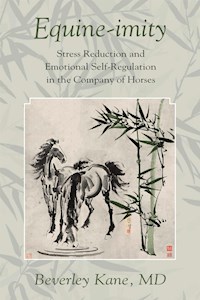
Ever wonder what it means to be “as healthy as a horse”?
Equine-imity teaches you how to achieve optimal mind-body health with qigong, a tai chi-like moving meditation, in the presence of gentle, sensitive horses. Written especially for non-equestrians and non-meditators. Seven easy-to-learn exercises. International resources for how to find a horse near you.
Based on our course of the same name at Stanford,
Equine-imity teaches qigong, a moving meditation, with, and optionally on, horses. It draws on principles and techniques from yoga, tai ji, mindfulness meditation, and Reiki, with a foundation of Daoist philosophy and Jungian psychology. From an East-meets-Western medical perspective,
Equine-imity includes state-of-the art information on stress physiology, sports medicine, mirror neurons, and the physics and metaphysics of energy measurement.
Das E-Book können Sie in Legimi-Apps oder einer beliebigen App lesen, die das folgende Format unterstützen:
Veröffentlichungsjahr: 2021
Ähnliche













You are free to cite, quote, and reproduce the materials in this book with the exception of copyrighted images from other sources as noted in the Illustration Credits. You are on your honor to notify the author of, and provide attribution for, any such use.
The information in this book is presented for educational purposes. It is not a substitute for treatment by a health care professional or personal supervision by a subject matter expert.
The names of most people and some horses have been changed for reasons of privacy.
Design by Meadowlark Publishing Services. Cover art montage by Judith Ogus. Published by Dreamspark Press.
ISBN 978-0-578-75115-3 Published 2021
To my beloved Ruben
Introduction
Part IIntroduction to Horses
1 Happiness Is a Warm Horse2 Original Grace, Original Graze3 Mirror, Mirror on the Grass
Part IIBodies of Knowledge: Somatics in Philosophy and Physiology
4 I Sing the Body5 Junger than Springtime6 Whoa, Nellie! Go, Nellie!
Part III Principles and Practices
7 The Shaman on the Shard8 The Ch’i Also Rises9 Reiki Gong10 Postures, Points, Powers, and Gestures11 The Wu Duan Jin
Part IV The Stanford Equine-imity Four Phase ProgramIntroduction
12 And the Horse You Rode In On13 Phase 1: Con Su Permiso: Meet and Greet14 Phase 2: OMMMMMM GroOMing15 The M.O. of the OM: Tying, Tools, Tips16 Phase 3: Am I Being Herd?: Leading17 Phase 4: The Meditation Ride18 Happy Trails to You
Appendix A: Body English, Body ChineseAppendix B: The History and Nature of EnergyAppendix C: Coming Soon to a Horse Near YouAppendix D: EAATing at the Grownup TableGlossaryIllustration CreditsAcknowledgementsAbout the Author
I n t r o d u c t i o n
When the grass looked greener at a Fortune 500 company, Allison left her comfort zone at the top of her game as editor of a small food magazine. But at the first meeting in her new corporate boardroom, she felt the threat of being laid low (or perhaps too high) by the Peter Principle of rising ever upward until you fail. Her performance anxiety was so severe that it was somaticized—expressed through her body—as a rapid heartbeat that sent her to the emergency room. The cardiologist found nothing abnormal with Allison’s physiological heart. He diagnosed her as having a stress response, a condition of the emotional “heart.” Weeks later, still experiencing “heart” symptoms, Allison came to the Wisdom of the Mare, an equine experiential learning program for women in transition. This somatic horsemanship workshop used interactions with gentle horses as a way to counteract the stress that comes from life’s major changes.
What Is Somatic Horsemanship?
Somatic horsemanship is the practice of exploring the physical relationship between humans and horses, on the ground and on the horse, in order to promote physical, emotional, mental, and spiritual health in both species. While all these aspects of the horse-human relationship are interrelated, for most horses the most tangible means of interacting is through the five senses and the body as a whole.
Somatic means of the body. Somatics as a mind-body conditioning and healing practice began with the work of the late Thomas Hanna, a student of Ukrainian-Israeli engineer and physicist Moshe Feldenkrais. The story goes that Feldenkrais used his understanding of electrical currents in mapping out the circuitry of the nervous system to rehabilitate a sister who had suffered brain damage. He then pioneered his eponymous movement therapy to reprogram the brain following strokes and for other neurological disorders. As with the Feldenkrais Method, Hanna Somatics emphasizes small, slow, isolated movements to heal injuries, correct anatomical abnormalities, and promote healthy aging in nerves, muscles, and joints. Somatic horsemanship uses these principles in teaching deep breathing; slow, simple muscle movements; and mindful activities with horses to tap into mind-body states of health, peace, and strength.
My relationship with my body became redefined in middle age. At fifty, I realized I was no longer twenty-five. Although I remained healthy, my body was noticeably, well … older. Long work hours, business travel, and expense account dinners conspired to thwart my attempts to stay fit. I had also lost the spiritual connection to my body that came from the discipline of sports and adherence to a healthy diet. Once a marathon runner, mile-a-day swimmer, and solo wilderness backpacker, I began to notice a decline in speed, strength, flexibility, and stamina. I was always an animal lover, and I found myself attracted to horses as magnificent beings who could become extensions of my body.
Who Moved My Cheese?
When the dot-com bust hit Silicon Valley at the turn of the millennium, I was working as a doctor-patient communication expert at WebMD. As the company began pulling its Sunnyvale operations, about fifty of us chose to take a hefty severance package rather than move to New York or Atlanta. Our managers solemnly paraded us into private rooms one by one to confirm the rumors and give us our walking papers. I thought, No big deal, I’m A-OK. Twenty minutes later, my true state of mind became evident when I drove a few blocks from the office to put gas in my car. Subconsciously more shaken up than I wanted to admit, I drove off with the gas nozzle still attached to my car, pulling the hose out of the pump.
I immediately began some frenzied mental machinations to plan how to find my next job. With an epidemic of closures and layoffs hitting the Valley, the book Who Moved My Cheese? by Dr. Spencer Johnson made the rounds. It was a kiddie-style allegory about two mice and two humans—and two types of reactions to having the rug pulled out from under them. One type remains stuck looking for the same old cheese; the other type moves on creatively.
My close friend Sheri, also a physician, sat in the garden with me while I poured out my feelings of stress and woe. After patiently listening to my lamentations, she asked, “So, what do you really want to do?”
The first thing that came to mind was, “Well, I’ve been wanting to take riding lessons.”
I decided to do this one small thing for a while instead of obsessing on my lost cheese.
Dreams and Dream
Guided by what Swiss psychiatrist and mystic Carl Jung called a Big Dream, a nighttime dream of cosmic proportions, my riding extended into the practice of equine-assisted learning and psychotherapy, and finally into somatic horsemanship.1 My first horse was aptly and synchronistically named Dream. In intimate, whole-body contact with this big, beautiful animal, I regained my sense of the physical. I felt Dream’s flesh and bone as part of me, felt us as each other’s2 centaur-like appendages, joined at the body and at the heart.
One year after the dot-com bust, I established my private practice, Horsensei Equine-Assisted Learning & THerapy (HEALTH). My services were dedicated to teaching career and social skills to corporate employees, university staff, and medical professionals. These programs emphasized the psychological and pragmatic aspects of the horse-human relationship in modeling communication, teamwork, and leadership. The somatic aspects played a lesser role.
Then, in the spring of 2011, I got bucked off a step stool in my kitchen. I sustained a fractured foot, a dislocated right elbow, and a sprained left wrist. If I were a horse, I’d have been called three-legged lame!
My orthopedic surgeon told me not to ride for three months. Not ride?! Now, most physicians know little about horseback riding. When a doctor tells you not to pursue a sport, you must consider where the advice is coming from. Is she just expressing generic caution about potential risks? Or has she identified specific biomechanical limitations in your body that preclude that particular activity? In my case, it was the former. I was physically able to ride but would not have tolerated another accident. So I decided to compromise: I enrolled as a client at the National Center for Equine Facilitated Therapy, a premier hippotherapy (physical therapy on horseback) and therapeutic riding facility. Riding, which I had always done holding the reins and usually in a saddle, was now done bareback and out of my control. Someone led the horse, another person was a side walker, and Corie Thompson, my inspirational therapeutic riding instructor, directed my movements. (Corie would later help create Equine-imity and become my first co-facilitator.) My entire focus was on how my body felt on top of the horse. Instead of the nervous, gotta-do-it-right attitude I carried into my riding lessons, here I was just another kid. We played the airplane game with my arms straight out. We played ’round the moon where I turned in my seat 360 degrees. These tearfully joyous sessions brought home the message that for me, the entry point to mind-body-spirit wholeness has always been the physical body. And the physical and metaphysical embodiment of wellness is the horse.
I continue to experience body and mind revitalization best when sitting atop a horse, but also when I am grooming, massaging, and breathing with horses, or just watching them in pasture. All these activities evoke feelings of strength, grace, balance, and peace. To make these benefits accessible to others through contact with horses, I offer the Equine-imity somatic horsemanship program to reduce stress, dispel negative emotions, support graceful aging, and renew a spiritual connection with nature and one’s happy place within it.
A proliferation of yoga and horsemanship programs, mainly for equestrians, has grown out of the popularity of yoga in corporate, college, and community wellness centers. Other somatic horsemanship programs use tai ji, Mindfulness-Based Stress Reduction, and the equine-assisted implementations of body-oriented psychotherapies such as Eye Movement Desensitization and Reprocessing (EMDR) and Somatic Experiencing.
Why Horses?
Horses are consummate teachers of healthy embodiment and emotional resiliency. Unlike our family dogs and cats, horses are not housebroken. They are not conditioned to feel shame and guilt for their biological functions. Cats and dogs are predators who create stress for other animals. Horses are prey animals who run to safety, then let go of fear when the danger has passed. They have survived for 60 million years by becoming more adept than their attackers at sensory awareness and emotional self-regulation. After being acutely stressed into a flight response, horses quickly recover and go back to grazing—their baseline equanimity. We learn from horses how to go from a state of hyperarousal, due to uncontrolled emotions such as anger, grief, and fear, to a state of peace.
Weighing up to 2,200 pounds, horses are the great equalizers of all people fat and thin, weak and strong, young and old. Anyone can feel light, powerful, youthful, and athletic beside or astride a horse.
Somatic horsemanship is one of many equine-assisted activities and therapies (EAAT), which include equine-assisted learning and psychotherapy, hippotherapy, and therapeutic riding. Scientific evidence is mounting for the benefits of these programs.
Why Qigong?
Equine-imity teaches the art of just being and the art of doing slowly and mindfully. The core of Equine-imity’s doing aspect is the practice of qigong (chee goong). Qigong is an ancient Chinese healing exercise with slow, graceful movements suitable for people of all ages and physical abilities. It is the most gentle, most traditionally health-oriented form of East-meets-West moving meditation.
Unlike sitting meditation, qigong doesn’t ask us to stay rigidly immobilized with blank minds. Unlike yoga, qigong doesn’t entail pretzel poses or head-down contortions. Unlike kung fu, aikido, and karate, qigong is non-combative, requires minimal strength and fitness, and results in almost no injuries. Qigong is the ideal technique for teaching humans to go back to grazing.
Equine-imity uses one of the best known and simplest forms of medical qigong, the Ba Duan Jin (literal translation, “eight sections of brocade”; poetic translation, “eight silken movements”). Medical studies of the Ba Duan Jin show its unique healing benefits. In the modified Shaolin Ba Duan Jin set that we practice, five of the eight classical forms can be done on horseback. We call these the Wu (five) Duan Jin and learn them initially on the ground, then on the horse.
The qigong movements prepare you for blending your ch’i (qi) life force energy with that of your horse. This mindful contact between your two bodies allows the human heart, with its rate of up to 120 beats per minute during times of stress, to slow to a normal 60 to 80 beats per minute by entraining it with the horse’s heart, with its resting rate of 40 beats per minute.
When Allison shared a dan tien ch’i hug with the mare Bella, the racing feeling in her chest subsided for the first time in weeks. The moment Allison exhaled into her dan tien lower abdominal energy center, Bella let out a huge, whuffling sigh of release. You will learn the dan tien press and the dan tien hug in chapter 13, Con Su Permiso, and you will learn to treasure the whuffle.
Why Somatics?
Equine-imity has at its foundation the practice of balancing the four functions described by Carl Jung: intellect, emotion, sensation (somatics), and intuition. In Western culture, stress is caused mainly by an overwrought intellect manifesting as worry and self-criticism and by runaway negative emotions such as anger, fear, guilt, envy, and sadness. The key to creating equanimity lies in cultivating positive behaviors based on healthy somatic and intuitive—including spiritual—attitudes and practices. We use the term somato-spiritual to mean the combination of body and soul that creates health and happiness in a deeply meaningful, even sacred, way.
What Can Equine-imity Somatic Horsemanship Do for You?
• Do you suffer from stress that manifests as bodily symptoms such as headaches, stomach aches, or insomnia?
• Do you feel a disconnect between your work, family, or social life and who you are, or wish to be, most deeply and idealistically as a person?
• Are you seeking a harmonious integration of your intellectual, emotional, physical, and religious or spiritual activities?
•Are you in transition or at a crossroads where merely thinking, talking, and worrying about problems and options has failed to create clear solutions?
• Do you suspect that there are subtle energies, coincidences, and hidden meanings in life that are not fully described in or predicted by the scientific, academic, or business world?
If the answer to any of those questions is yes, you can benefit from an approach that uses the wisdom of the body and the intuition, as taught by horses, to create health, wholeness, and balance in your life. For while horses are not highly developed verbally and intellectually, they are geniuses of somatic, instinctual, and emotional functioning.
What You Will Learn in This Book
Written for the not-necessarily-equestrian, not-necessarily-qigong-y reader, Equine-imity offers:
• A reappraisal of the human body as beautiful no matter what its size or shape
• Horses as models of embodiment and teachers of physical, emotional, and spiritual health
• Stories of horses healing humans
• Seven simple, easy-to-follow medical qigong exercises
• Applied principles from exercise physiology and sports medicine, natural horsemanship, and equine-assisted psychotherapy
• The Stanford Equine-imity four phase somatic horsemanship program, proven to reduce stress
• Resources for how to locate horses within half an hour of your home or work
• Resources for how to pursue equine-assisted activities and therapies as a career
• A heartfelt appeal to keep horses appreciated, valued, and employed
Equine-imity is for those who have, or have had, horses and for those who have never even touched a horse. It is for anyone in middle age or older who wishes to become reinvigorated by the power, grace, and majesty of the horse. Equine-imity is also for younger generations, who, studies show, cope more poorly with stress than older generations. Teens and young adults can use Equine-imity’s principles of sports medicine, martial arts, natural horsemanship, and meditation for sports and school challenges.
Equine-imity does not attempt to make you into an equestrian or a qigong master, although if either of those happens as a result of its activities, your life will be much richer for it. But you can use the teachings far beyond any experience with horses and qigong.
This book teaches you how to return to, or find for the first time, a place of invigorated peace and health. It helps you keep finding it, and keep returning to it, even without horses or structured exercises.
Equine-imity is divided into four parts.
Part I introduces you to the nature of horses—why they are so well suited to teach us how to reduce stress and let go of damaging emotions. Horses live in their bodies differently from the way we, our cats, and our dogs do. You will learn important ways in which horses are different from our household pets.
Part I also examines the evidence for a sixth sense in horses and humans. When doing somatic horsemanship activities, it is important to be aware of all influences coming into play. We present evidence that, according to landmark work by parapsychologist Dean Radin, PhD, bodies can, independent of the mind, precognitively sense a variety of stimuli.
Part II gives you a look at some historical and cultural views of the human body. Many religious and esthetic traditions make it difficult for us to appreciate our bodies as a source of pride and pleasure and as the key to stress reduction. Part II also looks at the science of stress physiology and psychology as it relates to the qigong forms in Part III. Westerners accustomed to partaking of their philosophy and their science in separate bowls will see how these ingredients can be combined into one recipe for living.
Part III teaches you how to orchestrate the body’s subtle energy systems in coordination with your breathing and muscle movement. You will learn the Wu Duan Jin qigong forms, plus some techniques from yoga, mindfulness meditation, and Reiki, preparatory to practicing them with, and sometimes on, a horse.
Part IV shares the entirety of our Stanford Equine-imity program, allowing you to experience some or all of the activities under the supervision of an experienced, trustworthy horse person.
It is fine to skip the background material and go right to the techniques and activities in Parts III and IV. Later you can go back and read the rest of the book while sitting in a lawn chair beside your new horse friend.
Don’t know how to meet a horse? In the back of the book, appendix C gives you resources and suggestions for finding equine-assisted activity programs or private individuals with horses in your area.
A not-at-all-hidden agenda of Equine-imity is to teach appreciation of horses, the land they live on, and the trails they walk. In writing this book, I visualized all of you and all of the horses who will be enriched, and perhaps saved, by your engagement with each other.
Our bodies are our temples and horses lead us to the altar.
1Red Mustang Stallions Dancing in the Desert. In Carey, Michiko Akahori. Women’s Meaningful Dreams: The Treasure Within the Feminine Psyche. Doctoral dissertation. Institute of Transpersonal Psychology. Palo Alto, CA. 24 May 2010. https://pqdtopen. proquest.com/doc/597937273.html?FMT=ABS
2 I use the single word each other to denote Oneness among beings.
Why are horses ideal for teaching us how to live better? How have we come to see these intelligent, sensitive creatures as facilitators of all aspects of human development? A big part of their value for us is the way in which they can react to minute changes in our moods, behaviors, and body language, offering us constant feedback for our actions and internal states. In speaking of horses as psychological, emotional, or somatic beings, any divisions we make among those qualities are ultimately artificial and arbitrary. We make these distinctions only to emphasize the horse’s unique contribution to our appreciation of the somatic dimension of our integrated selves.
Horse Psychology
Unlike our family cats and dogs, who evolved as predators and are now highly domesticated, horses evolved as prey animals and remain essentially feral even in the captivity of our barns and pastures.1
Horses are social creatures who readily and honestly respond to the challenges inherent in forming and sustaining relationships. Horse herds have an established, but often labile, hierarchy that is tested several times a day to reconfirm that the healthiest, most able horse—who might be the smallest one—can continue to lead the herd and ensure its survival. Dominance among horses is both situation dependent and non-transitive.2 That is, some horses are dominant around food, some around a patch of real estate in the shade, some around monopolizing people, some around their love interests or buddies. In my horse’s herd, I witnessed a non-transitive hierarchy where Rainy was dominant to Cody and Cody was dominant to the rest of the herd, but Lokin and a few others submissive to Cody were dominant to Rainy.
With horses, what they see is what you get. Their physical actions are consistent and congruent with their thoughts and emotions. Incongruency occurs in humans when our outward expressions don’t match our inner thoughts and feelings. Many horses are uncomfortable with our incongruencies. Although horses don’t cognitively formulate the statement “This human is incongruent,” they can become agitated by the palpable tension we exude in repressing our emotions and by the confusion we create with our conflicting requests, mixed messages, and indecisiveness. Most horses are fine with our crying into their manes; they are not fine with our putting on a happy face while we are crying inside. Although horses can be patient and forgiving, faced with our incongruency or lack of leadership, they will take matters into their own hooves, ignoring or avoiding us in order to feel safe and sure. We gain their trust and cooperation when we are congruent and able to display clear, consistent intent.
Horse Emotions
Horses are naturally curious, but seeing an unfamiliar or unexpected object triggers the survival instinct. Horses fear anything they perceive as a bodily threat until it is proven to be otherwise. A typical response to a strange stationary object is evasion or cautious approach-and-retreat behavior, often accompanied by snorting and hopping. When surprised by a moving object like a flapping tarp or a bird flying out of the brush, horses may shy, spook, or run until safety can be re-established. Then, after being temporarily panicked, horses quickly forget about the incident and regain their equanimity. Rather than hold on to trauma or analyze it to death, horses go back to grazing as if nothing happened. The back-to-grazing principle is one of the key teachings from horses.
As part of their need for inner-outer congruency, horses abide our emotional extremes, as long as we don’t express such extremes abusively. Even when we relate to them with emotions that are displaced from our other relationships—a dynamic called transference—horses remain unperturbed. Hence we cherish their ability to tolerate our mental and physical projections, as well as our emotional transference.
Horse Physiology—Horses as Models of Embodiment
Horses are the epitome of embodiment in the Buddhist sense of the body as the earthly manifestation of the soul. Their sheer size and the magnitude of their movements evoke our heightened awareness. They live in states of intense sensuality—eating, running, excreting, mating—without guilt or shame. Horses put us back in our bodies by showing us how completely and comfortably they live in theirs.
Since the horse is a prey animal in the wild, her life depends upon her sensory, and likely extrasensory, acuity. Survival requires attunement to all stimuli in her environment—smells, sights, noises, and tiny skin perturbations. Horses can feel a fly land on their backs. They can smell water in the desert from miles away. They can see, with visual fields totaling roughly 357 degrees (see drawing), the flick of a herd mate’s ear out of the corner of their eye. They sense the difference between our leaning one shoulder toward them or away from them. Horses have a highly developed ability to discern changes in the stance and arousal levels of other herd members, an ability they easily transfer to interactions with human beings.
Horses motivate us to slow down and relax. They help us transfer the hyperactivity—the “energy”—of our minds toward our lower bodies and the ground. A resting horse has a heart rate of 35 to 40 beats per minute. An anxious human has a heart rate of 80 to 110 or more. With the dan tien press and the dan tien hug described in chapter 13, the human heartbeat can entrain with that of the horse. This unconscious synchronization of heart rates slows the human’s heart and causes her to feel more relaxed.
Horses can also energize and strengthen us. Watching a horse gallop and rear up in play, we are infused with stamina and power and joy. We feel especially invigorated when they carry us on their backs in a ground-covering trot or canter.
As we will see in chapter 10, Postures, Points, Powers, and Gestures, horses have big energy centers that are anatomically analogous to our own. When we blend our energy centers with the horse, body-to-body, there is an intimate exchange of movement, flow, and shared potency. Part of the conventional wisdom about why little girls love horses is that it is so empowering for a 60-pound child to partner with a 1,000-pound animal.
Horses who live outdoors in fields and forests teach us about our connection with nature. They awaken within our cellular memory a time when we, too, lived simply on the earth. The revival of nature-based therapy seeks to rescue us from the ills of traffic, smog, and sick building syndrome and restore us to health. “Healthy as a horse” means following the example of horses who live naturally on the land.
By interacting with horses somatically, emotionally, and psychologically, we deepen our awareness of personal issues and core feelings, and increase our ability to reach our true potential. We learn how to establish boundaries, blend energy centers, and direct a large creature, and therefore ourselves and our lives, by using mental focus, clarity of intent, and somatic blending. These skills have far-ranging applications for satisfaction in social relationships, careers, and parenting. And you will have the opportunity to discover that for yourself as you put this book’s principles into practice.
1 The Western Hemisphere has no “wild” horses. Proto-horses originated in Wyoming, USA, 6o million years ago, and were the size of a fox. They became extinct after the last ice age, 10,000 years ago. Equines now living in the Americas are descended from those who were introduced by, and escaped from, fifteenth-century Spanish explorers and missionaries such as Cortez, Ponce de Leon, and Coronado. These once domesticated horses are termed “feral.” The last remaining species of true wild horse is the Przewalkski (sha-vahl´-skee) horse of Mongolia.
2 Glossary terms appear in brown on first use in the text.
Emotions are like wild horses. —Paulo Coehlo, Brida
Cody, my high-energy, high-strung Arabian gelding, spied a life-threatening form coming toward him at a gallop—the dreaded, deadly, horse-devouring white plastic grocery sack carried on the wind. After doing the “Arab teleport”—a quantum leap with no intermediate states—to land ten feet away from the bag, he realized it was not going to hurt him.
Oh, he shrugged. No big deal. I’ll just grab some more grass.
This return to baseline equine-imity after a fright is characteristic of horses. Horses do not hang on to episodic trauma, unrealized threats, and temporary upsets the way we do. They are conservative. That is, their survival as prey animals who rely on flight depends on their ability to conserve energy for running, should the danger prove to be real. They do not waste energy on situations that prove harmless. Unless the potential menace becomes an actualized calamity, horses quickly go “back to grazing.”
Grazing is not necessarily eating. Horses can graze for hours as a way to relax. The horses we brought to the Stanford Wellness Faire grazed on the lawn continuously for six hours, largely ignoring the hay we laid down. For them, nibbling on the sparse grass was an anti-stress activity for coping with hundreds of horse-selfie-seeking faire-goers and the Stanford marching band. Grazing is like a pacifier for a baby. In adult humans, the same purpose is served by stress eating, chewing gum or tobacco, and smoking.
Can you think of something about which you have built up worry, fear, anger, jealousy, sadness, or resentment that you would like to let go of? The qigong postures, gestures, and forms you will learn in later chapters will teach you to release these unpleasant accumulations and to go back to grazing.
March is the most beautiful month of the year in Northern California. The hills are Glocca Morra green. Bright yellow mustard flowers grow high as a foal’s eye along the San Francisquito Creek in the oak-studded forty-acre pasture that is my office. This is a much touted nature therapy environment where clients come for their private Equine-imity somatic horsemanship sessions.




