


1,99 €
Mehr erfahren.
- Herausgeber: Booksell-Verlag
- Kategorie: Poesie und Drama
- Sprache: Englisch
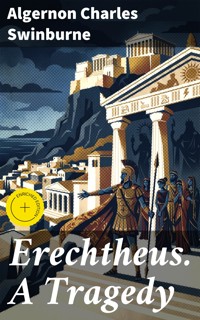
Erechtheus. A Tragedy is a compelling exploration of ancient themes, weaving the myth of Erechtheus, the Athenian king, into a rich tapestry of poetic diction and dramatic structure. Swinburne's characteristic use of lyrical intensity and rhythmic innovation shines through, as he delves into profound questions of duty, sacrifice, and the intersection of personal desire with the demands of fate. The work stands as a homage to classical tragedy, drawing inspiration from Greek drama while simultaneously infusing it with Victorian sensibilities, reflecting Swinburne's fascination with the interplay of love, death, and divine retribution. Algernon Charles Swinburne, a prominent figure in the 19th-century literary scene, was known for his radical views on aesthetics and morality, and his fascination with themes of freedom and constraint. Influenced by the classical canon, as well as by his own experiences with political upheaval, Swinburne often grappled with the tensions between individual will and societal expectations. His intimate knowledge of Greek mythology and tragedy culminated in this bold work, which resonates with the emotional weight and ethical dilemmas of his time. Erechtheus is a must-read for enthusiasts of both classical literature and Victorian poetry. Swinburne's masterful command of language combined with the timeless themes of love, loss, and the relentless march of destiny invite readers into a world that transcends its historical context. This tragedy serves not merely as a retelling of an ancient tale but as a profound reflection on the human condition, making it an essential addition to the canon of literary classics. In this enriched edition, we have carefully created added value for your reading experience: - A succinct Introduction situates the work's timeless appeal and themes. - The Synopsis outlines the central plot, highlighting key developments without spoiling critical twists. - A detailed Historical Context immerses you in the era's events and influences that shaped the writing. - An Author Biography reveals milestones in the author's life, illuminating the personal insights behind the text. - A thorough Analysis dissects symbols, motifs, and character arcs to unearth underlying meanings. - Reflection questions prompt you to engage personally with the work's messages, connecting them to modern life. - Hand‐picked Memorable Quotes shine a spotlight on moments of literary brilliance.
Das E-Book können Sie in Legimi-Apps oder einer beliebigen App lesen, die das folgende Format unterstützen:
Veröffentlichungsjahr: 2023
Ähnliche








Erechtheus. A Tragedy
Table of Contents
Introduction
A city’s survival is weighed against a father’s love, and the scale is held by forces that do not bargain.
Erechtheus: A Tragedy stands among Algernon Charles Swinburne’s most ambitious dramatic achievements, a work that seeks to reawaken the grandeur and austerity of Greek tragedy in a modern poetic voice. Its classic status rests not on popularity alone but on the seriousness of its artistic design: Swinburne attempts a sustained tragic form in verse, shaped by choral movement and ritual intensity. The result is a drama that invites readers to measure the costs of civic duty, the limits of human agency, and the solemn beauty of disciplined poetic speech.
Swinburne (1837–1909) was a central figure of Victorian poetry and criticism, associated with the period’s renewed fascination with classical antiquity and with experimental forms of poetic drama. Erechtheus was published in 1876, during a phase of his career when he repeatedly engaged with Hellenic subjects and tragic structures. Reading it now means entering a nineteenth-century effort to converse with ancient models without merely translating them: the play is an original composition that draws on Greek mythic material and tragic conventions while remaining unmistakably Swinburne in rhythm, intensity, and moral pressure.
The premise, presented in the severe simplicity proper to tragedy, turns on the threatened fate of Athens and the figure of Erechtheus, a legendary Athenian king. The play dramatizes a community at the edge of catastrophe, confronted with demands that reach beyond ordinary politics into the sphere of sacrifice and sacred obligation. Without revealing the decisive turns, it is enough to note that the drama is powered by an irreconcilable collision between public necessity and private bonds. Swinburne sets the audience at the painful intersection where what preserves a people may destroy what makes life worth preserving.
One reason the tragedy has endured is Swinburne’s insistence that ideas must become action and action must exact a price. The play does not treat patriotism as mere sentiment or religion as mere ornament; it stages them as real forces that compel decision. In doing so, it revisits enduring questions: what a state can ask of individuals, how fear and honor are cultivated, and whether moral clarity is possible when the stakes are collective survival. The drama’s emotional charge comes from the fact that these questions are not abstract; they are embodied in family, authority, and community.
Swinburne’s verse is integral to the work’s standing, because the language is not simply a vehicle for plot but the medium of the tragic experience. The cadences and patterns of choral speech, the ceremonial density of address, and the compression of feeling into formal lines all contribute to an atmosphere of inevitability. Even for readers new to poetic drama, the play demonstrates how structure can create meaning: repetition, invocation, and heightened diction are used to build the sense that human choices unfold under immense pressure. This craftsmanship has kept the tragedy in conversation with literary debates about form and voice.
The play’s literary impact is also tied to its position in the Victorian revival of classical drama, a movement that sought to learn from Greek models while testing the resources of modern English poetry. Erechtheus exemplifies a serious attempt to write a tragedy that reads as literature and as a performance text in the mind’s theatre. Its influence is felt less as a single line of imitation than as an example of what English verse drama can attempt: a return to ritual seriousness, an embrace of choral architecture, and a willingness to let myth speak to modern concerns without being reduced to allegory.
The enduring themes of the work—sacrifice, duty, civic identity, and the tension between divine demand and human feeling—help explain why it continues to attract readers interested in tragedy as a mode of thought. Swinburne treats conflict not as a puzzle to solve but as an experience to endure, where competing goods cannot be neatly reconciled. The drama is therefore less about surprising outcomes than about the deepening of necessity, the revelation of what is valued, and the exposure of what is vulnerable. This approach gives the play an austere universality that transcends its mythic setting.
Erechtheus also matters because it illuminates Swinburne’s broader artistic aims: to fuse sensuous verbal music with intellectual severity. The work challenges the stereotype of Victorian poetry as either moralizing or merely decorative by presenting a tragic imagination that is both lyrical and uncompromising. It shows a poet using ancient material to test modern ethical limits, asking what language can do when confronted with collective fear and personal loss. In this respect, the play has served later writers and readers as a touchstone for the possibilities of high poetic drama in English.
The book’s classic status is strengthened by how it sustains attention on the public dimension of tragedy. While many dramas center on individual ambition or private wrongdoing, this play places the polity—its continuity, memory, and obligations—at the heart of the stage. That emphasis makes the conflict feel both ceremonial and immediate: the fate of a city is not an abstraction but a lived reality made of homes, children, and inherited vows. Swinburne’s Athens becomes a lens through which to examine how communities justify demands, distribute suffering, and preserve identity under threat.
As with many works that draw on classical myth, the power of Erechtheus lies in how it makes ancient story into a living argument about the human condition. Its mythic framework allows Swinburne to strip away the distractions of realistic detail and to focus attention on the essential: what is owed, what is chosen, and what cannot be recovered once given. The drama’s formal gravity encourages a mode of reading that is slower and more attentive, rewarding those who listen to the movement of the verse and the ethical pressure behind each exchange.
In a world still shaped by debates over civic responsibility, collective security, and the cost of loyalty, Erechtheus retains a troubling clarity. It speaks to the persistent question of what societies demand in moments of crisis and how individuals are asked to carry those demands in their bodies and their families. The play’s lasting appeal comes from its refusal to offer easy consolation: it honors the dignity of serious choice while acknowledging the pain such choices entail. For contemporary readers, Swinburne’s tragedy remains a compelling reminder that the oldest stories endure because they continue to name our hardest conflicts.
Synopsis
Algernon Charles Swinburne’s Erechtheus. A Tragedy is a verse drama that reworks an Athenian heroic legend within the conventions of classical tragedy. The action is set in Athens at a moment of existential threat, when civic survival, religious obligation, and dynastic continuity collide. Swinburne frames the story through choral movement and heightened rhetorical debate, shaping the narrative less as domestic intrigue than as a public crisis. From the outset, the play situates its characters under pressures that exceed private desire, presenting the city itself as the central stake and the gods as an unavoidably present force in political life.
paragraphs
The play introduces Erechtheus as Athens’ king and chief defender, a ruler whose authority is inseparable from the city’s sacred traditions. Opposing forces gather, and the possibility of war becomes immediate, pressing the court to weigh action against ritual constraint. Swinburne emphasizes the gravity of decision-making through formal speeches and choral commentary, establishing a moral landscape where courage, piety, and prudence are contested rather than assumed. Early scenes bring forward the tension between human planning and prophetic or religious demands, making clear that victory or survival may require costs that ordinary politics would not contemplate.
paragraphs
As the threat intensifies, counsel and deliberation take on the shape of a trial of values. The drama focuses on how a ruler should respond when the city’s safety seems to depend on compliance with divine will. The chorus, functioning as a civic conscience, broadens the frame beyond individual characters to collective fear and hope, turning each decision into a question about Athens’ identity. Swinburne’s sequence of debates steadily narrows the range of acceptable choices, portraying a society in which religious sanction and communal expectation exert real coercive power, even over those who would resist them.
paragraphs
Erechtheus’ household enters the political arena, and family bonds become entangled with public necessity. Swinburne places particular weight on the voices of women and kin, whose responses expose the human cost behind civic rhetoric. The court’s internal divisions do not simply mirror factional politics; they reveal different understandings of duty, honor, and the limits of obedience. The drama proceeds by escalating confrontations rather than by rapid external events, using argument, lament, and choral reflection to show how an impending conflict can transform private roles into instruments of public policy.
paragraphs
The approach of battle or catastrophe forces the central question into the open: whether Athens can be saved without committing an act that violates ordinary moral intuition. Swinburne’s tragic mechanism turns on the incompatibility of goods, where preserving the city may endanger the household, and maintaining purity of conscience may endanger the state. The chorus responds to these pressures with shifting tones—fear, reverence, and patriotic resolve—thereby dramatizing how collective sentiment can both support and torment leaders. The narrative moves forward as options are weighed and reweighed, with each exchange tightening the tragic dilemma rather than resolving it.
Historical Context
Erechtheus (1876) is set in mythic Athens, but its dominant institutions are those through which classical Athenians imagined their own origins: the polis, the royal house, and the cults centered on the Acropolis. Swinburne builds his tragedy around religious authority, civic duty, and sacrificial obligation as these were later understood from Greek sources, especially the complex of rites and legends attached to Athena’s city. The setting evokes a community whose political legitimacy is inseparable from divine patronage, with public safety and collective identity mediated by temples, priestly offices, and the moral language of service to the city.
The mythic material behind the play belongs to archaic and classical Greek tradition, but it is most clearly preserved through later literary and antiquarian testimony. The name Erechtheus is associated with an early Athenian king and with the Erechtheion, the unusual sanctuary on the Acropolis linked to Athena, Poseidon, and ancestral cults. The story of war between Athens and its neighbors, and of a demanded sacrifice to secure victory, appears in Greek tragedy (notably Euripides’ lost Erechtheus, surviving in fragments) and in later summaries and quotations. Swinburne’s drama consciously participates in this classical transmission rather than inventing a new myth-cycle.
The political imagination of classical Athens—democracy, civic militarism, and ritual patriotism—forms an important historical lens for the play, even if its characters are kings and queens. In fifth-century BCE Athens, ideology tied military defense to the city’s divine favor and to the exemplary self-sacrifice of citizens. Funeral orations and civic festivals celebrated those who died for the polis, and mythic exempla were repeatedly mobilized to justify collective endurance in wartime. Swinburne’s use of a legendary sacrificial crisis echoes this moral economy: the city is depicted as a total claim on its members, and public salvation is framed as a sacred, political necessity.
At the same time, the tragedy reflects the religious landscape of ancient Athens, where cult and politics interpenetrated. The Acropolis was not merely symbolic; it was an active ritual center with multiple deities and hero-cults, and its architecture encoded competing claims about origins and protection. The Erechtheion itself, begun in the late fifth century BCE, is closely tied to traditions of Poseidon’s mark and Athena’s patronage, and to the memory of ancestral kings. Swinburne’s dramatic emphasis on oracular demand and sacrificial rite draws on the Greek notion that the gods’ will could determine civic outcomes, while also highlighting the human costs of interpreting and obeying that will.
The immediate literary model for Erechtheus is Greek tragedy as revived and studied in modern Europe. By the nineteenth century, the surviving plays of Aeschylus, Sophocles, and Euripides were central to classical education in Britain, especially among the educated elite. Greek was a key credential of cultural authority, and tragedies were read both as art and as documents of political and ethical life. Swinburne, steeped in that tradition, writes in a deliberately elevated idiom and adopts formal features associated with Attic drama, including choral lyricism. This classicizing choice situates his play within Victorian debates about whether ancient forms could speak to modern politics and morality.
Swinburne’s own era provides the most direct historical context: mid- to late-Victorian Britain, marked by rapid industrialization, expanding literacy, and intense conflict over religion and social norms. Algernon Charles Swinburne (1837–1909) belonged to a generation for whom poetry was a public battleground over belief, sexuality, and political allegiance. He became famous in the 1860s for works that challenged conventional piety and propriety, and he was associated with aesthetic experimentation and with strong anti-clerical and republican sympathies. Erechtheus, published in 1876, belongs to a later phase of his career but continues his engagement with authority, sacrifice, and the claims of collective ideals.
The 1860s and 1870s in Britain saw wide-reaching reform and argument about the state’s moral responsibilities. The Second Reform Act (1867) expanded the electorate in England and Wales; the Ballot Act (1872) introduced secret voting; and the Education Act (1870) reshaped elementary schooling. These developments intensified attention to citizenship, public duty, and the legitimacy of institutions—precisely the kinds of questions that classical tragedy can dramatize. Swinburne’s Athens, though mythic, becomes a stage on which conflicts between personal feeling and public necessity can be examined in a heightened form, resonating with Victorian anxieties about the demands a modern nation could make upon its people.
Swinburne’s politics were also shaped by European upheavals that captivated British radicals. The mid-nineteenth century witnessed revolutions and national unifications, and British writers frequently treated foreign struggles as mirrors for domestic ideals. Swinburne publicly supported Italian unification and praised figures such as Giuseppe Mazzini; he also celebrated political liberty in verse. Erechtheus channels this wider nineteenth-century fascination with civic freedom and national survival by focusing on a community threatened by invasion and forced to define itself through extreme commitment. The play’s heroic rhetoric of the city can be read against contemporary arguments about patriotism, war, and the moral limits of political necessity.




